Elon Musk vs Sam Altman | The Real Story
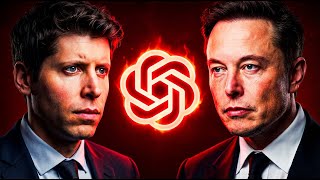
Elon Musk and Sam Altman co-founded OpenAI in 2015 to address AI risk, but split over the company's shift to large language models and its Microsoft partnership. Musk left and later criticized OpenAI's move toward profit, sparking a public feud about the company's mission and governance.
Chapters
A lot of people these days are concerned about the rise of AI. Dangers of AI, artificial intelligence. AI could manipulate or possibly figure out a way to kill humans. Does it frighten you? Does it worry you AI?
Somewhat.
Many people fear the impact AI will have on their lives.
This is getting dangerous.
Both Sam Altman and Elon Musk say they can help with that.
We understand more about how to make AI safe.
We're going to make sure humanity's okay here. But they disagree on how to get there and who should control the technology. I don't trust OpenAI. I don't trust Sam Altman.
I think he's probably just trying to slow us down.
Each has a track record of saying one thing then doing another. Together, this raises some serious questions about governance, transparency and profit. This is the story of Elon Musk versus Sam Altman. Today we're gonna see how they went from Co founding OpenAI in 2015 to feuding in public in 2025. A rivalry between big tech billionaires.
First, to understand why Altman and Musk are fighting, we have to go back to 2015, back to when they were friends.
I'm looking for a new video game. Can you give me a recommendation?
Overwatch.
I play Overwatch.
Yeah, that's great. Anything else? This is Elon Musk. He's a world famous founder and the mind behind Tesla and SpaceX. You're Elon Musk? I am. This is Sam Altman. As a president of Y Combinator, Altman is well respected for spotting market opportunities and helping startups like Airbnb and Stripe Scale. Next, you're about to see one of their midweek catch ups. The following story is recreated based on Insider accounts.
August 2015. Wednesday, 8pm Madera is a popular restaurant in the Bay Area. In a private spot at the back, Musk and Altman sit across from each other. Tonight's topic is the future of artificial intelligence, the rise of the machine. Musk believes in the technology, but he's vocal about his concerns. Just listen to what he has to say here. With artificial intelligence, we are summoning the demon. You know, you know all those stories where there's the guy with the pentagram and the holy water and he's like, yeah, you sure he can control the demon? Doesn't work out. Altman also sees the risk, but he's still optimistic about the possibilities. He writes about creating a framework for how we figure out a safe and happy future for coexisting with smi. To Altman, the real question is about who shapes the technology. First and ensuring that AI is aligned with human values. And by the end of dinner, Altman and Musk are on the same page. As their ride pulls up, they agree they need to do something to stop the bad guys like Google trying to earn money and power from AI's potential. So they decide to create OpenAI, an open source nonprofit with a mission to make artificial intelligence safe and accessible for everyone without answering to shareholders. In December, they recruit top talent and secure a billion dollars in funding. And for a while, life is good at OpenAI. They're sticking to the mission and researching moonshot projects. However, in just a few years, one insight is about to cause infighting and Musk pulling his entire investment foreign.
Musk officially leaves OpenAI publicly. The reason given is a conflict of interest because Tesla is working on their own AI for self driving. But this isn't the whole truth, and here's what I've been able to identify. Let's wind back the clock to see what actually happened. From 2015 onward, OpenAI has only been working on basic small AI models. But then in June 2017, Google makes a breakthrough discovery called the Transformer. And OpenAI starts experimenting with it. What they figure out is that the Transformer can do something people didn't think was possible. The Transformer tech can scale up large language models, or LLMs, by reducing the size of computing bottlenecks. It's like switching from a slow single file line at the grocery store to a massive self checkout system, a concept known as parallel processing. OpenAI could get these models to predict the next word in a sentence by training them on tons of data at once fully unsupervised, and it changes everything. Altman now believes these models are the future of artificial intelligence.
Personally, the single thing I'm most excited about is what this is going to do for scientific discovery.
So OpenAI pivots and starts building LLMs. This move changes the way they operate, moving away from general research. And as you'll see later on, this shift in strategy creates tension with OpenAI's original mission. But for now, Musk is concerned about Google's progress. He thinks OpenAI is miles behind. And since it's going to cost a fortune to catch up, he suggests a more aggressive approach. According to Musk, OpenAI needs to do two things. One, raise more money, and two, think about becoming a for profit company. At first, the board is open to these ideas, but Musk thinks they're moving too slow. And in early 2018, he tries to take over OpenAI and get rid of Altman as CEO. When that fails, Musk throws a Hail Mary and offers to fold OpenAI into Tesla. But again, OpenAI's board turns him down. They feel that no one person should have full control of the company. This leads to Musk walking away from OpenAI, pulling his funding and promising to create a competitor.
But first, how the hell does OpenAI survive without Musk's money? Because by the start of 2019, their social mission is hanging by a thread. Altman says OpenAI needs billions of dollars in capital, but nobody wants to hand out that kind of money to a nonprofit. So Altman creates something unique. He's not quite convinced about becoming a for profit just yet. That comes later. Instead, he comes up with a new model he calls a capped profit. It's a system that's part charity, part corporation. The model is so rare that I struggle to find another example. So let's break down how OpenAI uses it. There's essentially two companies. One is the parent and the other is a subsidiary. At the top sits OpenAI Inc. Which is the nonprofit. Then below that is OpenAI LP, which is sometimes called the Lab or just OpenAI. This is the capped profit company. And here's how it works. Investors can make profits, but only up to a limit. More specifically, 100 times what they put in. Any additional money they make goes back into the nonprofit. Some argue this new model is exactly what OpenAI needs to survive. Yet others worry it puts them on a slippery slope, free falling toward the corporate behavior they set out to oppose. Regardless of where you stand, the move helps them raise money. In July 2019, OpenAI lands a game changing deal. They announce a billion dollar partnership with Microsoft. Almost overnight, OpenAI goes from financial trouble to one of Silicon Valley's hottest startups. They steam ahead with LLM Research, paving the way for ChatGPT in late 2022. But this growth comes at a cost. Not all of these changes align with the original mission. And that's exactly why Musk is furious with Altman Foreign.
Remember how OpenAI set out to build value for everyone and not just shareholders? Let's see if they've stuck to that promise. Since their first billion dollar investment, Microsoft has put in much, much more. As of today, their total Investment is around $13 billion. Details are shaky, but it looks like Microsoft is getting most of OpenAI's profits. Analysts also suggest OpenAI is becoming more and more commercialized. They're shipping products faster, particularly with ChatGPT, which is reportedly raking in $300 million a month in revenue. Plus, Microsoft has the rights to take OpenAI's tech and dial it into Bing, Copilot and Azure. And despite the promises of being open, they're not really living up to that anymore. In fact, GPT3 and GPT4 are kept under wraps. People can't access the code that powers ChatGPT, which OpenAI claims is about safety. Then there's Altman's appearance in front of Congress. You make a lot of money, do you?
I make no. I paid enough for health insurance. I have no equity in OpenAI.
Really? That's interesting. You need a lawyer.
I need a what?
You need a lawyer or an agent?
I'm doing this because I love it.
But here's a real BombShell. In late 2024, OpenAI announces plans to become a for profit public benefit company. OpenAI confirming plans to restructure its operations in 2025, specifically a public benefit cor and Bloomberg reports that Altman will get a 7% stake in that venture. For context, those shares could be worth up to $21 billion. This isn't a big deal just because of the equity, but because OpenAI could start to look more like a traditional tech company. All that said, it is possible. Altman genuinely believes that a for profit structure is the best way to scale OpenAI's impact. But Musk isn't buying it. For him, it's hypocrisy. Altman says one thing than does another. He calls Altman a swindler and a scam, tweeting that OpenAI has become a closed source maximum profit company effectively controlled by Microsoft.
If you're rooting for Musk against scam Altman, hold that thought for just a second because Musk might not be that different.
Elon Musk.
Elon Musk. Elon Musk is suing OpenAI. He's suing OpenAI because he thinks they've abandoned their mission and become too commercial. Musk even offers to buy them out for $97 billion, saying he would pull his offer if OpenAI goes back to being open source. But let's be real for a second. His venture XAI is also a for profit closed source company. And don't forget Musk himself pushed for OpenAI to be for profit and tried to seize control of the company and fold it into Tesla. Then there's this question of bias. Musk has a history of calling ChatGPT too censored and corporate. And he's pitching his alternative chatbot Grok as a truth seeking AI that's anti woke. But how objective can it be if it's built and operated by a corporation? Even Grok3 censored criticism about Musk and Trump in 2025. This question brings us back to AI alignment. How sure can you be that a for profit model, whether it's Xai or OpenAI or Google, can align with human values? There's a real risk it could just churn out answers that benefits whoever controls it.
The AI is optimizing the compression and the compression is optimizing the AI. Everything that makes it successful is exactly what makes it dangerous.
So Musk's war against OpenAI makes you wonder, is it about a broader social mission or is it just a game to catch up with the competition?
So here we are. The AI wars are just beginning. On one side there's what some people would call the evil, you know, like Google and Meta. But then there's these two. Musk claims nobody but him can be trusted to save us from a dystopian future. Meanwhile, Altman says he's trying to shape a brighter outcome, even if it means inching closer to becoming a for profit company. Both clearly want to come out on top, whatever it takes. And maybe, maybe that's just the reality. The cost of winning might be too high for a non profit. Who then do you trust to control the future of AI?
More from Hiten

The Library of Minds: "The Social Network Ruined Startups" | Hiten Shah 4x SaaS Founder


This startup repair factory is worth over $11 billion #entrepreneur #founder #productmanagement



This is how a $40 billion crypto cult came crashing down #crypto #terraluna #stablecoin #dokwon

This is the only casino the government can’t shut down #gambling #tech #startup #founder



