Hiten Shah - How startups are building a future using AI that is fully inspired by our past!
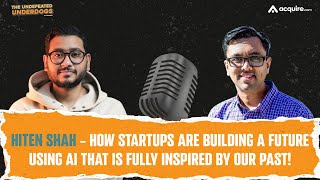
Hiten Shah breaks down how to evaluate AI opportunities using two frameworks: tailwind vs. headwind, and early/middle/late stage. He advises skipping crowded areas like code generation and customer support bots, and instead exploring earlier-stage AI like video avatars and music generation.
Chapters
So with AI and what we're seeing, there's two categories that I think are in the middle that I would not touch today. The one category is code. AI writing code for you. It's not early anymore. There's so much investment being made in that, so much FUD. Even that thing, Devin, that got $100 million recently from some very prominent people, I really believe that that's the wrong time. Unless you could raise so much money or you have such a unique insight. But it's just harder. I think there's actually more headwind than there is tailwind because it's just crowded and you haven't hit the real crowded. Where norms are fully established, product market fit is true, which is what happens.
When it's later welcome to the Undefeated Underdogs Podcast, where I unpack and narrate stories of ambitious people who turn obstacles into opportunities. My goal for this podcast is to create a platform to narrate underdog stories and maybe play a small, teeny tiny role in inspiring you. I intend to highlight the underdog mentality and make authentic conversations with people who play the long game, take action with a chip on their shoulder, and convert obstacles into opportunities. Buckle up as I'll be bringing some authentic founders, VCs, community builders and content creators who got underestimated their whole lives and yet they beat all the odds to became insanely successful. Now, today I want to tell you a little bit about Our awesome sponsor, acquire.com selling a business is as tough as building a business. As someone who went through this process once, selling my own startup, I know the pain it takes to get to the end zone. This is where our sponsor shines. Imagine this. You're a founder who's built a solid SaaS product, acquired customers and generating consistent monthly revenue. The problem is you're not growing for whatever reason. Lack of focus, lack of skill, or just plain lack of interest, and you feel stuck. What should you do? The story I'd like to hear is you buckled down somehow, reignited the fire, get past yourself and the cliches and start working on your business rather than just in the business. You start building an audience, move out of your comfort zone to do sales and marketing, and in six months you triple your revenue. The reality isn't as simple. Situations may be different from every founder facing this crossroads, but too many times the story ends up being one of inaction and stagnation until the business becomes less valuable or worse, work less. If you find yourself here or your story is likely headed down a similar road, I offer you a third option. Consider selling your business on acquired.com capitalizing on the value of your time is a smart move. Acquire.com is free to list and they've helped hundreds of founders already. Go to try.acquire.com Sharath and see for yourself if this is the right option for you. Now let's get into today's episode. This man is building startups since 2003. That is 21 years of wisdom, knowledge and invaluable experience. Be it growth, product, market, fit, sales, design, social apps, B2B SaaS, highs, lows, selling companies, failing companies. He saw everything and he's going is still going at a faster pace than many founders I know. Currently he's the co founder of Neera that protects your company documents from unauthorized access. And he recently launched a podcast called Hiten Show. You know who he is. So I have this intro before I saw Hiten on the screen, but let me actually go through and read the whole intro. I thought I would introduce him saying that he's the startup Yoda with the mustache. Hiten, welcome to the show without the mustache.
Thanks for having me. Yeah, that was a Covid thing.
I literally have like a mustache emoji. Oh, nice. Nice on the research doc. But right off the bat, being a fan is such a small thing, I would say to you because I've been looking up to you for like more than, you know, like five, six years since I found you. I want to be part of the startup world and you being here is something special and I've been like, you know, in warrant interview since long, so I'm so glad it's happening right off the bat. You've done many things like I said. But how are you feeling as a podcaster having your own show in 2024? Because you've done shows before with Steli and you know, so many other folks. But this is your show. You're the man. So talk to me about Hiten as a podcaster.
Yeah, you know, I did 500 episodes with Steli and a lot of them were like 10, 20 minutes max. And we had kind of popularized that format when it was okay to just have an audio podcast. So I think the first thing I'll say is I don't think it's okay these days to just have an audio podcast. And that's like probably the starting point of how I think about podcasting today. You might not know this, but back in 2008 I think we had tried to build a or six or eight. I don't remember Again, I'm old. We tried to build a podcast advertising network. So that was such a long time ago, right? Over a dozen years ago, like almost 15 plus years ago. So podcasting has been in my head, ironically, for a long time. I would say that to answer your question, without rambling too much about it, because I have a lot of thoughts on this.
Go ahead. You have all the stage in, we have all the time.
All good, all good. Thank you. I appreciate that and I appreciate the awesome intro and I'm very excited to talk to you. I think you need a high production value today and we can just thank Mr. Beast for that. There's a lot of other people to thank for, but let's thank him because him and Marques, these people have added so much quality and raised the bar and standards for doing something that. Where you're using your voice and now video to kind of share your ideas and your thoughts, whatever that may be, in whatever category. And I use those two categories because I think they're very interesting and very different, both of them. But ultimately, how I feel about it today is you need a high level of production. We were using a MacBook mic initially when we did our podcast back in the day. You can't get away with that now. People are going to complain. Yes, the world's different. It's like a mature market. But I've been looking at it for over 15 years when it was nothing. And I tried to build a business that failed back then. So the way I think about it today, and it really goes to what somebody asked me, and again, none of us can predict the future, but when they were reviewing the early episodes, because we really treat the podcast like a product, and I found a team on the production side that can handle it without a lot of finger pointing from me or feedback or anything, and can do it at the standard that I have. And I don't mean the quality and the video and all this mic and camera and all this crap. I actually mean, like the iteration ability, because I think the goal is to iterate until it's a popular podcast. Our goal is to build the biggest startup podcast on the planet. That might not happen, but I believe it can. And I believe there's a lot of opportunity to do that. So when I shared the early episode with my friend for feedback, because I knew that he listened to and watched a lot of podcasts, ones that I can't stand or watch myself, but that's a longer story. I don't actually listen to a lot of podcasts or A lot of shows. I definitely like folks like Marques because he's entertaining and educational and willing to tell the truth as much as we can understand it from what he's trying to do. And so he said, like, are you doing this for two years? Are you doing it for 20? And my answer was, I'm doing it for 20, otherwise why would I do it? Why would I put my name on it? So my goal is to do this for a very long time.
That's how I think about shows and podcasts today, which is like, you can do them short term and I don't think there's anything wrong with that. But if you have a bigger opportunity in mind and category, do it for longer, take a longer term view on it because I think that's the world we're in now. Which means you'll invest in it, you'll buy the fancy camera. If you can afford it, you'll. If you can't afford it, you'll realize that you need to really have high quality content. Even if you don't have high quality production. That's okay, like you can do it. But I think ultimately those are the things that are on my mind related to this, which is like the standards have, have gone up and the bar has been raised and it's thanks to the Mr. Beastification of this space.
Thanks to those creators for sure. I think. Shout out to Marquis Brownlee. I just want to share my $0.02 on this recent controversy that's been floating around on the Internet, which is really stupid. It is so. It makes me so bonkers that people have time to throw shit on other people. It's like you're going out of your way and writing these big ass threads because one man, whoever it is, like, not just Markeys, like I see that trend becoming more popular, especially on Twitter. There is the other side of Twitter. There is this kindness side of the Twitter which, you know, I think you and I belong to. There is the other side where people throw just shit and talk. Pull them down, try to pull them down. But yeah, again, going back to your point, but I'm very curious, what would you say for people who wanted to start a show? Because I just recently did some research on podcasting, it apparently looks like there are only what, 3 million active podcasts and a total of some 7 plus million, which is I think still like very small compared to the number of YouTube videos or the number of startups or the number of like SaaS products. Like, you know, compared to that, it's still early I would say. Right. And in your opinion, to match that point of, okay, the bar has risen. Do you. What would you say to, like, for people who are just starting, do they have to focus on the production? What is your advice for them?
I truly believe it's like anything else where a category gets mature or a sector gets mature, however you want to look at it, and things change. As to what? Table stakes. So what is the minimum bar for a successful podcast or show today? I still think you could get away with audio only, but if you're gonna do audio only, guess what? Your content better be better than anything else on the market. So one good example of this is like, you go on YouTube and people really care about the thumbnail. And so then what you start doing is you start looking at mocking up the thumbnail against other thumbnails in your category. So now every time we do a show, there's a thumbnail and there's a mock up of a thumbnail of our show with everything else around it that someone might see if they're the type of subscriber that would subscribe to my show. And so that's actually indicative of what you need to do. You need to test and iterate regardless, because it's so crowded. I agree it's still early from some of those numbers you shared. Even though it's in the millions, it could be in the tens of millions or even hundreds of millions. So it's still early. But I've been saying it's early for 15 years on podcasting and, you know, it is definitely later than that. I think the bottom line is like, do you have product market fit with your show and what does that mean for you? What is the market you're going after and what is the product you're producing? The product is the content and the market is your audience. Right. The thing I love about it is it can't be any simpler. People vote with their views, they vote with their reviews, they vote with what they say. On Twitter. For example, just the other day, I shipped a show and it was an experiment. All of our shows are experiments.
Right.
They're probably going to be experiments forever, but they really are. And so it was a 13 minute episode on hiring and firing.
Yes, I saw that. Yeah.
And that same person that told me the 20 years thing said, don't have fillers. Make it so that the ratio of bangers on the show is really high. And so then it was like, hey, you know, you're kind of right. If someone's listening to all these Startup shows, all in and you know, turpentine media shows and all these things. How do you differentiate and how do you stand out from the crowd and how do you provide something that other shows are not? Then when you think about a product, again, you worked at Product Hunt, so you saw a lot of products shipping and launching. The ones that work really well are one of two things. Either they have an audience that they can already promote to regardless of what the product is, and it's a large enough audience so they can get those upvotes and reviews and feedback, or they have a product worth talking about.
Right.
Those are the two things. You got nothing else in today's world if you want to be popular. So I guess the first thing is do you want to be popular or not with the podcast? And then the more deeper context is who do you want to be popular with? It could be 10 people. It could be your family. That's okay. I'm not saying like you can't be small, not at all. But you have to decide and you have to pick that audience because if you don't, then you're screwed because you have no one you're building for, no one you're creating for. And if you have no audience today, then you would focus on what can I do that's missing in the market, just like you would with a product. What can we do that differentiates us so we can get that word of mouth? And if nothing differentiates us, then we need to make sure we can get the audience at a low enough cost. Hmm.
What would you say for folks who says record the show, they will come. Create, create, create high value content. They will come. It's like, you know, build a product, they will come type of a. There is, there is a series of people so I belong to that I will definitely not. I don't have the, the audacity to compare myself with you or someone who's investing their time, money and energy because I'm doing on this, on the site, like whenever I have like, you know, free time, I really reach out to people who I admire and respect and I bring them on the show. We talk about like the, you know, everything authentically. That's it. That's my angle. Like there is no, I would say there is no, it's not. Scheme scheming is not a pre planned strategy that I actually kind of like went through. Like just like the way you said. So again, question is, what would you say that build for 10. But I am here to play the longest game I Signed up. I loved when I recorded my first episode. I'm like, let's freaking do this for the rest of my life till I have the energy, till I have a mic, have everything in my capacity. So I'm here to play the 20 year, 30 year game. I haven't thought through a lot of things you said. So what would you say for those set of people who are like, I think hobbies, you know, not like full time podcasters.
Well, I'm not a full time podcaster. And that's why when you asked the initial question, my answer really was I found a team that can do the iteration cycles without me putting in more than however long it takes to record the podcast. That's very important because I have a day job and it's a very important job because I raise money from investors and I spend all my waking hours thinking about that business, unless I'm hanging out with my family or doing something like this. But like, that's like way more than 40 hours a week that I spend on my business. And I have other businesses too that I am major shareholder in that I don't spend anywhere near even a few hours a week on. And so I think, like to go back to answering your question, you can do something for the love of doing it. Those 500 episodes I did with Steli, we did it for the love of doing it. Until we fell out of love of doing.
Was pretty simple. We talked about growing it. We even talked about hiring someone to help us grow it. And we probably could have the person we were thinking of. She went on and has a great career in marketing. And in hindsight, I think about that, I'm like, what would have happened if we worked with her and she helped us grow the podcast? Because it was just one person that just showed up and we were like, huh? And it's not that we didn't like her. We actually liked her a lot. We just didn't feel like we wanted to spend the money or grow the podcast in that way at the time. In hindsight, that might have been a good idea. I think we were doing it because we enjoyed talking to each other and we thought other people would get value from the things we talked about. And that was definitely true. That podcast went far and wide, but we never gave a shit about how many people were listening to it. And I think that's to your point, right? In this podcast that I'm doing now, because of the investments I've made and the opportunity that I see, I'm willing to just think of it more strategically. But I think with podcasting, you get a shot on every episode to win the audience. And that's actually what excites me more than anything else, which is I get a shot every time I drop an episode to win an audience and make a mark in their minds, and that's what I do it for. So it's still done for the same passion of helping people and wanting to share the things that I've either learned or the opinions I have, or more importantly, the perspective and point of view I have, because it is unique. And I didn't do this kind of podcast before, but I would have conversations one on one with so many people that I thought that a podcast that had that vibe would be helpful to others. So even though I'm putting a lot of effort into it, in the sense of money, to be honest, because other people are putting the effort.
I still do it because I love to do it. And what do I love to do? I love to help other people with their biggest challenges, and that's the simple truth. So it's not very different, in my mind, from what you're doing. You have an audience on Twitter, you find people like me and others that you. You say you admire. I'm very flattered and humbled. But like people that you just want to have a conversation with, and this is a convenient way to have that conversation if, you know, for no specific purpose, except you're doing a podcast and you want to share these conversations with other people. And that's kind of what we did when we originally did our podcast, Deli and I. And it was fun, and we just did it for the fun of it and the passion for it, and we never got bored of it until we did, and then it just didn't make sense. And a lot of it had to do with both of our life scenarios just changing, and it kind of organically fizzled out, so to speak. And now I have a catalog, and he has a catalog of a bunch of bullshit that we said for 500 episodes, which is like, you know, at least 5,000 minutes or whatever you want to call it, which is like over 100 hours, probably. And that was cool. And so I don't really believe in build it and they will come. I believe in understand them and then build it, and then, yes, they will come. So that understand them is the piece that you're missing because you're not doing it to reach a certain audience or anything. You know, even like on some of my podcast episodes, I know I got into Advanced topics, and I'm sure of it. And I know I talked about things that nobody's really talking about, at least one or two nuggets in an episode, but I still got feedback from people saying, hey, what about more advanced topics and stuff. And I thought about it and I'm like, yeah, I could talk about a lot of deep stuff, but I don't want to lose the audience. And the goal is to really go for a really broad and wide audience. But I know that. So that helps me figure out what are the topics and what should the show be about versus what it shouldn't. Am I going to talk to, like an advanced AI researcher? No. Am I going to talk about advanced AI training and all that? No. But am I going to talk about AI and how to build products using AI? Yeah, for sure. So I think, like, if you can define the audience, then it helps you define the product, which then helps you get more of the audience that you're looking for and run the experiments to see how you can get them. And I just take a more product mindset. Experiment mindset, scientific method approach. Part of it is very much ingrained in me from the lean startup and spending time with Eric Reese and everyone else that was thinking about it back in the day. I definitely feel very lucky to have been maturing in my startup sort of journey at that time, in my tech journey, to be able to learn those things because they still apply to almost everything I do today.
I really, really like the way you're mapping your strength to this new experiment. I feel everybody should do that. Like, everybody should hone into their curiosity and their strengths. And I feel like I have some homework to do. Thank you for the last 15 minutes because you gave me some indirect homework for me to, like, figure out my audience, the how. I think I have a strong why. I think I have to figure out the how. So appreciate you.
So, again, here's the thing. If you're an indie hacker, which I would label you as. Not that I like labels, but it's a good construct to understand. Your biggest weakness is you don't think about audience enough. And you're just bringing that to the podcast, that would be my reflection on what you just said. So if I were to give you advice, which I guess I am for a minute.
Go focus on audience first. And you build a lot of stuff. You've built a bunch of stuff. You're building some stuff now. That's the one piece I see missing in most of the stuff you build. And that usually bleeds over to everything you do.
Solid, solid, solid advice. Appreciate you. Let's switch gears a little bit. I want to unpack your 21 years. You've observed and you've gone through a lot of waves, be it the first Internet wave to social wave content, crypto web 3, now AI. What are your observations through these waves? Why do people go bonkers and do they have self awareness and then go bonkers or they just are part of the herd? And how do you define or define the each. Each wave as you progressed, like you know, throughout the 20 years of your investment in startups? Yeah, just talk to me about these, you know, the ups and downs of these massive waves that actually move the entire world.
Yeah, I think there's two frameworks here that come to mind that I kind of share with people when we talk about these topics. So the first one is this idea of tailwind and headwind. So tailwind is wind behind your back that's pushing you forward whether you like it or not. Tailwind is. Sorry, that's tailwind. So headwind is wind that's coming at you that you have to fight to get momentum and speed and velocity that you have no control over. The control you have is, do you pick areas where there's headwind or do you pick areas where there's tailwind? And really, if you want to go a little deeper, it's how much headwind versus how much tailwind. Because even in AI today there is headwind.
There'S not just tailwind. And so in certain areas there's more tailwind than there is headwind. And you can get through that headwind because of the tailwind.
Can you elaborate? Can you expand on that?
A very good example, a very good example of this is WhatsApp. And this is going to get into the second framework too. WhatsApp copied Apple's interface and provided that same or similar experience to Android users. And on top of that, they made it extremely easy and free to do something that used to cost a lot of money when they launched. What was that? International calling. They made that free as long as you had enough data, which essentially was also something that was getting close to free or cheap, unlimited data. Right. Very close to that. It's still not quite there, but close enough that I don't anymore have to get on a phone call and worry about how much each minute is costing me. I don't need to use a calling card to call a foreign country from the US and vice versa. They would have to use calling cards too, right?
Yes, yes.
So when you think about that, how much tailwind did they have versus headwind? They had way more tailwind than they did headwind. And they extremely intelligently capitalized on that in a number of ways. What I just said is probably just like 2 out of like 50 ways that they capitalize on big and small. But I think I pointed out the two main ones and they took advantage of the fact that Apple was building a new paradigm for phones, and it's not a new paradigm for phones, it was actually a new paradigm for computing. But none of that mattered to them. What mattered is this fundamental thing people were trying to do that they can provide. Not a 10x. 10x is great. That was 100x better experience, because when you could make something literally free that didn't used to be free, that's 100x. And they discovered that they figured that out, they doubled down on it. Then they sold for $19 billion to Facebook with like, I don't know the exact number, but I think it was like 50ish people or less.
Yeah. Oh, no, it's, I think 29 or so. Like very.
Whatever it was, it was so small that, that it was incredible. Right. And there was a lot of hoopla at the time. And I do not think Facebook has made a larger acquisition since. It's incredible. I mean, incredible even on Facebook's part, but that's a different story. So when you think about it like that, this is the second framework, which is, you know, I don't believe there is such thing as AI products, and I don't believe AI is a category in itself. I think of it as closer to aws, which is enabling technology.
I think you could argue mobile is almost that, maybe. But a lot of people try to say AI this, AI that. I think these products are AI powered. Yeah, but are they AI products? I don't think those things exist. These are still software products. We're still writing code, we're still doing all that stuff. And I don't just mean still like, this is how software products are built through code. So that's one thing I would say. But then when you think about the categories that AI is disrupting, the way I like to think about it is, are we early? Are we in the middle? Are we late in that category? And the worst part to be in is when it's in the middle. And I'll define what that looks like. So if you're early, it means that there's so much opportunity and there's not actually a ton of competitors. That means you can invent a bunch of stuff, build some new paradigms or whatever and get away with it. But then as things start getting to the middle, that's when I get allergic. And I don't recommend jumping in because a lot of the norms are established, but there's still all this stuff that isn't. And things start looking the same. One product and another product, another product, they all start looking the same. And then when you're late, you can then pull a Google. They came in as the 20th or whatever search engine and were able to innovate because they could just look at the market and be like, what are all the problems? What are all the things that suck? Because it's much easier to build a 10x experience not from scratch, but from looking at what already exists. Another good example of that is that's what Apple does. They come in late. They don't come in early, and they don't come in in the middle, they come in late. Even with the avp, the Vision Pro.
Yeah, the Vision Pro, it's late.
But I don't mean late like the opportunity's gone. I mean late like there's been so many experiments on that, from Magic Leap to what Meta has been doing, Oculus, et cetera. But it's late. And yeah, it's still early in the broader sense of the transformation those things will do in the world. But the tech is barely there for it. But they pushed the envelope and built something now that is going to set the standards going forward. That's what Apple's good at. They set standards going forward. Right. And this is probably one of the most innovative categories they've jumped into, if I'm not mistaken. So with that being said, let's talk about AI real quick, because I talked about mobile, which kind of gives you an example from a wave back then. So with AI and what we're seeing, there's two categories that I think are in the middle that I would not touch today. The one category is code. AI, writing code for you. It's not early anymore. There's so much investment being made in that, so much FUD. Even that thing, Devin, that got $100 million recently from some very prominent people, it's called into question on YouTube. Right. And then there's a lot of refuting and this and that back forth. That's not. When you enter a market. I really believe that that's the wrong time. Unless you could raise so much money or you have such a unique insight, but it's just harder. I think there's Actually more headwind than there is tailwind because it's just crowded. And you haven't hit the real crowded where norms are fully established. Product market fit is true, which is what happens when it's later. But then you can shift the paradigm. Cause you can just dissect exactly what's wrong with the existing things. And a lot of people, a lot of companies become complacent when it's late. The reason Google could exist is because of search companies. Prior to it, they got complacent. They weren't really thinking about how do we make great results. One of the reasons that we have Google in a little bit of a struggle right now, depending on who you talk to, it's a little bit or a lot, is because they got complacent even though they had all the technology. And what did they get complacent on this ridiculously amazing business model. Probably the best one on the planet still. What are you going to do? Right, so another category in AI, I only have two. So code was one is actually customer support. I think we're in the middle.
Yeah, I do agree on that 100%. Everywhere I see it's a copilot for customer support. Copilot for this assistant for that. Yeah, totally agree. I didn't mean to interrupt you, but.
Yeah, no, no, you're good. That was it. So those are the two frameworks for me. Headwind, tailwind and trying to assess that on whatever you're going to get into. And then the secondary one is just is that category or area early in the middle or late? And how can you assess that to determine whether you want to enter it or not? And more importantly, can you win? Can you win enough of the market share that you care for? Can you get enough of that audience that you care for? I think when it's the middle of a category or an opportunity, it's super hard.
Where do you think we are right now, 2024, apart from code Customer support? They're in the middle. I want to ask about, in your opinion, what are two categories that are very early? What are two categories that are getting in that late mature state?
I think this idea of being able to have video avatars of ourselves, I think that's actually very early still.
Okay.
Because we're just starting to see really good examples of that. I think even video creation, which is related to this, but it's different. It's like production and things like that. That's also very early. There is now signs that it's getting later and later. In that category because there's just more funding. And a lot of this honestly has to do with how much funding has gone in because the more funding there is, the more money is being spent by the companies. The more money being spent by the companies means that the impression for the audience or whoever they're targeting is starts getting different because they're starting to see ads and starting to use these products. So to me, like this idea of AI generated video, whether it's for avatars or for full blown trailers, movies, whatever, that's fairly early. But some of it might be heading to mid in some subcategories there. The other one that's related also is music. We just started seeing some amazing examples of music creation using prompts. That's still early, but when you start seeing stuff that's like starting to work now. I'm waiting. Okay. It starts turning into the middle phase of this category, I guess when we start seeing popular music that's generated 100% by AI or even 80, 70% by AI. But here's the thing about some of these with AI, are we going to even know?
I just tweeted about, I think a couple days ago there was this video from Palantir's CEO. He's been interviewing by some journalist and he started like flipping something mid interview like, like in the middle of the journalist asking question. I genuinely thought that's an AI generated video. I genuinely thought about it because it felt like all of a sudden he did something that is so random that only you see in memes. So to your point, I think we'll go into. When do you think we'll go into a stage where like we don't know what is real and what is AI generated? What do you think? What is your prediction? Hiten?
I don't have any timelines because.
The only people that are going to have the true timelines are people that are living in the future and building this stuff and seeing it on a day to day basis. But the problem with that is like most of it is in code and research until it's not. So I would say that some of this stuff probably already exists. You know, everyone's talking about how in the US it's an election year and things like that. And there's a lot of concerns about misinformation and deep fakes and stuff like that. I did a tweet the other day about, you know, what if a company makes the deep fake technology and then makes the technology to detect the deep fakes and a lot of people Gave examples of like antivirus and things like that. That. Right. And I said it as a reaction to what Microsoft dropped with the, you know, essentially the deep fake of people and real people. I don't have any predictions. I'm just here to live in as close to the future as I can, within reason. But you know, one thing that I think the future that we saw in sci fi and things, this is. I guess this is the one thing I. It's not that I'm concerned about this, but this is the one thing I do think about. Are we just creating the sci fi that we've all been reading about? Is that just all we're doing? Because if that's all we're doing kind of sucks. And here's what I mean by that. It means that the ideas are still old ideas. And I'm not saying we should have new ideas, but I'm kind of saying we should have new ideas. So if you think about it like that, I think some people have read too much sci fi.
At the same time. Every single time I get in my Tesla Model 3, it is a performance because I drive it like I stole it when no one else is in the car. Only when no one else is in the car except friends who might be okay with that. I feel like I'm living in the past, not the future. And what I mean by that is when I was growing up, I watch every episode of Knight Rider, even the shitty last one.
The car can talk to me if I want it to, right? It can. The car can drive itself. All I have to do is put a destination in. And the car is all electric, it doesn't require gas, and the car probably has more chips and electronics than my entire house and everything in it is my guess. I don't know for sure, but that's my guess. Even if it doesn't, it has more battery power than my entire house, right?
So when I think about that, I don't feel like I'm living in the future. I feel like I'm living in the past. And I'm not saying that's not an exciting feeling. It's actually a very exciting feeling. But what I wonder is, are we just living the reality of the fiction that we wrote in the past or that we read in the past? And if that's the case, I think what would excite me is when we start seeing things that are out of this world, because if it's sci fi to me, it doesn't mean it's out of this world anymore because it's in the realm of possibility.
Man, that is deep. That is so deep. In a way, what you're saying is we're building a future.
That we're completely inspired from the past that we already created. We're not creating something inspirational that will lead us to, whoa, this is never seen before. I think the numbers. I think the reason we get excited about FSD and all that is because like you said in your words, I know, I watched growing up Jetson, the cartoons and everything, the flying cars and all that. I think it'll be possible in the next 20 years. No way.
In this rapid pace that we're growing. It'll be possible because we imagined that. Now we're experiencing it. That is why we're excited about this technology and we think we're living in the future. But you said we are really, really experiencing the past that we imagined that we thought it's the future.
Like even the. Even the humane AI pin, which I don't want to talk about.
Why would you not talk about?
Enough people have talked about it. And.
I admire the team for trying.
Right.
I admire the team for having the background and expertise to raise the kind of money they did. Mm. So I don't, you know, there's no reason to poke at them because they're not us. They were able to raise the money and build the product. But even that, what I was gonna say is that's living in the past. And that's a product that hasn't delivered on the value that they promised, which is a different story. And that's the problem there. It's nothing else. It hasn't delivered on the value they promised, which means they shouldn't have promised that value. It's very simple.
Yeah.
That's why I don't want to talk about it. Because, like, I'm not a hater. I love technology. I'm an early adopter, self proclaimed. It's in my Twitter bio. Once I realized I need to say that to people because I want to live in the future, but even that, it's the Star Trek thing. It's all it is. And like the pendants and the, you know, all these things, the tab and this and that, like the Limitless Now. And.
There are some things about it that might feel like living in the future because some of the things that I think it's going to do might be things that we haven't thought of yet. And I'm not saying I really want new things that we haven't thought of yet, because I think that's a ridiculous ask of any product folks or company or business. But it's kind of my philosophical point of view today. Now, that being said, things that excite me are things like Air Chat.
Yes.
Naval and Brian and Cruz new app. And the reason for that is these are product people who are like craftspeople. And you could just tell when you use the product, there's all these little nuances. And I even said it on Air Chat. Like, it's the little details that wow me about the product. It's the fact that when I talk into it.
And I'm done, it starts adjusting the text. In the way that we're in this phase of AI where it needs to adjust the text, it doesn't just spit out a transcript and it's great, it spits it out. It even knows how to do spacing, so it's better to read. This is a very thoughtful approach to things. Now when I think about any sci fi I read or any of that, those little nuances I can't recall, I almost feel like I'm living in the Future more with AirChat than with the Tesla I drive. And I know that's super weird, but if you think about the experience on AirChat, it feels like that because after I used it for a bit on day one of my signup and using it, which was not day one of the product, especially after using the initial product they built, it made me really think that every time I get on Twitter, if I could speak into it and it could do that magic, it would unlock a lot more creators on that platform. And that's exciting to me. Those little things to most people, they'll be like, that's not sci fi, blah, blah, blah. I'm like, exactly. That's someone creating. Yeah, it's someone creating and curating an experience in a product that is really meaningful and different.
I absolutely couldn't agree more. I'm fortunate enough to like, try both versions. Like you. The first version was just pure raw idea of them experimenting. And I think I almost felt like Naval is on a mission to go on a war with other social platforms. It felt like that because it was so radical. It was like very, very different. The visualizations and the avatars and all that. And it's like too much. And I think that's the thing I appreciate about them. Like you said, I think people are building products.
Everybody'S building product, and there are few folks are building art. And I think Airchat is art. In my opinion, it's because, like, you Said it's those little things and you give. And they gave us only few things to do, not 10,000 things, which was the first air chat. You can do 10,000 things now they only allowed us to talk and that's it. There is nothing more like. And I think my prediction is they are going to get rid of the video or they will be like a separate version of air chat on air chat, which is dedicated to video. But I would say giving people less options makes those impressions like those little impressions that we all experience. Then we think, okay, wow, this is never felt this. And I think I like the way you framed the whole thing. I think in a way, if you want to invent the future, I think you have to pay attention to the details that make you walk. Not like the biggest things or the impossible things that you imagine that are in works. I feel. Yeah.
So Apple calls it surprise and delight.
Yes.
So you know, it's in a lot of it has to do with personal experience versus collective experience. So a good example of this is figma.
I don't think the products that innovative. I think it's dope. I think it's great. It's unlocked a lot of value and a lot of collaboration internally at companies. I don't think it's that innovative. I think the innovation is more like you could do all this in the browser, but is a product itself and the experience innovative? I don't think so. That cursor and everyone sharing it, is that like a 10x better experience than other things? Debatable in my mind. But the innovation was someone felt so strongly about technology that they made a decision to build all of it in the browser instead of the desktop. That was innovation. And then what did that enable? Sure, it enabled a little cursor and all that, but that wasn't. People think of innovation incorrectly is what I'm trying to get at. Tesla was innovative, but it was innovative because they invented the batteries that enabled this sci fi to come true. It's not because the car drives itself, in my opinion. It's because the batteries enable the car to drive itself. And there's a bunch of other stuff like that. So I think we think of innovation incorrectly a lot of the time. And I think the same goes for things like the Vision Pro where the experience is innovative. But what got us to that experience is really the real innovations right now. Until those things are not the innovations anymore. So is Tesla's battery the innovation anymore? No, absolutely not. But was it what enabled everything? Yes. So I guess there's a difference between an innovative experience and enabling technology that was innovative in the first place, that allowed everything else to come after it. And so I'm looking at those things and thinking those are more innovative because they didn't have anything to do with the Sci Fi, but they enabled the sci Fi experiences. And so when I think about air chat, that's the innovation is like the way that I can use my voice to create text, but the consumption can be either or is the innovation, but the enabling tech is the AI. So there's classes of innovation. And I think we're going to hopefully see people start unpacking that a lot more because innovation has not really been unpacked enough, especially now that the pace of it is so incredible. So this is my whole thesis of like, I want to see the stuff that isn't talked about in the Sci Fi because I think that inevitably that's the stuff that leads to the stuff in the Sci Fi, but I want to see more of that. So this is where like some of the nuclear energy and you know, like recently there's these solar panels that are really small and you know, they don't need to be chained together and all this stuff. And like people are talking about putting them on a mouse. You know, it's like back in the day when we had them on the calculator. But those solar panels, they can be charged by normal light, like the light in my room without the sun. Yeah. Okay, what's that going to do to create the Sci Fi? Right, Because a lot of the Sci Fi doesn't talk about the technology because we didn't know what the technology was when we wrote the Sci Fi. So just bringing it back full circle. I'm not trying to say that the Sci Fi is not awesome, but I'm just saying I just think about the cool stuff and the cool stuff is really the enabling innovations.
I love that talking to those batteries. I think they exist in, in, I think quartz watches which are not automatic or mechanical.
They.
They run on these solar batteries for lifetime and they can be charged.
It's.
It's already there. I think to your point, what are they going to do now with this new. That what are going to. I think the paint they're going to add is going to change. Yep. Take those and implement somewhere else. I love that. Maybe on headphones or something or, you know.
Exactly.
Something different. Wow. I want to talk about AirChat, but the last 20 minutes was phenomenal. I got so many goosebumps moments and I felt like this is what we need to kind of expand and talk more so that we go away from the hype, the AI hype, and talk in detail about what really matters. I think this really matters, the approach and all that. But let's switch gears a little bit and talk about philosophy. Like, you know, you're one of those people I've been following for ages, and I learned so much, not just from a tangible standpoint, like growth metrics, you know, how to grow and all that, which is important, but intangibly how to develop a mindset, how to be like a founder, playing the long game. Really build that muscle here. Not, you know, here, but here. So I want to talk about, in one of the things you repeatedly mentioned, you know, so many times, is your dad, like, his role in your life. Talk to me about your roots, you know, how he influenced you and when it all started. Like, when did Hiten. It's like, okay, I want to become a founder.
It wasn't my choice. So since I was. He says four, I think it was five. My dad has an incredible memory, so it's probably four. So since I was four years old.
He told me I should be a founder, I should be an entrepreneur. There's a lot of reasons that he said that, but I think the most relatable reason is that he's a physician, and he doesn't really believe in, like, traditional mindsets. That someone his age. He's 73, almost where, you know, I'm a. I'm a doctor, so you should be a doctor. He just never believed in that. In fact, he discouraged me from that. And he said, like, I don't really use my brain. Most of my work is muscle memory, and I have a ceiling. And he basically didn't want that for me. So I'm probably very rare in the sense of I had no choice because someone from four years, since I was four years old, which is now 38 years, told me that this is what you should do. And I was 4. How do I know anything? I don't know anything, right? So I'm a product of what he wanted. And there's irony there, because if I was a doctor, I'd also be a product of what he wanted. That's what he wanted. Right? But he didn't want that. So if I became a doctor, he'd probably be like, that's not what I wanted for you. You know, he wouldn't be disappointed or anything. He'd be like, that's what you wanted, though. That's great. But that's not what I wanted for you. So, you know, I don't know if there's something he saw and told me that or it's something he wanted for himself that he didn't get. But what I do know is that by the time I was 4, 5, 6, I was so curious. I would start opening up all the electronic devices in my house. So the second I could lift a screwdriver, I was opening everything up because I wanted to see how it works. So just to circle all the way back. He had a great influence in my life in many different ways, that one probably being the root and the core. But ultimately I think my personality is to figure out how things work. My favorite book growing up was this big thick book called How Things Work. And I probably read it end to end. And no, I didn't become an electrical engineer. I'm not a programmer, although I stopped programming at QBasic, if anyone knows what that is. I had a computer since I was 8. I love engineers and working with them. I used to be able to out Google them. I still can, but it doesn't matter anymore with the copilots and all that, it doesn't matter. They can do their jobs better than I could help them with and I really value what they can do. But ultimately I'm not an engineer or anything like that, but I really, really, really, really deeply care about how things work and that extends to people. And that's it. And that's, I think just me. And some of it is influenced by my dad. But even my ability to tell you that is because my dad gave me the freedom to think at the earliest that he possibly could. And what I mean by that is freedom to think freely. Freedom to do freely.
How are you feeling now, looking back? Do you really want to become like a founder when you came to census and you become like, I don't even.
Think about it now. How can I think about it?
Because you didn't do anything else.
How can I think about it? Like, just think about that for a second. How can I think about it? You can't. You were four years old and someone told you something and you did it. So then what's there to think about? There is no alternative. That was the. That was not even a choice. It was made for me and I accepted it before I even knew what I was accepting. So there's nothing to think about.
What do you.
Right, you don't get to choose your parents, you don't get to choose what they say and do to you. Right? This is what he did. I'm grateful and thankful, but, like, I don't know the alternative. And if I think about the alternative, I wouldn't even know how to think about it.
Were you ever kind of put yourself in a position where, what if I wanted to become someone else? Like, I have this identity?
No.
So you never came across this?
I don't. I don't take on my identity as much as I think other people might take on their identity. I learned a long time ago there. There is no such thing.
Can you expand on that? Like, what do you mean by there is no identity?
I don't think there is any identity. I think the identity is a construct that sits in other people's heads about you. It shouldn't sit in your own head about you. But that's a much deeper conversation I.
Have all the time.
We set a scheduled amount of time. We're already over. Otherwise, I would keep going. I would be happy to keep going. No.
We can definitely do this again if you want, but I think that's the. But these are, like, the deep conversations I'll have with someone one on one. Right? Like, it's like, because they're struggling with something, they're identifying with something in their heads. And then I remind them that identity isn't your choice. It's what other people think about you. So what is your choice? What is in your control? Not much. Right. And that goes back to, like, some of my philosophies. Like, I don't think you should worry about what other people think about you, because then they're defining your identity. But then I don't think you should define your identity either. And then we're now full circle. So then what? Well, then you're a blank slate. So then what do you do? Well, you show up. You show up in every moment. Right? You told me to come on this podcast. I showed up for you. Right? I did it for you. I didn't do it for me. And so we had a great conversation because I did it for you. I didn't do it for me. And whatever you think of my identity, that's your business. And whatever this audience thinks of who I am or what I am, that's their business. But we are animals. Like, we're different every moment. Our physiology, our genetics. Like, everything's changing all the time. Like, this is how it works, right? This is life. We're organisms. Why would you want to get stuck on thinking you're this, that, or the other? It's not worth it. That's how I live. My life.
I think that's the best possible way because you're unbeatable in a way because you have this fluid, flexible, open mindset that you're not fixed to. I think fixed mindset, you know, doesn't help much. I think that is the best possible to. Best possible way to end the show. I know we're kind of like over time I joined late, my, my bad had like some technical difficulties.
If I didn't have another meeting we could keep going. It's not a problem at all.
No, no, no. I appreciate you Hiten. I think we should definitely do another time whenever you're free. But this has been an eye opening conversation. I hope for listeners as well the new perspectives, especially how they view about AI and you know, what they should do as founders. So yeah, genuinely, genuinely appreciate you for joining me. Any closing thoughts, any anything that you want to share with our audience?
No, I think, I think, you know, I go into these conversations with very little expectations and I go into them with an open mind to your point. And I hope that the audience got something from it. You know, I hope the bangers per minute were enough, you know, that's all I got.
Oh man, this is fun. Appreciate you folks for listening again. Thank you Hiten. We'll keep on going. There are some amazing guests joining the show. Talk about all things life, business, startups, everything. So stay tuned and cheers.
Thanks for having me. Bye everyone.
More from Hiten

The Library of Minds: "The Social Network Ruined Startups" | Hiten Shah 4x SaaS Founder


This startup repair factory is worth over $11 billion #entrepreneur #founder #productmanagement



This is how a $40 billion crypto cult came crashing down #crypto #terraluna #stablecoin #dokwon

This is the only casino the government can’t shut down #gambling #tech #startup #founder



