How 3 German Brothers Shamelessly Clone Startups
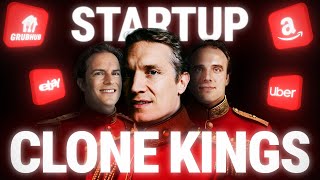
This YouTube video ("How 3 German Brothers Shamelessly Clone Startups") recounts Rocket Internet's rise: the Samwer brothers started by cloning eBay (Alando), quickly monetized exits, then institutionalized a playbook outlined in Oliver Samwer's 1998 thesis. From 2007 Rocket Internet replicated U.S. startup concepts across international markets by recruiting ambitious young founders, keeping large ownership stakes (reportedly 80–90%), spending heavily on marketing and hiring, and pursuing fast exits or public listings. Notable cases include Alando (sold to eBay), Citadeal (Groupon clone), Zalando (Zappos clone, IPO 2014), Wimdu (Airbnb clone, rejected buyout), Jumia (Amazon clone in Africa), HelloFresh, and others. The video covers both commercial successes and ethical/operational controversies (copying listings, aggressive tactics, visa issues, toxic culture), and notes Rocket's declining effectiveness after ~2019.
Questions this video answers
May 1999; the three brothers pocketed $43 million in three months.
1998.
2007.
Approximately 80–90%.
About one new company every seven days.
Chapters
February 1, 1999. EBay's founder, Pierre Omidere, gets an email from his assistant. It's marked urgent. He opens it and finds a link. He starts clicking through the website. At first he's not sure what he's looking at. The branding is similar to ebay's, but everything is in German. He clicks an image of a camera and nearly falls out of his chair. There's an auction price, product description and seller review ratings. Pierre clicks back to the homepage. Automotive, books, electronics. But then, right next to that, roller skates, train sets, soccer ball. It's exactly like ebay. Pierre sounds the Alarm. And on May 21, he flies to Berlin to discuss a buyout. It would give ebay instant access to the German market. He arrives at the meeting expecting to see typical German businessmen. But the three brothers that sat across from him weren't even close to what he imagined. On one side is Mark, the smooth talker. On the other side is Alex, the quiet genius. But in the middle sits Oliver, intense, ambitious and clearly in charge. Pierre is stunned. These three kids hadn't just copied his website. They'd anticipated Germany's Internet adoption and responded by building a Silicon Valley style startup right in the heart of Europe. Nine days later, eBay purchases Alando. The three brothers pocket $43 million in three months. They look at each other and they're all thinking the same thing. What if we did it again? This is the rise and fall of Rocket Internet. They call themselves a startup incubator. Others call them a clone factory.
They cloned us. I didn't think they were doing it for the beliefs. I thought they were doing it to make a lot of money.
Very quickly, Airbnb called them a scam.
All of a sudden, I felt like we had a gun to our head.
But whatever you want to call them, one thing is certain. Rocket figured out a way to build, scale and sell companies at a pace Silicon Valley had never seen. And they're still doing it. But here's the crazy part. It was all planned in an academic paper. Foreign.
It's the late 90s. Oliver Samwer arrives in San Francisco. He's in town to study American startups. For his German college degree, he's booked dozens of interviews with the best minds in Silicon Valley. Founders, VCs, lawyers, and even professors. He wants to find out what makes American startups so special, how they grow so fast, and how they transition into these multinational companies. He wants the formula for himself. In 1998, Oliver publishes his thesis thesis. And it's ahead of Its time. He argues that founders should target markets with no competition. He says that execution matters more than ideation. He even notes that the most successful companies go out and talk to customers. His thesis even predicts a few things that won't happen for decades. He talks about remote work before Zoom, angel investing before yc, and aggressive expansion before blitzscaling. But buried deep inside Oliver's thesis is something else. The blueprint for a billion dollar business model. How to take an American startup idea and export it to the world. And for more than 20 years. Oliver follows pretty much every single principle in this thesis, except for one.
So how did they go from copying ebay to copying startups at scale? In 2007, the Samwer brothers started Rocket Internet. They called it a startup incubator, but in reality, it was a factory that ingested American startup ideas and spat out European clones. Let's break down how their machine worked. First, they scanned Silicon Valley for startups experiencing rapid growth. They probably looked at key metrics, tracking funding rounds, growth rates, and emerging market trends. Next, they matched ideas to markets. They looked for regions with minimal competition where they could make a copycat work. Then they had to find founders. But Rocket knew just where to look. They targeted insecure over performers. Usually these were fresh business grads with two years at McKinsey. People smart enough to execute and hungry enough to work 100 hours a week. Rocket's pitch was simple. Come be a CEO. But there was a catch. Rocket usually kept 80 to 90% ownership. After that, they spent to win Rocket back. Clones would market aggressively. They spent big on online ads, billboards and TV commercials. They scaled at extraordinary speeds. Some startups would hire four to six people every single day. Chances are, if you were a young consultant or an investment banker, Rocket was in your LinkedIn DMs. The end game was always clear. Rapid growth followed by strategic exit. They'd usually sell back to the company they cloned, then rinse and repeat. At their peak, Rocket was launching a new company every seven days. Just think about that for a second. A new startup every single week. But this wasn't just luck. This was science. After copying ebay, the brothers took Oliver's thesis and turned it into a playbook. A good example was Citadeal, Rocket's version of Groupon in Europe. After just five months, Citi deals scaled to 80 cities and 6600 employees. But rather than compete, Groupon decided it would be smarter to buy Citadel and get instant access to the European market. So they swooped in and bought it for $100 million at some point. It wasn't just American startups. Rocket copied Alibaba in Southeast Asia and ended up selling it for $4 billion in total.
Let's zoom in on what powered Rocket's clone factory. It came down to three driving forces. First, a win at all costs mindset. Rocket embraced an ultra AG aggressive expansion strategy. They overcapitalized their startups and outspent competitors. In one example, Rocket went to market with $200 million for an Iranian ride sharing app, more than four times the budget of any regional rival. Their commitment to winning also meant skirting local laws. One of their Malaysian based startups was allegedly targeted by immigration rates because some of their hires didn't have proper visas. And instead of filing the correct documentation, they took a more rogue approach. They installed cameras outside the building so people could hide if cops showed up. And if they really wanted to win a category in a new market, they backed two competing companies and let them fight it out. That's exactly what happened with Take It Easy and Delivery Hero in Europe. The second driving force was aggressive marketing. Remember this?
At their previous company, Jamba, the brothers invented Crazy Frog to sell ring tones. If you had a phone in 2004, you couldn't escape it. That annoying sound was everywhere on YouTube, that song has nearly 5 billion views. But here's what you didn't know. Oliver created this character to drive you crazy. And by creating a viral ringtone on a subscription model that was hard to cancel, Crazy frog made them $400 million in just one year. Jamba gave the Samware brothers the their first taste of bold marketing. It taught them to think differently about getting their products noticed. While they nailed the basics like SEO, digital ads and billboards, the brothers also got creative. A good example is Zalando, their European clone of Zappos. They traded equity in the company for primetime ad spots on a German TV network. Those commercials helped Zalando become an overnight sensation. The third driving force was brutal expectations on their founders. Some companies were required to grow 20% month over month with mandatory metrics reports every week. But missing these targets wasn't just a setback. It usually came with the threat of being merged, sold or shut down. And because Rocket typically controlled over 80% of each company, they could make these changes quickly and quietly. Rocket's playbook was ruthless, and for a while, it was extraordinarily effective.
But one of Rocket's companies made them rethink their playbook. Wimdu, their German clone of Airbnb. By early 2011, Wimdo had hired 400 people and spread across Europe. The Sambler brothers knew how important Europe was to Airbnb's American customers. So they invited Brian Chesky, the founder of Airbnb, to discuss a potential buyout. Feeling the pressure, Brian agreed to meet. But what he found in Berlin shocked him. There were hundreds of people copy pasting his entire company. And as he investigated further, Brian saw major red flags. WIMDU was burning cash and using questionable growth tactics. They falsely claimed to be the international version of Airbnb and stole listings without permission. They even sent employees to stay at Airbnbs so they could poach hosts. But Brian saw through the scheme. WIMDU was just another quick payday, not a sustainable business. So Brian rejected the deal, walked away, and immediately labeled them a scam.
Reason we ended up buying them is I just didn't like the culture. I felt like we were missionaries and they were mercenaries. I didn't think they were doing it for the beliefs. I thought they were doing it to make a lot of money very quickly. And I believed in a war, you know, missionaries would outlast now under mercenaries. And I also felt like the best revenge against an Internet clone was just to make them run the company long term. Term, it's like you had the baby, now you gotta raise it.
This was Rocket's first major failure of their fast flip strategy. Airbnb went on to win the European market. Because Wimdo, like most Rocket clones, wasn't built to succeed. It was built to be bought.
The Airbnb rejection was a huge wake up call. The Samwer brothers realized their strategy was flawed. It only worked if the original company was willing to buy. So they adapted. Instead of only building companies to sell, they started building companies to last. Less focus on rapid growth, more focus on a sustainable business model. And for a while, this approach made them a lot of money. Rocket created Jumia, an Amazon clone that became Africa's first unicorn. And instead of trying to sell Zalando, they took the company public in 2014. And at one point, it was so dominant that it reached a 28 billion billion market cap. Meanwhile, Zappos, the company they cloned, sold for much less, at $1 billion. Rocket also owns HelloFresh, the meal kit company. Today it's worth $2 billion. But Blue Apron, the American company they copied, was sold last year for $100 million. The copy was worth 20x the original. After the Airbnb rejection, the Samur brothers added to their playbook. They realized building second had other advantages too. You could learn from the original's mistakes improve the business model and maybe even build something better than what you copied. But it didn't last long. Rocket's refresh approach worked until roughly 2019. In the last few years running, their playbook hasn't been easy. Rocket's performance marketing tactics aren't as useful in today's social media landscape. The global startup scene has also changed. Founders have way more funding options now, and very few of them would even consider leading a company for only 10% equity. Their current companies are also struggling. There's no better example than Jumia, their Amazon clone in Africa. It went from Africa's most valued startup at 3.8 billion to $470 million in just five years. More importantly, though, Rocket's reputation has suffered. Two decades of aggressively copying other companies has ruined their public image. Over the years, reports of toxic culture and questionable growth tactics have all piled up, and now they seem to be struggling to attract deals like they used to. It also looks like the Samwar Bros have scrubbed their names from Rocket's website and other ventures. But despite Rocket's reputation, they're still scanning the globe for successful startups and copying them at lightning speed. Genie is basically Uber for the Middle East. Global fashion group copied ASOS in emerging markets. Home24 is Wayfair's German twin. Payflow took Expensify and made it Spanish. Spenmo is bringing Earn in to Southeast Asia. But even if their playbook has become less lucrative, the Samwar brothers legacy isn't defined by the recent setbacks.
The brothers keep a low profile these days. You won't find them on podcast tours or giving TED talks. But their strategy has left us with some tough questions. Is this savvy business or shameless theft? Smart capitalism or unfair exploitation? And what does this say about creativity? Is true innovation about the initial concept, or about who can actually make an idea work at scale? And is copying really that bad if you're serving markets that the original company ignored? After all, while American startups were fighting over the same users in San Francisco, Rocket brought online shopping to Singapore, ride sharing to Tehran, and food delivery to Sao Paulo. They didn't just copy, they adapted. Each clone was tailored to local context, cultural nuances, and regional economic realities. Rocket's playbook also challenged the tech world's narrative. Silicon Valley romanticizes the lone inventor who has a breakthrough idea and builds a global company. But the Samwar brothers showed a different path was possible. At the same time, Rocket's blatant copying of American startups and did eventually catch up with them. Bad press, reputational damage and likely deal flow problems. It seems like barely anyone wants to do business with them these days. It's funny. For 20 years, the brothers followed every single principle from Oliver's thesis except for one.
More from Hiten

The Library of Minds: "The Social Network Ruined Startups" | Hiten Shah 4x SaaS Founder


This startup repair factory is worth over $11 billion #entrepreneur #founder #productmanagement



This is how a $40 billion crypto cult came crashing down #crypto #terraluna #stablecoin #dokwon

This is the only casino the government can’t shut down #gambling #tech #startup #founder



