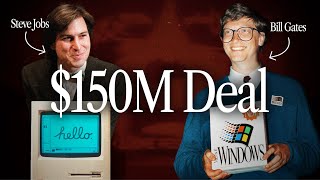
In August 1997, Bill Gates invested $150 million in Apple and committed Microsoft to five more years of Office for Mac, saving the company from bankruptcy. The move came with Microsoft making Internet Explorer the default Mac browser, possibly to improve Gates' image during DOJ antitrust scrutiny or settle a dispute over stolen code.
Chapters
It's August 1997. The tech world holds its breath. Steve Jobs takes the stage at Macworld Expo. Apple, the company he co founded, is on life support. They're bleeding $1 billion and are 90 days from bankruptcy. But the look in Jobs eyes isn't defeat. It's actually determination. The audience leans forward, expecting a miracle. A groundbreaking new product to save Apple from the brink of failure. But what happens next will leave them completely speechless. Suddenly, on the giant screen behind Jobs, an unexpected massive face appears. It's Bill Gates, the man whose Windows operating system is crushing the Mac. The crowd is stunned. These two aren't just rivals, they're enemies. Mortal enemies. What could possibly bring them together at Apple's darkest hour? What follows is one of the most shocking announcements in tech history. A move so unexpected, so controversial, it will change the course of both companies, or ever. And probably saved them both too. But to unravel this twisted tale of friendship turned rivalry turned strategic alliance, we need to go back. Back to where it all began.
Picture this. It's the seventies. Disco is in. Computers look like refrigerators. Keyboards sound like typewriters. And the Internet, it doesn't even exist yet. But all of that's about to change. Because in suburban garages across America, a revolution is brewing. And it's being led by a bunch of college dropouts who are about to Change the World. 1975. Bill Gates and Paul Allen have been busy in New Mexico. They've just founded Microsoft. Little do they know their rival is already taking shape. 1976. In suburban California, Steve Jobs and Steve Wozniak found Apple Computer. And they're about to cross paths with Microsoft. 1977. The tech world witnesses an unexpected alliance. Gates and Jobs joined forces on the Apple ii, blending Apple's revolutionary hardware with Microsoft's cutting edge software. For now, they're a match made in Silicon Heaven. 1981. The tech landscape is shifting. The current heavyweight, IBM, comes knocking. They're late to the personal computer party and need an operating system pronto. Gates, ever the opportunist, sees his chance. He whips up a new piece of software, and somehow Microsoft retains the rights to sell it to other companies. This move shocks Jobs thought Microsoft was exclusively supplying Apple. The chess pieces are moving and the game is about to change big time. 1983. Sensing the changing winds, Jobs extends an olive branch. He invites Gates back, offering a sneak peek at Apple's new secret project. It was inspired by something Jobs saw at Xerox, the graphical user interface GUI. It's a calculated risk will this reignite their partnership. 1984. Apple returns with a bang. The Macintosh launches with that epic, iconic super bowl ad. The tech world is in awe. But in Redmond, Washington, wheels are turning. Gates hasn't forgotten about what he saw. 1985. Microsoft fires back with their own GUI. Windows 1.0 hits the market, and Jobs is livid. Was Microsoft even allowed to release their own gui? Jobs doesn't think so. But a contract loophole saves Microsoft from any legal repercussion. And before Jobs can mount a counterattack, internal politics at Apple reaches a boiling point. In a shocking twist, Jobs is kicked out of his own company. Is this game over for Apple? 1990 to 1994. As Apple stumbles through a revolving door of CEOs and misguided products, Microsoft reaches new heights. Windows captures a staggering 90% of the PC market. Has Gates definitely won the war? 1996. A verbal sparring match is underway. Jobs comments that good artists copy, great artists steal. And we have, you know, always been shameless about stealing great ideas. Gates, not to be outdone, replies, we both had the rich neighbor named Xerox, and I broke into his house to steal the TV set, only to find that you had already stolen it. Underneath all of this, there was another instance of stealing going on. But more that later. 1997. Apple is quietly imploding. The company is bleeding money. A billion in losses, and they're 90 days away from bankruptcy. In a desperate Hail Mary, Apple's board brings back their prodigal son, Steve Jobs. But even he knew he couldn't do it alone. Apple needed a miracle, and it came from the most unexpected Source. Back to August 1997. Jobs takes the stage at Macworld Expo. He calls in Bill Gates and does the unthinkable. Jobs announces a partnership with Microsoft. In a shocking twist, Jobs makes three key announcements. One, Internet Explorer was going to become the default Browser on Mac. 2, Microsoft Office would be available for Apple computers for the next five years. Three, and here's the crazy part. Microsoft was going to invest $150 million in Apple. The crowd was stunned. What could have driven these rivals into each other's arms? And why would Bill Gates, with Apple down for the count, help his biggest rival get back up? Okay, buckle up. The real story is just beginning. So why did Gates do it? There are two answers to this question. One is a narrative that we've been fed for years, and the other, well, it's a bit juicier and not many people talk about it. So let's start with the most Popular explanation. With great power comes great scrutiny. Microsoft was under investigation by the Department of Justice. They were asking some uncomfortable questions about whether Microsoft was a monopoly. The investment made Microsoft look like the good guy, instead of a ruthless corporation trying to crush its competition. So Bill Gates could point to the investment and say, see, Would a monopoly do this? But here's where it gets really interesting. There's another explanation that doesn't get as much attention. It involves a secret battle that had been raging behind the scenes for years. A battle over video players. That's right. By 1995, Apple had made a shocking discovery. They claimed that Microsoft and Intel had stolen a significant portion of code from Apple's QuickTime Player in order to make their own product called Video for Windows. But here's the twist. Apple didn't immediately go public with this information. Why? What were they waiting for? And how does this connect to the $150 million investment? Well, it might have been tied to a secret settlement over these software piracy claims. The deal might have been a way to settle quietly without a legal battle. That could have been disastrous for all three companies. So which explanation do you think is true? Was it a strategic move to fend off regulators, or a clever way to settle a software dispute? Or maybe, in true Bill Gates fashion, it was both. So what happened to Apple and Microsoft after getting back together in 1997? One was a clear winner. Was it Bill Gates and Microsoft? At first, it kind of seemed like it. Microsoft walked away from their monopoly case with just a slap on the wrist. Just when the government threatened to break Microsoft up, Gates managed to keep the band together. But here's the twist. In 2003, Gates did something he probably regrets. He sold all of his Apple shares. If he'd held onto them, those shares would be worth 50 to $100 billion today. So who's the real winner in all of this? Believe it or not, it's Apple. Jobs staged one of the most epic comebacks in corporate history. The imac, the ipod, the iPhone, they can all be traced back to this moment. So do you remember how this all started? Bill gates gave Apple $150 million when they were 90 days from bankruptcy. But now you know that was only half the story. What do you think? Was Gates a secret hero, a brilliant strategist, or both? Let me know in the comments below. And don't forget to like and subscribe for more fascinating stories from tech history.