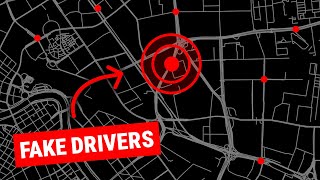
Uber's Gray Ball program identified suspected government regulators and showed them a fake app with phantom cars to evade enforcement. The tool, repurposed from an internal safety system, helped Uber expand rapidly across cities while avoiding legal consequences until a 2017 New York Times investigation exposed it.
Questions this video answers
December 2014
2017
About 200 cities; over $300 million raised (investors named: First Round, Benchmark, Google).
From ~200 to ~600 cities; valuation from $3 billion to nearly $70 billion.
Chapters
On a Snowy evening in December 2014, a few workers from Portland's transportation Department change into plain clothes. They're about to leave the office, but they haven't stopped working. In each of their pockets is a burner phone with only one app installed. Uber. Today is the big day. After months of complaints from taxi drivers, concerned citizens, and frustrated lawmakers, they're about to conduct a sting operation against Uber. The goal? Catch Uber drivers operating without proper permits and collect enough evidence to prove that Uber's violating local laws. Let's ride along with John. A public sector veteran, John arrives at his destination, Old Town. He heads towards a corner of 6th and Davis. There's plenty of bars around here. Perfect spot to catch an Uber. He pulls out his burner, opens the app, and requests a ride. That's weird. There's plenty of car icons on his screen. But he gets an error message. No rides available. He tries again and again and again. No rides available. Frustrated, he digs around his back pocket for his personal device, an iPhone 5. A gift from his wife. He tries to book a ride on his personal phone. No rides available. He calls one of his colleagues. Same problem. He calls another colleague. Same thing. This doesn't make any sense. He walks up to a stranger and asks if they wouldn't mind opening up Uber to check something for him. The stranger obliges. Confirm your pickup location. Ride confirmed. Confused, frustrated, and angry, John goes home empty handed. What John and the stranger didn't know was that they were looking at two different versions of the app. Why? Because John worked for the transportation authority, and Uber's secret spy tool had marked him as a threat and showed him a ghost app with phantom cars. This is the story of the Gray Ball program, one of the most sophisticated cases of corporate espionage in modern history. Uber is potentially facing a criminal pro. Very little tolerance for this level of deceit. It involves a secret algorithm, global deception, and billions of dollars. And here's the crazy part. Uber got away with it. The Gray Ball program wasn't always about tricking law enforcement. It did actually begin with good intentions. In 2010, Uber was growing fast. Calling a cab from your phone for half the price. People loved it. But their expansion was also creating an army of enemies. Taxi drivers, unions, and city officials all saw Uber as a direct threat to their established systems and revenue streams. It got so bad that some drivers were being violently attacked. As taxi drivers and legislators around the globe opposed Uber's expansion, executives at the ride hailing giant prepared for battle. So facing fines, arrests, and growing hostility, Uber needed A way to protect their drivers and sustain the business. Uber launched the vtos program, or the violation of Terms of Service. It was designed to identify and neutralized threats. This program targeted aggressive users, scammers, and even competitors trying to spy on them. At first, vtos was about safety, but soon safety turned into strategy and eventually evolved into something much more questionable. By 2013, Uber was in 200 cities, and they had raised over $300 million from investors like First Round, Benchmark, and Google. But the battle had shifted. It wasn't just taxi companies anymore. Local and state governments were on the offensive. Investigators posed passengers running sting operations against Uber. If law enforcement caught them breaking local laws, they could shut Uber down. And if that happened in enough places, Uber's master plan would fail. So they had two choices. One, they could slow down and play by the rules, or two, they could find a way to break them without getting caught. Uber chose option two. They believed it was better to ask for forgiveness than permission.
Soon, Uber realized that they could use the same vtos program to evade law enforcement. It was pretty complicated, so let's keep it simple. They fine tuned the algorithm to figure out who was working for the feds, and then they blocked their accounts. Uber started with social media profiles to see if people worked for a government agency. Then they checked if a user's credit card was linked to a government account. They monitored users who frequently opened and closed the app, and figured out which phone models agencies used. They even tracked locations to see who spent a lot of time near government buildings. But law enforcement started to catch on. They began buying burner phones to avoid being blocked. Agents would activate these phones in a completely different area to where they worked. Then they would download Uber and create a new account. It didn't work for long, though, because Uber knew something was up. Why did these hundreds of new accounts have no trace data? Why were they taking one ride and then disappearing? Uber figured out who was behind it, and they fought back. They even went around stores to confirm the phone models the feds were buying. And then they blocked those, too. It was a game of cat and mouse, but Uber knew they needed to think bigger. So they took the algorithm one step further. They created a decoy version of the Uber app and showed it to accounts that had been greyballed. The ghost app showed phantom cars on the screen, making the user think they had finally been unblocked. But every time they try to book a ride, they received the same error message. No rides available. And if an agent got lucky on a burner account and somehow managed to book an Uber, the algorithm would dig deeper into the data and cancel the ride. For years, officials around the world couldn't catch rides, and more importantly, couldn't catch Uber. They had no case. Greyball bought Uber enough time to keep growing without worrying about complying with local laws. And once they had enough riders and drivers on their side, they pushed for favorable laws that made sure Uber was there to stay. Everything was going to plan until some people at Uber became very uncomfortable with their digital smokescreen.
Inside Uber, the program was allegedly well known, from leaders at HQ all the way down to the managers on the ground. And not all of them were okay with what was going on. Some people felt conflicted. While they were technically protecting the company and its drivers, they were also being a bit too shady and possibly breaking the law. It got so bad that people inside Uber couldn't keep quiet for very long. Several employees blew the whistle on Gray Ball and leaked sensitive information to the media. And eventually, in 2017, the New York Times broke the story. Public backlash was swift. People hated the idea Uber could be using personal data for other things, too. The news ruined Uber's reputation. The company was once seen as disruptive and innovative. Now Uber, they just looked dodgy. And regulators all around the world were interested in every move that Uber made. I think that Uber managed to escape relatively unscathed. And it's all because of where Greyball came from. Remember, this was all part of Uber's original terms of service program, and Uber strategically framed it in this way. They claimed that Greyball was necessary to protect the platform from bad actors. It wasn't targeting law enforcement intentionally. Instead, it was a security tool meant to combat bots, scammers, fake accounts, and competitors trying to disrupt the platform. Sometimes that meant law enforcement agents were marked as a threat and shown the fake app. But according to Uber, never on purpose. Blocking a government investigator, that's illegal. But blocking suspicious accounts that happen to include them, that's just the cost of good security. Uber was banned in a few cities and had to deal with a wave of bad press. But the benefits they gained from Greyball were huge. In just three years, Uber expanded from 200 to 600 cities, saw their valuation grow from 3 billion to nearly 70 billion, and became the dominant player in the rideshare market. And they did it by dodging regulators at every turn. Think about it. Would Uber have grown that fast if they had to follow every rule, every regulation? Probably not. Imagine the logistics across hundreds of different cities, researching local laws, filing paperwork, and waiting for approvals. That's a ton of work. The gray ball saga raises massive questions about corporate ethics. Was this fair game or was it too far Disruptive companies are almost always going to piss people off because the current way of doing things isn't built for them. This can lead to gray areas and pushing boundaries to get ahead. But here's the thing. There's so many different opinions about how to grow a company. Some people say you have to skirt old rules until the new ones catch up. Others think these kind of shady tactics are okay, but only if you're creating something that will change the world. And then there's a group of people who believe that ethics should never be compromised. So what do you think? Where is the line? Are these kinds of tactics fair? Is it possible to grow a company without bending a few rules? These are the questions I'm exploring on this channel, so please share your thoughts in the comments. And if you want to hear more stories about behind the scenes tactics used by your favorite companies, make sure to like and subscribe.
More from Hiten

The Library of Minds: "The Social Network Ruined Startups" | Hiten Shah 4x SaaS Founder


This startup repair factory is worth over $11 billion #entrepreneur #founder #productmanagement



This is how a $40 billion crypto cult came crashing down #crypto #terraluna #stablecoin #dokwon

This is the only casino the government can’t shut down #gambling #tech #startup #founder



