The TRUTH about Mad Men’s marketing tactics
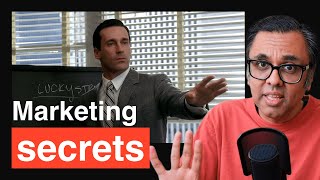
A spoken reaction video by Hiten Shah that analyzes Mad Men ad pitches (Don Draper and others), explaining why certain creative strategies work — e.g., strong brand association, reframing, emotional storytelling, positioning for niche audiences — and when they fail (misaligned sex appeal, poor audience fit). The video reviews examples (Hilton, Heinz, Lucky Strike, Kodak/Carousel, Jaguar, lipstick, cereal) and extracts practical marketing lessons for startups and brands about positioning, differentiation, and emotional resonance.
Chapters
Everybody else's tobacco is toasted. No, everybody else's tobacco is poisonous. Lucky Strikes is toasted.
He made them tell him something about the process or something about the product, and then he just pulled out one thing he found interesting and said, that's the ad. Honestly, sometimes it's that simple. You just find something that other people aren't saying.
On today's episode, we're going to break down scenes from Mad Men. What does that mean? Well, I'm going to look at ads that Don Draper was pitching and give you my opinion on them and exactly what we can learn from them. Let's jump right in.
Now, there's one word that promises the thrill of international travel with the comfort of home.
Hilton.
How do you say ice water in Italian? Hilton. How do you say fresh towels and Farsi? Hilton. How do you say hamburger in Japanese?
Hilton.
Hilton. It's the same in every language.
It doesn't get much better than this kind of reframing. When you can really associate it that strongly. It's very rare for this to happen. So an example of this out there in the world that we're very familiar with is Kleenex or Uber or Marlboro. All these brands that now we associate it with the category so sharply that oftentimes people are picking, you know, Lyft or Waymo, and they're like, I'm gonna go Uber. Well, that's when you know you're winning, but you're trying to say something about the brand, and what you're trying to say about the brand and the association with it has to be related to the brand positioning and the experience you create. So if you're a startup and you're thinking of doing this, don't do it half hazardly. I really don't want to see those ads. I really don't want to see that copy. What I want to see is when it really aligns with what you do.
It'S clean, it's simple, and it's tantalizingly incomplete. What's missing? One thing.
Pass the Heinz. You mean the Heinz ketchup? It's Heinz. It only means one thing.
This is a very dangerous strategy that's easy to get wrong when people force it. But there are a lot of examples out there of this getting done right. Apple, when they would show the white headphones. So the concept here with the Heinz thing reminded me of that, where you don't need to mention too much and you can leave the rest to people's imagination. And those white headphones are still iconic. Even the AirPods are white because of Apple and their approach to doing this. Everyone thinks they can just throw up a billboard with some random creative idea and make it work. They don't really think through what is that unique space you can take up in someone's mind when they see the ad. And this is what I would suggest to anyone thinking of advertising with billboards and how these Heinz ones with the ketchup, they very much reflect influence by omission. And I don't really see enough ads and marketers thinking like that. When it comes to startups and their billboards, they're trying too hard with words.
One mother, starting in the prehistoric caves, serving beans to a shaggy little boy by the fire. Then a Greek woman in a toga with a little shepherd boy, Calamity Jane, a pioneer boy all the way through the gay 90s to today to a little lunar kitchen with the earth off in the window, you know, futuristic clothing, interesting bowls. The kid has just taken off his space helmet as he takes a warm bite. Heinz beans. Some things never change.
So this idea of them being able to imagine themselves in the scenario, even if that scenario has nothing to do with them, is really fascinating. So he's using that framework and then positioning the product across time so that historic time back in the day, the product didn't exist, but it makes you imagine that it did, because then that'll cement the idea that this product is timeless. And so if it could have been used in the past and you're using it now, it'll be used in the future too. So an example would be like if Intuit did an ad like that and said taxes should be easy. Just like, you know that whole saying about death and taxes, right? They could play on that. No matter what, you're going to have to deal with this. And so that's a strategy that was used here. It's really key framework. I would call this strategy inception strategy.
We have six identical companies making six identical products. We can say anything we want. How do you make your cigarettes? I don't know. Shame on you. We breed insect repellent tobacco seeds, plant them in the North Carolina sunshine, grow it, cut it, cure it, toast it. There you go, There you go.
Everybody else's tobacco is toasted. No, everybody else's tobacco is poisonous. Lucky Strikes is toasted.
This reminds me of a very specific strategy when it comes to building any kind of product. It's very obvious, but most people don't do it. You build something, you figure out how people are using it, you figure out who finds it most valuable, and. And then you just double, triple, quadruple down on that. And oftentimes it just becomes your business. He made them tell him something about the process or something about the product, and then he just pulled out one thing he found interesting and said, that's the ad. Honestly, sometimes it's that simple. If you're thinking of, how do I market my product, how do I talk about it, whatever, and maybe you're in a commoditized market, you just find something that other people aren't saying, and then you turn that into your narrative. So taking an example like this, the folks at ConvertKit, when Mailchimp was the most popular tool for SMBs and freelancers, et cetera, they basically took that market and said, hey, we're going to build ConvertKit just for creators. Now, here's the funny thing. That demographic has only grown. So now that demographic itself is a market. And Beehive has their own version of differentiation against ConvertKit by being simpler, easier to use, to the point where. Where ConvertKit had to make an acquisition to match up with what Beehive was doing. So this is the way things evolve. And that's a very good example of the strategy of, hey, there's a market. It's commoditized. How do you differentiate? And you could differentiate in ads, because back in the day, ads were everything. That was the way you reached people. Now you need to differentiate on the positioning of your product and who you're best for.
This device isn't a spaceship.
It's a time machine.
Lets us travel the way a child.
Travels.
Round and around back home again.
To a place where we know we are loved.
One of the most powerful things that Don Draper does is his presentation style. I think it's actually underscoring the fact that he uses own images, because that's a hack. He's gonna have the emotional resonance. He's gonna speak softly, he's gonna get a little emotional. You can even see it. So you're sitting there and you're like, wait, that could be me looking at my photos. And then the way he's saying it of, like, the nostalgia and, you know, almost bringing you back to that time. And so I think that aspect of when you tell your story when you're pitching is super huge. Because the thing is, when you're pitching your company, the only thing folks on the other end want to see is your excitement for what you're doing. Everything else is secondary. If you're not excited about it, how the heck are they going to get excited about it. So when you can think of something that has emotional resonance like that, where anyone that watches it is going to be sucked in and be like, yeah, I can imagine myself like that. That's a big deal. In fact, I think we have a major void of this kind of positioning or this kind of approach in AI today. We aren't actually inflicting people's emotions. In fact, we might be inflicting the wrong ones. Instead, we should be encouraging the positivity of it. The fact that this is a helper for you, this is something that's going to help you make your job better. This is going to help you do things faster. An example would be description where they've built an AI tool and instead of calling it overlord, they called it underlord in order to help appeal to your appropriate emotions, which is, this is something that's going to help you, but it's under you, not over you.
I know I'm not a manager, but it's very hard to get things done with you in another room.
Well, I obviously have the opposite feeling.
Permission to speak freely?
What?
The copy is still describing the car as another woman, but a woman you can't have because they have all the qualities of a Jaguar. Good looking, expensive, fast, and frankly, not practical.
I've always been fine with all that. But what's the line?
Jaguar. At last, something beautiful you can truly own.
So luxury is all about aspiration. Why? Because it costs a lot of money. That's why it's called a luxury. Good. When you're pitching something that's at a premium price point, make sure you pitch it. Aspirational thing. Apple comes to mind where you have an iPhone and it is an aspirational thing if you can't afford an iPhone yet. But then when you can, you have that validation. An example of this is their blue versus green text messaging. There's a company that competes with Airbnb called Wander. Every time I hear the name and I see their tweets and I see the videos of the new places they're adding, I feel like I want to be there. I feel like I want to go there. I feel like I want to wander over there. So that's one where it's a luxury brand compared to Airbnb. And they're very focused on really highly curated places I can stay.
From a basket of kisses, she picks one. It makes her unique. It colors her kiss. And her kiss, well, it colors her man. Belgia Lis lipstick mark your man. She makes the Choices. And she's chosen him. She wants to tell the world, he's mine. He belongs to me, not you. You've given every girl that wears your lipstick the gift of total ownership.
That ad is brilliant for one simple reason. It really empowers the person it's targeting. In a situation where normally maybe the woman isn't empowered, the behavior that already happens is what's being highlighted here with that product. Think about it. A woman puts lipstick on. If it happens to be on a shirt collar or a neck of a man, then what ends up happening is that people notice. And so it's basically putting the lipstick aligned with an aspiration. I'm in control. This is my man Kellogg's.
When you hear it, it's more than a name. It's the warm embrace of home, a family. And where does that family begin? It begins with two beating hearts, like two pastries alone in the dark, sharing a single foil wrapper. Imagine a husband coming home from work. His wife greets him at the door wearing a satin negligee, leads him to the bedroom. With one flick of a red polished nail, she ignites the coiled heat from a nearby toaster, which is also eager to receive his now warm pastries. Gentlemen, I give you the Gel Jolie by Martin Margaux. You know we're a kid cereal company, right? If that's all you want to be.
The lesson here is pretty simple, which is don't use the same strategy of sex appeal in an area where it just doesn't make sense. Unlike the lipstick ad, this one did not hit the mark, and sex appeal was not the right angle, and it probably wasn't even the right audience to go after. The last part of it, where he talks about if that's all you want to ever be is fascinating, because expansion of a product offering requires repositioning, and ultimately, it's all about audience alignment with the message, regardless of what audience you're going after. And a lot of times, you end up having to tweak your product to make that happen. When you're thinking about expanding your product line, you should first start with the audience you already have and expanding it instead of going after a new audience as a default that you think will work because your organization probably doesn't have much expertise in that audience. All right, that's a wrap. That was me reacting to a bunch of ad pitches from Mad Men. My favorite one was a carousel ad because of how great ads really inspire emotions in people that cause them to actually go take action, such as Buy that Kodak Carousel. It's all about the audience and the message and making sure that those two matches. You can have the best thinking around an audience, but if the message doesn't land, it doesn't matter. All right, so I'm done for today, but I need your help. Comment below and let me know what you'd like me to react to next.
The show is produced by Supermix. Thanks for joining.
More from Hiten

The Library of Minds: "The Social Network Ruined Startups" | Hiten Shah 4x SaaS Founder


This startup repair factory is worth over $11 billion #entrepreneur #founder #productmanagement



This is how a $40 billion crypto cult came crashing down #crypto #terraluna #stablecoin #dokwon

This is the only casino the government can’t shut down #gambling #tech #startup #founder



