Andrea Cagan and grief expert, David Kessler on Writing Through Loss and Trauma
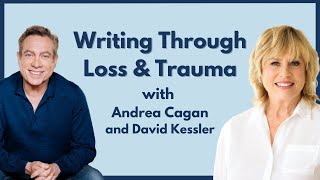
Andrea Cagan and David Kessler discuss using writing to process grief and trauma. They cover how to beat writer's block (start anywhere, write without editing), why journaling heals, and how to handle triggers safely. A free holiday grief journal is available at writingthroughloss.com.
Chapters
Hi, everyone. So glad you're here. Welcome, welcome. I'm here with my dear friend Andrea. Hi, Andrea.
Hi. It's a pleasure to be back.
I know. All right, give us just a few minutes to let everyone come on and say hello, let us know where they're from. Okay.
So we'll just give folks just a couple of minutes to get on. I always like to give people extra time. Hi, Diane. Good to see you. Hi, Sandra, good to see you coming on from New York. Welcome, welcome. I'm just going to give folks lots of time to find us.
It usually takes a little bit and I know many of you will watch this in the replay. So if you haven't been on before as you come on, you can say hello, let us know you're here, but you don't have to.
Welcome, welcome. Glad to see folks coming on.
Welcome, everybody.
Paula from Pennsylvania. Good to see you. What'd you say, Andrea?
I said hello, everybody.
I know.
Patty's here from Minnesota. This is like my Romper Room moment just to read hello. As they come on, we'll give everyone a chance to come on.
I see lots of folks coming on, so we'll give them time.
It's a somewhat rainy Saturday here in Los Angeles. Hi, Sherry from Maryland. Welcome. Hi, Joy from Texas. Good to see you.
Patricia says hi. Andrea. Hi, Maria from Australia. Good morning to you.
Good morning, Maria.
Morning in Australia. Hi, Nicole from Maine. Good afternoon to you in Maine. That's what's so fascinating about this, isn't.
It, Andrea, that it's so amazing from everywhere.
Good morning in Australia. It's good evening in the uk, different.
Parts of the day. Some places it's even different days.
I know. Well, I think in Australia, it's a different day.
Melissa's here from Arizona. Maddie's here. Hi, Maddie. Sandra's from New York. Alex is from Arizona. Welcome, welcome. All right, just give everyone just a couple of more minutes, then we'll come on. So Michelle's from New Jersey. If you haven't been here before, if this is the first live you're watching, I'm David Kessler and this is a Facebook live. We're doing this.
Group here. Started after the first Covid shutdown in March. So many people told me they weren't able to go to their grief group after a loved one had died. They couldn't see their loved one who was dying in the hospital or their loved one had died. They couldn't have a funeral from COVID deaths, other deaths, new older ones, and wanted to create this group. So that we had a place to talk and post with one another and support each other through this because if we couldn't be together physically, we could at least be here virtually. So we've been here, we've been growing. And I'm so glad you've joined us. I bring wonderful guests on today. We have Andrea Kagan, who's our guest. We'll be talking to her about her amazing work. She's written amazing books. I'll introduce her in a moment. All right. Let's see who else is here. Fallon is from New Jersey. Hi, Fallon. Tanya from Cupertino. Where's that? Is that in Northern California?
Maybe so.
All right. Doris is here. She says, Andrea, love listening to you.
Oh, thank you, Doris.
So today's guest I'll be telling you about, but as we always do, as a tradition here, we have a moment of silence to honor those who have died. We're all here because they mean so much to us and still do and always will. And I believe when they die, they don't quit loving us, and we certainly don't quit loving them. So a moment of silence in their honor if you'd all join me for it.
Thank you so much. I have an amazing guest I'm going to be telling you about, a free gift we have for you today in a little bit, but I want to introduce our guest. Andrea. I'm going to introduce you, if I may.
Please do.
Andrea is an incredible writer, editor, author. Books she's worked on have hit the New York Times bestseller list. And how many?
Over a dozen.
Over a dozen books. She has been an editor to all of my books, most of my books. I think there were a few before you. Before.
It's a great pleasure for me to do that.
Yeah. You've been quite amazing. And you've also, my goodness, you've ghostwritten books. There's books you can't even tell us you helped write that we know and love. There's other ones you've edited that many people have, you know, loved, whether they be Grace Lick's book or Return to Love. And Joan London, so many books you've been a part of. So you've been a writing teacher of mine. You're a coach. You have writing classes. You teach us all that our voice matters and our stories matter. So I'm thrilled to have you on. Let's just see who's joined us. All right. Gloria is here from Rhode Island.
Let's see Los Angeles. Read us here from Mountain View. Wonderful. So many people are coming on and joining Us.
Great.
So today we are going to talk about writing through trauma and loss. And one of the things that I created for you is we have a holiday grief journal that you can download so that you have it for this holiday season to deal with your own loss and grief. So if you're interested in that, just know it's at writing through loss.com writing through loss.com. and I'll put that in the comments later and in the video. But let's get right to my guests. Andrea, you know, you and I have actually taught a class once before. You've been here twice. This is your second time.
Yes.
And you and I have taught a class together on writing through trauma and loss.
And it was a series.
It was a series in the first workshop. Yeah. And I think the idea of writing through grief and trauma scares us so much. And I think for many people, writing in general is scary, much less as a source of healing. But I think, you know, our ego, our inner critic, all that just kind of blocks us so many times. So tell us about when we feel blocked and our inner critic, because that's such powerful information you have.
I teach this a lot because everybody who sits down to write has to deal with this. And we deal with it with more things than just writing. We've always got something in there judging us. But what I do is I look at my inner critic sometimes as something separated from me. I talk to it, sometimes I write it a letter. I let them know who's boss, and.
They show up very. This inner critic shows up often when we're about to start something. So I like to remind people that you don't have to start at the beginning. You can start in the middle. And that way you don't have to feel like, oh, I don't know how to begin. I don't know how to tell my story. And so I think it's really important to just understand that you've got a story and you're going to just begin wherever it sort of appeals to you to begin and just begin writing. And we have to not follow the critic who's telling us whether something is good or bad, because it's never really true. We are not writing to be good or to be bad. We're writing so that we can unburden our hearts and put our feelings onto a page. And it makes. It lightens us.
Wow. I just want to say that again, we're writing to unburden our heart. That is so beautiful. And I want to tell people a couple of things. First, of all that, what you said was so powerful. One of the things that I think the inner critic can do is not just tell us we can't do things, but cause confusion. And sometimes the inner critic goes, because I've had this feeling, oh, my goodness. Do I start at the story when I was born? Do I start the story of my son who died when. When he was born? Where do I start? And you've always been like, david, there's no wrong place to start. Start in this moment, start when he dies. There's just no wrong moment. And that was so powerful.
There's also no wrong way to write. You just do it. However it comes to you is correct.
And by the way, we're going to have time at the end here for you to ask Andrea some questions in the comments, and if you want. So one of the things also that I want to just acknowledge you about personally is you. When my son died, obviously, and it's so heartbreaking that we can't do it now. You know, people brought the casseroles and came over and all that. And I don't know, about a week or two weeks later, you took me aside and you said, david, I know you may not know if you ever want to write about this, but I know you'll never want to lose these details. I could come over if you want, and write the story of your son dying. And I was like, oh. And I took you up on it, and you literally sat at this computer where I'm sitting, and I stood behind, and I just told you the story of my son dying. And you wrote it word for word. And you're like, david, you'll lose some of these details. And it's an important story not to lose. And that was just a beautiful, beautiful gift.
So thank you for that.
You're so welcome. It was a pretty powerful experience for me, too.
Right. So when we talk about this idea of everything being so scary when it comes to writing, I think about.
Writing through loss and trauma. We get very afraid I'm going to open up this wound. Why would I do that? I've got the pain under control, or I'm in so much pain now. I think we don't understand that. You know, as we've heard, what stays in us works against us. What we get out helps us.
That's beautiful.
You know, and to get it out of us, to let that loss have a voice.
You know, there's just details we'll forget. As we talked about, the other thing I hear from people is they'll Go. My mind so overwhelmed. Why on earth would I write about all this?
Putting it on paper actually has been shown to help with the overwhelm. You get it on paper.
Order, to take the chaos and put some order into it.
Right, exactly.
You have to focus on one thing. It's very helpful.
Right. And I think our mind can come up with so many reasons not to write. I'm not a professional. I'm not a storyteller. No one's going to want to read this. And one of the things, going back to what you've taught me, the inner critic says things to you like, no one's going to read this. I don't know. Do you have your per. Do you have permission to write about this? There's other people involved. And the answer is, this is your story. You get to write your story.
You get to write anything you want. And then it becomes your choice if you want to share it with someone or not. And then you don't have to share all of it. You can say, well, I'd like to share this part, but this part I want to keep close to my own heart and just have it myself. And you have the choice to do that. But when you first write it, you just got to let it come out exactly as it is. And that's when you'll remember details that you forgot or that you would like to remember. And then you make decisions along the way about who or what you want to share it with first. It just belongs to you.
Right, Exactly. And I also think about, you know, we don't know where to start. We don't have any structure. That's why I wanted to create. Because this holiday is so intense. I wanted to create a grief journal that's free to deal with the holidays, to have a place. So please feel free to go to writingthroughloss.com or. Krista's been wonderful in putting the links in the comment. So you can get the free journal. It's writing through loss, or just click on the links that Krista's putting.
Writing in a journal creates a new ritual because as we're missing our rituals that we've had with loved ones, and it's time that we begin some new ones now. And writing in a journal is a very good way to begin that.
And, you know, so many people, you've said this. So many. You told me this. So many people say to you, andrea, I can't write. And then.
They say, I see. Have you written before? No, but I've kept journals and I Thought, well, what do you call that? To me, writers simply write. And whatever form you write in, you're still writing, Right?
And it's so powerful to put those words on paper and to be able to witness your own grief and to have this record because that loss is so important. It's interesting going back to your inner critic, and I've had all of this, and I think you've taught me all this is so many times, besides going, it's going to be too painful to write. It's going to work against you to write.
My inner critic will say things like, I can't write, or I don't know where to begin, or I don't want to write. And I think you've taught me to write. I don't want to write, and here's why I don't want to write. Or the other one was, I can't concentrate. Start writing about why you can't concentrate.
It's a great way to stop writer's block is you say, I have. You write down, I have writer's block. This is what it feels like. And suddenly you're writing, and then you can move into other places. But that's a surefire way of releasing that block. I use it a lot myself.
Right. So, you know, when we talk about why write, it's because. I mean, I'm sure you'll have a million reasons, too, for writing. For me, it's healing, it's sharing, it's giving meaning, it's memorializing. You have a story to tell. You can create a legacy. Why do you write, Andrea?
Well, what came to me just now when you were talking about it is that I do this thing which I call losing time, where I go, whatever I've been thinking about, stressing over or whatever it is, I move into this other realm, this other place where I'm starting to write, and all of a sudden the time goes away, all those extraneous thoughts go away, and I'm not aware of my world. I'm aware of the inner world only. And there's a great relief in that. And it reduces a lot of the chaos. And then suddenly I've been in a creative project for an hour and the time's gone by and I haven't been stressing. That's one of the reasons. And the others are a lot of the reasons you do. I find healing, and I find that I remember details when I begin writing that I couldn't remember before, or conversations. If you'd asked me before I started writing, I wouldn't have been able to tell you what I said or what he said or she said. And then as I write, something opens up and it comes to me.
I'd love to take some questions from you. Feel free to put them in in the comments. Any questions you have for Andrea, remember to get the free holiday grief journal@writingthrough loss.com Writing through Loss all right. Don is here. Lynn's here. Thank you. Want to learn how to journal? Fallon? I used to be able to write, but now I find it impossible. That's your inner critic, by the way. It's possible you can write. I'm just telling you that it is possible.
Do you have suggest Denise says. Do you have suggestions for places where we can submit short pieces on grief and loss? Well, first of all, and you may have some too, Andrea, I just want to tell you one of the most read pieces on grief and loss. Well, Sheryl Sandberg on Facebook. You can just write a post on Facebook that she wrote at the one month point. You have a blog, Andrea?
I do. I write it every week. I've been doing it for years and I put it on Facebook and I have it on my website and Instagram. So I'm not looking to go out and get it published. I'm putting it on my social media places and a lot of people get to look at it and comment and it's really wonderful.
Robin says I compare from the beginning to now and it's so different. It's. Yeah, you're. Your perspective changes, doesn't it?
You really get to see that when you write about it.
Right. And we've all gone back and opened up a journal or something from five years ago and go, oh my gosh, I am so glad. I'm not that.
Maybe I should close this journal again.
Right. I can't. Oh, I can't believe I thought that. Or whatever. Donna says, I would like to journal, but it's even difficult for me to write letters or even a long text. You know, it doesn't have to be long. It can be a paragraph. Yep.
Write two sentences every day. You could come up with a thought and just write a couple sentences down. And then one day you may just suddenly feel like expanding on that. But don't, don't force yourself because that'll push it further away.
Doris asks, do you type or handwrite?
I used to handwrite all the time. And then when I began to work on my computer, my handwriting is getting so terrible because I don't practice with it very much that I found that I do it on the computer most of the time, but if I write poetry or a short thought, I do it by hand because there's something about the flow of the writing that adds to what you're writing about.
Either way, do it however you can.
Yeah, it goes back to. It's just like grief. There's no right way to do grief. There's no wrong way to do grief. There's no right way to do writing. There's no wrong way. Kath says here's her question for you, Andrea. I've been told it's helpful to write but not read it back as a way of healing. What do you think?
I think when you initially put it down on the page, it's good not to read it back because then you start editing it. So but. But I think that you will read it back, but just keep going, keep writing. In my class, I do like 40 minutes and people just write and I ask them not to go back and correct anything at that time so that they can just let the thoughts flow and then later you can go back as often as you like.
The other one I would say about that is I'm a big believer in what I don't know if this is actually a technical term or I heard it or I believe in. I let my writing do what I call. I let my writing get cold. I write something, I put it away. I don't look back at it. So even if I'm journaling or something, I don't read it and then try to proof it or read it in that moment. I put it away and continue writing. No, I'm going to go back and look at it another time.
A lot of great writers say that. They do that.
And let's see here.
I'm sorry, I'm going to mispronounce this Holomay. How do you write when the loss is very triggering?
My answer for that is, and you may have something to say if something is triggering. First of all, I feel like a. Triggers are the map of our grief. It's where the pain lives and it can be where the healing resides. If writing about the trigger or diving into it is too much, write about what's around the trigger, what you think about the trigger. Don't go into it, but write about what's around it.
Or you can put down one word, agony missing. You can just do a little tiny bit. Just don't put any demands on yourself. You could just do a little bit. And I love that idea, David, of writing about saying writing down. I Can't write because I feel so triggered. That's sort of the same thing as getting rid of the block.
I came on late. Janice says, may I ask Andrea's last name? Of course. It's Andrea Kagan. You can find her name in many books, including mine. She's been an incredible editor writer, and, you know, you've worked for them all, Simon and Schuster, HarperCollins, all the big publishing houses. And like you said, you have a blog every week so they can find you on Facebook or on Instagram.
C A G A N, by the way.
C A G A N. Absolutely. Doris says, thank you. I write daily in my journal.
Good for you. Great. Great.
Jillian says, my problem is I start writing in this site, but I get so carried away. It's real, it's so long and really tells a story. I decide to answer the responses in my post by going live in a few days. It's actually healing me to write about how I feel. Absolutely.
That sounds wonderful.
Marcia says, what about traumatic loss? Very important. We have seen that writing helps so much with trauma. It helps us distance ourselves from the traumatic event. It helps us not be the victim of the event, but we get control over writing about it. So it helps bring control to a traumatic event. So many reasons. And you've probably seen me over at times.
The idea of how to not be you may have been victimized in life, but that doesn't mean you have to have a victim identity in your mind. Writing puts you in control. Would you agree with that, Andrea?
Absolutely. Just keep your box of tissues nearby.
I've done plenty of writing and crying at the same time. Let me tell you.
Paula says we can also write about our wonderful memories. Absolutely.
Yes, you can.
And I'll tell you a couple things I do. Number one, and there have been times I've done this with my living son and some other people will be sitting around and start telling stories about my son David. And I'll go, let me get a recorder out. And I just put my phone recorder on to just get it down and then I'll go back and transcribe it later.
And those wonderful memories are just incredible keepsakes.
You know, it lasts forever. One of the reasons, you know, I thought this grief holiday journal was so important was this idea that, you know, we're all stuck at home these days. We're so isolating. And, you know, the world is tough these days, even today being election day. The reality is if your candidate won today, you probably wish your loved one who died was here with you. If Your candidate who, you know, lost today, you probably wish your loved one was here. I mean, these big days make us even miss our loved ones even more. So it's so important and I think to memorialize them, to give them life, to have them live again. On the paper.
Maurice says, yes, David, that's exactly what I do as well, David. I write. Put it away. And I look back at it. Absolutely.
A healthy habit. It's a good way.
It is a healthy habit. All right, if you have any questions for Andrea and I before we hop off, happy to answer some of them. Faye says, this may be weird for some, but when I write grief, I include some whimsy or humor in it. It helps me cope and recall the sad times.
That's wonderful.
I think that's great, Faye.
Yeah.
Okay. Oh, Annie says Annie was in our writing class before because we did a Writing through Trauma and Loss once before.
Andrea, have you recovered fully from the fall you had. Sorry to bring up that memory.
When we just for everyone who doesn't know when we were doing this class last time, Andrea took a fall right at the beginning. And you've healed so beautifully.
Feeling great. It's so sweet of you to ask. I'm doing fine. Everything's back to normal.
And.
It was a hard experience, but I healed from it quickly, so I feel lucky.
All right, if you have any other questions, please write them in now before we go off. And just to let you know, I'm David Kessler. This is Andrea Kagan. I'm so glad you're on this site. If you're on the site, it's peer to peer support. I come on once a week or so, sometimes more, and I really love tuning in and seeing how you are all supporting one another. And the reality is, if you're having a bad day, come on here and write about it if you want. If you're having a good day, it gives other people hope. Come on here and write about it. That's so important. Denise says the first thing I wrote after losing was a how to journal. I wrote it in the second person. It helped me put a character mask on so I could write from a different perspective.
Do you understand everybody what a second person is? It's when you say you did this and you did that. Oh, I forgot to take this away.
Well, it's live. That's how it works in live stuff. So is there a journal book you recommend? Well, I would say start with the free journal. We're giving you writingthroughloss.com we did it two ways that, one, you can write with the lines, or two, if you've got, like a beautiful journal book, you can just take our prompts and then write in your journal. So we did it both ways. So you have it. Fallon says, can't wait for the next grief writing class. So wonderful. We're going to be doing one soon. Coming up shortly. Everyone's thanking you, Andrea. You are such a blessing to us all.
Thank you. I'm so happy to be here with all of you and I can't wait till David invites me again.
All right, we will have you back soon. So all of you, thank you so much. We're sending you so much love. Remember, there's a free grief writing journal we have for you writing through the holidays to help you, and you can find it@writingthroughloss.com we're also putting it up in the comments. Thank you so much, Andrea. Thank you for being a friend, an editor, a writer, and an inspiration in our life.
Thank you for giving me a place to speak about it.
All right, everyone, until I see you again, much, much love to you today.
Love to everyone.
Take care. Bye. Bye.










