Celebrate the Release of Finding Meaning!
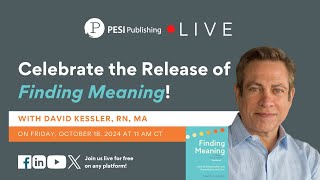
A recorded livestream conversation between host Kate Sample (Pessy Publishing/Bridge City Books) and grief expert David Kessler celebrating the release of his new workbook, Finding Meaning, the Sixth Stage of Grief. They discuss why Kessler created a workbook version (to provide tangible tools for clinicians and people in grief), how the workbook can be used standalone or with the trade book, notable exercises (shame work, acceptance, hero’s-journey framing), and practical advice for supporting people in grief. The video also notes early commercial success and promotion of a free three-part class tied to the workbook.
Questions this video answers
Over 16,000 copies (reported during the livestream).
A free three-part series starting Monday; sessions will be recorded and available afterwards.
Chapters
Hi, everyone. Welcome to our livestream today. My name is Kate Sample. I work for Pessy Publishing and Bridge City Books. And we are honored and thrilled to have David Kessler join us today. World renowned grief expert and author of his new book with us, Finding Meaning, the Sixth Stage of Grief. Excuse me, the workbook. David, thank you so much for being here. It's so great to see you.
Thank you for having me. I'm really thrilled to be here. It's been a wild ride, Kate.
It has been a wild ride from. From publisher to author. We've had a very intense shared experience in the last couple weeks since your book came out.
We have, we have. You know, I. I was so surprised, as I know you were, with the reaction, and I don't think any of us expected it to sell out so quickly on the first day, but I am so grateful that, like, people saw a need, clinicians wanted it, clients wanted it, and it's getting in the hands of people, and I love the feedback. You know, you write a book like this and you're like, please, please let it be the helpful tool I want it to be. And so glad to hear it's. It's connecting.
It is. It absolutely is. And I. Yes, you know, it's a good way. It's a good thing to have to panic about as a publisher to make sure there are enough books to go around, but, you know, a little panic inducing nonetheless. And I share your same sentiment. Now, we know how much people are looking for this work, how much people are engaged and following you, and we're getting it into the hands of people who, who need it and who want it. And we're looking at over 16. 16,000 copies out there now where, for me, as I mentioned in one of our internal meetings, that means 16,000 people more have. Don't they feel less alone in their grief? They feel less alone because of this book. I know we've kind of positioned it as a. As a. If it's possible to write down what it's like to sit with you in your work with people who are deep in their grief, I think we've accomplished that. So congratulations to you in this, this wonderful workbook, and thank you for writing it with us.
Thank you.
Yeah, tell me a little bit about it. I know there was a little bit of hesitation at first. Do we want to do a workbook? Do we not? Why. Why did you feel compelled to write this? Tell us, tell us the story.
I think a few things, I think. And by the way, if you, if you See us holding it up a lot. There's. There's a. There's a. Another agenda there just to name. There is an AI copy out there, and it looks a little like this. It's got the same exact title, which is shocking, but it doesn't have the author as David Kessler. So we just want you to actually buy the one you're hoping. So that's why I've been, like, holding it up for folks, because we've gotten emails from people who said, hey, in the middle of the book, it quits talking about grief. And I'm like, oh, they bought the AI version anyway.
Well, I was hesitant, and I, I, you know, I have been.
I've done six books, and the idea of a workbook, I wasn't. I've never done it before, and I wasn't sure about it, and. But this last book really did lend itself to a workbook, and it is. I just. Like you said, my intention was like, as if we were in the office together or as if I was sitting with someone at their kitchen table. And I think the other big driver that really is so important to me is you've, you know, seen me for years, and we've worked together for years training therapists. So many therapists, clinicians, shared. They just didn't get the grief education.
And we're very tangible people. We need tools, we need techniques. And I think some people said, you know, I sort of know how to do the first, second, third session with a client, but where do I go from there? And I wanted this to be a tool that clients could use to supplement their work and bring it in and talk to their therapist or do it on their own. Not everyone can afford a therapist. Not everyone has access to an agency where they are. I wanted something that was really accessible and that the clinician could use for session after session after session and really help guide them.
Yeah. Yeah. Well, I'm so glad that you did come to that decision, because mission accomplished, you really did create a toolbox, if you will, for not only those in grief, but also those who are supporting people who are in grief. Whatever, you know, whatever the situation may be, you've certainly accomplished that. So thank you for doing that and for sharing your work with the world, because it matters. It makes a big difference.
Well, you know, I don't even like to claim it all as mine, that I've just had, you know, the privilege of sitting with people for so many decades, and they've often been my teachers and so many other clinicians and people that, you know, I've had the honor to work with.
Yeah, yeah. And it was. It was kind of a step into all of that. Your expertise, your experience, your conversations. It really. It really feels like in the book that we get to dive into your mind and your work, which is a big accumulation of all of those experiences.
Well, I have a little joke that I say, and it's not really a joke, it's kind of true that I've been privileged to have some amazing co authors. And I say with this one, I have a really important co author, the person who's doing it.
Yeah.
You know, they're really writing their story, their healing, their work down, their. Their love, their loss, their. Their path.
Yeah, I love that. I love that. Are there. When you think about the workbook, are there any particular exercises or activities that you want to mention today that stand out to you as the. Being particularly impactful for readers?
I think a few, you know, well, clearly all of them. But I think you for a few that stand out, is that one. I don't think people here do your grief work. What does that mean? So I really broke it down to helping people understand.
Not just identifying your feelings, but here's what to do with them. And then I love, like the shame exercises. People have told me. I would have told you I didn't have shame in my grief, but after I did that, I saw that. And just some of the things around, struggles with acceptance. I love those exercises. They seem to really be resonating with people. And as you know, I see the book and the workbook is taking people on a journey through their grief. And one of the things that I think you and I even talked a bit about and I struggled with this is I love the hero's journey.
Yes, we did.
I wanted to really help people. And many people are familiar with it, Joseph Campbell's work and that, you know, whether it's Star wars or any great story, we love Lord of the Rings, any of those. It is the hero's journey. And there's often a death in the beginning, and we're thrown into the dark nights, which is grief. And so I love doing the hero's journey.
And then having a place for people to write their own journey out and their hero's journey to. To sort of recognize that how amazing it is that we've survived. And yeah, I want to tell you, the other thing is.
It was fascinating to me.
Someone shared with me that they bought the workbook and I said, great, thank you. And they said, I put it on the shelf for now. And I said, oh, I'm curious, can you tell me more about that? And they said, I'm not ready to go into the pain.
Yeah.
And I said, completely understand that feeling. And I said, I wish you actually could put the pain on the shelf with the book.
The book on the shelf. But the pain is still with you.
Right?
The book is the tool to help move the pain from you to the paper, to help get it out. So it's interesting, that idea. And I think that's one of the cool things about it, is that it is a way to navigate these things that are often vague, like this grief stuff, how do you get through it? And I just want to mention, especially for so many clinicians.
And by the way, we have.
A free three part series that's starting and it's starting Monday, but it's also going to be recorded in case anyone's like, oh, I or my client can't make that time. They'll all be recorded. Because I know it can be challenging to start a book or even get support. As you know, I have dealt with this not only professionally for decades, but being a bereaved father, a bereaved son, watching my father be a bereaved spouse, that I get how hard it is to start a book. That's why we wanted a three part class to help people. We all started together and those will be recorded. But I also wanted clinicians to know and everyone to realize grief just isn't death of a person. It is the death of something. I always say that a breakup is the death of that romantic relationship. Divorce is the death of a marriage. Job loss is the death of that paycheck. We have pet loss. We also have loss of ourselves sometimes with our childhoods and our abuses or people I say, who are dealing with narcissistic abuse. It can feel like death.
So, you know, when people do the workbook, they can use any death they feel like they've experienced. It doesn't have to be the death of a person. And that's why I think it's really going to help so many people with this, deal with their loss and witness their own grief.
Yeah, absolutely. When you were, when you were saying that, I was thinking of your podcast with Dr. Ramani about the narcissistic abuse and you absolutely nailed it when you said that that's the, the death of, of oneself and the only. I believe I'm paraphrasing, but I believe you said the only, the only loss that we can get back.
The only death we can come back from.
Not easy, by the way. Not easy. It's like none of this work is easy. And I think one of the. The other things I tried to do, I don't know if you noticed in the workbook, but it. It certainly is clearly, as I said, a journey. But it's also, if you're like, I'm not sure about this, oh, I can just pick it up for two minutes and do a disloyalty checklist and see the places I'm feeling living again would be disloyal. So there's parts that are quick and easy. There's parts that require a little more thought. But I wanted it like you could start at the beginning or anywhere you feel called to.
Yeah, I remember in the editorial process that was very important for you, along with the hero's journey. I remember those phone calls kind of, you know, noodling through how we were going to set that up. And that was part of how part of the conversation was keeping it so accessible and not needing to be linear, not needing to follow certain steps. You know, people can dive in where they need to. I'm seeing Julia, Kim made a comment here that she appreciates the workbook can be gone through in companion with or independently from finding meeting meaning. And that was actually one of the questions I had on hand was, you know, this is based on your original trade book called the Six Stage of Grief, Finding meaning. Sorry, flip that around. And so that was one of my questions. Do you need to read the first to have the second? And Julia answered it so beautifully that you don't. You can. You can jump into the workbook without having read the book.
Absolutely. I mean, the workbook, you know, it's interesting. Here's the thing about grief is that our grief is so individual. For some people.
The feeling, their feelings going to the funeral, it's enough. Other people need a little more support. The workbook might be great. You know, there's people who want to do this and need the support of a clinician. Get all the support you need. It goes with groups. I can't tell you how many folks from my grief educator program, the certificate program, are like, this is what we're going to do with our groups. That it works so well in all those aspects. Absolutely. Start with the workbook. It's a perfect place. I really try to explain everything in it so that you don't feel like, oh, I need the other to start. You can start right with it.
Yeah, yeah. It stands alone. Absolutely. And if you wanted to dive Even deeper. I think the book is a great companion to the workbook and vice versa. It works out really well.
So just to tap into your wisdom, if there's someone who's watching or someone who knows another person who's very perhaps deep in grief at the moment, what are some things that you would tell that person to feel just a little bit better today in this moment?
Well, if someone's supporting someone in grief, our work isn't to fix them. They're not broken, they're in grief. Our work is to sit with them and it's really okay. It's interesting, you probably have heard me say this. I see the back end statistics of my website, grief.com and the most visited page is the best and worst things to say to people in grief.
Literally.
We're a grief illiterate society. We don't even know. Like I always say, I'm teaching people what our great grandparents knew, how to be with one another in grief and to just love them way there where they are and just sit with them. And it's okay to say, I don't even know what the right words are, but I'm just here with you. That can be enough.
Yeah.
If you're someone who's dealing with a loss, I'm just so, so sorry. The world is going to want you to get over it, recover from it, move on. I don't feel it's like a common cold that you should recover from. The work is to learn to live with it and to do your best to not judge your feelings, your grief. You know, I say to people, we all come from a long line of dead people. Like every ancestor we have has died. Somewhere in us is an organic process, a wisdom that we can trust. And to sort of not listen to the world or think it's supposed to be like a TV show where one episode the loss happens, next episode you feel it, third episode, it's behind you. Grief has a much longer shadow in real life.
Yeah, it sure does. And I, in that I hear you saying, you know, be gentle with yourself, understand that this is a process. There's no timeline, there's no timetable. There's no right way to do it.
Only your way.
Right, right.
And not compare. You know, the world is going to talk about, well, this is going on, or what's the worst grief? The worst grief is always yours.
Yeah.
Yours. It's the only one you can attend to.
Yeah, yeah. I often think, I don't know if it's, it's yours or you were paraphrasing. I'm not sure, but I've heard you say many times, there's no hierarchy of grief. There's no one grief that's worse than another. And you capture that eloquently. And the most important grief is your own, you know, and that's the only one you can come to. That's a beautiful sentiment.
And I think one of the things I hope that my work does is help people find security in their grief. That just that idea that it is true. There's horrible things in the world. There's war, there's collective grief, there's public deaths that affect us. There's tragedies. There's just like, you know, there is no hierarchy. And you can stand in your grief and know that everyone else's grief can exist. It doesn't take away from yours.
Right.
It's not a sum total game. And it really is something that.
Understand ultimately grief is usually love. And it's a change we didn't want and we know how to do. In our modern society, the peaks and climb every mountain and walking through the valleys is important. And for those supporting people, walking with them is really important. Being there is everything. You know, I tell people it's not platitudes, it's presence. Be present.
Right, right. And certainly that, that translates differently. Someone, someone knows what a platitude is. You know, presence feels very different. Oh, a change you didn't want. I love that. Well, David, thank you so much for being here. I know we're at time and I feel like, you know, we know each other well. We could talk. We could talk for hours. Everyone please check out the book if you're interested in doing more work. If you aren't familiar with David, please get familiar with him and his work. He's amazing. Thank you all for being here. And thank you, David, for publishing this book with us and for trusting us with your work. I know you have options with the amount of success that you've had with your other books, and we very much appreciate it. Thank you, everyone. Have a good day, enjoy the weekend and we'll see you soon. Thanks so much.










