David Kessler talks with Dr. Christine Moutier of American Foundation for Suicide Prevention
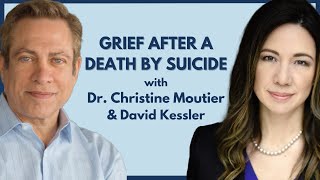
Dr. Christine Moutier of the American Foundation for Suicide Prevention discusses suicide prevention and her personal mental health journey. Men die by suicide about four times more often than women, and roughly 30 percent of suicide deaths involve alcohol or substances. She points to AFSP resources and the crisis lifeline at 800-273-8255.
Chapters
Hi, everyone. I'm David Kessler. Welcome, welcome. I'll give you a few moments to sign on. Hi, Dr. Mountier. Good to see you.
Hey, so great to see you. Thanks for having me on, David. And please call me Christine.
Thank you, Christine. I appreciate that. Call me David.
So I'll just give everyone a moment to find us. And I actually play a game where I try to see if I can find us, too. It's the best way to sort of know if you're new. When people come on, they often will just say hello, let us know where they're from. It's a nice way in our disconnection to feel a little connected here. For those of you who are new to the group, I know there's a lot of new people. We get many new people every day. I set up this group after COVID 19 and shelter in Place started happening because so many people were saying they were unable to go to their grief group. And then we had so many people who said they couldn't say goodbye to their loved one. And then so many people who had deaths related to Covid and non Covid related deaths that couldn't have a funeral. So we started this group and we've been going ever since. And it's nice that, first of all, I'm so sorry you're here in this group. I'd rather we were in some other group, but this is the reality we're dealing with. And I want us to at least stay connected because knowing that we have some sort of connection helps us with this disconnection we're all feeling in the world. So let me just. Speaking of connection, say hello to some of the people. Carla's on. Sherry's here. Sharon's from Midland, Texas. Lisa from Pennsylvania. Christine, you're too young to know this, but there was a show called Romper Room when I was growing up. Oh, no.
I was right there with you.
These people. Okay, Diane from Massachusetts. Kinoko from Hawaii. Betsy from Tallahassee. Jennifer from Alaska. Ivy from New York City. Lori, Colorado. Shirley. Pittsburgh. Bill from Georgia. Gareth from London. So glad you're here. Michael's here. Annette from Tennessee. Pamela, Wisconsin. Daniel, Illinois. Carla, Georgia. I'm so glad you're all getting on, finding your way on.
Let's see. Kenny from Puerto Rico. Well, thank you all for being here. I don't want to take up too much time because this is such an important topic we're discussing tonight. We're going to be talking about being a survivor of loss from a death by suicide. And you may be going, oh, I haven't had that kind of loss. But I always say, stay tuned because you'll see we're going to end up talking about guilt and blame and mental health and all kinds of things that I'm sure will come up. And towards the end, I'd love to have you post some questions that you would like our wonderful guest here to ask to answer. So without further ado, let's start, as I always do, by just taking a moment of silence in honor of all those who have died. You know, as I always say, I believe when someone dies, we don't stop loving them and they don't stop loving us. So just a moment to send them love, whether they live in your heart or whatever your beliefs may be.
Thank you for doing that with me. I appreciate that. So I am so excited that you are here.
You are an amazing psychiatrist. You're an amazing person with the American foundation for Suicide Prevention. I am scheduled to be one of their keynote speakers at a conference later this year, which may get postponed. We'll see. So I'm a big fan of yours, of the organization. I'm a donor. This work is so important and I'm really, really honored that you took time to be here with us. So how did you enter this world?
Well, first of all, thank you so much, David, for your warm words. And I am equally a fan of your work and the incredible ways that professionally and personally your impacting people who, you know, as a society we are, I hope, and like to think, I think we do have some objective measures kind of moving the needle and the shift in culture so that we can talk about struggles, grief, our losses and help really kind of process them together that we know that is so essentially important. So thank you for all the groundwork that you've laid in the past and the way that you continue to care so much about real people. It's really evident in your work.
So, yes, a bit about my background. So my story that lands with me now working at the national level in suicide prevention at the American foundation for Suicide Prevention, really, I think, started with my own very personal experience of my own lived experience of a mental health struggle that was very significant. That was at a time in my life, I was in the middle of medical school.
That.
When you look back on your life and there are these turning points that for me was a pivotal turning point because I actually had to stop and reflect and get help and treatment and start becoming much more, you know, integrated with reality of what was going on inside me. I was really trying to push through it and just kind of buckle down in the culture and many families and many workplaces. And for me, it was the environment of both my family I grew up in, as well as medical school that had taught me just put on the happy face, just buck up and use more discipline and get through it. And that was a moment where I. I really couldn't. And in a way, in a weird way, maybe paradoxically, thank God for that, because in being forced to have to address what were some really significant root issues for myself, I got therapy for the first time.
Eventually came back and finished medical school. And then over the course of my training in psychiatry and early years on the faculty, I was at University of California, San Diego School of Medicine at the time. I.
As many of you know, when you experience your own either loss or lived experience like that, you become so sensitized to the ways that people around you and the larger culture.
Don'T have a language to help you kind of, you know, be able to process what you're going through, to be able to connect and. And heal. And so that became something of sort of a hypersensitive radar that I just carried with me, you know, just sort of organically after that experience and then ultimately later became somewhat of a mission. And that part of it started when I was in my residency training and the medical student that I had worked closely with several months prior took his life and.
Really was a shocking kind of experience for me, as suicide deaths always are. And so even though that wasn't a family member, it was a pivotal moment again, another pivotal moment where after my own struggle and then after experiencing this feeling very blindsided, and yet realizing that so many medical students and physicians and just people in general are struggling. And when you're not in a culture where you can talk about those things, we can make, you know, we can try to change that. And so that's been sort of my path ever since. And I did have the privilege of starting a suicide prevention program for the physicians and trainees at UCSD about maybe 12, 13 years ago. And then while I was Dean for Student affairs and Medical Education within the School of Medicine there at UCSD and began volunteering for AFSP as well. And thank you, David, so much for the way you support AFSP as well. I was on that side of it, volunteering, helping the chapter hosting Survivor Day every November for a period of years in San Diego. Then seven years ago, was fortunate enough to move across country and join the staff of the American foundation for Suicide Prevention. Now I'm on the East Coast. AFSP is headquartered in New York City and I live in New Jersey. And.
Your group here may or may not know about afsp, that we were founded by individuals and families who had lost loved ones to suicide, who at that time in the 80s thought there really isn't enough research going towards understanding suicide risk, let alone preventing it. And so that was the start of the organization afsp. And since then it's grown into a nationwide organization that has chapters. Does awareness raising and prevention work in a variety of different ways through the out of the darkness walks, but also through a very strong policy effort at the federal and now all 50 states level. But that original our origin story has remained our fundamental point of devotion in terms of suicide loss survivors to learn more about how healing occurs and to really connect the community as well. Again, that's what I'm so impressed about what's happening here in your work, David. The research commitment has remained strong as well. We now have this sort of comprehensive strategy that's all of those things, everything really, except except for providing direct clinical service. And so as the chief medical officer, I get to be involved really with all of it. And it is an exciting time in the national space. And that means at the local community level and of course, communities are very diverse from one to the next. But at the national level as well, we see the culture changing and minds and hearts opening up to the realities that have been there forever. But we just had so much stigma that we weren't able to really let science shine a light the way that it's happening now. So it really is something of a personal as well as a professional passion of mine with regard to preventing suicide, also with regard to supporting those who have lost loved ones to suicide. And so.
I feel the weight of responsibility of it. But it's also so much part of my heart and my life that I'm gratified in the work.
Well, thank you so much. And you know, I talk about the idea of making meaning. Your founders literally made meaning that's now turned into this amazing organization. So it's an incredible legacy.
We talk about history and culture. And one of the things I often think about in my own career to frame this discussion is when I began, I was in hospice and palliative care. And just because of living in Los Angeles.
You encounter many people in the business. And one of the things in the show business world, one of the people early on, and he spoke about this, so I'm not divulging anything. He hasn't talked about publicly is Michael Landon at the time was dying of cancer and no one had talked about it and no one had talked about it on tv. And he was really committed. He wanted to go on the Tonight show and talk about cancer openly. And I remember having a discussion with my father who was in his 80s, who said, you know, cancer used to be a stigma. You know, there was stigma, there was shame about it. And now we look back at the idea of Michael Landon talking about cancer openly and we go, well, of course it's an illness. I look forward to the day when we talk about mental illness, our self harming thoughts or death by suicide, that we look back and someday we go, can you believe there used to be stigma there?
That's right, yes. But we're not there yet. No, not quite. And I hope that all of you though are in touch with the change that is happening. I mean, I live in a bit of a bubble, I'm sure, because of the work I do and our chapter network and every event we do. We are living in that vision that we're trying to create a world where there is no stigma and really where you get to be completely kind of honest and vulnerable and authentic and connect on those things, you know, whatever they are, including the mental health concerns and including losses.
But so it can happen because I also, by living through that experience over a 15, 20 year period at an academic medical center where it shifted. It didn't feel fast at the time for sure, but looking back on it, there was this incredibly dramatic shift from not being able to talk about these issues at all or you would, you knew you'd be judged and it would be assumed to be some sort of weakness or just a very confusing point. It was just such a lack of understanding about the human experience of mental health that no matter your occupation or your standing in the world, you can experience. And I believe it is very universal. So I mean, the neat thing I think about what is happening that I see in the cultural shift is that you may see it in the younger generation. There is this almost a demand for authenticity where they're celebrating the take off the makeup and you know, basically stop the bs. We just want it direct. And, and that really does sync up very nicely with. Well, mental health is part of our reality. We all have mental health whether we have a mental health condition or not. And so it's, it is actually changing quite radically. But I realized that, you know, we live in families and we live in communities where there's a whole. This change is sort of is at a trickle pace until the tipping point kind of just spills over. And like you're saying with cancer, we do. We're aiming for that. We believe that that can happen.
I actually did a talk on death by suicide for the police department, and it was interesting. When I was done, one of the officers, I was so proud of him, he said, you know what? I had, without really thinking it through, I had made a decision I wouldn't attend funerals that were a death by suicide. And now I see the reality of it and how I have not been giving respect and honor to it as an illness. So can we start there and talk about it as an illness versus a choice? What do we know about that?
Yes, I mean, the way that I've sort of sorted through, you know, thousands of scientific studies from all disciplines looking at what drives suicidal behavior and ultimately also what drives suicide death, and there is just no refuting that while it is complex, while there's never one singular reason or cause, even though from the outside it can certainly seem that way because there can absolutely be external precipitating events that are syncing up with those internal risk factors for suicide. But there's always just sort of a convergence of really multiple risk factors. And so what those words I'm using about convergence of risk factors and. And an outcome occurring, that same language could be used for a cardiac outcome or an autoimmune condition outcome. And so the language that I would use that I think is helpful is to understand suicide in its big frame is a complex, but it's a health outcome at the end of the day. And so I think some people do think of suicidal struggles as. As its own illness complex. And that's scientifically sound as well, because there is enough now understanding both just empirically through clinical studies as well as neuroscience and cognitive studies, to see that there are these clusters of events and health and risk factors that come together to not only allow for suicidal ideation to occur, which is a very common experience among people, but for that to then kind of cross the barrier that most people thankfully have from thinking to acting on it. And then, of course, the suicide attempt itself, and what happens after that in terms of, you know, whether it's fatal or not, depends much more largely on the method that they're using for that attempt than it does on the level of ambivalence, the level of intent, you know, the whatever. You know, if there had been a psychiatric condition, all of those things kind of fade into the background once you get to the point of the suicidal behavior. It's really about method. And that's why access to lethal means is such a huge part of not only scientific research, but also suicide prevention efforts. So when we teach on suicide and understanding suicide, and of course that's part of suicide prevention, but it's also part of suicide loss and healing efforts, as well as to give people bereaved by suicide loss the opportunity to have some learning occur based in the science around a framework that doesn't, certainly does not necessarily explain their loved ones suicide, death and the path that led to that. Because that is always so complex and, and most of it is hidden from view because it's been, it occurred internally within the person's mind that we as a society, we just don't, we haven't provided ways for people to share openly. And so that is not the fault of any one person or any one event. That's kind of the nature of the world we live in. And back to what I was saying earlier, that's why we're so determined to change that culture. So a complex health outcome is one way to look at it.
And you know, of course we always hear when you hear of some well known person who died by suicide, or you just even hear in your own world of someone who maybe wasn't close to you, people go, but they look fine. And you know, what's going on inside of us is very different than how we look from the outside.
That's right. And yet we are so, so.
We'Re funny in that way and odd in that we know that when we really stop and think about it, how all of the evidence and so many examples are there. And in your own life, you know that the external appearance does not tell the full story almost ever. Even if somebody's doing generally okay, you don't know what's going through their mind. And of course we've been so socialized to put on the face of being okay and functioning and just pushing through that.
So it is very understandable why it is kind of so shocking that you could have just seen them earlier that day. And how is that possible that they were not giving some signs of what was going on in their mind or their planning.
The other thing I wanted to mention and ask you about is so many times people think they wanted to die. And in my experience in talking to people who have attempted death by suicide, rarely have I seen them say they wanted to die. They were trying to manage an internal pain.
Yes, that's right. That's exactly right. We know from, again, from the Science and from attempt survivors, people who lived through to tell the story of what were those decision points in their mind. We've learned that under extreme crisis moments, any human being, and particularly in people who are more at risk for suicide, there is a stress response that takes your usual cognitive problem solving skills. And, and when the cortisol and the adrenaline is rushing through your body and brain, your amygdala is firing, which means it's oftentimes a much more pared down ability to think and think of flexible, creative problem solving options. And that's what the front big frontal lobe part of our brain does for us. But when the amygdala fires, it wins. And that's that fight or flight instinct. And so it is. You're so right. The person is feeling some level of either psychic or physical pain or both. And they've also come to a sense that things, they cannot see a way through it. And so it's a coping strategy and problem solving moment of suicidal crisis where the suicide as an idea is a way to cope and a way to solve the pain and desperation that they're in. So you're so right. It's not that people just have a preoccupation with dying or death on its.
Own and their wiring in that moment cannot see a way out. In fact, it seems like they often think the opposite. That they're wiring in that moment is saying this would be better for everyone.
That's so true that things that our brain can do, our brain, all of our brains do lie to us in that moment. The brain is lying to the person and has them utterly convinced that they have become burdensome to others, that others would be better off without them. And those usual ways of feeling connected and having the perspective that is much more probably aligned with reality, that people love them and that they, they're not seeing that this will become the complicated and traumatic loss that, that it does in every instance. And so that really busts through some of those really uninformed ways of thinking about suicide from the past. That, that thought that, well, the person must be selfish then, because you know they're not. That that's not a possibility in that cognitive constriction, that tunnel vision moment. It simply does not work that way for people. So these are in fact some of the kind of scientific findings that we tend to highlight as part of education about suicide so that we can reframe it in the truth that, that it is rather than those old ways. It's hard to break through the old mold. But I do Think it is happening.
Right. The other one you hear is I think what is it? It was a long term answer for a short term problem. And I'm like, you're assuming a healthy functioning mind in that moment that was not sorting through long or short term issues. They were trying to deal with pain.
That's right.
That sounds great in the light of day and with rational post analysis. But in that moment, time isn't even a thing. They're in that moment of pain and it feels forever and it feels like there won't be a way through it. So.
I know that the aftermath, the grief and the coming to, to some path of a healing process and healing journey is very complicated. And we've been in this space for a long time. To have walked parts of that path ourselves and with others to understand that it takes a lot of self compassion and compassion with others and certainly in a family unit if there has been a suicide death, a lot of patience and kindness to realize that we're not on the same timing and we don't cope the same way, we don't heal the same way. And to allow people in your own lives to have the space to do that while you're still taking care of yourself and finding ways to connect and continue to move forward. It is, as you well know, a complicated journey.
I also think about whether it's called proximal causation. I tend to just say to people sometimes our mind wants to say what preceded the death caused the death. It was the phone call we had, it was the argument. It was that I didn't see them last week. And it is a bigger problem and a larger illness and correct me if I'm wrong on any of this is than what happened in the last moment or what happened the night before.
That's right. That if you think about it this way, those events occur in our lives and in millions of people's lives every day and they generally don't lead to a suicide death because you see people working through and finding other ways to through. So there was something.
Inside that person that set up a reaction that was the foundation was already laid for.
And so I know that is one of the most challenging things to kind of find a way to frame any of those moments where you've, where your instinct was to pin the blame on a certain event or moment or something you did or didn't do. And suicide is simply more complex than that. And.
So I, and I think, you know, however you end up framing that issue, there is a way through so that in some way you're seeing, you're understanding that there is a larger frame on this and possibly then also moving towards the finding meaning or making meaning and in a way really honoring your loved one and remembering their life and not just the way they die, but who they were in the fullness of which look, as people, we're complicated as well. So it's not an all good or all bad or all anything who they were as a human being. And there are some just, you know, as you alluded to, David, about our founders of the organization, there are some incredible ways to make a difference in others lives or, you know, people find they gravitate towards the thing that is, that makes sense to them as a way to find meaning and purpose and to honor their loved one.
Right. And sometimes. And by the way, do you mind taking some questions?
No, not at all. I'd love that.
This is your time. If you want to put in some questions, we'll take a look at them. You know, and so grateful that your founders started that organization. But I also teach people that, you know, finding meaning doesn't have to be a foundation or an organization. It can be that you're changed, you know, that you want to live a life that honors them. You fought for their life and, and now you can do something with yours that honors them. I always remind people, I tell the story in the book about how.
My son needed insurance and he had issues and didn't want to go on Obamacare and there were all this political mess with it. And we had talks about getting him insurance. It'd just be a good thing to have. His brother had insurance. And so he finally said okay. And I just was so stressed about this insurance meeting we're going to have with an agent. And the agent came in with like a streak of pink hair and was just light and funny and took what could have been just a really tough meeting with an insurance agent and made it fun and light and simple.
Wow.
Turned out to be the last time I saw my son.
So I often talk about with people you don't know when you're just being your best self, whose life you're changing. You know, I'm always in gratitude to her for that because that moment was really wonderful that I got to spend with him.
Isn't that something? And that person could have had no sense of that. And I.
There's a saying that's similar that we use among our colleagues at afsp, which is you don't know what that other person is going through. And that speaks to all of the above.
So, yeah, thank you for sharing that, David. That's really.
Well, it's interesting. I was talking with someone the other night about how things have changed professionally, that there was a time where if you're a professional, that would not have been appropriate. And now, like, no, it's okay. I can share it.
Oh, yeah.
The other thing, when I work with physicians and work with counselors, we also have to work on the language, you know, and I think that's in the community. We'll go, oh, you know, her uncle was a suicide. And I'll go, was her aunt a pancreatic cancer? I mean, how you die is not your identity.
Right, Exactly.
Or that we know that. All right, that's right. Let's see some questions here. Can you talk about substance abuse and alcohol and how it relates and affects death by suicide?
Absolutely, yes. The research is really clear about the prominent role that substances have in risk for suicide. And.
So I'll give you some data points and then we can digest it a little bit. So of all Americans who die by suicide, about 30% have alcohol or substances in their system at the time of death. Now, that could mean that it was part of the method of death itself. It could mean that it was something that they had been using leading up to their death. It could mean that they had struggled with an addiction, a substance use disorder, but not necessarily. And so that's where the complexity comes in. Now, the other part of substances is, especially with the opioid crisis and the emergence of a substance like fentanyl in particular, which is a highly lethal version of an opioid. The other reason that substances are so relevant now with regard to our national rate of suicide being on the rise for the last 20 years is that whenever you introduce something that does have that lethal potential into communities and it becomes widely available, that becomes a major impediment to suicide prevention that elevates risk. And so it. But it is also true that people can use or drink or have an addiction and, and never attempt in their life. So it's, it's. It's the story of suicide risk factors in general that it doesn't take just one. It takes multiple converging. But once you've identified among the list of risk factors and substance use and substance misuse certainly is a risk factor. Once you have it identified, if you have reason to believe that there is a possible suicide risk in that person, then those become your targets of intervention for preventing suicide. So the issue, of course, is just that substance use is so incredibly complicated and in many cases very intractable until the person is ready and kind of submits themselves to serious treatment. And that's not a quick or easy path between the start of identifying a substance use problem and their readiness to accept treatment, treatment and help.
And I just often talk about, it's such a different world now. I mean, you know, when I was a kid it was like, what are you going to do? Is it going to be marijuana drinking, maybe cocaine? And now the drugs are so, so lethal. Yes, couple of people are asking these questions in different ways. What do we know about genetic components? Are men more likely to die by suicide? How about 18 to 21 year olds? And let's start with those two.
Okay, great.
Let's start with the gender question. So yes, men die by suicide at about four times the rate as women. However, women and girls have higher rates of suicide attempts and attempting behaviors. And so that does mean that there is a big difference between the genders in terms of which method of suicide they gravitate towards. With of course, men gravitating towards more highly lethal means. And there is a whole effort that we could talk more about that does relate to men and suicide risk and particularly households than men and women, frankly, who own guns and where lethal means is just, you know, can be readily accessible until they get very serious about safe storage.
So that's the gender, a bit of the gender story. 18 to 21 year olds are in a, if you look at the age range.
Suicidal, well, suicide death is the very highest. Now rates are in middle aged Americans among race ethnicity, it's white Americans that have the very highest rate. And so it is the case that white men account for about 70% of all suicide deaths in our country.
What you see though in terms of the age progression with suicide risk is.
Suicidal thoughts and behaviors. Well, unfortunately over the last decade or so the shift has been downward to earlier ages. It's still very, very low numbers on a national level. But it's definitely going in the wrong direction. And there's a lot of concern about why that is and what can be done for the young children. I'm talking about the, you know, really the 7 to 12 year old range for forever. Before that it had been the case that around the onset of puberty. So that could be 11, 12, 13, 14. That is the period where you start seeing suicide attempts occur again, still at a much, much lower level and death at a much lower level, thankfully, but not zero. But then as adolescence progresses from about 15 to 19, that's where the rate of suicide death zooms up, both in, especially in males, but females as well, a less steep curve up. And then it's in the 20s that the suicide death rate begins to approach that of the adult population. So it is still the case that among teens and even in the early 20s, the rate of suicide is again, not zero, but it is lower than.
30S, 40s, kind of middle age, adulthood, genetics. Right, thanks. Need a reminder on that one? Yeah. There's a lot of work going on right now to look at genetic underpinnings. And what it looks like so far is that like any complex health condition or health outcome, the genes play a role, but that they are far from the whole story. And that among health conditions across medical, neurological, you know, the whole gamut, there are very few autosomal dominant conditions. Meaning if you get that gene, it's sort of your destiny to have that health condition. And so it is far, far from that. But that said, it does look like genes do play a role, both in terms of the inheritance of mental health conditions that themselves might put somebody at risk for suicide. Things like bipolar disorder, depression, schizophrenia and other mental health conditions, eating disorders as well. But it also looks like there. There could be some genetic underpinnings that sort of travel outside of the transmission of those mental health conditions. Meaning that there could be ways that those things that we talked about earlier, about the cognitive reactions to stress being a little stronger, more exaggerated, going to that tunnel vision and that that rigid place of honing in on suicide and not being able to really access creative, flexible problem solving, that is probably a genetic basis for that more extreme sort of reaction when under stress to the cognitive, rigid tunnel vision. But the big picture with regard to genes and family history and inheritance is that because we get the question sometimes, well, I lost one family member to suicide, so what about my kids? Or what about so and so? And what we know is that it is anything but somebody's fate, and that there are many, many opportunities to make sure that that person is being afforded maybe a bit extra attention to coping and support and connecting and keeping.
The basics, exercise, sleep, social connection, all of those things strong. It would be kind of like this if you have a family member or like, I actually had a friend who had three or four male family members who had all died of heart attacks under the age of 50. And so he knew, he was a medical student friend of mine that he had, Even in his 20s, he was already practicing prevention for himself, because we knew that there are some genetic underpinnings to Heart disease mortality, but also that there are prevention strategies to mitigate that risk and to absolutely address any known risk factors. And so he was working hard to keep his cholesterol down, keep his weight down, good diet, you know, all of that stuff, no smoking. So, you know, the same kind of prevention strategy could be applied, but it doesn't mean you live in fear and feel that it is anything. That's inevitable.
Right. Two more questions, then I'll let you go. Thank you for being so generous with your time. Of course, I see a lot of people either beating themselves up, they didn't see the signs. Now they look back and they see the signs. There's a whole blame going on with the signs. And you know, one of the things I see people do, I'm always reminding them, is the signs usually don't mean anything until someone dies. Just in the sense that, you know, if you say to me, how are you doing today, Dave? And I go, my technology's been driving me crazy. It's been a rough day. If I die tomorrow, you're going to go, why did I not, like, understand what David was going through? That's right, this 2020 hindsight, and go, how did I not hear him?
Yeah, that is exactly it. You know, there is this tension because that is 100% true. And the truth of the matter is that even if somebody is having suicidal thoughts, has disclosed that to their family member, friend or therapist, or primary care doctor, even if they have other signs of distress.
Statistically, it's actually a very low rate, thankfully, that those clusters of warning signs turn into the person ending up taking their life. And so we can't, the other part of it is we just can't beat ourselves up for the fact of life that even among the most expert people, I'm talking trained surgeons, trained aerospace engineers, like they, when, when an outcome goes bad, badly, of course you always do the post hoc analysis, the, the, the dissection that in, in academic medicine is called M and M rounds, where you go back and you do the, the case analysis to learn from it. But the truth is, no matter how, how scientific and how pinpointed we get, there will never be a perfect way to, to detect that there's not a way to predict human behavior, including suicidal behavior. And so if there's anything that's going to speak to your sense of guilt about that, understand that the science is working so hard to get better at predictive analytics and predicting short term suicidal behavior, and we're not there yet, we're far from it. And so let alone.
These are studies where you have access to hundreds of data points in the person's life. We're just observing people in our day to day lives. And yes, we do include as suicide prevention education to learn the warning signs and let your radar become a bit more sensitive. But it never promises that that's going to be a guarantee or a way that we can always know what's coming next. We can't. And so I hope that you will be able to kind of.
Move past that sense of self blame a bit because it we that that's holding yourself to a completely unrealistic.
And I always tell people if you really had the power between life and death, they'd still be here. I mean clearly it was out of your control where they would still be here.
Yes.
A couple other things to just mention along that discussion is I always tell people in grief there's what we call yearning. And yearning is different from self harming thoughts. Yearning is I miss them so much, I wish I was dead. And when we talk to them, and by the way, correct me if I'm wrong, it is an okay thing to say, are you having thoughts of harming yourself?
Oh yes.
Okay thing to ask. We get afraid we're putting it in someone's head, but that's not the reality that we should be worried about.
No. And you, you can ask. You know, when I ask the question, it's usually that they've just been telling me about their stress load or how they're, it's usually, you know, they're talking about their life and situations in their life, but they're talking about it in a way that, that you can tell there is a level of feeling overwhelmed or trapped or hopeless. And so I will say to them, when you talk about, and I'll use their words or reference that situation they're just talking about, it sounds to me like it can be really challenging. Are there times you think about ending your life either in those moments or other moments recently? And so you can ask them, do you think, are you thinking about suicide? Do you think about ending your life? Are you thinking about harming yourself? All of those things. If they're not, they'll just simply tell you no. If they were, it gives them an opportunity to share that. And that can be a really pivotal moment to start a process of opening up and kind of moving out of a state of, you know, kind of having to keep it under wraps. So many people who are feeling suicidal are, are not telling anyone about it.
Isolated. Right. And for Any of you out there who are just hearing that and going, why didn't I ask him? Just so you know, or ask her. Even if you ask someone, it still doesn't mean you have the power to stop. We want to ask, we want to do everything in our power to prevent and you know, you're not responsible at the end of the day for someone else's illness or someone else's life. By the way, what is the youngest you have seen someone with self harming thoughts or heard of that?
Well, we have heard of cases in recent years of even like 5 and 6 years old, 6 year olds having thoughts of ending their life. And at that age, as you know, kids don't even necessarily have a, a complete concept of death yet. So.
It is very concerning. We think about.
How children are picking up on so much through media and social media.
But there clearly are some children who at a very young age are suffering.
So even though it may strike you as just really kind of out of the blue or something, you can't wrap your head around if a child ever talks about that, I would absolutely take it very seriously and help them to be safe. I mean, it's kind of like the way that we as parents will do everything we can to keep our kids safe with regard to any, you know, any sort of public health threat, whether it's seatbelts, whether it's stranger danger. You know, I would do that and I would absolutely get a consultation from a mental health professional to try to understand what is happening in that child's mind and in their health that's leading up.
And I always bring that up because I want people in grief to realize that we see it that young. It's not something that occurred because of the phone call or the lunch or whatever. Our mind tells us later that this is an illness we see in people very young. So it just sort of helps us, I think, understand it's not about that moment before.
Right? I mean, I totally agree with you. It's not about that moment, even though it did become about that moment. But the truth is people who are at risk for suicide, it is most often a much longer term sort of condition that has an ebb and flow to it. But if they had been saved in that moment, those suicidal risk factors, they would have still carried that forward with them. Even that I agree with you. This is a much longer term type of health issue to address.
So tell us how we can get help, look for help, find out about the American prevention for the American foundation for Suicide Prevention. I Have it all in front of me, but I'll let you do it.
Sure. Yes. Thank you, David. Yes. I mean, more than anything, I would want you, if you're in a place where you're looking to maybe connect with other suicide loss survivors, like in this way, but maybe in other ways. If you go to afsp.org you'll see a button that says I've lost someone to suicide. And there are a host of resources and, and I'll just tell you about a couple of them because, well, one in particular is so, so very special. It's a program called Healing Conversations where we've trained people who are bereaved by suicide loss to become a peer support to someone who is newly bereaved. And so people who have more recently lost someone, usually it can be long term, too long ago, but usually it's more fresh. They will find us and make a request to have a visit with that trained counselor or not counselor, trained peer. They're not clinicians. And in some ways that's the beauty of it. It's just really connecting experientially human to human and learning also about the community of lost survivors and the support that is available. You'll see a listing of about 800 suicide loss support groups on all across the US we work really hard to keep that legitimate and up to date and a host of other things. During COVID outreach, requests to our Healing Conversations program actually went up by about 30%. And it's not necessarily because suicides went up, but it meant that people were looking for resources. And that program is so easy to be online because you can connect by phone or video chat. So I would just really, more than anything, wish you well. Hope that you are finding ways to feel centered and grounded and connected to others as you kind of continue to move through this. We know it's not a linear experience. It's fraught with unexpected moments, and that's okay.
And if anyone's having a crisis, they can always call 800-273-8255 and just know there's people there always that can help you or your loved ones. Thank you so much for being here. I really appreciate it. Anything I can ever do for the organization, I'll be your biggest volunteer. I so appreciate your work that you're doing and the organization's doing. So thank you for being here tonight. I really appreciate it.
Thank you so much, David. That means a lot. And thank you to your community and all who are gathering. It's really incredible.
Well, and one of the things that these evenings afford us and you've been so gracious with your time, is there's many voices in grief. And this is an opportunity for us to hear from different people. Just amazing people are coming forth. We're going to have Brad Lamb come on, and he's going to be talking about addictions next week. Patti Davis is going to be here, Ronald Reagan and Nancy Reagan's daughter.
Tomorrow night is going to be Vanessa Williams, who's going to share about her life and her story. Kathy Ireland, Sean Korn, who's an amazing yoga leader in the yoga field. So Paul will be here with his grief yoga. So lots of people who are here because we want you to know as you go through a pandemic and your own journey, you and your loved ones are not forgotten. And we are here for you, at least virtually. And there's a place you can talk to one another. And as I said, I'm working on some things so we can have more interaction. So thank you all for being here. Thank you, Christine. I so appreciate it. And I will see everyone tomorrow. Take care.
Take care.










