Dr. Christine Yu Moutier and David Kessler
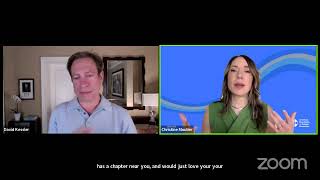
A recorded conversation (filmed on World Suicide Prevention Day) between grief expert David Kessler and Dr. Christine Yu Moutier, Chief Medical Officer of the American Foundation for Suicide Prevention (AFSP). They introduce AFSP's mission and chapter network, clarify distinctions between suicide prevention and postvention, and emphasize that suicide is a complex, multifactorial health outcome often involving mental illness and/or addiction. The speakers discuss stigma and language (recommendations to avoid terms like "committed suicide," "successful/failed attempt," and "gesture"), the role of brain physiology and cognitive constriction in suicidal crises, the interplay of social determinants and addiction, and the value of organizational postvention (communication, grief support, contagion mitigation). They encourage seeking support for traumatic grief and point listeners to AFSP resources and local chapters.
Chapters
Good afternoon, everyone. Let me get my recorder on. It's my big job here.
Foreign.
Welcome, Dr. Mou, nice to see you as always. Same. And how about folks let us know where they're coming in from. It's always fascinating to see in the chat where people are from. Wow. England, San Diego, Texas.
Illinois, Florida, Canada.
Connecticut, Ireland, Columbus, Washington D.C. oxford.
Dallas, New York. Wow. It's, it is amazing. And it all South Africa. It also shows how universal grief and loss are and what we're dealing with here today. Thank you all for being here. Well, we're going to dive in.
I want to welcome you all here. I'm David Kessler and I'm so honored to have Dr. Christine Mouy with us here. So nice to see you. Thank you for joining us on we're actually filming this on World Suicide Prevention Day. So what an important day to be doing this on. I wonder for the few folks that might not be familiar with you, if you might take a moment to introduce yourself and tell us about your amazing role there.
Sure, I'd be happy to. Thank you so much, David. Thank you for inviting me back. I love being with you and with your community of grief supporters and people who are interested in grief. This community is so, so important. So I am Christine Yu Moutier. I am a psychiatrist and I serve as the chief medical officer at the American foundation for Suicide Prevention. And what that means is that and just maybe by way of background, I became interested in suicide prevention and maybe interestingly as much from my own personal and sort of other professional experiences with losing colleagues, having struggled myself, having family members who have had lived experience of suicide. And then as a psychiatrist, of course, I've worked with many, many patients who have been either suicidal, who have attempted and survived or who have lost their own loved ones to suic now at the American foundation for Suicide Prevention, where I've been in my role as chief medical officer for 11 years. That experience is one of really looking to translate the research around suicide and suicide healing, bereavement and healing into actionable strategies. And we do that at AFSP by funding suicide research and specifically the research around suicide bereavement, loss and healing is a kind of a continuous priority for us. In our research grant portfolio. We also have a nationwide network of chapters across all 50 states and Puerto Rico comprised of tens of thousands of volunteers, families who have been personally touched by suicide and that is from all sides of it, loss and lived experience. And we put on programs that are education about suicide prevention and also for loss and healing support. And then lastly, we have a very strong way of organizing around policy at the federal and state level. So really, anyone who has an interest in mental health and suicide prevention has a place within the AFSP family. And anyway, I look forward to just talking more about the different ways that that that may play out for different folks.
Yeah. Thank you so much for being here. And for those of you who may not know me, I'm David Kessler and my field is grief and loss. And just like Dr. Mo, I this is an area that I've been doing professionally for decades and also with my mother's challenges around mental illness. My son, one of my son's challenges. And this is such an important topic. Some of you may know me from Tender Hearts, our online grief group, or the Grief Certificate program, or this may be your first time joining us because you wanted to be a part of this important discussion. I want to start with maybe framing it. You and the organization do such amazing work around suicide prevention and just like you said, you recognize the organization recognized there's a continuum. I've been honored to speak to your long term suicide survivors conferences and groups and the idea that we will do everything we can for suicide prevention. And we also recognize that there is a group of people who have had to deal with the worst scenario playing out and a loved one who's died by suicide, which is our focus today. So it's interesting. We often hear about prevention. One of the things I'm talking more and more about in your organization has long talked about is in addition to the importance of prevention, it's also important we recognize postvention and postvention, you know, in my mind is how we support and how we deal with the aftermath when someone has died. Do you have any distinctions you want to share about those two things, prevention and postvention?
Sure. Gosh.
Many things come to mind. But I think the most top of mind point that I would start by making is that I want this group to understand that at afsp, suicide is viewed as a complex health outcome. And in that sense, prevention means doing our utmost as a society. Investments and research and programs to reduce suffering and mortality. But it does not mean that every life can be saved. When we talk about other complex health outcomes that are leading causes of death around the world and in our country, we know that an investment from a public health standpoint can reduce suffering, morbidity and mortality. But we don't necessarily expect that cardiac mortality or cancer deaths will come down to zero because in the case of complex health issues, we can do our utmost and we can make a difference, but not in every instance. So I want to make that distinction because the word prevention, even in our organization, the American foundation for Suicide Prevention's name can be a little bit misleading if one takes it to mean that it means that every instance of a loss of an individual could have been prevented because that is unfortunately not the case.
You know, one of the things that's so important about that is I have noticed in my work with people in grief over the years who have had a loved one die from suicide.
Prevention discussions can feel painful and can feel like, wait a minute, what does that mean for my loved one? What does that say about me? Did I not do enough? And I often say one of my hopes for the future is we're very clear, like I had a small skin cancer. We know, easily treatable, there's stage one cancer, good treatments for it, good success rate. We also know there's stage four advanced cancer that's aggressive, that despite everyone's best efforts, that person's likely to die.
My hope in the future is that there'd almost be a way we would know, oh, your loved one had stage four addiction. That was aggressive. Your loved one had stage four mental illness. Despite everything you did, we're clearly not there. And I think it's so easy to have a lot of self blame around this when we hear around prevention. But it is hard because it's so important we treat everyone.
Like they can be saved while knowing it's not exactly true.
Yeah, that's right. I think that's where the.
Kind of the, on an individual basis the challenge comes. And also the truth is because suicide is quite complex. And I would say maybe.
I struggle with this because I actually see it very much in the same model as other complex health issues. Meaning there's genetics, there's biology, there's early environment, there's current environment, there's self care strategies. If you think about all of those principles that they apply to almost every other health outcome as well, like cardiac health, it's not just, you know, taking meds. I think where it's different maybe a little bit is that death from suicide certainly in most instances does have a significant contribution of mental illness or addiction, which I consider a mental health condition as well. But it's not just, it's not those in a vacuum. And whereas I think maybe with cardiac death we would be very focused on the heart disease and maybe less, but maybe erroneously less focused on stress management and the events going on in someone's life and the trauma and the, you know, there is actually research about cardiac mortality and when you don't treat the depression or when you don't address hostility and stress, that that has every much as much effect on the outcomes and eventual cardiac death as the ejection fraction, which is the percentage that the heart is pumping out of blood. And so brain and body are connected in all instances. And in the case of suicide, there are many, many factors that come to bear. And so I love your, I love the idea of the stage one through four. And I think our science isn't quite there to be able to say this is the level of, you know, the likelihood. We ask, you know, oncologists that all the time, what are the odds? We don't even think that way. And maybe that's also needs to be addressed because we're not in the clinical realm. We should be much more.
Knowledgeable about when suicide risk is there is present where we act like it catches us off guard even as clinicians, let alone family members because we haven't yet fully incorporated all of the learnings into our sort of deep, deep cells in our brain and body that we're living that way. Understanding that this risk is present can be present in, in any population.
And part of what I learned from those I've served in grief over the years and one of the main groups besides working with people in grief directly is I do so much teaching around therapists and I'm really working hard as everyone is to try to change some of the language and just want to go over some of those basics for folks who haven't heard some of them, I often share, as many people do, it doesn't feel appropriate, helpful to use the word committed suicide. Committed feels like a crime, it feels like a sin. And death by suicide is not a crime or a sin. I also talk about how we refer to folks, you know, we sometimes say, oh, you know, her uncle was a suicide. And I said, would you ever say her aunt was a pancreatic cancer? So I think the language is really changing. And we're trying to educate mental health professionals, medical professionals about using language that recognizes this is a death by suicide, but it is not someone's identity.
Right. And I would add that especially for therapists and clinicians, sometimes there have been sort of inadvertent, perhaps like judgment laden terms like a successful or failed attempt. Those are not recommended terms. They don't really make sense and they're frankly very jarring to someone with lived experience or loss because it implies kind of A moral thread to all of this. And that's not treating it like the true health outcome that it is. Plus it's completely unnecessary because if you use the term suicide attempt, it does imply that they lived through it. Whereas you, if you say died by suicide or ended their life, you know, just suicide or suicide death, those all imply what they mean. So it's, they're, they're not only judgment laden, but they're kind of superfluous and not, not necessary. Actually I, I think for clinicians also avoiding things like, and I know this is a very common term, gesture.
A cry for help, manipulative. I don't like that framework at all. I don't think it fits the scientific, you know, findings around suicidal behavior. Because we are all trying to arrange and manipulate our environments to be as comfortable and healthy and, and as we can. And for some people those efforts look different, but that does not. That's not a dichotomous difference. That's all of us in different ways depending on where we are in our journey.
And let me go a little further in that point, we also know that death by suicide is not someone wanting to die. It's often a complex set of circumstances and ways they're trying to manage horrific pain. But the goal is not usually to die, it's to manage the pain. Would you agree with that?
Yeah, I think that is true in the vast majority of cases. I mean, some of the complexity around suicide is that even though science is really clear about the risk factors overall, what is more complex is the fact that for each individual there's a certain set of risk factors that are playing out on their path of pain, suffering, then hopelessness, oftentimes some cognitive constriction that is found to be more extreme or prevalent. We all can get there in a stress induced state. Our brain, the prefrontal cortex becomes shut down a little bit in a state of acute stress. That's a normal stress response. The amygdala is firing so that those higher cortical, how we cope, thinking creatively, using a sense of humor, having optimism, sort of playing in all of those get naturally physiologically shut down a bit temporarily for any one of us. But for people who are prone to suicidal behavior in their life, those reactions are more quick to happen and more sort of extreme. In the brain, those are not choices people are making. Those are oftentimes genetically inherited traits in the brain about the physiology of the brain.
So correct. I think this is less about people who are kind of thinking and obsessed with, you know, death and dying, and more of a pathway of pain and suffering. For any number of reasons, both psychological as well as physical pain, we know that mental health, but also physical health conditions play a role, usually not without the mental health condition part, whether it's secondary to, let's say, the chronic pain or whether they have a truly, you know, independent history of depression, ptsd, anxiety, psychosis, bipolar, et cetera. But oftentimes it's an interplay. So that heterogeneity, heterogeneity amongst people who are manifesting suicidal behavior, who die by suicide is very, very diverse. And yet there is a science that tells us about all of it collectively, and it does make it more challenging when we're thinking about how to apply it to a loved one's life or certainly if you've lost somebody, how to. How to think about that pathway. And I know that is certainly on. On our minds when someone in our life does take their life, we just crave an understanding as to what happened. How did it happen?
Brave is a, is a good word. And you, you come at this as, you know, coming out of general psychiatry, and this became your focus. I, you know, understood general medicine and worked in hospitals for years. And, you know, grief is my focus. And I think because we've seen so many other medical conditions, when we think about this, I know when we look at all the other medical conditions, I always say, when you're in pain, pain is all there is. And that's just as true as those medical conditions as the ones that can be a factor in a death by suicide. And I think no different than I see in all those other areas. We often, look, families, look, what was that one thing that did it? There was one thing that did it that we missed. And, you know, I've been working on a workbook and dealing with so much around guilt and this. And at the last conference, I was doing some of those exercises with people because I think guilt is such a constant companion for people who have had a loved one die. And it is a burden. And I believe our mind would always rather feel guilty than helpless. So in that search for that one miss thing that we should have seen, I think we know, and I'd love for you to talk a little more about. It's rarely, if ever, one miss thing.
One thing in general that did it right.
It's very, very tempting. I think just like you're saying that we would gravitate towards guilt versus a helpless feeling that is probably just a natural human instinct that we maybe, maybe somewhat culturally bound Maybe not.
And I think that is also the case that we crave a clear and simple explanation. That's true. No matter how educated we are, we just, our brain immediately goes to why. And one thing, and unfortunately or fortunately, that is not the way suicide works. Of all the huge growing literature and scientific discovery around what drives suicide risk up it the the most clear thing. There are several clear things, but one is that it is multifactorial in every instance. And this is borne out in a number of scientific methods, of types of studies, including the psychological autopsy method which looks after someone has died by suicide at the likely factors that were contributing to their death by suicide. And, and in most case studies of psy autopsy after suicide there are an average of, you know, six to ten factors at play. Life events can absolutely be relevant, can be contributors, or could even be what you might consider a precipitating factor, meaning the sort of last straw that breaks the camel's back on a whole multi layered set of risk factors that were already present, probably interacting, also interacting with protective factors. But unfortunately in those moments, risk factors winning out if you will, because protective factors are very real and very important like coping, resilience, connectedness, seeking mental health care, talking openly and you know, receiving support and being involved, I think actually in our movement contributes to a protective factor. But what can happen because our brains and our bodies are so. Health is so dynamic is that at that moment in time, those, those other, and they're not just feelings or events, they are changes in our brain and body kind of temporarily dismantle those, those natural sense of resilience, optimism, coping, connection. So you can be the most connected person in the world and actually feel very isolated and disconnected and that I think sometimes family members who have lost a loved one will, will feel that how is this possible? Did they not, did they not know how much they were loved?
And I think.
That'S a complicated question because in the experience of a suicidal pathway they may absolutely know at times. And on the one hand, and in other moments of despair and cognitive distortion and constriction that happens in that state of tunnel vision that leads to suicide, it is kind of shut out and blocked out. And so, you know, I, I think just for suicide loss survivors, it can actually be an important step along the path of healing to just open your mind up beyond that one reason kind of craving and to learn about what science has found and, and allow that to start to permeate your reflections and your thinking in your own situation. That can be helpful for people to really have some movement along that, that in that way.
And you know, listen, I think about my own mind. There's times I'm clear, my mind is misfiring, I'm not seeing things in the healthiest way. And so when I think about someone being in a very ill state in their mind, I think of there's a lot of misfiring going on. And I think many times families that I work with, I think of it as proximal causation. Our mind wants to think the argument before the death caused it. Like proximal causation to me is when our mind goes, whatever happened before the death must have caused the death. The missed phone call, the not checking in that moment, whatever it may be. And one of the things that I often talk about with families is have you ever ran interference before and perhaps stopped it? Many times they will go, yes, they have ran interference before. And I remind them if they had done it this time too, the conditions, the complex issues that led up to it, if they had been able to stop at this time, would have still been there for another day also.
That's right. Yep. That is, that is completely, I think, the. The correct and aligned with scientific discovery. That's the way to think about it. And so it's a tough one because we probably over ascribe causality to these specific moments in time in terms of the true reality. And yet from a prevention standpoint, many loss survivors do get involved in prevention because there could be things that make a difference and it could be far, far upstream, actually from ever having suicidal thoughts even. It could be getting that trauma addressed and processed. It could be being in a school environment where the culture and the environment. There's this science around this program called the Good Behavior Game that taught teachers in kindergarten and first grade teachers about a classroom management system. And they followed these kids out 15 years and they had about 50% the rate of suicidal behavior and suicidal ideation as the non good behavior game kids in the same urban Baltimore area. So there are many, many upstream factors that can make a difference. And we definitely do overly focus understandably on those kind of immediately preceding moments to the suicidal behavior or the death.
I often think about the mind is predictive and protective and it wants to figure out the circumstances that led to this to make sure nothing happens again. And unfortunately, if we could have done it before, we would have. I always say if love could have saved them, they wouldn't have died. And if I think of a theme I often hear, it is what you mentioned. So many people Will tell me you can't imagine all the love at their funeral. I don't think they were able to let it in. And that's not always the case, but it is something I often hear. And while we're talking about factors, I wonder if we could talk about addiction and mental illness.
You know, I often work with people whose loved ones had a dual diagnosis. Can you talk about addiction and mental illness as factors?
Oh, sure. I mean, you know, you were saying earlier that you were kind of alluding to your own cognitive distortions that might come into play about, you know, any number of things. I, I. The way that I would look at it is, as human beings, our brains are very. They're a physical organ in the brain, in the body, they're very active and dynamic. We now know there's neuroplasticity, meaning they're not set in stone. The way the synapses are wired, we can actually modify those. But all of us, whether we have a mental health condition or addiction or not, our brains can lie to us. We get in places of cognitive distortion depending on our, you know, a whole host of things. How, you know, how we were raised, how neurotic we are, our sense of interpersonal sensitivity and slights, and we can just distort all kinds of things. Well, in the case of a mental illness. And again, I would include addiction as a, as a brain condition and under that larger umbrella. But for simplicity, we'll say that terminology. Mental illness and addiction.
Those are conditions that lead to the brain lying to the individual far more deeply and frequently or persistently than without those conditions, where that still happens. But hopefully we develop ways to kind of catch it and reality check. And people with depression and bipolar disorder and even schizophrenia, there's a cognitive behavioral therapy designed for people with schizophrenia. Even, you know, I think addiction is further complex because, I mean, they all have their complexities, for sure. But because addiction, you know, inherently involves.
A physiological dependence on a substance that is altering your, your mind, your thinking, your judgment. That obviously leads people. It wreaks havoc with people's lives, which has a whole secondary outcome of, you know, loss of relationships, income, you know, some housing, all of the things that additionally present all sorts of other risk factors for suicide. Not to mention that it can go the other way around, that all of those social determinants of health can lead to higher rates of addiction. I think that, you know, the one other thing I would say is that.
The suffering is, is as real and valid amongst all of these types of brain conditions. We might call Them including addiction. And that society has had some stigma and judgment in probably different ways around every single diagnosis. Right. Whether it's an eating disorder.
A gambling addiction, a substance use addiction. And those stigmas are ill informed, but they, but they've made their way into our sort of DNA the way that we see things. And so I think just reminding ourselves that people are generally doing the best they can with the resources, the support and the treatment opportunities that they have. And.
They all can present risk for suicide. I think we have understudied the role of addiction in suicide. We know that it plays a very significant role. We also know that of all of the overdose deaths deaths, some percentage of them were actually suicide deaths that were unable to be determined by the medical examiner or coroner. And so there's great overlap in a number of different ways around these issues.
And I think we often think of addiction like there's one addiction out there also. I mean, there's so many different degrees of addiction. One person addiction is so different than another person's addiction. And I think probably a lot of people here dealt with a loved one's illness in so many ways. One of the things I often get asked is, you know, how do we tell children when someone's died by suicide? And I always say, I would say something like, for a young child.
We can die by illnesses in our body, but we also can die by illnesses in our mind. And your loved one had an illness in our, in their mind. And I even am trying to, as I think more about the language, to use the term, even less and less. They took their life and say even more. The disease took their life, the illness took their life. That's because I don't think it was our healthy whole person that we knew and loved who did it. I think it was the illness that did it.
Yeah, I think that is a, a really clearer way to express the, the end outcome of a multifactorial path that did very likely involve probably multiple health conditions. In most instances it wasn't just one, it wasn't just depression, it was oftentimes two or three or more both. Mental health addiction included sometimes or substance use playing a role in there, even if they didn't have addiction and physical health, physical health interplays as well.
So I think that language is terrific. And what I've noticed is that for families who were very informed and knew about their loved ones health issue, that when they can make that connection to the suicide, death and to the depression or the ptsd, the addiction to all of that, that can be a really, actually excellent way to express it in conversation, in an obituary because it, it actually elevates suicides public health awareness for a true message linked to health. And I. So I think families actually, whether they mean to or not in this sense, are really playing an important, important role in the public health approach to suicide prevention just by messaging it that way. And sometimes it's not that clear to families and that's, you know, that, that's not, you know, they, they, they can be honest about the way they actually experience their loved one's death.
Yeah. And most families, I would say.
End up learning a lot that they wish they would have known before. But I don't think that means had they known they would have been able to prevent it. But once you're in it. And one of the things I often get is, but my loved one wasn't mentally ill. And I always say you can't see it, but pretend you can see the wall right here and you can see the wall right here. I often think of like this wall as complete mental health. And this wall is complete mental illness. None of us are completely mentally healthy. None of us are completely mentally ill. We're all on a continuum and we can't see anyone's baseline and we can't tell which factors are going to affect them because something that could be that, that last straw on the camel's back might affect one person horribly and another not so much. Yep, that's the science.
We can't see yet that that's, I love the way that you put that. And it's entirely true that mental health, like physical health, lives on a continuum. If you think about every actually physical health condition, people with diabetes, it's just that their metabolism and their blood sugar ends up being disordered and reaches a cutoff point where we call it that. But the truth is there are people who are living, you know, along the continuum. It's the same thing with depression, bipolar disorder, ptsd. And so that is so true that it's, it's not, it's, I think, less important whether or not they had a diagnosable mental health condition. But like you're saying, where was their mental health around that time? And it's because we've had such stigma and low level education as a society about mental health, we have not allowed ourselves to talk openly about what we're experiencing. And that's one of the first steps in a suicide prevention approach is to open up that awareness and that psychological safety so that if someone is experiencing new feelings Thoughts, experiences, desperation, fear that they don't have to keep that inside and most of us still do. And that's a cultural phenomenon. It's also I think, a very primitive thing. If you think about even like animals and insects, what they do when they're under threat and feel vulnerable, they tend to ball up and withdraw and put up the shell. And we do that as human beings too. So in suicide prevention we need to really take that into consideration that that's what people are doing all around us as they are suffering. And that's the reason that any indication of change is worth caringly and lovingly exploring and supporting them non judgmentally. And it doesn't mean that that on its own is an effective way to prevent suicide. I think there's a lot of kind of feelings about, you know, warning signs and opening up caring conversations at different stages of healing after suicide loss. But it is certainly something that wherever you are around the topic of suicide, it can be a person's first step in opening up, which can unlock a lot of the experience from continuing to spiral down in a, in a vacuum of silence. And it can be a way that, you know, when you learn that someone actually continues to feel, you know, positive feelings about you and respect for you after you've just told them that you're suffering, that you're overwhelmed, you feel trapped, like you might feel like a burden to others and they, their esteem for you does not go down. In fact they, they pay attention to you more, they support you more, they ask how they can help you're still, you know, the, the mature whatever you are, professional or you know, human being, the relationship is intact. That's very freeing. And that's, that's the world that we are trying to create where one without stigma actually means we get to behave differently and in a way that is proactive about our health and, and about our well being and, and that of our loved ones. And this is hard, this is not an easy thing to, to figure out how to live that out. And I can say that because I'm an expert at this, you know, in this national space. And I'm actively trying to figure it out in my own life and in my loved one's life. And I struggle with that and I have to check in and you know, lean on my own mental health professional or get guidance from others. So don't expect that this is just going to be, you know, simple. And so there's something wrong with you. When it's not, it's really not because we're Trying to live in a different way than has really ever happened probably in the history of, you know, the human condition. Condition.
And for people who are attending this and their loved ones have died so many times, even the support can be so activating. Like, did you see it coming? Did you? I mean, just the things people don't even mean to say, like, oh, I have to review if I have to miss something while you think you're giving me some sort of support which doesn't feel supportive at all. And we actually know around bereaved individuals, when your loved one dies from a sudden event such as a heart attack, you might get close to 80, 90% of support from family and friends. When your loved one dies by suicide, by addiction, by mental illness, challenges, it's in the 20% area. There's less casseroles, there's less calls, there's less visits. And I often think about, you know, guilt is what we believe we did. Shame is who we believe we are. And so many times, you know, people live in this world where one family member is like, we're all going to say they fell or this happened. And there's such a cost to not telling the truth. Truth. And sometimes for people's own psyche and survival, the truth isn't safe enough. And I don't think we can force anyone to say any more than they can in their moment. But there is this stigma. And I feel so bad because, you know, to tell someone who's so burdened in the pain of grief, by the way, try to educate others is a tall order.
Yeah. And. And that that is not for everyone or might come in time that that becomes clear that that's your passion. I want to come back to your original how we started this conversation where you were mentioning the terms prevention and postvention, because you're now talking about some really important postvention principles about telling the truth and how to communicate about the death. So we use the term postvention, as you said, in the aftermath of a loss to suicide. And one way of thinking about postvention is think about the school, the workplace, the faith community. Any organization where a loss has occurred, there's actually a responsibility on the leadership to handle that moment in a way with caring, compassion and professionalism and knowledge. And that's the piece that, my gosh, no one, fortunately, is experiencing this all the time. And so leaders don't know what to do. And oftentimes they do nothing or they acknowledge the death, but they don't call it a suicide. So a postvention Response on one level is an organization's a leadership's response that involves a communication strategy where there are two main goals to help the community to grieve in the most healthy and, you know, open way possible. And the second is to mitigate any risk of suicide contagion. And that the suicide contagion prevention piece actually makes postvention a form of prevention because you might prevent another individual in the community from their risk escalating at a moment where that exposure to another suicide, that's a risk factor for suicide. So that postvention response is all outlined in our postvention toolkits. I would encourage anyone to go on AFSP's website, afsp.org and you'll find the postvention toolkits. You'll find any number of ways to learn more or to get involved. I will say if you're looking for a way to become more involved in either prevention or suicide loss and healing support. AFSP has a chapter near you and would just love your, your expressed interest. I will tell you our chapter network is diverse and amazing, but they are all actively looking for people like you to get involved. So I would just, you know, put that out there. And again, postvention is so important. And we do say in the field, postvention equals prevention because it does have that reducing risk effect.
And it's so important that we do have these conversations. And you know, we're really honored. I know you're one of the teachers in the certificate program. We have so many school counselors who are dealing with those issues of wait a minute, we're putting plaques up for the kids with cancer. But you know, we don't want to add. I mean, there's so much complexity in this that the more of these conversations we have, and I always say too, our healing always has to start with ourselves. And I do a lot of teaching around.
Healing is not disloyal to those who have died. In fact, I believe it honors them. And I believe that ultimately what healing means is that we're no longer making decisions or we're living from that event that happened or their illness that has broken our heart. And to make sure we get our own help. Whether it's reading your groups, My Tender Hearts group, to really make sure you get support. And one of the things that I just also want to add to this discussion because I do so much work and it's important to note.
This often is more than grief. It is traumatic grief. And so I always want people to really make sure their understanding to get the support they need because you deserve it. You've been through so much. And like I said, this is not just probably what happened, but it's the aftermath. It's the years before. So many people I see are so weary because grief is so exhausting. And they actually lived with anticipatory grief before it. So I'm so grateful that we can come together and have these kind of conversations. And my organization, grief.com is so proud to help. I'm not just a speaker for you. I'm also a donor. I'm also involved. I encourage everyone who's been affected by this, and even if you haven't been affected by this, probably someday you will. And please get involved. So I want to thank you so much for being here. I've been incorporating the questions all along into our discussion. So thank you for joining me today in this important talk.
Oh, David, thank you so, so much. You know, I. We at AFSP are huge fans of yours, your incredible body of work and that is so dynamic and ongoing with your community and all of your groups and efforts. And we will do anything also to support your efforts. So thank you so, so much for the partnership. It's amazing.
Absolutely. And all of you out there who have, have so been affected. Our heart goes out to you and you have our love and support. So thank you so much for joining us today. I really appreciate it. Much love to everyone. Thank you. Dr. Mouye. Thank you all for being here. And I hope to see you.










