Grief Expert, David Kessler interviews Dr Melody Moore on infertility and the loss of her father.
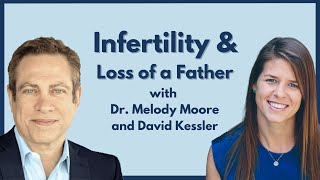
Dr. Melody Moore talks about losing her father to vascular dementia and her years trying to have a biological child through IVF. She describes watching him die, the grief of infertility after egg freezing and multiple failed cycles, and rituals that helped her through both losses.
Questions this video answers
Don
Seven years ago; August 10th
Don was 72; Melody was 36
14 eggs frozen
Four IUI attempts; none resulted in pregnancy
Chapters
Hi, everyone. David Kessler here. Glad you're joining us. Tonight we have the wonderful Dr. Melody Moore. Hey, Melody. Good to see you.
Thank you.
So say hello when you find your way on. I'm going to find my way. See if I can find us. All right, let's see. Oh, good, good. I'm seeing us appear. So say hello. Let us know where you're from. I know it takes a few minutes to find us. Tuesday's my double day when I have a bunch of different things. So we come on an hour later here. All right, I see Robin from New York, Betty from Ohio. I can now guess where people are from. Shirley from pa, Jennifer from Alaska. Wow. Hey, Jennifer. Good to see you. Melody, where are you coming from?
I'm in Manhattan beach in California, just west of lax. Not that anyone goes there anymore to fly, but I'm close to you. David, right?
That's right. Ivy from New York City. Robin's here. Eve is here. Pat's here. John from Massachusetts. All right, I'm going to confess something. It's like the most bizarre thing to confess, but I will. It's not even a confession, but it's such a strange thing.
I was saying at one point during the pandemic.
I just need to get out of the house. I wanted to go for a drive. And everyone's like, where are you going? And I go, well, you know, when I was young, we would just go for a drive. They didn't have to be a destination. So we went on a drive, and I decided I wanted to go see lax. And I was talking to my friend Beth, who actually did one the other night, and she was like, why, if you're going out, would you go to lax? Why wouldn't you go to the mountains? And I'm like, because the mountains look alike. Like, nothing's changed. I have spent my life at, like, LAX three times a week. It was like driving into the 1960s. It was just bizarre, wild. It was empty. So I know it's strange that someone decided to drive to LAX for no reason, but I did. All right. Deborah's here from la, and her daughter is also a melody. Great. Arcadia says she saw me today with Hoda and Jenna. Absolutely. Rebecca from South Carolina, Colette from pa, Daniel from Illinois. Saw the Today show, too. Wonderful. Jennifer from New Jersey. Hey, everyone. Glad you're all here. Alan, welcome. Nice to see you. I'll give people a few more minutes to come on if you are new, and I might even have some people to let in. I should probably check that While we're all saying hello, that, like, I'm like, oh, there could be new people. I need to get in. And there probably is. Let's just see. I'm always, like, afraid I'll look and there'll be like, 300 people who want to come in. But that happens sometimes, so you just go with the flow. All right, so welcome, welcome, everyone. Good to see everyone. Let me know if you're new. Some people say where they're from, but you don't need to. Others will, you know, sit in the back. I always say some people sit in the front seat, some other people are in the back and, you know, whatever you want. Like, I'm one of those people at lectures that unfortunately I go sit in the front, but a lot of people are back row people. There's no right or wrong way to do this. Susan's from LA and she just loves Dr. Melody Moore. Well, what love, Joe? Betsy's here from Tallahassee. Naomi from the Bay Area. Valerie from Oakland. Yvonne says hello to both of us from Melbourne, Australia.
Where am I supposed to be today? It's so bizarre because right now I'm supposed to be. I'll tell you, in the alternate universe today. I am in Brisbane today. Brisbane, then I'm going to Adelaide in my alternate universe. Didn't happen.
Eva, how long does it take to get a response from you by email? Eva, this is the best place to get a response from me. We get over.
I mean, one day we counted and There was like 1100 emails in a day. So I would say if you got a question, this might be the best place, just because life is pretty full these days and, you know, you'll understand this. As a.
Psychologist, Melody, I never thought. One of the first things we do in the morning, I do in the morning, and some of the people who help me on my team is we search the emails for suicide because those are the people we go to first. So not that that's a way to get my attention. And we're not going to. We're just going to send you to the right place because I'm hardly the place to get. All right, well, I'm so glad you're here and I want to thank you for being here. And we always start these by giving just a moment of silence in honor of those who have died. So if you can join me in a moment of silence and just send them love.
Thank you so much. Such strange times we're in. I watched a little bit of the George Floyd funeral today, and I know you were in session all day. Because we were trying to connect our tech check. So, Melody, how has grief touched your life? Who?
I actually thank you for the question. Thank you for having me. Thank you for our friendship, David. One of the biggest places it's touched me, as you mentioned, is the death of my dad, which I'm grateful to be able to talk about. I'm facing my altar and there's a picture of him smiling right in front of me that I often reference when I'm in session. This is where I sit when I see clients. Strength, you know, wisdom.
Right.
So can I. Can I tell that story?
Please do. We'd love to hear about him.
So. So the most intimate I've been with grief was at the loss of my dad. It was a slow loss, as I'm sure many of you are familiar, because he had vascular dementia. And so when anyone has any type of dementia, we're. We're sitting with losing them piece by piece. That was my feeling with my dad. It was like he was in his late 60s and then he was a young adult and then a teenager and then a toddler and eventually an infant before his death. I was so grateful to have been able to be with him in that process of his decline and to see him slowly unravel and to appreciate the way in which he kept his sense of humor. As he lost faculties and as he lost capacities, he held on to this sweetness and the sense of humor. And so part of my grieving is like what I'm doing now is in the retelling and in the resharing of the things about him that I came to cherish even more deeply, especially more deeply after losing him. And there was a moment where he was in a space of. He was mostly at home. We had respite care, but he was mostly at home. And he died at home, which I'm so grateful for that. And there was a moment where he was struggling to walk and struggling to talk, but he got himself up, he got himself into a walker. He went all the way across the house to get my mom's hand and bring her through. This was like a 10 minute scenario, about 20ft, and then to come and get my hand, another 20 minute scenario and bring me to her. And we're both kind of looking at each other like, what is this? This is like the place where we're feeding him and changing his diaper, that we're there and he puts my hand on her hand and his hand on my hand and then her hand on my hand. And his hand on top. And he looked at us in the eyes, both of us, back and forth, back, back and forth a few times. But he just was so salient. He was so with it. And he said, you need to know how much I love you. You need to know how much I love you. And I was like, take this in, you know, self. Take this in sweet baby girl that was so wounded, which I'll talk about that. Take this in teenager that was hurt and felt rejected. Take this in adult self that gets this profound gift, hearing these words from my dad, like, let me take this into my whole, whole body and just cherish it. So some backstory that I think is useful is that when I came out as a lesbian at age 18, my dad, as an evangelical Christian, really deeply struggled, deeply struggled with accepting who I am and accepting that I was his daughter. And so he grieved my not having lived that. You were talking earlier about the parallel universe of where you would be if not for quarantine. His parallel universe of who I would be if not for being gay. And his imagination of what it meant for me to be gay was very different than my reality of my own getting to be gay and the privilege that has come with my identity around my orientation. But his inability to find acceptance was so deeply painful, harmful and painful to me at 18, 19, 20. And he developed, over time, a sort of tolerance for my identity, for my sexual orientation, but he never fully embraced my full being. He couldn't. He just couldn't get there. For reasons that I respect and understand and grieve, when it came time for me to marry my wife, I asked him to walk me down the aisle. And he said, I wish you had never asked me that, because I don't want to break your heart, and I have to.
And so he just never quite got to the place of acceptance. And as he was in his dementia declining, this was seven years ago, I would say things to him, like, dad, wherever you're going, when you see the light, like, when the truth arrives and you feel badly, know that I. I forgive you. And he would. I'd sort of say it tongue in cheek, but also, I meant it. Know that you know when. When. When more is revealed to you, wherever you're going, know that I'm with you and I support you and, like.
Kind of a joke with him. So, David, when he finally passed away, it was a day where I had been through this whole process with my therapist of I don't want to be there when my dad dies. I don't want to be present. I was so afraid and so stuck in my fear because we had many moments of him having heart attacks and, you know, the pacemaker and all that, like, getting shocked back to life. And I was so scared once he died and it was just me, but that wasn't the moment of his death. And I had said to my therapist, I do not want to be there. And it made me scared to be around him by myself.
What was. What was the image? What was the fear of, like, oh, my gosh, if I was there, what would happen?
I think I must have thought I would have been so overwhelmed and not been able to handle it. I must have been so concerned that I would do something wrong or not be able, like, blame myself that he died, even though that was completely inevitable. I think I was frightened of a dead body, having never seen. I had never seen one. I think I was overwhelmed at the intimacy, right. That hadn't yet experienced to know the beauty in it. And so I just was, like, wanting to push away the feeling of having to be that vulnerable and that connected to him in that moment and the responsibility of it and the gift of it. But I didn't know. You don't know what you don't know. Thankfully, I had a therapist who helped me yearn to be there, get through my fear, and really want to be present at night. And so I tell that to my dad, like, I hope I'm here. I hope when you go, you choose. You choose to let me be with you. And in those spaces of, like, I don't know if he knows what I'm saying.
So at the point where he died, it was only my mom and I at home with him. He was 72, I was 36, and I kept telling him he brought me into the world when he was 36, and I'm going to take him out now that I'm 36. And so it's this, like, sort of beautiful synchronicity in time. And you know, this. David, my friend, my dear friend, Sean Corin. Her father had died three years before mine, and I think you had her on recently as a guest. And so she was one of the people and the main person really holding me up through this process, holding my hand, taking care of me, where we were in different states, but on the phone, walking me through it, you know, especially those last days of, like, he's not going. He's not going. And we joked and used humor and called it death Watch. And, like, it's time. And he was begging to go and she said, you know, it's my dad's dead day anniversary tomorrow, and so I'm going to go to a ritual with him and pray. And I'll tell him, if you've got any favors, go to go to Arlington, Texas, and pull up Don Moore. He's ready to come. And I was like, thanks for that. So the next night, my dad's laying there. I was writing a book chapter. My mom runs in and says, will you help me change him? Of course. So I go in and she goes to get the diaper. I look at him and I'm like, he's not. He's not breathing. Run over mom. You know, come. Come be part of that. I don't think he's breathing. And she runs over. She runs right to his chest and lays her head down on his chest and starts telling him how much she loves him. And I run right to his head. You know so much more about grieving and the ritual of the soul leaving the body than I do. But I found out later, much later, that Tibetans believe the soul enters and leaves through the top of the head. And I was like, interesting, because I just happened to not happen to. But that's where I went. And I was screaming, go, go, go, go, go, go. And my mom was saying, I love you, I love you. And he, you know, he did the thing where he did a sort of a fake last breath. And we looked at each other like, is this it? And then he did the big gulp. And we looked at each other again. And then he offered the most beautiful exhale, just the sweetest, most full release. That was so peaceful and one. It was, like, wonderful. And I was immediately in awe of that, of that weaving and of him and of me and of my mom, who had been in love with and married to this man for 43 years and loved Jesus just like he did, and jumped up and started screaming, hallelujah. Hallelujah. Hallelujah. Hallelujah. She was so excited and celebrating his capacity to be reunited in their minds with what they believe. You know, he's in heaven and he's with Jesus and so excited. And I felt like.
The miracle of me being able to witness that love because it was so unselfish, it was so for him, her happiness for him. And I was, like.
In awe. And then I walked into the kitchen to call, to call the folks to come pick up his body. I turned around and looked at his body and realized he's not there. Like, he's fully, fully gone. And as someone who works with people with body image and has had my own body image struggles. I was like, I'm clear, we're not the body. We're not the body because he's not that body. And I wasn't afraid. I just was. It was like clarity like I've never known. And so we called the folks to come get him. My mom was calling him her people and brother. And so I called Sean and I said, your dad killed my dad. So that worked out well. And now we have this really weird dad anniversary. For real. For real. This is in the evening in Texas, about 8 o' clock at night. So it's past dusk. It's getting pretty late. It's August, but it's still like it's pretty dark. My mom comes in and I look out of the windows in that same room where I'd been sitting right before she came to get me. And he passed and there was a rainbow, full on, full on rainbow that came through that window and landed on the chair where I had been sitting writing pretty much all day. And a lot of during that, during that time. And I was like, am I imagining this? I said, mom, do you see that rainbow? And she said, yes, there's a rainbow at night. And it actually took me a couple of days to realize that that was my dad's sending me, I believe like a. A precious. I'm sorry. Please forgive me. Thank you. I love you. Like his ho' oponopono prayer through the rainbow in that moment. And it was so beautiful and healing. I felt unnecessary, like a bonus blanket of love wrapped around my heart. It was the sweetest. And then the grief after, you know, some time got really hard.
Have I been touched by grief? It was ongoing. It still is. It was.
More intense than I ever could have anticipated. It was full bodied experience. I witnessed feelings in my body I'd never had. I would go on a walk with a friend and wonder why she was walking so, so slow. And then realize she's keeping pace with me to be kind. And I am shuffling. Can't even. My boots are so heavy I can't even pick them up and take it. I'm just barely putting one foot in front of the other. So fully.
Encased, encumbered by the brokenheartedness of that loss which felt so deep and tender and beautiful but also.
Full.
Like a full loss. I really felt like a shift in the layer of protection that I think I had always imagined that my dad provided was gone. And I felt a very different, just a different reality, a different sort of A shift in the DNA structure, as my friend Nicky Meyer says, around my relationship to my own mortality and to my own humanity.
And tell us his first name.
Don.
Don. How long ago did don die?
Seven years. August 10th.
And what would you say it was like then versus now in terms of how you hold it?
I'm glad it's now. I'm glad it's now. I feel like today I hold such gratitude that like, the grief comes sort of.
It'S like wrapped in gratitude that I do experience that the loss means it's a reflection of how much love there is between us. And I feel like now I contacted him even in that moment of silence that you offered to begin. And I was talking to him earlier today about let anything that I possibly have to share be useful, be with me in this. So I feel like now there is a sense of our relationship being present for me and him being that sort of proverbial not guide.
I don't feel like he gives advice, but I do feel his sort of like, hand on my shoulder or like a. Like an encouraging nod from him in my life. Whereas then seven years ago I was like, wrecked.
I really felt I was having a hard time making decisions. Should I go back to seeing clients? Should I not? Should I rent? Should I buy? Should I move to California now? Should I stay in Dallas and make sure my mom's okay? Should I go to yoga or just lay here on the floor and cry some more? Like, I was very indecisive, especially in the very beginning.
I was very.
Self focused. My pain was the deepest pain and the only pain. And it became very. My mom hosted a celebration of life the night before his funeral. And I couldn't leave her bathroom. I was getting ready in there and I never left the bathroom. And she kept coming. There were like 200 people at her house and she kept coming in and saying, please come, people want to see you. And I was like, don't care. Not my problem. Lost my dad. And I was defiant that way. And that's not really my personality. Normally, if anything, I would lean toward the police, but I could. I was too, like, this is my grief and I'm cherishing it in a way that I was like holding it. So the, the, like, the difficulty, the, the lack of capacity to move, the energy of it in terms of the heaviness has lifted significantly.
Someone asked about what was your mom's grief like after being married for 43 years?
Heartbreaking. Heartbreaking. She's still. It's different as she's moved but she's heartbroken. They just had 43 years and they loved each other, which isn't always the case. Right. And so one thing that she did was she made us all and herself two blankets out of his T shirts, many of which were funny slogans like dad joke, kind of kind of guy. So. So she wrapped herself in those blankets and would just literally wear them like a uniform. She really struggled to eat. I was very worried about her nutritionally. She went into some deep denial and went away. I think that being in their home where they shared so many memories together became immensely difficult for her. And so she left and she went on like a month long. She had a lot of privilege to be able to do this. But she went on like a month long cruise and then away and kept, she kept leaving. It was like, it was clear that she was so unsettled in her body that she, she couldn't find the ground. And I don't think wanted to find the ground where they lived together and was at once comforted by being in their home and around the memories of his energy and repelled by it because it was just too, too difficult to take on. And so her grief hit her later than mine. When we got into the A car to be taken to the funeral, I was bawling, crying, and my mom looked at me and said, we're not crying. We're happy dads with God. And I was like.
You'Re happy dads with God. I'm devastated and I cannot repress this. I know myself too well. I need to fully be with my feelings and right. Like we all grieve differently. She wasn't wrong. She just needed to like shore up and keep it together that day. And I needed to like lose it and bawl my eyes out.
So we're excited happiness, you know, of. He's at peace, he's with Jesus, he's with God. You know, it's. I can see how it would be wonderful. And then you're like, oh, no, now here's my life. And I didn't get to go, this is tough.
This is tough. Yeah.
You know, I also. There's a thing about the pure grief that's within us versus all the external triggers. And sometimes like your mom, people do need to get away to signing to kind of get a hold of the pure grief versus everywhere they look, they're sort of bombarded with a memory or trigger or something, you know, so it's interesting that sort of how she did it.
That's a really useful distinction that to Be away from whatever external triggers there are you can tap into.
Yeah. And sometimes I'll tell people whether it's like, you know, just go on a walk in a place you've never been with the person, so you'll find the grief doesn't go away. You just don't have the external triggers. You get to sort of work on just what you're feeling inside in those moments.
Yes, that's right. Because it was easy for me to leave. I mean, I was an adult. I had my own place. It was easy for me to leave and go back there. But when I would go visit my mom, I would have to, like, this is going to be hard to, like, be back in that house. Yeah.
You know, your story is.
Touching, and it's also so deeply.
Tragic. Your story isn't. But in contrast to right now, how people haven't been able to be there for those last moments.
That's right.
You know, so many people in this group.
You know, just weren't that, you know, those moments were taken from them. I mean, we, you know, we had the luxury. One of the things I remember speaking of fathers is my father. I brought him home hospice, literally dying in my living room. And what was so strange is we had his hospital bed and like, a horseshoe of chairs around it that had been like that for days, where he was the center. And after he died.
More people came over. His body was there waiting to be taken away. And I looked at one point and realized circle didn't even include him anymore because sort of that big life force of his wasn't pulling any longer. He was sort of everywhere all of a sudden.
Yeah.
So what you said about that. Yeah. A lot of people are talking about Father's Day is coming up. So how have you handled Father's Days over the years?
I. At the beginning, the first few years were difficult for me to see. The ads coming in, you know, in the email. This is our Father's Day sale. And the cards that. Wherever you shop Father's Day cards and things like that, like, tears would come or constriction in my body would come just in seeing, like, I won't have that with my dad.
Now. It's more like I'll. I'll have a conversation with him. You know, I'll do something that he would have done without him, but be in. In my mind in conversation with him. Sometimes I talk to him out loud. I'll sing to him because he's saying a lot and he whistled a lot. So I'll do that. But I'll. I'll just have a conversation with him.
And make it. I feel for me, with grief and everything, ritualizing anything is useful, putting attention toward it. And so for me it's that it's like naming it and being able to spend some time with him. Usually. My dad loved the blues, and so I have a whole bunch of his old records and I'll play those records and make coffee and, you know, do what my do I would have done with my dad if he were here on Father's Day, but just by myself.
Or with my partner, you know, I have those moments. I don't know if this happens with you and clients that someone will be arguing with their mother or their father. They'll be having issues. And I'm like, oh my gosh, I so wish I had a mom or a dad to have that will with. And I can't believe you're sort of arguing and taking it for granted what you've got and all that. And then I have to realize they actually don't have. My dad or my mom have their own experience that may be very different from my relationship.
People do get to all do it differently totally.
And we don't know what we don't know. It would be easy for me to look back and I think, beat myself up or let an inner critic shame me about the time I didn't spend with my dad or the things I didn't say to him in my 20s or 30s or teens.
And I feel his complete forgiveness. Whether or not I'm making that up, I don't care. I feel it. Right. That's like my sense of it. And it doesn't feel like it would serve me to live in the.
The regret so much as it does to live in the. This is what I could offer and did offer and the same in a bi directional way of like. Like I shared. My dad never fully accepted me, but the things I can remember about him are like his tenderness, his generosity, his kindness. It's not what. It's not what sits with me in my body. When I think if he were sitting here, I don't think of like his. His judgment.
Let me ask you this. I often talk about, you know, judgments come from fear. They come from beliefs.
Is it true for you? Are you able to see it at all that you know, the place where he didn't accept you, not to minimize the horrible impact that may have had on you, but that there was probably also a part of him that loved you and just wanted you in heaven with him? And was afraid you weren't going to get there.
Right? That's exactly right. It's completely coming from fear, which I think is why I could have compassion for it and even respect. Like, I get it. I get it that you are. And I also could respect somebody being so committed to their belief system. Like, you're in integrity with your belief. You know, when he said no to walk me down the aisle at my wedding, for example, like, I respect your integrity, even if it means it's harmful to me personally, spiritually, I respect it. And I absolutely agree with you, David, that, that. That all judgment comes from fear of not knowing, wanting the best coming from. This is an expression of my love. But impact is different and both can be true.
I feel really old saying this because it's something I would picture someone really old saying.
It's going to also change in a whole nother way when you have your own children. Yeah, it's so eye opening, even. Like, I have to remind myself, like, there's times my older son, you know, I think he was turning 22 or 23, and I was like, so what are you doing for your birthday? And he said, I don't know. And you know, I'm like. And I had to remind myself when I was 23, I wasn't planning my birthday with my dad. And yet suddenly you're the parent and you're like, wait, we're gonna do something for your birthday. Right. I've got to let him have this whole life of his own peers. And so all of a sudden you see it all in a very different way.
Yeah, that's right.
So speaking.
Wow, someone just wrote Melody. How have you changed as a result of your loss? That's a good question. I had to ask that one.
I think I've become more kind.
I think that there was. David, you can tell me about this because I've only had this. This is the only parent I've lost. I'm grateful for that so far. I almost feel like I took on some kind of healthy or unhealthy, some sort of. Like this is my responsibility. But I don't mean that in a way that it felt like it encumbered me or burdened me. I did feel like I am carrying somehow I'm carrying Don Lewis Moore's DNA. And so I have. I felt some responsibility to carry through his most beautiful qualities.
And I think I have done that. I really feel like I've changed and become more like him, more intentionally like him in the ways that he was wonderful, like I became more generous. I became more, I think, kind of just what I mean is tender. I have an edge. I can be real bitchy, real cutting or abrasive. And I think trying to be intentionally a little bit more like my dad has made me softer and more tender.
And I think I've become a lot more playful, like goofy and silly. He was very much that way, like singing and whistling and joking around, using funny voices. And so in that way, I actually feel like I've changed to become more like him. And one of the things I think David was going to just bridge into this is that I became much more clear that I wanted to have children. And I was single when he died and I was 36. And so, like, the shock wore off. I was about 37 by the time that happened, by the time I could pick myself up and start to make decisions again. And one of the decisions I made very quickly was I want to freeze my eggs because I want to make sure that I protect myself in the event that I age out of fertility thinking. Having just turned 37, that was going to protect me.
And how did that.
That did not work.
Thanks, David. I told David and we talked about this conversation. I was like, so, you know, my other deep grief in life is. Is infertility, which I'm sure there are other better, fancier words from that. I'm just speaking from my own experience.
I thought that at 37, when I froze my eggs and they had 14 that were frozen, that that would be enough. And then I felt secure. And one of the things that did for me was help me not rush into relationship. Like, not try to find somebody to be with just to co parent. And I was also open to parenting as a single woman, but I thought, I think I have a little more time before I do that. I'll wait till I'm 40. Well, I turned 40 and I was still single. So we went back toward fertility treatment. And there's so much in that, like, there's so much loss in losing loved ones and losing jobs and in divorce, right. And then Covid and all that's lost. There's like a different sort of loss. They're not comparative and they are different to fertility, but the. The kind of courage I had to shore up, to go toward that was immense. And the process I went through to prepare myself to become a mother when I was 39 was immense. I made so many decisions and shaped my life, changed. It didn't like, change careers entirely, but I changed the way it was working entirely around the Setup to have a child and to have a home with a nursery. Changed my hand, got off the road, stayed home to work so that I could, like, set it all up this way. And that's part of, you know, visioning. And.
I went in and did a couple rounds of. It's called iui. It's intrauterine insemination. Four of those, and none of them work. So it's like every time it doesn't work, there's this hope and this one and this wish. And then the letdown and the grief of that opportunity didn't work right. And so the cycle of that infertility treatment is really difficult because it's like. And here we go again. And trying to garner up enough hopefulness and excitement and wish and envision it. And there are all kinds of people saying all kinds of the wrong things all the time. Of course, because everything was wrong to me at that point. I. It was very few people that could have said something right. You'll be a great mom.
Ouch.
I don't know if I can ever carry. Right. All kinds of things. And my mom's own investment in my children, me having children. So those four rounds of IUI didn't work. I moved on to ivf, which is a more extensive and more expensive treatment. So all of this infertility comes with lots of shots, lots of hormones. If you've never done it or watched anybody do it, it's wild. You're just shoving shots into your body multiple times a day that make you blow up and impact mood. So there's like the actual grief that's happening each time I'm not pregnant. And also there's the experience of like, I am not myself because these hormones are like wild interfacing with this. This real process, this true grief. And then there's this like. So for IVF, I actually, from those 14 eggs, it's longer story than matters. Only had one viable embryo that made it through the genetic testing and the blastocyst and all of that. So when I went for the. The embryo transfer, the. My doctor that I've been working with and chosen in Colorado failed. She said she had some other priority that day. So I had a doctor that I didn't know come in. My current wife. My wife was with me and my mom was there and they. They came in and brought the embryo that. It's like. It's hard to put this into words. It was my only opportunity to carry a biological child. And they. They dethawed it and said it didn't Completely dethaw and showed us a picture of the blastocyst, which is actually like the size of a poppy seed. But, you know, they blew it up. And you can see it's like a fourth. So a big part of me was like, this will never work. And this other part of me was like, this is my only shot. And they were like, do you want to go through with it? I was like, after all this, yes. You know, maybe. Maybe my uterus will be enough of an environment of, like, love and care and blanketing it that it will want to grow here. And so I had a big investment in this working, obviously, like, so much money and time and effort and more emotional labor than anything, but it didn't work. And. And that grief has been. I was telling Dave, it's so deep. The recognition that I'll never have a biological child has been so deeply painful, way more painful than I would have anticipated. I am, of course, open to adoption. I'm grateful. I'm, of course, open to my wife, Courtney, carrying a child and.
The necessity for me of grieving, not being able to have my own biological child. It's linked to the grief to my dad, because I. I felt like I would like to carry him through that lineage, through that ancestry, through. And my mom, who I. I really felt like was very invested in her. Her. Her grandchilds. I've seen her with step grandchildren, and I've seen her with biological grandchildren, and it's different, just not right, but it's true. So I was so invested in that working out for me. And when it didn't, and it won't like, sitting with the finality of that, it was just like a. It was. It was a grief in my uterus. Like, it's a grief in my pointing to my lady parts. You can't see that. It's like. It was like a grief more in my second chakra, if you know that space above the pelvis, then, like, the grief of my dad was in my heart. It was more of, like, this whole. And then I had to grieve. Being a fertile woman and moving into a place of, like, it feels like crone instead of.
A woman with the capacity to bear children. And barren comes to, like, all these words and ideas that feel like, oh, I now have to identify with that. So again, it felt like an identity shift to have to. To be here, to have to sit now with, like, that will never happen for me. And the. The trauma that it. That arrived in my body, which I define trauma as anything that overwhelms our capacity to cope and leaves us feeling helpless or hopeless.
Was that other pregnant women would. I would feel like they were an affront to me. Like, you get to have that. I would become very judgmental about the way that people were parenting. Like, you get to do that, and yet, you know, you get to have children, and yet this is how you're treating them. You have no patience.
Like, and how many people, like, don't want a kid? And they're like, oh, no, I'm pregnant.
And it's like, exactly. And, you know, I know, I know. And I feel generally like everybody has the right to their own decisions. Everybody has the right to their own process. And yet with this, because I'm in my reptilian brain and in my trauma, everything was triggering me.
I led a leadership training for an organization that I founded. And right after that happened, two months after that happened, and I showed up and I just cried. I'm in charge of the thing. I roll in bawling, and I'm like, hey, my intro question was, what medicine are you bringing this week? There are about 50 people, and they're all going around and saying these gorgeous things, and I just start crying. I'm like, the medicine I'm bringing is my grief. I'm not okay. Somebody brought their infant, which was beautiful. And I was like, super out. How am I going to be with this? And I was so happy for her at the same time, but also like, huh. So it's. Infertility is so grieving. It is so different than grieving the loss of a parent because it's not talked about and it's not. It's not as easily shared.
And yet, franchise grief, it's minimized, it's charged. It's not enough to count.
Right. You didn't lose a baby.
Right. It wasn't like, there's a baby. What's your issue?
Yeah, yet.
And I have a good, good friend who, you know, went through horrible infertility. And it was like. I just felt like it was just like a roller coaster. And, you know, the story begins with like, I think this is the story of my baby coming. And the story doesn't continue.
That's right. Yeah. It's just an ending. And then this will never be. And then I hear things. I see things and hear things like, oh, when you look at your children and you see yourself reflected, and I'm like, that's not. That was. That will not occur for me. Or like you said, David, you should just adopt. Gay people should just adopt. Like, oh, wow. Oh.
But we know. I imagine everyone here knows that, like, the pain of just hearing the thing that's like.
Right.
Anything but useful.
And at the end of the day, your grief stands alone. And it stands alone and it's yours.
And, you know, I certainly don't want to minimize it. I don't want to make it smaller. I don't want to do anything like that. And at the same time, going back to our earlier conversation, you know, I often have a saying that relates to a little bit of what you said, that when someone dies, a part of us dies with them and a part of them lives on in us. Your dad, as you eloquently said, with your kindness and your generosity, lives on within you. And when you have children, my guess is that will get passed along to them and part of him will live in them.
Yeah.
It's not going to be DNA that is a loss that you're absolutely right. Will always be there. Yeah. But there is also a part of us that transcends the DNA.
You know, we have connection. Well, we're not the same DNA, and yet we all have these connections with one another. Yeah.
And I know there is a soul contract with whatever beings come, including if they're just dogs, that. I know that there is a soul contract.
Right.
That's right.
I am shocked how quick we just blew through that time because your story is so, you know, compelling and your dad, you know, Dawn. I feel like we get to know a little bit of dawn and sort of your trial and your, you know, your loss around infertility and. And it is sort of so connected between the parent and the longing for your own, you know, and we all hope when we have kids to do it right. We sort of find out we're more of like our parents than we want to be. And we all sort of missed the mark. But I'm so glad that you're on that road, and I'm so sorry it's been a difficult road. Thank you.
Thank you.
Anyone got any burning questions? I've heard we only got a moment for a couple of them, but I've heard people sending you some sweet things. Jealous says our stories are similar on many levels. My heart is with humility. You're so brave, Nicole. Thank you for your vulnerability and authenticity. You are right. No one talks about it.
Lovely.
Very, very sweet to see. You know, I'm just amazed at whenever someone comes on. I just know our stories are going to resonate. I mean, we all have dads. Many of us want kids. All those Things, you know, the human experience.
Resonates. Catherine, Kathleen says, any suggestions of something you wish you had done to memorialize your dad? I think in many ways you have, but I'm just curious. Is there any things you wish you had done to memorialize him, or are you still in the process of that?
I. I don't know if this is a memorialization. I do wish we had more of him on video before he came. Got really demented, because now, like, my wife never met my dad, and when I show her videos of him, he's like 20% there. And I'm like, oh, he was brilliant. He was so quick. He was so funny. And I never thought to take a video of him, you know, like, the decline happened. And I wasn't filming him.
We did. I do have some of his ashes, and they're here. They're in a. They're in a little vase. But. But the rest of them, my mom and sister and I got together, and my dad loved Colorado and had a. Like, a small home there. And so we walked down to the river where he would go every night when he was in Colorado, at this house, and went on to. Went onto the big rock where he. And we would sit and we threw his ashes out there. Actually, what happened there was we threw his ashes out, and when we did, the way that the light and the water and the ashes hit, made rainbows. No kidding. I can't make this shit up. So as we threw ashes, rainbows appeared over and over because there were a lot of ashes. I was surprised. And so that the memory of that was such a memorialization of him. He also. I hope this is familiar to somebody. My dad was a different man. He was unique. But he would give away dollar bills, $5 bills, sometimes $20 bills if somebody was lucky, to strangers that he would pass. He just never wanted anybody to know. And we wanted to be anonymous, that he'd give out money mostly to little kids, like at church. And so at his funeral, my mom got a whole bunch of ones and fives and put them in envelopes with Bible verses. And as people left the funeral set, she said, take an envelope. And inside I had written a note that we copied, and it said, please give this away anonymously to someone in commemoration of Don, who loved to give away money, which most people didn't know because he didn't give it to his friends. He gave it to little kids and strangers. So, you know, that was really sweet, and it was beautiful because unknowingly, we then started getting back stories from People that were like, you know, I paid for the guy's groceries behind me that seemed to be struggling to be able to get, you know, and I gave this kid. So it was just a really sweet reflection back of his generosity.
Very sweet, Very sweet. Well, someone's got an important question here. How can we get in touch with you? How can we know more about what you do? How can we find you?
Thank you for that. David could probably put this in the comments. I don't know how to do that here, but my website is drmelodymoore.com Dr. Melodymoore.com and the rest is all on there, basically Instagram, Twitter, Facebook, it's all Dr. Melody Moore. And so I would love that. I'd love to stay in touch with any of you and hear your stories. I don't often get to talk about this. I just am such a deep admirer of David's work and got to be with David after one of his losses and witness the authenticity and the beauty and your willingness to be vulnerable in that process. And so when you said, will you have this conversation?
I was like, where were we for that?
I'd rather talk about grief to than the expert. We were in Israel.
We were in Israel. Amazing, wasn't it? Let me just repeat that for people. It's Dr. D R M E L O D Y Moore M O-O-R-E.com so that's where you can find her. Thank you so much for being here. I want to talk to you after. So thank you all for being here. We've got amazing people coming up this week. In addition to amazing people like Melody, Frank's going to be here tomorrow night from the Five Wishes. I know many of you know that book. And then Esther Perel is coming on on Thursday and Fridays. Marilyn McCoo and.
Billy Davis Jr. And then next week, Joan Borinsenko. And just some amazing, you know, the people who are showing up are, are really lovely. Natasha Wagner is going to be joining us, Natalie Wood's daughter. Because I'm so curious. You know, there was. She was someone who was so loved by so many people and such a worldwide movie star and tragically died. So it's just interesting to sort of hear more about that story and how she's dealt with her grief. So, you know, I try to bring different voices here because I think there's no one voice in grief and we all do this differently and there's no one right way to do it. But I thank you all for being here and I will see you tomorrow night at 5pm and I look forward to seeing you then. Thanks so much. Take care, everyone. Thank you. Melody, I love you and I appreciate you being here.
Absolutely. I'm so grateful. Thanks, David.
Thank you.










