Help with Grief & Trauma after the LA Fires
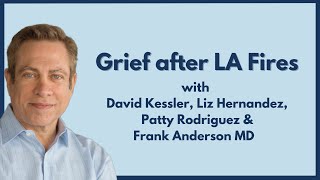
David Kessler, a grief specialist, talks with Patty Rodriguez, Frank Anderson, and Liz Hernandez about the emotional aftermath of the LA fires. They share personal experiences and offer guidance for people processing trauma and loss from the disaster.
Chapters
Foreign.
Welcome, welcome. I'm going to give it a few moments for folks to join us here. Thank you. Thank you for coming on and being here. I'm so grateful that you're showing up. I'm going to give folks a few moments to just get in and I would love folks to just say in the chat where you're coming in from. Where are you? We know many people are in la, but this has been, you know, an event that's.
Touched so many people in so many places. So love to know where you are. All right. North Carolina. Los Angeles. Vermont. Studio city. Burbank. Los Angeles, obviously. Los Angeles. New Jersey. Wow.
Wow.
Canada. Thank you all so much. Burbank. Malibu. Valencia, California. Welcome, everyone. Welcome, San Diego. Thank you all so much for being here. Wow. It's so meaningful that you're here.
It's. It's a hard time and I'm sure you feel that in the air already. I don't have to tell you this. So we're going to try to have the conversations we want to have or we need to have. So we're going to dive in to this in a moment. I want to start, though, with just a moment of silence for those who have died, those who have had their homes lost, those who have lost possessions, things.
Routines, safety, a million losses that have occurred here. So I want to just take this moment, to just hold them in our hearts, hold each other in our hearts. If you would join with me.
Thank you so much for doing that. I really appreciate it. You would join with me. Oh, hang on. I've got a. I have a, what I call a YouTube in the background. Replay coming up. There it is. You'll get to see. See it later on YouTube also and on our replay page.
I am so grateful.
That everyone has shown up, whether you're here watching this live or in the replay.
This has been challenging for so many of us in this moment. And as I always say, all grief often activates our old losses. For those of you who may not know me, I'm David Kessler. I'm a grief specialist. But I'm also someone who has had loss from the death of people that I care about in my life and family members, but also in my childhood, I lost a home not to fire, but to another natural disaster. So I am.
This brings up so much for me, just feeling it all around.
I'm joined by some incredible people that you're going to meet in a couple of moments. But.
I just want to start by saying, you know, tonight is us holding space and sort of naming the heaviness that's in the air. And people may or may not think that's grief. I often think we think that grief is always only death, But I believe grief is a change we didn't want. And natural disasters, the horrible things that happen in the world, are things we didn't want. And our mind can't comprehend the enormity, the tragedy of it. I think many of us.
Are exhausted on so many levels. Wherever you are in the continuum, there's people who are joining us tonight who have.
Had to say goodbye to their home. There were people who are joining us that have lost their home and didn't get a chance to say goodbye. There's many of us that said goodbye to our home and luckily still have it. And there's also this collective grief in the air, even if you didn't directly experience a loss of a home.
So there's the collective grief, there's the individual grief. And I think, you know, I want folks to know one of the things that's so important for me in my work is to understand that.
It never really helps us to compare losses, because the truth is comparing is of the mind. And we don't have a broken mind. We have broken hearts. And while we're talking about Los Angeles tonight, we also recognize this is not the only tragedy that's going on in the world. And we hold space for all of it. And.
Grief shows up in so many ways. And we're going to talk about grief and trauma, and I think this is traumatic grief that we're dealing with, and it dysregulates us. It confuses us. You know, we. We talk about grief brain. I always call it grief brain. And one of the things someone on my team shared earlier today is years ago, she worked at one of the big department stores after there was a big fire in Laguna, and the department store was allowing folks to come in and. And get clothing and supplies, and they gave the people who work there a list of what everyone needed, make sure they get two shoes and pairs of socks. All because they knew when we're in it, our brain isn't functioning correctly. We're in survival mode. And one of the things I know about grief, if I know anything, is grief must be witnessed. And so it's important we see each other as we are, where we are, in our pain. So with that, I want to bring on.
Our guests tonight who are also going to share their experiences. I'm going to bring on Liz Hernandez. Hi, Liz. Patty Rodriguez and Frank Anderson. Hi, everyone. I'm so grateful you're here. I wonder if you might just take a moment and. Why don't we start with you, Liz, and just introduce yourself and tell us how you're sitting in this world right now.
Oh, it's hard not to be emotional about it. You know, I'm. I've been in Angeleno for 25 years, and this city is.
All through my DNA. It is my heartbeat. And so I share the pain that this city feels.
I am very proud to hold space on the airwaves. I do mornings at 94. 7 the wave. And it's a true honor to be there and to support and to reflect back what so many of us are feeling.
As many of you may have experienced this, I went from watching the fire updates to then sort of instantly being impacted where the Hollywood Hills fire broke out and the alarms went off. And I was already staying with a friend because our power had been out for 24 hours and.
The sense of urgency to get back to my home.
It was. It's those things that take your breath away. And what really broke my heart was it was already 5:30, so it was dark. And as I was traveling up my street, watching all of my neighbors, my community in the dark with their hazards on, seeing their pets in the backseat, seeing their children being loaded in and.
This helplessness of, you want to stop and say, are you okay? But everyone is just grasping to hold on to anything they can hold on to because we had already watched the devastations in the Eaton fire and the Palisades fire.
And.
The fear that just overtakes you is really.
It's nothing I've ever experienced. And so.
You know, a really.
Just honest moment is the best way I can describe it is when I shut my door for the last time and I put my hand on my house and I just thanked it for the memories because I didn't know if I was going to return home. Was such a real, honest moment of gratitude, of pain, of fear, of trauma all wrapped not just for myself, but for our entire community.
And so I'm just really grateful to be here tonight to share. And I definitely can say that my compassion moved to empathy and just happy to hold space with all of you.
Thank you so much, Liz.
Thank you, Patty.
David, thank you so much for.
Creating this space for us all here tonight.
I share many of Liz's sentiments. I am born and raised here in Los Angeles. This is my city. The city runs. I am the city. The city is me.
I think in California.
Wildfires is Very much part of the experience.
But it's never been so close to home. Los Angeles.
10 years ago, I lost my house to a fire. Not to a. It was, it was in a wildfire, but I did lose my house. And seeing.
This devastation up close, the way it has been for the past two weeks, it opened up wounds that I even thought that I, that even, that I realized that I haven't really even closed or even.
I, I realized that I put many of my.
Much of my pain and trauma aside and not really worked on it. And this has.
This experience has allowed me to confront those feelings that I had tucked away for the last 10 years. But I, I also feel a profound sense of responsibility for my community in helping them understand that they're not alone and to navigate the challenges that they're going to face as they move toward rebuilding and recovery.
The worst hasn't even started yet. This is just the very beginning, the tip of the iceberg. And it's up to all of us collectively as a community to ensure that we are there for each other every moment of this journey. Because it's only going to get harder. And I speak from experience.
And that's why I'm here to, to speak to you all, to ensure that you guys don't forget about this in a week, in two weeks, in a month, even a year, because this pain is going to linger. But there's a potential of profound collective change that gives me hope because I side within myself the change that I saw in me and the life that I was able to create after the fire. And like that saying, you know, like a, like a phoenix rising from the ashes, that's exactly what Los Angeles is going to be. And we are, we're all experiencing this and we're all going to go through this together.
Thank you. Patty.
Frank. Dr. Anderson. Hi there.
Hello. I just want to say I'm honored to be here with all of you and I'm thank, I'm grateful to be invited and I'm so grateful for all the people that have joined us here today. So it's just, I feel honored. You know, I'm a newbie, I'm the newbie here in the group. Been living back and forth, moving to la. We were here for the holidays. My family had real estate agent, looking at houses, finding schools for my son. My whole family was like, yes, I can't wait to move here. And it was really kind of a shocking as it was for everyone moment we walked out of a school for my son, he's like they're so nice here. And boom, we saw the smoke, we went home, and then within a matter of minutes, we're like, oh, my gosh, is our house going to burn down? Because we've been renting a house here in L. A. And, you know, as this trauma expert who's been working in this field since 1992, with my own trauma history, I was like, oh, my gosh, I'm back here again. Like, I just felt it all again so quickly. My vigilance was there. My. I got to keep my family safe. I have to keep myself safe. And one of the things that was so striking for me personally, because, like, I do this for a living, and I sit with people's pain. I had no emotion in the moments of I have to be safe. Like, it was safety, survival, not sadness and grief and loss. And I was so struck by that. Like, wow, you do this and you help people, and you don't have access to your feelings because you're in survival mode, you know? And it's same thing for me, Liz, as soon, you know, we were kind of right in the middle of the Hollywood fires and the Palisades fires, and soon as the Hollywood fires started up, I think, where's worse? It's washing us. We've got to get out. Like, And I had this evacuation panic that I felt. Got to get out, got to get out. And my husband had the opposite reaction. He was frozen. He's like, I don't want to move. Let's just stay still. My youngest son was, like, collecting all of his things. I'm going to lose this. I'll never see this again. So I also kind of just witnessed the range of different responses within our family as this is unfolding and happening. So, you know, to teach it and help people and then to go through it again. I, too, Patty, had all my childhood stuff come up from my past, and, like, I know how to survive, right? I've been here. Like, this is familiar territory, but it was totally new because I had never been in a fire before. So I had that juxtaposition of I know this, and this is totally terrifying and scary. And it wasn't until me and my family were literally out of harm's way that actually my emotions started coming.
Then I felt sad and grief and loss and the desire to help. Like, oh, my goodness, there it is again, right? So it was very striking for me to be in that shock phase, to be exhausted by the vigilance and then to kind of thaw and start feeling emotion right and what can I do? And now I. Now I can help because I'm not in danger. And I thought about all those firefighters and first responders that are in trauma and helping.
Right.
They're doing both. And my heart goes out to all of them who don't have the option to get into safety first before you help. Right. So I'm sitting with a lot, you know, of complexity, as we all are, and just grateful for the way we can come together and kind of share it and hold the range together. So, David, thank you so much for gathering us and having us here.
Yeah, I want to jump right off on the complexity. You know, someone in the chat said something.
Their loved one during all this died from fentanyl poisoning. I also have a friend, his mother on hospice died while all this is going on. You know, when a tragedy happens, it isn't like the rest of our life stops either. So there's people who are juggling the events of every day on top of this. And.
You know, when we talk about stressors, this is pretty high up there. And I. Liz was one of the people. There was a number of us calling each other. Are you getting out? Make sure you're getting out. We were all sort of trying to take care of. And it was a moving target because we were, you know, who's where. Frank, you. And I talked Liz. And I talked Liz. And I had a friend who did not want to leave. Yeah, that was a whole nother range of emotions. Like, wait, in the middle of this, you're like, you're not going. Like, no, you can't do, you know all that? And we've seen people now who have died from not leaving.
Yeah.
Some people may know them. And I know that night I had this moment of one friend who is the calmest person. They've never raised their voice. I didn't think they were capable. I had said to them, if things get bad, come over, be with us. And all of a sudden their area came up, as in the evacuation order. And I called them up to remind them or make sure they knew. And they yelled at me, I can't talk. I gotta get. And I'm like, oh, my gosh, I've never heard them yell like that's. That's that stress. You are, you know, you're in survival mode. The other thing, that same friend, few hours later, is at our place. All of a sudden we hear there's a fire in our area. We go out, there's a fire here.
And.
And he turned to me and he said, Gets me. He said, you've taken care of everyone else. It's time for you to pack your own bags. And I was like, no, I'm the helper in this. I'm not the bag packer. And it just, you know, then I went back to my childhood. Obviously.
As we've had a few days now, it feels like there's survivor's guilt in the air.
And I want to give just a couple of tips of that, that that's very normal and to remind people they it's okay to hold gratitude that your world is okay.
And compassion and empathy for those that it's not. And the best cure I have ever found for survivor's guilt is taken action and helping some way, whether it's $5 to the red Cross or something else.
You know, hearing everyone's stories. Patty, what, what would you say given you lived through this, you went through this, you've gone down this road, what don't people know, what emotions, you know, you even mentioned a couple before that we may not realize we're going to have.
There's the feeling of shame.
And this rawness just feels. You're stripped and naked.
For many people that have lost their homes.
Many of them don't have a.
Savings in their bank account.
I remember for me at that time, 10 years ago, I was overdrafted in my bank account and I had a three year old.
And there was a shame because I had to go back to work almost immediately. There's no period of grief that I can just lock myself up in a, in a room and hide from everyone. I had to go back to work for my son. I didn't have savings to fall on.
So that's a lot of people are feeling that right now because they lost their safety, which is their home. This is something that they couldn't control.
And you're embarrassed, you're embarrassed of having to.
Pretend that everything's okay when in fact it's not.
And.
It took many weeks for me.
It really was for me.
A moment of clarity after this happened.
Because I quickly pivoted as the head of household.
And I looked at my son in the face and I told him.
This is never going to happen again. In the sense of we can't control things around us, but we can control who we are and what we do. I will do whatever it takes for our family to survive this and anything else that comes our way.
And I pivoted to finding ways to build a legacy and.
And, and wealth, not in the sense of, of.
Not so much Financially, but wealth within our families to within my family to lead and teach them that.
I am not a victim of this.
But that I can get through it.
And I can come out of the end of this a better person.
I could have easily fallen apart and felt as if the world just collapsed on me, because that's exactly how it feels. And those feelings are very, very valid, but they are not who you are. There's nothing, and I think I've learned there's nothing that we cannot overcome. Well, we are still abled body meaning in the sense that we can still think and feel. We are able to overcome anything. And that's what I've learned through this process and that I want to share with everyone listening and watching that this is, this, this is not going to define you. If anything is a moment of opportunity for you to find who your true self is and what your purpose is here in this life. Because I think many times we are blinded by the material. We are blinded by these societal expectations that others have of us and we don't see clearly. And it's only until we're stripped of everything and we are raw and naked and vulnerable that we see it. And this is the moment right now where we can pivot and find our true purpose and understanding of why we're here and who we, who we are, truly as the human being and the gift that we are to this universe.
Wow. Thank you, Patty. Thank you. You know, I always say the, the it sounds like the easiest thing to be is ourselves and it's actually the hardest in the world. So you are so right on. So thank you for that hope. And also just the idea of naming the shame and embarrassment. And I want to say for anyone who has children out there that are dealing with this, that maybe you've lost your home and you have children. Your children are going to feel oftentimes when things. Grief happens, they feel embarrassed. And as the adult, we feel like, don't be embarrassed. And yet, just as she said, it's. It's part of this. Liz, you have talked to so many people. You're on the radio. What do you feel like the pulse of la? The air is in the air right now. What are you running into out there?
It's overwhelmed. It's overwhelmed. It's, you know, it's beautiful to see the way our community is coming together. People want to help, they want to know how they can be of service. But we are being pulled in a lot of directions right now. We are checking for our safety, we're checking on our friends. We're trying to donate, we're trying to show up, we're trying to be so many different things right now that, that, like your friend said, David, sometimes we forget to even check in with ourselves and say, have I taken a deep breath today? How was my nervous system? And I think that collective grief we're feeling as a community is. It's palpable. We feel it in the air and we're not through this yet. And ultimately I think that it.
What we want most is to know that we're going to be here for each other, that we're not going to forget about each other, that we're going to continue to say, hey, I see you, I support you. I think that's really what the city is thriving on right now, that morale of. We are all impressed with one another, with the way we're showing up. I think that is giving us so much heart and so much comfort of. I think a lot of us are sitting back in awe after the overwhelm subsides of just being so proud to be part of LA county in this community.
Thank you.
Frank. We have said that grief word a lot. Tell us about trauma. Tell us about this and trauma.
Yeah, yeah, it's, it's so. I mean, this is acute trauma. Like we are all experiencing acute trauma. And you know, there's so many kind of do's and don'ts around it that we don't know about. Like, one of the most important things for me is love and connection. Like love and connection is the antidote to this, you know, and we have this tendency for isolation and withdrawal to keep safe.
Right.
And it's like it's made our family really want to be here more, to see the outpouring of love and support and connection that is in this community. I can say personally, the.
Differentiate like what's from the past and what's in the present. Like, that's something I'm struggling with. I'll tell you, with many of us who have histories in the, in the past, like trauma histories that kind of come up and resurface, it's so important to differentiate what's happening now with what's happening then. I had this powerlessness and then this punishment show up for me. Like, you don't deserve happiness, you don't deserve joy. See, I told you, every time you're happy, something bad happens to you, right? My son even said, is God telling us we shouldn't move here? Right? Is this a punishment? Is this a bad message? And so those thoughts that we have are so common to come up, like distorted thoughts from our history show up that kind of are serving protective functions, but in reality are kind of blocking our capacity for love and connection. They're trying to protect us, but they're blocking love and connection. I will also say watch your exposure. This is a really tricky thing. There's a lot of research and a lot of evidence that says the more we talk about it, the more we relive it, the more we encode it. So there's this sweet spot around sharing and feeling without overdoing it or underdoing it. And I think it's all. It's important for all of us to hold that line. I know for myself, when we were vigilantly watching every single area, it was overwhelming and I get panicked around it. Right. So regulate your exposure.
Right.
When is it helpful, when is it serving and when is it activating or actually encoding more ptsd? So that is a really tricky thing. And last. I guess the last thing I'll say, David, is, you know, people reach for soothing substances, which makes sense. And this is something that a lot of people don't know about. Acute trauma is that things like alcohol interfere with our capacity to process the trauma. Each of our bodies and brains and nervous systems needs a space to process. If we allow it to unfold, we've got the resilience and the capacity to move through it. When we block it, when we overdo it, or we inhibit it, when we're thinking we're helping, we're actually making it worse. I'm interested in teaching and sharing as much as possible. The do's and the don'ts, the do's and the don'ts around unknowingly. What makes it better and what makes it worse. There's a lot of research and evidence. One of the things that happened, Liz, when you were talking about the people coming together, it brought up September 11th for me. I was somebody who had to rush in and help in September 11th. The outpouring of support and love and connection is what got us through that we did. As you say, Patti, we were stripped to the core and then we rebuilt. That's what I feel is happening here for all of us in the midst of adversity. We have the greatest opportunity. And I know it's going to be hard. It is already hard. And there's enormous opportunity for change and growth in this. But don't push away the pain and the sorrow to jump to the. To the. To the opportunity, because you're going to miss Jewels, you're going to miss the wisdom. So that's what I'll share at this point.
Thank you, Frank.
It's.
I'm glad you talked about that. And I. Especially about the acute trauma. It's interesting.
Yeah.
So many people around me have mentioned ptsd, and I'm like, this isn't post trauma. This is trauma. Like, we're not post. Everyone.
That's exactly.
We're not post. We're in it. So when I think, like, we don't. Like, we need to get that. Like, we are collectively in the trauma that's happening. An idea to distinguish it. I hate to be the one to bring this up, but to give a full picture of reality. And Liz and I have talked about this, and this occurred in 9, 11. I remember as we collectively feel the love, feel the pain. Not everyone collectively feels the love and pain. And Liz, you and I were talking about how do we navigate the people who are like, it didn't happen to me. I'm okay.
Yeah.
Yeah. Challenging.
It is.
It is.
I told David I ran into someone I worked with who was very disconnected from it. They lived in a different county. And while she had compassion, she couldn't grasp the magnitude of what a lot of us were feeling. And I think what was really helpful for me is just even David walking in the studio saying, this is trauma because I felt guilt, calling it trauma because my home survived. So, no, I was dismissing that. It was trauma for me.
And.
I think that we.
As in.
The people that are experiencing it. And Patty, you touched on this, is just finding the vocabulary for ourselves and expressing what we have felt and what we have been through so that it can.
Register in a way that is comprehendable to people that haven't been in a situation like this and just lending that compassion. And it was really. It would have been really easy for me to be judgmental of that person, but I also felt compassion for her because I was like, oh, she doesn't understand. And that's okay because, you know, our minds want to jump. Yeah. You just have to let it be. And so, yeah, I think a big part of this, David, Patty, and Frank is. Is us hopefully helping and. And lending, finding that vocabulary to name what we feel, all of these different emotions, because it's so much. There's a lot of guilt right now. I know a lot of my friends have been saying that, you know, they were evacuated and then put back into their homes. And while, you know, even myself, when I drove up to my driveway, I cried my eyes out, and then When I opened my door, this wave of guilt just landed on me. And I couldn't even have that appreciation, that moment of appreciation, because I felt I wasn't deserving. And it's. It's a fine balance that all of us, I think, are. Are juggling so many different things. So I think it's just always reminding we got to be kind with ourselves so then we can go out and lend that kindness to other people.
I. I had the experience. I was here in the 9. I think it was 94 Northridge earthquake. And maybe about a week later, we were still having these really big aftershocks. And I remember I had gone to a movie with friends, and in the movie theater there was an aftershock and the aftershock, you never know, is it another earthquake at all? And in the theater, there were two types of people. Where's the exit? We're out of here. This is. We're in danger. And the other folks were like, shut up and watch the movie.
Right? That's right.
And I think that is part of our world. And sometimes, you know, just like you, Liz, it's easy and it's tempting to go to judgment. And I think it's also the same, like you said, Frank, someone who's maybe using, coping with substances, alcohol, to also have judgment and to just realize they're. They're at the edge of their coping skills too, you know, that, that their denial of what's going on is how they had to cope. And so many, we learn in grief. You're going to probably say this too, we realize is that these, you know, this is often suits of armor we put on in childhood that we never had anyone tell us it's safe to take off and we're still geared up now in it.
Well, and what I was going to say, David, I totally agree with you and I resonate, you know, we learn about the trauma, the acute trauma response from the animal kingdom, right? Fight, flight, freeze, submit. So those people that are numbed out and disconnected are actually feeling more life threat. When you get to the point of shutting down and submitting, you're like, it's over. I have nothing. Right? So when we're seeing all the people's different responses, some people are freaking out and some people are like, nothing's happening. I'm fine. Those are all trauma responses. It is the way we react and to really hold compassion, as you said, was like, wow. I'm like, I'm the freak out one in my family. And my husband's like, let's Just be still for a moment. Right. And so everybody does respond differently to that and I think it's really important. And one other thing, I'll say, David, I loved you said I love that this is trauma and this is acute. There's no ptsd.
Here's no ptsd.
We're working at prevention. We're preventing PTSD through love and connection. Isolation is one of the biggest indicators to cause PTSD after a traumatic event. What's your response? When we stay connected, we decrease our chances of developing ptsd. So we're in acute trauma prevention stage is the way I think of it. And LA is doing an amazing job around that love and connection piece that I can see.
The other thing that we've seen is, you know, this person's curt, that person's annoyed. There's a lot of anger. Anger and in grief, anger is a normal response. We go a little. It's tough on many of us because we had anger modeled so poorly and sometimes dangerously that we don't even understand there can be healthy anger in releasing it. And I always say with anger being this response.
Anger is pain's bodyguard. Like the person who's in anger is in pain.
And.
It just, you know, and it's hard for some to be vulnerable while others are angry. And you know, it's interesting, Frank, how you bring it to the same that it is underneath. At its core it's trauma.
That's right.
And in our also vulnerability. Second place, I hate to go as a moderator is I have always said when.
Things are at their worst, it can bring out the best in us, but not for everyone. And Patty.
Yeah.
You know, and you've been telling people there's some scammers out there. Tell us about that world. That is just, it's so a shame it has to exist. And yet the reality is it does. And we got to name it.
No, I mean the reality is that people are going to take advantage of this situation and they're, they're already starting. We have to remain vigilant and this is when community is even more important. Like I said, I, the, the worst is yet to come before we, we are in the road of, of recovery and, and self reflection and self change.
The.
The amount of scammers that we're gonna come across for that same reason, we have to remain level headed through this process. And there has to be two of you navigating. There has to be a duality within oneself as they navigate through this.
And.
Being able to switch that on and off in the moments where it needs to be. For example, when you're navigating.
The conversations with your insurance, your adjusters, your mortgage companies, these service providers are going to help you through this process. You have to be really level headed and not allow emotion to blind you.
And if need, have someone there next to you holding your hand.
And then when, if you ha. And then when you hang up the phone or, or you walk away from that conversation, then you can break down and cry.
But while this is happening, for the sake of your family and yours and for you, you must remain very vigilant. You know, in a perfect world, everybody would just be. It would just be love and everybody would just want the best for us. But the reality is that that's not the case.
And this is where community is so important. And just make sure you're there for a person who has lost their home and, and be there in those moments. And if you don't have anyone, I highly suggest if you lost your home right now, record those conversations. You're not going to remember any of those conversations. Write them down. Have a pen and paper with you at all times and, and read through everything. Read every line of your insurance policy. Read every line of every document that's presented to you. And do not be afraid of asking questions.
Many of us woke up or, or realized that we lost our home. And, and we're, and we go into this, this dark place of blaming the world, right? Why me? Why does this happen to me? Why does, why is life so unfair to me? You know what I learned during, when that happened to me? I learned that life doesn't owe me anything.
I learned that I actually owe life everything. And when I say that, I mean that I am responsible for what life, how life happens to me.
I choose to. I choose to be in this world and be of service to others. And what I give, I receive. And that's exactly what I learned. And since then, since that happened to me, I just felt like just life has been incredible because I chose to turn off that voice in my head that kept saying, I am the victim. Life is so unfair. How does this happen to me?
I didn't. I. No one understands how I'm feeling. I chose to turn that off because it wasn't serving me, it was only hurting me. I was hurting myself. How awful is that, that we hurt ourselves? The most beautiful thing, which is us, we are doing the hurting. No one is hurting us. We're doing that ourselves. So we have to turn that off and make sure that we're in a place where, and it's, it's difficult because, you know, again, it's, it's years and years of trauma, you know, and it goes back to childhood, right, where we, we, we lost that. We, we were never able to develop that self love, right? So it's very, very difficult.
But right now you need you the most right now.
And right now you have to be there for yourself and your community. And it's turn as, as painful as it is, it's turning off the, the negativity that our brains are constantly.
Spewing at us because, you know, like you mentioned, David, it's, it's a way, it's a, it's a, it's a way to protect ourselves, right, this negative vocabulary in our words. But it's really not, it only hurting us and it's, it's digging us into a deeper hole that just gets larger and, and you know, you get to a point where you just can't get out of it.
It's so true. And you know, that's one of the things that you're bringing is someone here who's been through all this, is that you do eventually get out of it. If you, you know, have support from folks and ask for it. It's hard to ask for it. You know, the other thing is we talked about duality and we talk about unhealed trauma.
We bring duality to so many things. We can use our faith to bring us strength.
We can use our version of faith to condemn someone, their house burned down. Obviously God wanted that. You know, we can distort religion.
We can use.
The politics of the world and the government to think about how can we be there to help rebuild. And we can also opportunistically use this moment to bring the worst of our politics to the situations and to those of us and many in LA right now, as you're dealing with these own feelings, it's hard to open up your social media, I mean, just to collectively see LA is being punished.
David, something that you've said that has been such a saving grace for me and, and being compassionate with myself. And what I'm feeling too is when we grieve one thing, we grieve everything. And yesterday I caught myself.
You know, I haven't had the bandwidth to feel my emotions like what Frank said, you kind of, you just go numb because you don't feel safe to feel what you're needing to feel.
Yeah.
And someone had shared a meme online about this man watching the planes drop the water. And he was so Excited at how precise they were. And it was sort of this proud moment that we all felt like, yes, they got it right. They're saving homes. I went from laughing to crying, where it shocked me, where I went and lost my breath. And then I immediately said, what's wrong with me? I was shaming my grief. And then I stopped myself and I realized, oh, okay, I have the bandwidth now to feel right. And then I went from allowing myself that cry to then my again. You know, your old trauma comes up. Oh, my God, I miss my mom. I wish my mom was here to hold me. So it's like this wild roller coaster of a ride.
But.
But gosh, it's so important. If I have one message, just you. We got to lean into that self compassion of not being judgmental when all these different emotions come up, from guilt to shame, to one minute you're laughing and you're feeling guilty about laughing at a meme, and then you're crying and then you're missing your parent who's passed. All these different things, you know, are just continuously coming up, you know, just being able to go back to a little bit of normalcy. You feel guilt. So I just want to say to all of us here, just honor what you're feeling and lean into self compassion again and again and again.
So true. One thing I want to add that people are often surprised about as we're going through this collective grief, there are among us what I call practical grievers. When it comes to the death of a person. They're the ones that go to the funeral, they cry and they're done. We're moving on. And our practical grievers are the one who goes, okay, you lost your home, you know, brush your pants off and get up and rebuild. No time to cry. And it's a different style. Important we not make them wrong and also let them make us wrong. We get to have our feelings around everything that happens, and we get to have all these different grieving styles here. And tonight I think we're touching on so many different styles and feelings of things that come up. And just, gosh, Liz, the feeling of your mom and you know, this is the time we would lean on this person or they would be here that comes up. And we have gone through this hour so quickly. I want to make sure we have time to just hear from each of you.
So much we could say, what do you want to make sure you leave people with and.
Have them here before we go.
Why don't we start with you, Liz?
The most Important thing.
When I think about things that I've been through in my own life that have felt very traumatic is gratitude and hope. You know, it's so hard for us to reach for a lot of people to reach for that gratitude right now. And I know we can't just shove ourselves into it, but we can hold space for our grief and our gratitude. But gratitude is the promise of hope. It's being grateful for what is to come. And I really do believe in the full recovery of our beautiful city and of each other. You know, David, you've said to me many a times, we're built to take many hits in this lifetime time, and we are so resilient, and I am so grateful for that. And that's all I can think of. That's what keeps. You know, as I was watching the news and just hearing every reporter, every official, I kept hearing the word gratitude. Gratitude, gratitude. We're grateful for the first responders, we're grateful for the firefighters. We're grateful to this city. We're grateful to the people who are willing to help. We're grateful for anyone holding space and checking on us. And I truly believe that it's going to be gratitude and us practicing gratitude in these moments of recovery.
Thank you, Liz.
Frank.
Yeah, boy, that's. I mean, first of all, I just want to say thank you. Thank you, David, for having us here, and thank you both, Liz and Patty. I've. I've felt I've learned a lot from sharing space with you and grateful just to be here. So thank you for that, I guess. You know, I'm surprised, David, because I had my. Oh, I know what I'm going to say, and I'm kind of changing what I'm going to say based on what we've all been talking about and what I'm feeling in the moment. And it is, for me, feel it all. Let yourself feel it all. Get ugly, get sad, get mean. Let yourself feel it, because that is your greatest chance to get through it. So many of us stop it because it's hard and painful, and that perpetuates it. So let it be ugly. Let those snots come out of your nose. Feel mean and angry and sad and disappointed, because that's where you're going to get to the core, as Patty said, and rebuild something new, because I don't think we get there when we suppress it. So go for it and get to the other side is what I want to share with everybody. That's what I'm going to try to do.
Thank You, Frank, Patty.
I want us to think back at who we were before the fires. We were a city coming out of the pandemic. A city that.
Many folks are, were going, are going. We're going through challenging times, just hurting.
The.
The limited housing in the city, homelessness in the city.
Yeah.
And we were kind of numbing ourselves from those realities.
Okay.
And I want us to see who will becoming now. We are becoming neighbors who are here for each other. We were going from strangers to becoming friends and being there for each other. We're seeing ourselves for who we really are as human beings. I keep saying on my Instagram something that my son, my nine year old son has been saying to me since he's been able to talk.
We're all made of the same stardust.
And, and if anything this has shown. I want everyone to remember who was there to stepping up to help. It was the, it was a community. It was a small business owners who are giving their all to those who have been displaced and are hurting right now. They were there first than any than anyone else. So I want us to continue remembering that as we rebuild and we look forward and rebuild and how we envision rebuilding our communities. It's a need.
That we have, the human need at our core by our biology at the, at the, at the cellular level.
It is community.
In the love that we have for ex. Just how, just how lucky we are to all be here in the zoom and hear our voices and feel our voices. How lucky we are to still be here and we have to have that fire and move it forward as we rebuild. And.
That realization gives me hope because I went through it personally myself. Now I know it's going to happen collectively at a level that is going to change the way Los Angeles is moving forward. There's a Los Angeles before the fire and there's the Los Angeles after the fire and there's Los Angeles after the fire is going to be closer together. It's going to be.
Rooted in community and it's the opportunity for us.
To everything that we have been fighting for, for us to see it realized right now. Yeah.
I love that.
Thank you. Thank you. I just want to leave folks with. In grief and loss. When you're in the just midst of the acute pain, it can feel so hopeless. And that this pain will be our new reality. And I just want to remind people no pain is forever. No feeling is final. And this pain, this grief, we want to run from it. And what we run from pursues us. And what we face transforms us. And I'm just so grateful. It's just, it's so touching just to see how fragile we are and how strong and resilient we are at the same time and that we, the four of us, are just a microcosm of LA and how people are coming together for one another. If you missed part of this, you have a friend you wish would have seen this. Just know you can go to grief.comforward/la and there's going to be a replay of this up there. I'm so grateful to the three of you and I'm grateful to all of you who are taking the time. I can tell you in grief you learn what's important, people and time. And you've given us time tonight. So thank you all so much for being here. Thank you all. Liz, Patty, Frank, thank you so much.
Thank you, David.
All right, everyone, peace and we'll be talking again. Thank you so much. Just the beginning of conversations in la. I'm sure.










