How You Can Help Others Navigate Grief
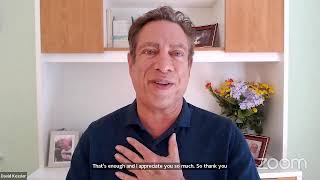
David Kessler, a grief specialist, outlines six things people need when grieving: to have their pain witnessed, express feelings, release guilt, heal old wounds, integrate pain with love, and find meaning. He argues modern society is "grief illiterate" and shares clinical examples and personal stories, including the death of his son.
Chapters
Foreign.
I got it set up. Welcome, everyone. I had to do some tech stuff. Thank you all for saying where you're from. There's people here from all over the world. I love that. All right, you make sure my captions are on. Thank you so much for sharing where you're from. I so appreciate it. All right, my last job and then I'm going to start is to push the record button. Wow. People from all over the world. Thank you for sharing that. I really appreciate it.
All right, we're gonna close down the chat now just for the teaching part and let's dive in. I have so much to share and probably not enough time. All right, let me get my recorder on.
Hi, everyone. Oh, my gosh. I'm so excited that everyone's here and you are here from so many different places. All right, hang on. We have a little technical issue. Let me stop.
Tracy, you have to leave. I'm so sorry. Otherwise, we're seeing you. So.
Let me just. Tracy, if you would just leave. Sorry. Thank you. All right, sorry. We got some extra sign ons there. All right. I want to make sure that I can just share with you lots of stuff. Let me try my recorder again. Here we go. See if you wondered if today was live. Is this proof? Is this proof? I hope it's proof.
Hi, everyone. Welcome. I'm so glad you're here. Thank you so much for. For joining today. I really appreciate it. It's so, so important what we're talking about today. And I got to tell you, I am honored that you have made time to be here. So I have so much teaching to do. I am going to just dive into it all. And like I said, I'm just. I'm just so touched even by your presence. You know, I think one of the things when you work in this field, you end up knowing the most precious thing we have is our time. And you are giving your time today. So I appreciate all of you that are here live. I appreciate all of you that are watching in the replay.
I'm talking today about how you can help in the world, you know, and when we help others, we end up helping ourselves. Helping is healing. Many of you have chosen amazing professions. Some of you were thrown into the depths of despair. And people begin coming to you who are a little behind in the path, asking how you're doing it. So, so important what we're talking about. And so many of you have signed up from all over the world. And helping with grief is more important than ever in a grief illiterate Society. And I'll tell you, we have a grief illiterate society. There's so many misconceptions and confusions about how to help people with grief. So that's why we're talking about this. You know, the important thing for me about this is that it's not just you're showing up. It's that you're showing up for a reason. You, there's, there's, we're going to talk about this. You know, you're in the right place if you're wondering how you could help others. Because we so need you in the world these days. You know, externally, you only have to look at my Facebook. I mean, you see the comments of hundreds and sometimes thousands of people who are in pain and in grief and stock and don't know of access and don't know of people. And there's, there's the external call of the world. And internally, my guess is you have a little voice or you wouldn't be here today. So I think there's a little internal call as well as a huge external call in the world. And it just, like I said, touches me because no one models grief for us. And when people are in grief, they get so isolated. And here's the thing that isn't often talked about. People will tell me, oh, my neighbor, my sister whose child died or spouse died, they're isolated their home.
And it's so easy for us to look at the person in grief and go, yes, they're isolated, but did everyone else have a part in isolating them? Did we leave them alone? Did we not see the world through their eyes? You know, we wanted to cheer them up. That's not, you know, it's, it's. And we live in this society that wants quick fixes and optimism and all that stuff that so many people get. And people get judged for their grief taking too long. And so many people, when they hear the word grief or death and dying or loss and breakups and divorce, a lot of people step back. And that's why I'm just so touched you stepped forward. You stepped forward today. So. And many of you are therapists who have been doing this and just want a few more tools. Some of you are coaches, some of you are people who have been through dark nights of your soul and you want to turn your pain into purpose. And we know so much now about grief and trauma, how connections with others heals us. It helps us heal. There is no actual healed, but it helps us go down that path. And I want to empower you with tools today. Unattended grief is heartbreaking for me to watch. You know, if you just think back the last few years, so many celebrities died, and you hear about them and how they died, and then at the end, there was a little footnote. Oh, and for the last few years, they were devastated by their sister's death. Oh, in the last few years, they were devastated by the loss of their child. Oh, in the last few years, they were devastated by the loss of their mother. Oh, the divorce really hit them hard. And it's like. And the grief got unattended. The grief got unattended.
Just yesterday in my grief group, a woman came on and shared that her husband had died twice. And I'm like, died twice? Like, was he resuscitated? What. What happened? And she said, no, he died a few years ago when his child died, when his son died, her stepson, she said, that was his first death. And she said, he lingered here in life, grief unattended. And then a few years later, then died himself. And she talked about how she was present for her stepson in his death and her husband's heartbreak and how she stood by him and honored his son and honored his grief, and she still thought they would have time together, they would have retirement, they would have years. And she got none of that. And just so it's like the whole family was hit with these huge tragedies. And even the word, you know, bereaved comes from an old Latin word to mean robbed. She. Her husband was robbed of his child. She was robbed of her stepson, and now she is robbed of her spouse. And many of you know, I am speaking today as a grief specialist, but I'm also speaking as a bereaved father. Like that man, I get those feelings of not wanting to recover and how if there's no help, that might be all you're left with. So that's why it touches my heart that you're here watching. And, you know, grief doesn't just show up in death. I always say, everything is a death. You know, breakup is the death of that relationship in that form. Divorce is the end of that marriage, the death of that marriage in that form. Betrayal is the death of the trust. You know, so much of it. You know, trauma, estrangement, they're all losses. And it's so important that we acknowledge all of those. And every year, I. I speak at a national conference, and I've gotten to know so many people there. And one of the things that's really interesting is I've been Going to the same conference for 10 years. Okay, just know, and this is about the world. Ten years ago, they have their main stage speakers with, you know, the thousands of people. And then I go there for that first year, and I'm in a little converted hotel room, you know, where everyone is. And I got like, six therapists out of thousands showed up to hear me talk about grief. And I kept going back every year, and it went to 10, and it went to 15, and then 50, and then 100. And last year, for the first time, and this year, too, I was speaking on the main stage, and I was doing that because I think partly it's the pandemic where we're understanding we can't ignore grief anymore. And I also. It's a shift that made me really even go deeper into offering training for so many people, is that, you know, I would be with these icons like Bessel Van der Kolk, who wrote the Body Keep Score, and Dick Schwartz, who wrote Know ifs Internal Family Systems. And I was with these older icons and, you know, and I said to someone, it's so amazing being around them, you know, for. And I almost wanted to say for those of us who are young. And the person beat me to it. And they said, well, you know, you're. You're older now. And I'm like, oh, I don't think I might like. It wasn't a compliment at first, but then I thought, it is time to teach. It is time to really pass on so many things I've learned over the decades. And if you don't know me, I'm David Kessler. I've written six books on death, on grief.
And a couple I wrote by myself. My last one, Finding Meaning, I wrote by myself. I wrote two with Elizabeth Kubler Ross. The first one was on End of Life Care. I also wrote one with Louise Hay. And I've been training professionals for years. And I have an online group, Tender Hearts, and I have a grief educator program. And I really try to apply all this experience online. So, you know, today.
We are here talking about how do we reach out through the darkness to guide others? You know, when the thing is, it's not fixing. People in grief don't need fixing. They're not broken. And there's this thing about hierarchy. Oh, we're going to help them. You know what? I don't believe in the hierarchy. I don't believe we're helping those grievers. The truth is, the death rate's a hundred percent. We're all going to deal with This, I don't think of it as helping someone. I think of it as serving one another. I mean, I get to serve every day. So these techniques, I hope, will help you. I'm going to talk to you about the six needs of the grieving. You're going to want to take so many notes. And I just want to tell you at the end, I am going to tell you about the opening of our grief educator program, which is so close to our heart. And we'll open it at the end of the training. But no matter whether that training is anything you're interested in, you're going to get tons of. Of tools today. So, you know, stick around. Lots of them. I want to talk about, you know, we've talked about how death can be a lot of things, but I also want to mention trauma. You know, people forget trauma is also the loss. It's sometimes a loss of safety. Maybe it's even the loss of childhood. Maybe it's even the result of the loss of self that you had to give up in your childhood to protect yourself. So today's tools are helpful whether you're a social worker in foster care, a mental health professional, medical professional, or you're a person who's gone through those dark nights and you want to help. And people often ask me, david, these tools, there's different ones for different losses. Most of them are the same. Most of them are the same. The physical therapist who's dealing with people who have lost a limb, it is recognizing that loss. The tools are the same. And to understand that there is no. These tools do apply. I went on this quest to help myself after my mother died. And I was in one of the first mass shootings when I was 13. And here's the thing. I thought I was damaged forever. It was traumatic grief. It wasn't just trauma. It wasn't just grief. It was traumatic grief. And I thought I was damaged. I was broken forever, wasn't going to have a good life. And here's one of the first things I learned. You might want to take this down. No feeling is forever. No feeling is forever. People may feel hopeless, broken, shattered. And when we are in pain, we think, that won't be the rest of our life. But it's important for you to remember for those you help and plant that seed. No feeling is forever. When a loved one dies, our grief can easily get complicated. Here's another important note. So often, people, unknowingly, because this hasn't been modeled, hold dearly their suffering. Instead of holding dearly the Love. I want to say that again. They hold dearly the suffering instead of holding dearly the love. Because we haven't had language around this, we haven't been taught this, and somehow we mistakenly think the suffering honors our loved one. I'm not talking about grieving. We absolutely have to grieve every bit of pain. But sometimes what can go wrong is the disloyalty factor. And it's one of the ways that people keep themselves in prison by disguising that suffering is loyalty. And loyalty is a story we make up in our mind. Let me tell you, my son David died seven years ago.
I continue to love my son every day. That's my loyalty. That's my loyalty. I will never give death the power to end the love that we had. I will never give death that power. Death can end a physical life. But I gotta tell you, and this is something else you might want to write down, continuing to love them after death is loyalty not a denial of life. It's an acknowledgment of the love. I'll say that again. Continuing to love them after death is really what loyalty looks like. Loyalty is not a denial of life. It's an acknowledgment of love. And I teach people the importance of grieving fully and living fully. But loyalty can get in there and complicate things and we can have a distorted version of what love looks like. And that love.
We don't want to make that small. You know, like I talk about, our grief doesn't get smaller. We have to learn how to become bigger. And I gotta tell you, my son, a month before he died.
He and his girlfriend, who was a social worker, sat in a lecture of mine when I was training therapists. And I gotta tell you, my son loved my work. He was so proud of it. And the interesting thing about it is I really.
Had to understand on a deep level, he would never want his death to constrict my work. He would want to expand it. And I think we have to see that as part of that loyalty too, with our loved ones. And it has to be fine tuned. You don't ever want it to be like you should feel better sooner, but. And I gotta tell you, you know, as you can see, it wouldn't be unusual if I was talking like this for a moment outside to random people. They were going, oh, David, we can see you're still, after seven years, a little emotional about your son. No, I'm not emotional. Those emotions are my love, which will always be there. My love will always be there for my mother, for my father, for a nephew of mine. My love will always be there. And I think about a friend of mine and teacher, Edith Eager. She's an amazing psychologist. She talks about how so many times. And I love to apply her work to grief, because here's what happens. Our mind begins to revolve and not evolve. We want our mind to be evolving in grief. We want it to be evolving. And, you know, the thing is.
You might want to note that we want to evolve, not revolve. And the mind replays what the heart can't delete. The mind replays what the heart can't delete. Revolving is your mind's inner wisdom trying to find a way out. But it's gotten stuck in a loop. And things can change with the right tools. You know, the world has also changed so much. The world has changed that it used to be life was about seeing a therapist, seeing someone trained, what university did they come from? And things have changed over the years that even therapists I know who are now online helping people out of their state, are doing it as coaches. We've got so many people who are skilled coaches. We've got ordinary people now who've experienced heartbreak and devastation, and now they lead others out of the abyss of grief. And it's so really extraordinary to see how we help each other by being there. You know, helping with grief is so rewarding because.
And this is troubling to hear, but it is reality. Grief and trauma get passed down through generations. They get passed down through generations. So you showing up here to become a little more grief illiterate. Let me tell you, we're helping to change the future. And every day I get to witness changes, you know, things like I couldn't imagine in my childhood. I was lost. You know, so many people get lost on this. And even as a grief expert, when I became a bereaved parent, it's not like, oh, I know a shortcut. No, there is no shortcut for this. I had to do groups, I had to do counseling like everyone else. And one of the things that helped me the most is having trained therapists for years. And they would show up in my courses and my trainings and for decades, and they would tell me of their losses, of their tragedies, of their griefs, of their parents dying, their children dying, the shooting, the murders, murders, horrible things. And they're there to help. They were always evidence to me.
That life can continue. And I hope to be that for others. And I hope that as you are so grief illiterate just to show up here that you will also be evidence to people that there is life after loss. Because we can get so lost in if we don't know just some of the basics. And that's why those six tools are important that I'm going to go over. And I can tell you as a bereaved parent, oh, God, still miss my son. And happiness is possible. I still find happiness. I find joy. And by the way, if you're watching or you've ever got a newly bereaved client or you're newly bereaved, look, you can't see it. Joy, anything. You can't see it. And it's always, you know, when we're talking about who we're talking to, it's a big mistake if we're not following their speed. We can't move people faster. But there is so much hope. There is no forgetting or moving on. It's an ongoing process. And when I think about helping people heal, I think about decisions that are made not out of the heartbreak, not out of the trauma. Healing, to me, looks like when we no longer make decisions from those devastating losses, I got to tell you, how many relationship decisions did I make out of abandonment? Believe me. And I think about, I understand that people can feel hopeless when they're in that dark night. And I know things can change even on the darkest night. And, you know, people in grief lose their hope often. And that's why we want to be evidence for one another. And I often say the heartbreaking thing is a loved one dying is permanent. The loss of hope is temporary. And until someone can find hope, we can hold it for them. And it's a different view because I see trauma and grief as persistent. Trauma and grief patiently wait for us. They don't go away. Think about that. Write that down. Trauma and grief are persistent. They wait for us. They don't go away. They are going to sit there unattended. And something else you might want to write down is all grief does not have trauma, but all trauma has grief. Okay? So.
One of the amazing speakers in our grief educator program, one of the psychiatrists, one of his sayings is, trauma blocks love. Love heals trauma. That's Dr. Anderson. Trauma blocks love. Love heals trauma. And, you know, we run from the pain. It's so intense. Why would we not? Why would we not? And we run from pain because we feel the pain is too much. That's why we have to disconnect. And we don't have a culture that says oh, no, let's sit with the pain. Let's sit with what's happening. You know, one of the things I say to people, which scares them and reassures them all at the same time. I say to them, the pain you're feeling is proportional to the love you have for them.
You love them a little. Little pain. You love them a lot. Lot of pain. And one of the other things, you might want to jot this down because that had that. That. That feeling. We want to run. What we run from pursues us and what we face transforms us. And just giving people space, just not avoiding it, just being with them. You know, people aren't avoiders. We're biologically predisposed to avoid grief. We want to avoid pain. And sometimes I say that and people go, oh, yeah, I get it. Like people in grief. It's like touching a hot stove. I go, no, no, no. It's like the hot stove fell on them. And one of the other things that's so important when people are sitting with those big feelings that feel too much, someone just said to me the other day, I can't. You're asking me to engage with this pain. It's too much. I can't. I can't do it. And I said to them, would you consider adding a word that may be helpful later? Just a word that may be helpful later? I said, what if it's. I can't yet. I can't deal with these feelings yet. But I have confidence that in time, we were built. You were designed to survive losses. You were built to take a number of hits this lifetime. But we can't heal what we don't feel. And, you know, many people have traumatic grief, as I mentioned, not just grief, not just trauma, but traumatic grief. Traumatic grief can be how someone died was traumatic, or you've got an old trauma that you project onto the death, or you've got both traumatic and you project old trauma. And we forget how widespread it is. And I think of early grief. Like, what's early grief? I think of it as the first two years. The first two years. And the interesting thing many colleagues and I were talking about, when people show up for therapy around their grief and decide to attend it, do you know when that is? When they first show up and say, I think I've been. I have some grief I need to attend to. Sometimes at five years, sometimes at five years. Someone tells me they. They wanted to send one of my books to their friend who died, but it's two months, so they missed the opportunity. I'M like, grief has such a longer shadow than we think. And that also gets a little distorted these days. You know, we now have prolonged grief, complicated grief. That word we used to use, complicated, is now prolonged in the DSM 5 that therapists use to have a diagnosis, to get paid. We want people to get paid. We want people in grief to have support. But I feel like even the word prolonged means you've been grieving too long. You've been grieving too long. And we actually sometimes also judge our own grief. You know, we feel like we're doing our grief wrong or we put our grief on a timeline. That's why it's important we know some of these things. Because, look, I was taught algebra, and I never used algebra. And.
You can be the most skilled therapist, and you probably didn't get enough training around grief. So it's so important. And, you know, one of the challenges of this life, sometimes I know people who have a loss, a breakup, a divorce, whatever the loss may be, this horrible grief. And they'll say.
All right, good, that's behind me. No more losses. And I think, no more losses. Oh, and they're on planet Earth. Gosh, there's. There's more losses on planet Earth. And I remember there was. I was at a party years ago, and there was a gentleman there who said, oh, I got a flyer for your grief thing you teach. I'm a therapist. And I said, oh, are you going to go? He goes, no, I don't really have anyone in grief. And I went, okay, that's an interesting practice that he has no one in grief. And I said, well, if you ever want to learn, you know, I'm around. I do classes. He goes, okay, sure. I'll let you know if I need anything. I went, okay. And then I get a call from him two years later. He has this client who her and her husband and their two kids were in a horrible accident, and her husband and her son were killed instantly. And he said to me, the mother and daughter are coming in for me to do grief work with them. What do I need to know? He said to him, I can't tell you over the phone what you need to know. Oh, my gosh, that sudden death, that's complicated grief. That's. That's a child losing a parent. That's a parent losing a child losing a spouse. I mean, loss of a sibling. I mean, it's. So I said, you know, I can't tell you over the phone. And he goes, oh, do you want to meet for coffee? And I'm like, no, I can't tell you over coffee. And that's the thing. None of us know who's walking through our door next. None of us know in our life who's going to need support. And it's, it's, you know, so many therapists tell me if they were lucky, grief was an elective class. So we've talked a bit about the broadness of grief. I want to talk about the six needs of the grieving. And this is what so important. And if you've heard this before, hear them a little different today because I've changed them up a bit. Still the same ones, obviously. But notice if you have heard them before, if you hear them differently. But here, I'm just going to read them to you, then I'm going to explain them. The first one is to have your pain witnessed. To have your pain witnessed. The second need is to express your feelings. The third need is to release the burden of guilt. The fourth is to be free of old wounds. The fifth is to integrate the pain and the love. And the six is to find meaning in life after loss. Now I'm going to go through all of them just so you have a sense of them. Okay, so here we go with the needs of the grieving. That first one, to have your pain witnessed. We want to see our pain and our love in the eyes of another. You know, there's that saying, time heals all.
No, what heals grief and trauma is actually connection. What heals grief and trauma is connection. In my online group, Tender Hearts, I always start by asking the person the name of their loved one who died because their loved one's not a loss. Their loved one is this amazing person that walked this earth. And, you know, we're also not defined by the event that happened to, to our life, but trauma can make us feel that way. It's also important when we see people, to witness them is to witness the wholeness, not the event of how someone died. Like, what I mean by that is the language. Someone goes, oh, her mom was a suicide. Her mom was a suicide, was her dad who died of pancreatic cancer. How we die is never our identity. It's never our identity. And to understand in witnessing people, no one is a problem to be solved. Grief is not a problem to be solved. We need to see their pain. And we also need to meet people where they are. And when we talk about witnessing grief and witnessing their pain and their trauma.
You can't have an agenda. We can't have, oh, they should Be further along. People are where they are, and that's where we have to meet them. Once someone said to me, how can I get them to joy? No, your work is not to get them to Joy. Your work is to sit with them where they are. Instead, how can I sit with them? And here's the. Here's the thing we don't quite understand is if we're going, how can we get them to joy? We're subtly going where they are in their grief is the wrong place. And that means we are judging them. And so the work is, how can I be the one person that in my presence, there's not a hint of, you need to change. There is a. Instead a loud voice of, I am sitting with you and, and I am witnessing what you going through. Because I can't carry someone else's grief. I can't make it better. But the gift is to be with someone in their presence and be meeting them exactly in that moment. The next one, the second need is to express your feelings. To express your feelings.
So now.
That we understand, we're going to have to touch the pain and we're going to have to feel it. We're going to have to sit with it. It's hard because I'll tell you, we don't know feelings. We think there's only, like, if I say to people, like, what are you feeling? They think, oh, my choices are anger, sadness, happiness. Oh, my gosh, jealousy, bitterness, contentment. I mean, there's a million feelings, and we don't know how to name them so many times because of our trauma. Like, I'll do like a check in with people and I'll go, just give me, you know, tell me how you're feeling right now, today. And literally they go into the. The trauma story, the Tuesday, and like, wait, I'm asking you about today. And you're taking us back to what happened six months ago, and we lost feeling our feelings for today. Sometimes that's a result of people not being witnessed. They didn't get the witnessing, they didn't feel seen. But we also know we're seeing more science telling us that retelling the story over and over can also be harmful. So what a fine art it is to make sure we're understanding who needs witnessing and who needs a safe place to express their feelings because we need to identify them. And, you know, we're not taught all the colors of grief. And we want to empower people to use their language and their voice and, you know, to come out of the truck out of the traumatic moment, we have to come into the present. And feeling what's going on now brings us into the present so that we don't re traumatize ourselves as we talk about.
These expressions.
Whether it's all the feelings, and I got to tell you, anger is a surprising one. I often talk about anger and I go to demonstrate releasing some anger. And people on zoom. On zoom tell me how they feel unsafe with someone expressing their anger. And partly that's because anger was modeled for them in such an unsafe way that they don't even know the safe ways to express anger. You know, we have all these feelings that get half felt. We're the first generation that have the luxury of feelings on feelings, oh, I'm sad, but I shouldn't feel sad. I'm angry, but that's not appropriate. And we judge them and we put them in back so we have to express those feelings. The third thing is we have to release the burden of guilt. Boy, I gotta tell you, when it comes to the burden of guilt, I think back to when I was writing the book. I did the first draft of my last book, Finding Meaning, and I've been working on a workbook for that that I'm excited about. But I'll tell you, I went back and I turned the first draft in, and the editor, amazing editors at Simon and Schuster, said, david, I noticed that guilt and self, blame and guilt and self. It's in the parents chapter, it's in the spouse area, it's in the guilt. It's all over. And I don't want you to be repetitive. So I think I found a solution. And I said, you did? Oh, okay, let's hear. And she goes, what if you just said in chapter one for everyone.
You said.
Something like, guilt often accompanies grief but is not warranted. Ta da. And I went, it's a beautiful sentence. I don't know that it's going to get rid of everyone's guilt. You think it will? And she goes, oh, I don't know about that. And I go, well, I actually do. 99 of my work is dealing with the guilt that we feel. It comes up layer after layer. And the guilt is normal. The guilt is normal. And family and friends get fed up with it and want to tell you to stop. And you know.
You have this burning need to talk about, oh, my gosh, if I hadn't gone to lunch, maybe my still loved one would still be alive, or if I hadn't done this, or I got mad at them one day when I was caregiving and. And all of that. And here's the thing. Friends and family want us to be done with the guilt. Sometimes it takes 20 rounds. Sometimes it takes 20 rounds. You know, you can't do 10 rounds if it's going to take 20. And here's the thing, and this is important to write down, too. It's about control. Guilt is about control. Our minds would always rather feel guilty than helpless. Think of that. Our minds want to feel guilty because then maybe we can prevent other things from happening. Something caused it, and we have the illusion of control. The mind would always rather feel guilty than helpless. And I teach people when they're like, what if I hadn't gone to lunch? Maybe the car accident wouldn't have happened.
Those what ifs, we write them down, we work on them, we test them till the person gets to the point where they can cross out the what if? And go, even if.
I hadn't gone to lunch, they would have died. It's not what if. It becomes even if. Even if I didn't ask the nurse for pain medication, they would have died. They were at advanced cancer in hospice.
What if we work with them to see they can become the even if? And that you didn't have control?
The fourth one, the fourth need is to be free of old wounds. We're talking about trauma and old wounds. Oh, my gosh. We bring all our old wounds to grief. Grief reveals so much pain that's underneath. The world doesn't think.
About trauma. They think about old wounds. They don't get traumatic grief. And we have so many wounds from our past that come up. You know, it can be a mistake to solely focus on the grief without understanding what's going on underneath. I was in the pharmacy, and this poor person was, like, dealing with the pharmacist and saying, I need these antibiotics today. And the pharmacist said, a number of times, we don't have them. They're not used. I can call your doctor and get you something more common, or I can order it the next day. And the woman burst into tears and said, why aren't you giving me the pills I deserve from my end? The pharmacist was saying, look, I got broccoli, I got green beans. Got broccoli in the back. I can get the green beans tomorrow. An old wound for her is, she didn't deserve it. She didn't deserve it. And, you know, I remember on the podcast talking with Bennet Brown and so many others Dr. Perry's talking about, it's not what's wrong with you? It's what happened to you. And our work is to change some of those wounds, you know, to change some of those wounds, to really think about it. Can they go from traumatic wounds to cherish wounds? Because these old wounds, they actually helped us survive one day. They helped us get through our childhood. There's. There's no bad parts about it. And yet, you know, they come up and there's horrible sayings in the world, even in the therapeutic world. And luckily we're. We're saying them less and less because we're making the person wrong. And like, if it's hysterical, it's historical, rather maybe if it's intense, there's some old wounds there. Can we talk about it without saying things in a shameful way? And the old wounds and grief get entangled, and we have to really see them both differently. The fifth need is to integrate the pain and the love. Acceptance doesn't happen once we think there's one. Acceptance. Oh, I've accepted it. Like I found acceptance. It was in the drawer. No, you got to accept that you got to go to the funeral, that they die, that you got to plan. If there's a million moments, not everything shifts in one day. And I'll tell you something that came together for me is the last place I saw my son on this earth.
We were in front of an office building where we had had a meeting, and we hugged and we said goodbye, very close to where I live. And I got to tell you, after he died, I avoided that place. I used to walk daily. I would drive by it. I avoided it. I avoided was just the place of this horrific wound for me. You know, I did my work. I even one day ended up there accidentally. It's interesting, Gabor Mate, one of my friends said it was no accident. But anyway, I felt like I ended up there accidentally. One day, I didn't realize, oh, my gosh, I'm there. And I got so angry, and I started yelling, and I even thought, david, you're on the street yelling and angry. And I'm like, okay, I don't care. And I was so angry, and I released so much pain. And as the years have passed, it's been fascinating to see how it's transformed. It's a place where now it went from the traumatic wound to the cherished wound. I go there and I feel like I get a hug from him. And it continues to change. I got to tell you.
Few years ago, I went on a TV show and I was interviewed by William Shatner Bill Shatner, Captain Kirk from Star Trek. And he asked later, after the show if we could get together. And I thought, sure, here's my number, I'll never hear from him. And like, he called the next day and we had lunch and we. Then that led to dinner and meeting his family met mine, and we have become great friends. We was just at dinner with him last night and I was telling him this story about that place and my son, and I said, you know, it was a place where the pain was revolving and now it's evolving. And he said to me, do you want it to evolve even more? And I'm like, oh, it's the sweet spot. I get a hug. And he goes, it can evolve even more. And I said, what? And he goes, tell me what the building looks like again. And I told him what the building looks like. I even had a picture of it. And he goes, that's my office, that's my office. And so now he's like, you know, you're over there, stop in. And so this place keeps evolving instead of revolving. And that comes in time when we're integrating the pain and the love, the curiosity. The last one is finding meaning. And, you know, here's the thing. I wanted to find meaning. People think meaning is in the death, and then they go, no, there's can't be a meaning in murder or COVID death. A child's dying, a pet dying, a horrible divorce. Meaning is not in the horrible event. Meaning is what happens to us later. Meaning is what happens when we excavate the pain. And it's a decision that we have to make at some point, consciously or unconsciously. Sometimes when I would sit with people and they'll go, I don't know if life's going on, I would say, can I touch your wrist? May I have permission? And I would touch their wrist and I would say, I feel your pulse. Life is continuing, so there is an integration. That fifth step can happen. There can be some meaning to find. And we always think about, oh, is meaning going to be the big charity? Is it going to be the 5k run named? No. It can be little moments, it can be little cherished moments. So meaning can be everywhere. But we never want to force meaning on anyone. They have to discover it in their own time. And when we talk about these six needs, you can't skip one, you can't skip one, you can't pass by directly. I can't tell you all the times I'm working with people. I'm like, okay, let me Check and see if I'm hitting all these needs. If we've done these. And they don't have to happen in any order, but you do have to touch on all of them, sometimes many times more than once. And I've got to tell you, grief is organic. As I mentioned, we were designed, we were built to survive a lot of hits this lifetime. And we have to allow it and see it and understand these needs that are inside of it.
That are there for us to heal. And I'll tell you so many times in our modern world now, when things come up, we're like, let's fix it on the outside, let's stop it on the outside. And it really is inner work. It really is inner work that we have to do. So it's so important. And the fact that you're here learning about this is so exciting to me. And I want to, if you'll indulge me, just take a few moments and because I'm really excited. Those tools I gave you, plus so much more, I'm excited. I'm starting my fifth grief educator program. It's getting better every year. And I just couldn't be more excited about just telling you how I could personally mentor you in this new cohort of grief educators that we're starting. I created it to go through all the needs of the dying and so much more and as well as really specific losses and hearing from not just me personally, like I do all the teaching in this. It's never a recording, it's never something that was pre taped. But amazing bonus people who are experts in their field. We're going to go over grief and trauma and boundaries and faith and children and culture and how grief is held in the body and how to deal with different types of grief and trauma. And I'm excited. I want to share my approach. But I got to tell you, the lineup of speakers we have this year is also off the chart. Have two physicians, we've got psychiatrists, social workers, one of the most well known.
People in the world from victims rights, from the trial of the century that you all know about are there and it's so exciting. And if you want any information, you can go to grief educator.com griefeducator.com and I'll tell you when you get that emergency call from a client or a friend and the worst that's happened, I want to make sure you have tools that you can feel confident in how you can help them and to know this is a world where you're needed. And if you're here listening. There is a voice inside that says maybe I'm supposed to do more in grief and trauma. Maybe I'm supposed to. It's 2024 and grief is everywhere. There's war, there's devastation, there's people dying in our lives. And clearly you're just not a bystander. We've learned posting on social media about something, thoughts and prayers is just not enough. In this world with the tragedies, we need people who are actively helping. And when tragedy happens, you know, there was a study years ago that said that, you know, responsibility can be dissipated when horrible things happen in the world. We figure someone else is going to do it, but not me and not you. We know it might be us. We know we can't just be the bystander here. And if you're here, you're probably here for a reason. Let me just tell you how the program works in case you're interested. It's a three month certificate program. We put a lot of work into this. It's not static teaching that was designed. Like I said, I'm live. Something happens in the world, we're going to be talking about it and how to deal with that, what's happening in communities and active discussion. And we want you to have the experience teaching. You really need to own this information and to practice it, whether you're a therapist, you're a coach, you're a medical professional, a mental health professional, or someone who has just been through the worst things that can happen and you want to turn your pain into purpose. Maybe you want to be a peer to peer supporter. In the old days we wanted that person that had the amazing degrees. Now sometimes we want someone that, oh, I want someone who's had a child die, I want someone whose spouse has died, I want someone who knows this. So all of that gets taught because people are often looking for someone like you. And you can go to griefeducator.com and as I said, it's me teaching and I'm going to empower people with different models, different ways to do this. Because the truth is you'd be part of something special. And it's people that I mentor and work with. And after you get certified, you're eligible if you want to, to go on grief.com which has millions of visitors and you can have a listing if you need help getting more clients or you want people to know that you're coaching and you're certified in my grief certificate program or you're a peer to peer person, you're now a certified grief educator who's been through David Kessler's program and has had their dark night. And you're here to teach. So I want to tell you how it's structured. And all these details I'm telling you are@grief educator.com. here's the thing. There is a weekly Tuesday teaching live with me every Tuesday and it's via Zoom. And even though it's live, if you can't make it, it's recorded. You could watch it you any device, anytime, so you can have it then we have labs. You choose one lab a week. It's like in school. I wanted this to be robust. I wanted you to have real world practice. Sometimes people ask, are we going to role play? No, we're not going to role play and play grievers. But we are going to talk about discussions around how do we handle real world situations. Our labs are relaxed, you can ask questions. And remember, you just choose one lab a week. And we have them all different time zones, all different time for convenient for you. Whether you want to go to something after work, early in the morning, midday, or you're in Australia or the uk and all of this lives on a private training website that you will continue to have access to. You can refer back, someone's coming in that's dealing with suicide. You want to go back and watch that lesson we did. Someone's dealing, you want to go back, it's there. Maybe you want to enhance or upgrade your career. You know, after the certification, we give you a certificate, many people frame it, people will put it online, you'll see there's logos we give you and saying that you're certified by grief.com and myself. And it's an exciting program and I thrilled to be doing it again. It's probably, I think, one of the most valuable things I do. And so many different people, whether they're counselors, therapists, peer supporters. We've had art therapists, we've had music folks, we have a producer that was in there. We have death doulas, people from funeral homes, clergy, school counselors. You know, maybe you're looking for a new specialty, maybe you just want to help in the world, but it's people who are making meaning. And it makes me so proud to see how people who have gone through the program are making a difference in their church or leading grief groups or volunteering or making an impact. And anyone who wants to help grief, anyone in grief, is welcome. You don't have to be any kind of background. We have an Amazing mixture of different people. And I'll tell you, the people who've completed the program. I'm so proud of our alumni. They're doing amazing things in the world. They're helping people. Some have built businesses. They're moderators and tender hearts. And like I mentioned to you, we this year have an amazing lineup of guests. I'll just go over them, but you can check out griefeducator.com to hear about them. We have Nancy Levin, amazing Nancy coach. Nancy, who is a master coach, teaches about boundaries and grief. Dr. Heidi Horsley. Oh my God. Many of you know her work. Social worker, doctor also and had a sibling die. Amazing teacher. Dr. Frank Andersen's joining us as a bonus teacher, a physician, psychiatrist, one of the leading trauma experts. We're going to have Elvia Folk who's a hospital administrator. We're going to talk about the grief people can feel as after medical care, they think maybe it's gone wrong, there was a medical error. We're going to have Liz Hernandez. Many people know Liz. She's one of the radio hosts on one of the number one channels here in Los Angeles. And she's going to be talking about how Alzheimer's has devastated her life in a lot of ways and how she's been working through it. We're going to have Rachel handling to talk about the story and how the story matters. She's a producer from was a producer on Oprah and Anderson Cooper. Sherry o' Laughlin from Compassionate Friends. Vicki J. From national alliance of children grieving. Dr. Christine Mouy, another psychiatrist from the American foundation of Suicide Prevention. Reverend Cordelia Wallace and Rabbi Steve Leiter are talking about faith. And then we've got Paul Denniston talking about grief in the body. And we have Kim Goldman, whose brother Ron Goldman died, as I mentioned, in one of the biggest trials of the century. To learn all these details go to griefeducator.com and I gotta tell you, we looked at programs somewhere, 6,000, 10,000. We wanted this to be doable. We wanted this to be accessible. The price little less than a community college course. And it's designed to help people go through their grief. Not just go through it, but grow through it. It starts on April 2nd. We're going to close registration March 28th. It may fill up early if you're not sure. I don't know if I'm ready. I don't know if I can do it. We have a 30 day guarantee. You get in, you see what it feels like. If it's not for you we get it. So all the Details are@griefeducator.com the certification begins April 2nd. If there is that voice in you, please, please listen to it. Check it out. Grief educator.com and I'm really looking forward to seeing you there, and I'm thrilled that you're here. And if you just took away these tools today, that's enough. And I appreciate you so much. So thank you. Thank you for being here. All right, everyone, take care.










