Larry King and David Kessler
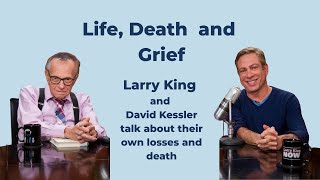
David Kessler, a grief expert whose son died from an accidental overdose at 21, talks with Larry King about finding meaning after loss. He proposes a sixth stage of grief beyond Kubler-Ross's five, and discusses how to support the bereaved and break stigma around suicide and addiction.
Questions this video answers
Meaning.
21 years old.
An accidental overdose.
grief.com
Elisabeth Kübler‑Ross (her book on death and dying — noted as having a 50th anniversary).
Chapters
On larry king now grief expert and author david kessler.
When my own son david died, I thought, I can't stop at acceptance. I need to find meaning. That was the book for me, to find meaning and help other people. Plus, americans want three things in their death. They want their death to be pain free, sudden and in their sleep.
So all next on larry king now foreign.
Welcome to LARRY KING now my guest today is grief expert and author David Kessler. David is one of the world's foremost experts on healing and loss and is the author of five best selling books, including you can heal your heart, Finding peace after breakup, divorce or death. David's latest book is called Finding Meaning, the sixth stage of Grief. It's currently available in stores and online. What got you interested in dying?
When I was 13 years old, I had a mother who was dying in the ICU in a very sterile environment. I wasn't allowed to be in there because you had to be 14. And at the same time across the street in the hotel was one of the first mass shootings in the U.S. so at 13 years old, I experienced my mother's death and this traumatic mass shooting. And there was no one there to help me.
And I knew there should be. So in some ways I think I've taken that and that's been a lot of my meaning to help other people go through some of the worst moments in their life.
Is there a name for the specialty that you do?
Some people call it thanatology, which is the study of death and dying. Others just kind of death and grief specialists. So a lot of people come to this work from different areas.
It's the one thing in the human species that will happen to all of us and we don't know when.
And we are also a society that doesn't know how to do it anymore. I often think I'm teaching people what our great grandparents knew how to do. We're a productive society. We want to get over it and move on. That isn't how grief works. We have to learn to live with it.
Does that mean our great grandparents handled grief better?
I think in some ways they did because they knew it was part of life. Americans almost think that death is optional, like maybe we'll do it, maybe we won't.
All right, the sixth stage. Now the five stages are denial, anger, bargaining, depression and acceptance. What's the sixth?
The sixth stage, I believe, is meaning. And when my own son David died, I thought, I can't stop at acceptance. I need to find meaning. That was the book for me to Find meaning and help other people.
How old was David?
21 years old.
What did he die of?
He died of an accidental overdose. He had been in recovery, doing well in sobriety and had one of those arguments that any 21 year old has with a girlfriend and was dating a wonderful social worker and went out with some friends and used again. And the drugs are so deadly these days.
And you had already written about this, you already been concerned about death when your son died.
I have been a grief specialist for years. And even though I had been a grief specialist, nothing prepares you. Of course. I wanted to write a letter to every parent I'd ever counseled saying I had no idea how bad the pain was. But I did want to find a way to honor him. And I talked to so many story people in this book, got their stories about their spouses, their parents dying, their siblings dying, their children, even pets. You know, I always think that grief is about love. And if there's love, there will be grief someday.
All right, is death different if it's your 21 year old son or your 70 year old mother?
Yes, it is different. However, it doesn't mean that one is better or worse. I always say grief is a no judgment zone. You know, when some people, people will ask me which is worse, you know, this death or that death? I always say the worst loss is yours, the one you're dealing with at this moment. For one person, it may be their 100-year-old parent. For another person, it may be their child, someone else, it could be their house burning down or their job.
How will this book help me?
Well, what I hope it will help people know is that in grief there is pain, of course, but there's not just pain, there's also love. Finding meaning doesn't take away our pain, but it gives us a cushion in addition to it. And what's really important for people to know is the meaning is not in the death. The meaning is what we get out of knowing them, out of honoring their life, out of remembering them.
So the first five still count.
The first five stages, people absolutely go through them. But we always say they're not linear, they're not a map for grief. You don't have to do them in any order, but we go through anger. We go into a period of denial. I can't believe they're gone.
Will I grieve differently.
If my loved one died in an auto accident or if my loved one died of natural causes? Older age?
Absolutely. One we get a little prepared for. We know someday when our Parents get older, they'll die. We're not prepared for a sudden death. So sudden deaths are often harder to deal with. You know, one moment someone was here and the next moment they're gone.
You deal with your own personal grief. You write about it in your book. Has your personal experience helped you understand it?
Good question. Yes, it helped me to understand it, but it didn't take the pain away. People would say, you know, what's it like for the grief specialist to lose his son? And I say, the grief specialist didn't lose his son. The father had to bury a child. So it helps. And yet I also know I have to grieve long and hard like everyone else does.
When we return, David Kessler on his relationship with Elizabeth Kubler Ross and how her groundbreaking research has led to our modern understanding of grief. The book is Finding Meaning. We'll be right back.
We're back with David Kessler. His book is Finding Meaning. A very important. But there was a long period of time when people didn't talk about death, right?
They didn't. It's really surprising. I had the privilege of working with people. For instance, Michael Landon, who was public about it, went on the Tonight show to talk about cancer openly before him. That didn't happen. Elisabeth Kubler Ross brought death out of the darkness.
Tell our audience who she was.
Dr. Elizabeth Kubler Ross was really a hospice pioneer and a legend in this area.
Sure was.
She identified them in her book on death and dying that has its 50th anniversary right now, 50 years since that book came out. So there's a new edition. And I'll tell you, Elizabeth was a very organic, rule breaking, pioneering person. And somehow the stages that we got to adopt for grief have been turned into five easy steps. And she would be appalled by that. We often think of that last chapter as the throwaway chapter. And she said, no, that's an important chapter. So her work has brought about modern day hospice, palliative care, lots of important things. It's changed the way we see end of life.
Why is hospice helpful?
Hospice is helpful because we've gotten this misunderstanding that what helps at the end of life is technology. And we look for miracles. And there is a time in our life when we have to realize if there's a miracle to be had, God doesn't need machinery to do it. God doesn't need medical technology. And there is a time to not be in the hallway when your loved one's dying in the hospital room. There's a time to be at their bedside holding Their hands saying goodbye. And hospice and palliative care knows how to do that.
We're all afraid of it, aren't we?
We are. And it's fascinating.
We don't know what happens.
We don't know what's next. And here's what's fascinating. Americans want three things in their death. They want their death to be pain free, sudden and in their sleep. But here's the reality. When we went back and talked to people who were dying of cancer and said, if you could go back to the day of diagnosis and die that day quickly, painfully, suddenly in your sleep, would you have wanted to? Almost all said no. When we're healthy, we say, take us out of the game quick. But at the end of life, the wind down becomes important.
Do people who are dying, do they grieve for their own death?
Absolutely. Absolutely. I think, you know, they have a lot of goodbyes. They have to say goodbye to their world, their family and friends. The dying person actually has more goodbyes than we do.
You wrote a book that was praised by Mother Teresa, right? Called the Needs of Nine the Needs of the Dying. My first book, what are the needs?
The needs are tender loving care, open communication, to die a pain free death, to die surrounded by your loved ones, to make sure that your wishes are followed by the health care workers who attend you. They're simple things we all deserve at the end of life. I mean, I have like literally Mother Teresa and Elizabeth Kubler Ross to thank for my career.
I remember I had a lot of grief when President Kennedy was killed, right? Someone I didn't know.
And we don't think public grief is real. And yet public grief is because that person, a President Kennedy, whoever it was a celebrity, they helped us know ourselves. They were part of our history too. So when they die.
We are connected with them, even though maybe we never met them.
Why are we so afraid of it?
I think it's the great unknown. I also think we don't talk about it anymore. You know, when I was a kid, we would be driving somewhere and we'd be stuck behind a hearse. When was the last time you were behind a hearse? It doesn't happen anymore. We move the dead around our cities now in white unmarked vans. Americans don't have an experience of death and dying. Death moved into the hospital and we lost that experience.
The problem is it's so freaking final.
Death is. But I also think when someone dies, we don't stop loving them and they don't stop loving us. And we are going to miss Them forever, physically.
Do people who believe in an afterlife, religious people, do they die better?
I think for some it's a cushion. For some it's not. I don't think there's any right or wrong way to do it. I do think that. I personally believe there's an afterlife. I think we're going to see each other again. It may not be like this, but I think we'll connect again. So I believe with everyone I've seen over all the years that we do go somewhere. I don't think energy disappears.
What do you think about assisted death? Quite a few states now have approved it. Do you approve it?
It's a complicated issue for me. The reality is I believe everyone gets to make their own choice. My job is to make sure in hospice and palliative care, we give you such a peaceful death and a peaceful way to leave this planet that maybe you want it or maybe you don't. But that's certainly anyone's right to have it.
Whose life is it anyway?
Right? It's the person who's dying. And a lot of times when we say that person's dying wrong, I always say, just remember, each of us have our own death just for us when our time comes, to do it our way.
Wow. Next, why people grieve differently and what you should do when someone you care about is going through the grieving process. My guest is David Kessler, and the book is Finding the Sixth Stage of Grief. We'll be right back.
We're back with David Kessler. The book is Finding Meaning.
Do we grieve over divorce? Not just death.
No. It's all things. So, for instance, a divorce is the death of a relationship. A breakup is the death of that relationship. A job loss is the death of that work environment. They're all griefs. One of the mistakes we make is we think, my loss doesn't count. Your loss counts. Whatever it is, all tears count.
So grief is universal, and it's often.
A change we didn't want to happen.
And someone isn't there anymore.
Correct.
That's awfully hard for people that I would gather to take. They're not there.
It is. And part of our work is to witness their grief, to see how hard it is without that person at the dining room table. Sometimes we give spiritual answers to human questions. Someone goes, I can't believe I eat alone every night without my spouse. Our job at that moment is to witness their grief and see how heartbreaking not to say, oh, they're always with you, because then we miss Their pain. Sometimes people will say, after we've seen their pain, do you think they're still here? Then we can have those conversations.
You have a website, I understand, grief.com.
Visited by millions of people who are looking for help. Because we can connect in grief online now in many different ways. You know, the Internet has become the town square in some ways around grief and loss.
We also sometimes judge other people's. I know you write Jacqueline Kennedy didn't seem to cry.
Right? And what I really wanted people to understand is Jacqueline Kennedy talked about that was her role as the first lady to be the strong person we saw behind closed doors. She absolutely did cry at the death of her husband. But we judge people's grief, that that's how grief should look, or it shouldn't look that way. And grief should be a no judgment zone. There's no right way to grieve.
I nearly died this year. I had a slight stroke and I was out. So I didn't experience any of it, but my family did. And people told me that they don't believe I'm alive.
Right.
What is it like when you get close to it and then you sort.
Of beat death, Larry, that's the question for you. What is that like?
It's weird.
It's weird. Did it change you in any way?
Don't know. I don't. I don't.
I love the honesty of that, you know? Yeah.
I don't know.
And you have more time here. You know, each day we get up, we've been given more time. And today you're using your time to help millions of people.
I had a famous Swami, Satya Dananda, tell me once that when he opened his eyes in the morning, that was a gift.
And he didn't do anything to earn that gift.
Correct.
So what did it matter if it was raining or if the toast was burnt? He didn't deserve the day.
Well, I think people that have gone through grief and hardships don't sweat the small stuff as much. Do you fear dying any more or less after your experience?
No, I don't think so.
Do you fear it?
Yeah. Oh, yeah. Because I don't believe there's anything else if there's nothing. See, you believe there's something else.
I do.
So that makes it easier in my thing, in my thinking for you. It ain't easy for me.
But if there's not anything, then your story will be over and you'll be at peace and there'll be nothing. And yet you would have left behind this amazing body of Work that will go on forever and ever and always change the world.
I don't think about that.
Well, I do.
Death of your son, I would imagine that's the biggest grief of all. The death of a child.
It's brutal. It's brutal. And I have to be with that pain. I can't make it any better.
But I can find meaning. We're not finding meaning in his death. I find meaning in his life. You know, these days, every kid in kindergarten gets an award, and he got an award for the most likely to be a helper. He didn't get to have a life where he got to help people. My hope is in finding meaning, he gets to be that helper in death that he never was in life.
The book is Finding Meaning. The guest is David Kessler. Now, final moments. He'll answer some of your questions sent in over social media. We'll be right back.
We're back with David Kessler. The book is Finding Meaning, the Sixth Stage of Grief. Some social media questions. Sharon Duquette on Facebook. I'd love you to speak about the way parents and family members could feel less blame and shame over suicides and overdoses from addiction. As it seems to me society shuts down even more with these types of deaths.
Horrible stigma around death by suicide, mental illness, being mentally compromised, addiction, and. And one of the mistakes we make is we blame the victim. And modern science is telling us that dying by suicide, dying by being mentally compromised or addiction are real illnesses that the brain experiences. And we all had an old way of thinking that people choose suicide or they choose addiction or can say no. We know that's not true anymore. No one in their right mind would choose those things. But that's the key. Their mind is ill. Is there a.
Common thread through suicides? I am always amazed how anyone could take their own life.
Well, here's the thing we know now is that people who have survived, they attempted a death by suicide all tell us they did not want to die. They were trying to escape the pain. So it's about pain for them. It's not about death. And to me, the meaning is us finding better ways to deal with addiction and mental illness and being mentally compromised. That's the meaning we have to bring forth to change the world.
How come with suicide, many people will say, he was happy. He gave me no reason. He left no note. Why did he do this?
Because we put up a facade now and we make it look like we're fine and we don't know how to be vulnerable and tell people with social media and everyone's looking great and having a good time, that life is hard sometimes and we have to be okay with the valleys people who are unhappy and sad and having a tough time. We need to help them feel safe enough to speak up.
Joandrea Da Cuba on Facebook. It's been almost three years since my stillborn baby became an angel. I've been diagnosed with PTSD and depression. My question is, now I'm going to therapy for PTSD and depression. Is this part of grieving? What's ptsd?
Post Traumatic Stress disorder. She's naming. A lot of us get post traumatic stress when a death or something bad happens in our life or trauma. My work is to let people know post traumatic growth happens even more. And so in her case, I want her to know and I don't know her clinically, I'd want her to know that there is a normal despair, there is a normal depression and sadness that will happen when your baby dies.
Christine CR on Facebook with the amount of violence in this country and deaths from mass shootings, drug overdoses, suicides, how does a person find meaning in this sixth stage?
Great question. The meaning is not in those horrific events. The meaning is what we do after. What do we do about these shootings? What are we going to do about addiction? What are we going to do about mental illness? The meaning is what we do after the person dies to honor them, to make the world safer so that other people don't continue to die that way.
Do you know why people shoot up schools?
People shoot up schools, I think because they are mentally in pain. They have access to weapons they don't know how to be responsible enough for. And we have to learn we're our brother's keeper. You hear? After a shooting, that kid was quiet, that kid was strange. But none of us said, what's happened to you? Not what's wrong with you, but what's happened to you that makes you not talk to people and not connect with other human beings? We have to make this world change by becoming our brother's keeper.
Best GW on Facebook do you find children have an easier time finding meaning than adults?
I worked in Children's Hospital years ago and in Children's Hospital, kids would be less afraid of dying. They would be less afraid of dying than their parents.
Why do you think?
I think as we get older, we get more afraid, we get more fearful, we get more attached.
So kids handle it better.
Kids seem to. It's. They do. And it's heartbreaking for us. Heartbreaking for us and sometimes we don't want to tell them the truth and the reality is it's better for kids to know.
Do you find that same best GW on Facebook Also, do you find that certain cultures have an easier time coming to terms with or finding meaning when their loved ones transition?
Some others do you know because they see the dying more than us. There's countries where you see people going to funerals and being created. We have being cremated. We have such a separation from death that we don't see it in our world until it happens to us. And then we're so unprepared.
To talk to you forever. Thank you, Paul.
Larry, thank you for your work.
Oh, thank you. The guest has been David Kessler. The book is Finding the Sixth Stage of Grief currently available in stores and online. And as always, you can find me on Twitter at kingsthings. I'll see you next time on LARRY king. Now.










