Psychotherapist, Esther Perel and grief expert, David Kessler discuss grief and trauma
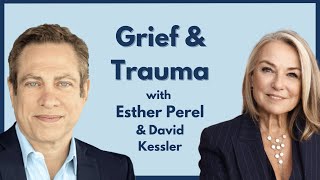
This content was created by David Kessler. This content was uploaded by David Kessler. This is a YouTube video titled "Psychotherapist, Esther Perel and grief expert, David Kessler discuss grief and trauma" created on June 13, 2021. It features a conversation between David Kessler and Esther Perel discussing various aspects of grief, trauma, and healing, including personal experiences, the impact of COVID-19, and the importance of rituals and acceptance in the grieving process.
Chapters
Hi, everyone. David Kessler here. I'll give everyone a few minutes to find your way on. Thank you for your patience. We were a little delayed because of my Internet, so I so appreciate your patience and thank you, Esther, for Europe patience and.
Keeping going through this. I think I unfortunately kept you from a swim.
My Internet company. And on behalf of them, I will give you an apology for that.
We have the appropriate amount guilt.
Thank you so much. I appreciate that. Folks, as you come on, please find your way and let me know when you're here. For any of you who may be tuning in for the first time, I'm David Kessler. This group was started after COVID 19 really took hold in the US so many people were unable to go to grief groups. Their grief groups got closed. Then people found themselves with loved ones who were dying. They couldn't say goodbye physically to them. Then after they died, there were no memorials or rituals that they were able to do. So we looked for what we could do when we could at least gather virtually. So we've been doing that ever since. And I don't believe there's one voice in grief. So that's why I'm so thrilled to have different guests on and every night we have different people on. And tonight's the wonderful Estea Perel. So I'm excited that you're here, and let me see if I can find myself here so we can begin to chat with people. All right, let's see who's here. So far we have Amy's from Albany, New York, Fiorella from New Jersey, Anna from Yakima. I'm not sure where that is. You'll have to tell me. Sandra from New York, Daniel from Wheeler, Illinois, Jennifer from New Jersey. Diane from Fort Worth, Texas, Rob in New York. So many wonderful people hopping on from the Bay Area. Welcome, welcome. I'm glad you're all here. So we often take. We always take a moment. You know, we're all here because someone we love has died. And I like to just take a moment in silence to honor them, send their love. Send them love. I don't believe when someone dies, we quit loving them. Nor do I believe they quit loving us. So if you join me in just a moment of silence in honor of all those who have died.
Thank you so much for that.
Stair. I'm so excited you're here.
Thank you.
So many people know your work as I do, and I appreciate you coming on.
I certainly, you know, I've heard your beginnings. You've had.
Connections with loss for a long Time. I'm curious, when was the first time grief registered in your world, in your mind, in your psyche?
Whoa. That's a surprising first question. I would say the first time, I must have been about four years old. Three. Four years old. No, probably four. And I asked my mother why I did not have grandparents, why there were no uncles and aunts or cousins, why there were just the four of us. And my mother very factually answered me, they were all murdered in the concentration camps. And there was not much attention to child development in my family. Things were just presented as is.
And then slowly I began to register. You know, I would see all the numbers on the arms of the people around me and just this notion that it wasn't one person that had died, it was just about an entire. An entire people. And.
That notion that, you know, my life, therefore, was going to be, you know, it had been a kind of a symbol of revival and survival and that. That there was a lot of history on my shoulders.
What does that do when, you know. You know, one of the things that parents always want to do is not tell kids anything bad.
That notion of, let's not tell her till she's much older is kind of how we do it now. Do you think it was helpful, you just hearing the information and the facts?
I don't know if I would say that it was helpful, but it was demystified. It meant that death lived amongst us, loss lived amongst us. The decimation of an entire culture lived amongst us. And the regeneration of all what had lost also lived amongst us. I think it's really. I don't know other. I have never known it differently when people say, you're too young or I wait till you're older. They say it about sex, they say it about death, they say about money, just about all the unmentionables, all the big things that really matter. You told that you will be told at some point later on, which, of course, is that that philosophy in and of itself means it will never happen. Because it means that there is a lot of anxiety on the part of the adults to actually have those conversations. So in a way, it allowed me to then come and say, what was their names? You know, what did life look like? Do you have any pictures? Of course, there were very, very few pictures, but there were some. And, you know, there were very clear days when we commemorated their birthdays, you know, certain anniversaries. And at least I knew why they became somber. I knew it wasn't shrouded in this kind of mystery. That tells you something big is happening. But you shouldn't ask which happened in other homes, by the way. It is just that it allowed me to. So in that sense, yes, I do think it is helpful. I think that every child understands the big things of the house. They don't always know what it is, but they feel, they understand the sensation, the tension in the house. And if it's open, then you just ask a question and you get a little answer that is age appropriate and you move on. If not, you learn not to ask, but you feel it and it enters your body and it just becomes a kind of an internal being inside of you that is amorphous, unexplained, but deeply present.
And I think people don't realize when kids think, feel something, as you mentioned, we internalize it, that it's something about us, maybe we've done something wrong. These secrets are something I may have had something to do with. So.
I'm sure that's brutal information to have. But I think I'm often telling parents children need the truth.
I mean, in a way, the truth is easier than the sense of grandiosity and self centeredness that children have. Children do believe that in a superstitious way, that they have the power to make certain things happen and not happen in their imagination. And death, if it isn't articulated, becomes a space for dark imagination.
And in that sense, I think that the truth is actually lighter because it just is presented. As a matter of fact, it says whenever you need to talk about it, we talk about it again. And generally what children will do is they come for little homeopathic doses. You know, they sit in the back of a car or they're lying in their bed and it's a moment of more vulnerability or it's a moment of parallel play, you know, as they drive and look forward and they don't have to deal with the eye contact. They're sitting in the back and they just ask you a little question and you kind of turn around and say, oh, what? And then you answer and then they're on to the next thing. They just need the pieces of information that help them organize reality.
Yeah, many people think that children sort of consistently stay in pain, kind of like we do. But kids go in and out of it and in and out of it.
Correct, let's say agent is the major moment, by the way, because age 4 is when children are naturally theologians. They ask you, where do we come from and where do we go? And at that moment, you know, if you simply answer it and depending on what you think happens, you know, do we go to heaven? Do we go in the ground? Do we re. Enter nature? Does the soul continue to live? Do we live inside of other people? There's a number of different stories depending on our own beliefs. Sometimes we don't really know what we believe, but we tell something to the child that is reassuring and they move on to the next thing.
Right? One of the things I have a lot to ask you about, but about grief and loss and death. But before we get there, I'm so aware, because this has come up for so many people, we have such an amazing expert with us on infidelity that we have many people in this group that find out about an infidelity after their spouse has died. And so they have the task of reckoning with this in their mind without their spouse.
They obviously go through many things that you work with people all the time. Was I this? Wasn't I not that?
What would your advice be to them as they struggle with that after the fact without the spouse to engage with?
It's a very complex question, you know, that I don't think I would do justice in this short amount of time. But the thing is this, an infidelity or an affair is not the total definition of your marriage.
People need to know that you may have had a very loving, caring, loyal, although not faithful relationship with this person who also had an affair. It doesn't invalidate everything. I think that's really important. People go to their grave with all kinds of secrets. Some go to with the secret that they were raped. Some go to the. With the secrets that all the maniac went on. Some go to the. So it's about the secret. It's not just about, you know, the betrayal and the violation of the trust. And for some of us, it's the violation of the trust. And for some of us, it's a sense of betrayal. For some of us, it's the fact that we felt duped, and others it's this lying and the secrecy. And others it's just simply a question of, you know, what did it say about us? Did it rewrite our story? So you ask yourself, you know, what is the piece here that is really the one that kind of, where does the knife cut? You know, where does it hurt most? I think that that's because there's loads of different kinds of hurts around infidelity. You know, what is the pain point that will help you then understand what you need to do and then to understand that, you know, sometimes affairs happen Also, in very good relationships, it's not always the symptom of something missing in you or missing in the relationship or missing in the other person. It's often. It's complicated. It's complicated where people will at times, you know, turn to the kindness of a stranger almost as a way to preserve their relationship. I mean, it is a. It's a very twisted thing to say it like that. But what I do invite you to do is to know that.
The whole relationship, the 25 years before don't get invalidated because this happened. What you think was, was the moments that were good were good. The moments where you held each other and where one of you said, I love you were real and that resist this notion that the whole thing was a fraud and the whole thing was a lie because of this one thing.
Right. One thing I'm curious to ask you about along those lines, and I'm not.
Justifying anything when I say that. I just want to add that, you know, I've studied infidelity for a decade now, but sometimes when one tries to explain it, when it quickly can look as if one is justifying it. Absolutely not.
Right. What I see many times in people in grief that I've worked with at times in myself is, and we do this in all areas, just like you mentioned, we take the last. Whether it's an infidelity that came out, or maybe they didn't have a good death or we weren't, and we just make that the whole relationship. And you know, I talk about, you have so many days in your lives. The day they died was one. And maybe you have 40 years of marriage. The day they were unfaithful, maybe one, or maybe the affair was, whatever it may be, but just like you say, we tend to stretch it out and look at it just through that lens. But I often see how easily we can get stuck in that bad moment, whether it's the bad death or the infidelity or I forgot to say I love you with that day or whatever it is. And it seems like to me, it reckons to old wounds that often haven't been attended to.
Does that resonate with you in some ways that if you, if someone says to you, yes, I hear you say about there was still, but no one can love me, he never loved me, I'm unlovable. It seems like to me they've gone and there's bringing more into the mix. And I guess we always bring our old wounds into the mix.
I mean, look, if, if, you know, what happens is A relationship is a story.
And we all tell a story about that relationship. And pieces of information we're going to use either to validate or to disqualify deep beliefs that we have about ourselves. I was lovable after all, you know, I was able to say goodbye until the end of a person. I was there exactly the way I wanted till the last moment. I am a good person. And whatever I was told by my childhood has finally, finally been rectified. And then the reverse, I was not able to be there. And whatever I was told in my childhood or I found out that my partner had lied to me or had cheated on me, and I realized that I always wondered, I always thought he would leave me, she would leave me. You know, they would leave me. Whatever the gender fluidity here, it's really. They would leave me. And it got confirmed. So we live with deep beliefs about relationships and deep beliefs about ourselves. In it, we all grow up. I call it the unofficial resume. It's our relationship history that goes with us to every situation and that it becomes the lens through which we will often interpret the various events of our lives. And what's so interesting is that it's not the egregiousness of the event that will determine people's reactions. It's the predisposition that they bring to the event that actually will determine the intensity of their reaction.
Did I say that?
The predisposition or the intent they bring to it.
It's a small. A small tear.
Right.
You know, can be cataclysmic for some people. And a big tear can actually still find its place in a story of a person. It's. It's what. It's a combination of the thing that happened with what I bring with me and how I'm going to receive this event in my life.
Right.
I don't. It's a very. You know, it's not an easy thing to explain like that, because. And why. Because if you say that it has something to do with what we bring.
The very people who do bring will more likely than feel like it's blaming the victim.
Right? Right. No, no, not at all.
Instantly become. You're saying it's me. No, it's not.
No, no, no. Right. But we all show up with our past just like the person shows up with their past. Yeah, we all. It's not just the person who was betrayed that has a past. Everyone brings a past to every dam.
Here's the way I would say. And I think that that is a lot of. With loss, death, and the grieving thereof, everybody. I think when we choose a partner, have a kind of an official reason why we were drawn to that person, what attracted us to that person, what we've built with that person. But I also think that in relationships, we often have an unspoken bargain. It's the invisible deal that we made with ourselves.
And sometimes that deal is, I picked you because you would never. I thought you would never leave me. I picked you because I thought you were a good person. Even though I knew that we would have a zillion other issues, but the one that really mattered to me, I felt really safe about. And that invisible bargain, when it gets broken, the invisible deal that I made with myself, that often will influence the way that we are dealing with the loss, if it is accepted or if it becomes a conflictual, fraught experience of loss, because, you know, the way you went.
Didn'T fit the deal that I had made.
Right. There's also the lost opportunity to get to work it out with that person when they die. I also want to go and talk for a moment about Elizabeth Kubler Ross. That was my teacher, did two books with her. And I was honored to work with her on adapting her stages from.
Dying to grief. And as I always say, as she would always say, they're not a map for grief. They're not linear. They're organic. You don't have to follow them. There's no one grief model. The stages, for anyone who doesn't know them at this point, are denial, anger, bargaining, depression, and acceptance.
I've heard you talk about acceptance. Why is acceptance of situations in our life so important?
Look, you asked me at first, when was my first experience with grief? And, you know, it's interesting because I'm much more known as someone who speaks about aliveness than someone who speaks about grief. But, of course, my whole work about aliveness in many ways has been a response to this grief. You know, what is the difference between not being dead and being alive, between surviving and thriving? So both my parents were Holocaust survivors who spent five years in concentration camps and then were another five years illegal refugees in Belgium. So they were alone. They lost 200 people combined. They were the youngest of a family of nine and a family of seven. And their entire community was the same. It was. So loss kind of came with mother's milk. It was injected. It was. And I try to watch these people. How did they stay alive? Because it's only the strong ones that stayed alive. That's a given. What made these people wake up every day five years in A row in freezing weathering camps and still want to live. What did they do? And one of the things they did is they imagined that the other people were living and waiting for them. You know, it was an exercise of the imagination. It certainly was nothing happening around them that made them want to stay. And then when they did come out, then they wanted to at least do justice to those who had made it so that they were going to live life at its fullest, because all the others didn't have the opportunity to do so. And then I asked them, you know, what did they do sometimes when it would grab them like that and just they would capture the magnitude. And then I understood the power of repression. You know, it wasn't really smart for these people to get into their grief on a regular basis to mourn. They had rituals, rituals took care of the level of emotion that they brought to loss. But it was contained. A ritual was contained. So what were the rituals? It was memorial candles, it was planting forests. That was a major thing. Creating things that were going to live, you know, putting plaques with the names of the people so that they were named, so that they had existed, so that they didn't just vanish in smoke, meeting other people who had come from the same places with whom they could speak, speak about their past and create a thread of continuity of their life. So witnessing became a major part of the grief experience. And sometimes they came together to mourn, and sometimes they came together to celebrate. Same people, you know, And I think this is a community from which we can learn a tremendous amount. Why? Because that community actually was the first community where the concept of adult trauma was ever applied. Until then, we thought trauma happens the first five years of one's life and then afterwards you die. Nothing bad can happen.
So studying this community, which, by the way, never went for mental health services. Never. So they did it on their own without really understanding what they were doing. But they had their natural healing powers that they cultivated. Their resilience, if you want, was really sharp. It was really sharp. It's what every research has found out. Afterwards, you know, like you were talking about how your partner does grief yoga. My mother went to these places where you did thalassotherapy, hydrotherapy, you know, long before anything was written about, you know, water, mud, hot, cold. But they understood the need to create sensation on the body that will kind of, you know, shake up the parasympathetic nervous system without any science behind it. And that's what I've watched the whole time in terms of understanding how I Think one of the things you often say is that the grief experience is either done together or alone. I have never seen it done alone. I've actually only witnessed the power of the collective in this sense. This is why we are here tonight with a group.
So there's a lot in there with what you just said that's so powerful. First of all, it's interesting. You know, I'm thought of as someone. As a grief specialist. I actually think my work is about life. And we were talking before we came on about the idea of being on the road, and we're not on the road traveling. One of the things that I always tell people that's fascinating is, is when I was doing lectures, we would do them in a hotel. There'd be a big meeting room, and sometimes after everyone was gone, the cleaning crew was there, and we had been in one meeting room, the accountants had been in the another meeting room, the Spanish for healthcare provider. And the cleaning crew would say, what was your group? And I would say, why? And they would say, because your group was laughing the most. And I would say, grief. And they would say, what kind of grief? And I would say, that kind of grief. And I think there's something about grief that stretches our bandwidth for pain and for joy. And the joy part we often don't talk about.
Right, right.
That really was what led me to the sixth stage, that after my son died, I didn't want it just to be acceptance. I studied Viktor Frankl. I wanted meaning. I wanted people to find meaning. So, so many people.
I do see them getting stuck in the grieving, and life seems like a disloyalty.
And that seems somewhat new. Is it? Or is that we just see that.
Interesting, If I tell you so, here's how I would say this. When I wrote Mating in Captivity, which was a book about how we maintain a sense of aliveness, eroticism. Not in the sexual sense. Aliveness, vibrancy, vitality, radiance, curiosity, playfulness, imagination. Those dimensions of life. Right.
I really went back, actually, to Antwerp, Belgium, where I began to describe to my husband that I always noticed that there were two groups. Now, I applied it to this community, but I think you can apply it to every group, that there were two kinds of grief processes that I had observed. Now, I didn't put this in words until I was an adult, but I remember vividly the images. There was those who. I would go to their house and it became morbid. The curtains went down, the lights was low. You felt that the people were not dead, but that they lived very tethered to the ground. The world had become a dangerous place. You couldn't trust anybody and you certainly couldn't be alive or playful or laughing or experience any joy or pleasure. Because you can't do these things and be vigilant at the same time. You cannot be on guard and have fun.
It's like if you let go and you laugh, then you're not looking at the danger. And the other group were people who lived in the same world, but in some way had understood the erotic as an antidote to death. Staying alive is a way to deal with death. It's actually not a way to deny that death has happened or to be disloyal to the person that you lost. It's a way of saying, I carry this with me and eat. Energy energizes me. It becomes a death defying experience, that aliveness. And that is where you call it meaning. Meaning is a complicated thing. Because when people feel that the death was unfair or unjust or gratuitous or what a waste or should have been prevented, what meaning can they find in death, right?
But I already tell them in that moment, I try to clarify that no meaning in the pandemic or a virus, there's no meaning in a cancerous death. The meaning can be our response. The meaning is what we do after.
That's right.
That lives in us, not in a murder, it lives in us after.
The meaning is the more you live life at its fullest at that moment, the more you actually give meaning to the life that was no more. It's really that connection that is very challenging sometimes for people to make because they say that I can be the closest to this person if I myself start to live, you know, in a subterranean level. And I am saying, no, on the contrary, the greatest vengeance on the gratuitousness of loss is to make your life as full and as embracing of the life that is no more as can be. And once people get that, they get the permission. They get the permission. It's really that to live again and to enjoy life again and to understand that the enjoyment of life is not a betrayal of the deaf person and of the loss, but it's actually.
Giving the honor to that loss.
Right? And of course, for anyone who's listening and is newly bereaved, that doesn't mean we're saying early on, you're. Of course, that's. When it is dark, it is sore, horribly painful. But I often say we have two jobs. Grieve fully and live fully.
Right? It's kind of the last of everything and the first of everything. It's almost usually a year where you get to do the first time that you do everything that you used to do with that person and at this time you're not doing with them and then everything that was the last time that you did with that person that you're not doing again. And I think it takes a calendar year actually, which, you know, some religions really figured that out and put it in a one year calendar too. But.
And it's interesting, you know, I think that got misinterpreted by some people in the world that grief ends at a year. And that's not. But I do want to say one of the things that I always found fascinating about that year and I saw this more.
I see my Internet going out, but I saw this more in the Jewish religion that when you went back at that year, it wasn't that anyone said your grief is over, but there was a sense that you could be allowed to live again.
Correct year, correct? Correct.
And there's no marker anymore that says now you may live.
Actually, not just now you may live. Now you may celebrate life, right? You can always live, but now you can celebrate life. You can re engage with the generative quality of life, the one that brings, you know, birth, new things, regeneration, replacement. The first year you deal with what is going to leave you and after that you can replenish with new. But that doesn't mean you stop grieving. The grief is a feeling. The morning is the set of rituals that we do about the loss.
I also see so many people, I think this is where the trauma comes into it that they feel like someone's died. It's just a moment until someone else dies and they stay in this fear. And I always say fear doesn't stop loss, death, fear stops life.
Right?
We, we still, we have to go on in, in spite of that fear in honor of the person who died. But I think sometimes we can get stuck in the, the traumatic moment we stay in it.
Because I think that when you get hit and you go into a state of contraction, right then you, you, you, you know, to do this again just to open to, you know, is a, it's actually a physical experience. You know, it's a. I don't always know why one person stays in that vigilant, contracted state that just says, well now I'm prepared for the next thing. Just, you know, keep hitting me versus those who, after a while, you know, the best honor you can give to a person with whom you have had a loving relationship, especially when it's a positive relationship, is to be able to experience that another loving relationship because you carry inside of you the story that you had with the person before. To stop loving or to stop coming close to someone. You know, it's a very interesting thing that I also would ask my parents. It's like, you know how this is a community of people where everybody, the day they were liberated, met somebody and they would say, I'm alone, you're alone. I've lost everything, you've lost everything. Let's get married. These were not people who had attachment fears. I mean, they just. And then the next thing they did is they had babies. Because to have a child showed them that they were still human after being so dehumanized. So they did these major life affirming things that were part of their grief. They didn't deprive themselves of that. They knew that they needed to rebuild and they threw themselves in it with vengeance and often did not talk about the loss because they were so busy building, building, building. When they became older and they had done the building, that's when they began often to tell the stories. But I think that there is no more beautiful way to carry someone inside of you than to experience with someone else those amazing things that you developed in your other relationship.
I think on some level also it is sometimes a conscious, sometimes an unconscious decision we have to make. I was very conscious about it. I had a lot of people after my younger son David died saying, are you going to be able to do grief work again? Can you still do this? And one of the things that I thought about that I do have to make these decisions. And I thought about my son who by the way, loved my work and was so proud of it. And I thought, would he want his death to constrict my work or to expand it? And so for me, like you say, I expand it in his honor.
And sometimes people don't like that idea of there's a decision for them to make.
And an expansion would not be good.
So I do a lot of things in my own work, with patients, in my office of letter writing, right? Letter writing. I think that speaking to the dead is essential. It's not a sign of madness. We talk to people, we have voices inside of us. And we don't just have to do it when we're dreaming. Sometimes it's going and putting those letters on the grave, if there is such a thing, or just sit on the water. But it is about being in Conversation. Sometimes I do an empty chair. I put the person in the chair, and I have them talk. And then I had them reverse role so that they can actually hear the answer, so that your son could actually tell you, I actually do want you to continue. And then you just see them because they're sobbing and they're not with me. They're totally talking to that person, and the conversation liberates them. It's like in the role of the other that says to them, go on. Continue living. Stay with your craft. You have to continue playing music. You have to continue to. You know.
They create a continuity, in a way, with the person, and they internalize that as well. So I think a lot of enactments, especially in the beginning and at transition points. And at transition points, you know, I had a woman that I worked with, and she had transition points. Every time she had to make a big decision, she set up an altar, and she went to talk to her, and she talked to her wife and just asked her every time, you know, I'm talking about going like that for the schools, what you think. And then she'd have this whole enactment conversation. And, you know, anybody who would look from the outside would think, what is that? And I just thought, so beautiful, so ingenious. You know, big decisions. She went to check with her.
And it's so. I think, you know, interestingly enough, we talk about continued connections. There was a time that was frowned upon, I think, very mistakenly, that that relationship is supposed to end. And I think a healthy relationship continues. Someone told me once their therapists, and there's very few therapists that would do this, you know, that have them write a letter of goodbye. And I'm like, you had a big goodbye. You don't. There's not a disconnection we have to make you. It's been disconnected already. One of the things we have to talk about right now.
Visuals are so important. A ritual helps us visualize the loss. I think, in our modern world and in our current. Current world. I look at the number of people who have died from COVID and I figured this out. If you took that, it would be that number 110,000. That would be like 724 planes crashing in the last two to three months. If a Southwest plane crashed, and I love Southwest, but if one was crashing every two hours, we would be in a state of, my gosh, I don't even know what we'd be in a state of, but we'd be in a state of something. We don't have these rituals And I think when we look at race relations in this country and we had the visual of George Floyd, that visual woke people up who needed to be woken up. Talk to me about the importance of these rituals and a visual for loss.
And you're talking about a few different things here. So here's, so here's the thing. I live downtown Manhattan. 911 struck. My kids were literally in the school. There were 3,000 deaths. The entire downtown was filled with pictures, candles, images of the rescuers, of the victims stories. I mean, you couldn't have something more ritualized, more almost fetishized in the way that it was there for everybody to witness. This is an incredible thing, that 110,000 people. We had to remind the president that maybe he should lower the flag. So this has been highly political and this is really also a situation where we know from other countries these numbers did not happen in most other places. This is not something that was inevitable. And so it really creates a very complicated set of reactions about the nature of the death itself, the anger that accompanies those deaths. So it has to be said, it's the invisibility, it's the lack of acknowledgment and it's the politicization. Then comes the fact that on top of it, on a personal level, there is. You can't say goodbye. That whole piece of this, you can't hold the person. And then you have to have these online commemorations, these online funerals, which really, instead of all the time talking about the lack of it, I think that the fact that people so quickly were able to create these online ceremonies that they could record them, which usually people don't record funerals, record weddings and birthdays, but not funerals. And could hear them again. I actually think they were rituals, but they were not embodied. You couldn't hold, you know, holding such a major part when you need to sob and you don't want to talk. And that was the thing. People could not have that level of expression. But I don't know that as a whole we have completely lost the power of the ritual. In addition, on top of it comes the fact that the death are not equal. The death affected the people who were essential workers. And the essential workers were people that until then, people had often not valued nearly enough. And then comes the killing of George Floyd, but there comes the invisible killing of Breonna Taylor and the violence against women. And the moment racism isn't new, it's the fact that it was filmed. So finally, suddenly, we wake up yet again to the Violence here. And at that moment, you know, I think that there was such a clash where the anger took over from the. From the sadness, from the grief, from the emptiness, from the loss that. That became the energy, just like the unfairness of it. The.
Authority. And since you cannot go.
At the bigger authority, people went at the authority that was right in front of them. You know, you fight the one. You fight the one that's right there. If you can't find the one that actually holds the strings and everything like that came together.
Right? And I think a thread that connects with why we're here is grief must be witnessed. And we didn't witness the 110,000, because there weren't 110,000 caskets and funerals. And we didn't witness as blacks were being unjustly killed and treated until we could no longer look away.
The grief must be witnessed, but the death has to be acknowledged, and even the numbers have been played with. So then you feel like. Then you start to really feel like, which world am I living in? Which reality are we talking about? The truth isn't even agreed upon.
Right, right. Exactly. Exactly. If anyone wants to ask some questions, because some people asked if they could ask questions, send a question. And I think about.
How does opt. And I think we kind of talked about this in some ways about how does optimism live in this modern world with these sets of conditions?
Because I think it is a lifeline out of this.
So I'm gonna say it like this. I think that one of the places where you can get a real granular feeling, just for those of you who are interested in this, is in my podcast. Where should we begin?
By the way, I put it up for people, right?
I put this. I did a special series of couples under lockdown that were dealing with grief and grief the way you had defined it, David, which wasn't just because with the grief of the death of a person, that's one thing, but then comes the grief of the loss of the world that we knew, of the reality that we imagined, of the future that we had planned for. So it's that bigger sense of loss. And I tried to capture that in some of those episodes of couples under lockdown. So it's anywhere where you listen to the podcast. And where does the optimism in this moment come from, exactly? From the very place where we just ended in the previous question. I think that an enormous amount of the demonstrations worldwide, because this is global, is a combination of people just saying enough is enough, and people having a sense that maybe this time Something could really change. That's optimism, you know, that actually the wrong will be righted by making this world a little bit of a better place. Be it socialized medicine, be it, you know, affordable childcare, be it unemployment, be it the things that make people feel that they are not completely alone with all the big burdens of life, that there is a system that really protects them. And I think that that's one piece of the optimism in this moment. I think the other optimism is the most beautiful love songs and love poems were written in sometimes in the most dire of circumstances. So we don't stop loving because we are. Because we are bereft.
We don't stop loving our children because we lost our partner. We don't stop loving our other children because we lost one child. We have this amazing capacity to do both at the same time unless we suddenly shut down. But if we. If we hold on to the one that is in front of us, you know, we. We feel like we are in the middle of life and death at the same time.
Right. You know, one of the things I think about these days that concerns me about when we talk about the grief of the world were missing and naming it grief, is that I was talking to different friends and it feels like we're all waiting for the bell to ring, to go back to our old life. And I tell people, I don't think there's a bell. It's not even. When is it going to ring? I don't think there's a bell. There's not a moment even. The other day I went out. I went to walk down my street where there's beautiful restaurants and stores. You see them beginning to close. You. You see them boarded up. It's the world we knew isn't coming back.
But there will be another word.
There will be another world. World. And it will be different, and it will be meaningful. And I think that's something that, like, you know, when you think about the people who came out of World War II and concentration camps, they had a sense. No, no, that world is gone, but we're going to rebuild a new one.
All right?
I mean, you know.
It'S a very. It's. You know, what's so interesting is that we're going back and forth between a conversation that tries to be humanistic and philosophical to one that becomes psychological, to one that becomes political. And this is how these things are interwoven. And ever more so at this particular moment, the world many times has been destroyed and many times has been rebuilt. And so far you know, some people think there will be one day the end of the world or the planet as we know it. But till now, we've always been able to come back with something, but we don't generally go back. We move on to something else. And. And then when it sits for a while, we think that's the way it's always been, right? But it isn't.
And that's what grief looks like. That is, you know, coming back to the grief and living that we don't get to. You know, it's like the door closes behind us and we all reach for it. We want to reopen it, but it's. It's no longer. We can't open it anymore. There's only the door in front of us.
Patricia asks, I've lost so many people, including my parents, now my daughter also. How do you heal your heart?
I don't think you heal your heart. I don't know that. That. And certainly not when you say now also. I think.
You know, for some people, and there is a thing that sometimes there is a reason that I'm still standing, what's expected of me at this moment. Maybe my task at this moment is to remember them, is to be their witness so that I remember that these people lived. Maybe my task is actually that because I learned to become. To be so close to people and to be. And to have good, loving relationships with them. I one day will meet somebody who has been looking for me who didn't have what I had, and a child who didn't have a mother or another person. And I will become. I will have purpose because I will give to somebody else that which is now available, and I have nobody to give it to. I think it's those kinds of transformations that gradually start to kind of heal that heart. But I don't know that I would say it's a healed heart. I would just say it's a heart that continues beating and wants to wake up in the morning.
And, you know, so many times I think we look for the meaning and the purpose, and we look in us like, what's my purpose? And people are feeling lost and in grief. And, you know, sometimes people go, life owed me. And I'm like, if you want to find your purpose, you owe life. Look around what's. What's in front of you. Just like you said, you know, that.
I, you know, my son died. There's other people who need to be fathered, too. And it's in honor of my son. If there's other things I can Do.
But how long did it take you, David?
Taking me. Taking me, still taking me.
Good. All right.
I think.
But there is a darkness that certainly was all encompassing for a long time. But I knew early on.
If I'm alive still, I wanted to really live.
So it's one of the, you know, it's sort of like you're just like you say, if your heart is beating, you still do have life. What will you do with it? Orna says I didn't have grandparents because they vanished in the Holocaust. I grew up around death, but losing my son three months ago, I feel like I'm always around it now.
By the way, three months ago, in grief, time is like the day before yesterday, the day before yesterday. So.
It will, you know, that you will be in that darkness. There's, you know, I think sometimes we want to get through the pain quickly.
Three months, you barely have absorbed the reality of it. You still walk in the room, for example. I don't know if that's situation, but you still walk in the room and think that you're going to see them. It takes months to even enter the room and remember that you're not going to find them there. Want to call, you know, listen to the voice on the machine. It's like it takes a while. You're in shock stage. If we were really talking about stages, this is still a complete shock stage where the reality of it hasn't even sunk. Three months is nothing.
I have a little outdoor area not far from where I'm sitting. And just a few days before my son died, we had his 21st birthday. And there's a certain spot he sat in and it was brutal to look at. I needed to change it for a while, but I could still see the spot in the bricks. I knew exactly where he was.
And I've danced with it in so many ways. I've been mad at it, angry at it. That spot, I want to change it. I want to take the bricks out. And last night I sat there and connected with him and loved him. That's what it is now. It wasn't what it was in the beginning. And tomorrow I could be angry at that spot again. But it's just being with the organic process. And that's how long that's going on. Almost four years.
Okay, so taking is the right verb. Active verb, Right?
Right, yes. Still. Still very active. Still very active. And helping is healing to me.
But I also think that it's important to tell Orna to grow up without grandparents is to miss something because you See the concept of grandparents in others, but you don't experience the loss yourself. Your parents experience the loss of their parents. You know, it's. The fundamental question of loss is can, you know, loss of something that you never had?
Right.
I don't think so. I think that fundamentally loss is connected to having had. So you have the experience of not having had grandparents, but you didn't experience the loss of your grandparents, whereas we are experiencing the loss of your son.
Right. You know, interesting. One of the things you've talked about in other settings that I'm curious to bring up with you. Sometimes I try to talk about things people don't often talk about in grief. I talk to people about sex is a loss when your partner dies. Another one I talk about sometimes is jealousy. That jealousy is a normal emotion after someone dies. We see on our Facebook happy families. We. Your spouse dies, you see happy couples. It's Valentine's Day. Thoughts on jealousy? Because I know you've talked about jealousy in other areas.
This is actually more envy than jealousy.
Yes.
You know, I see you with a baby, and I lost mine. I miscarried. I see you with, you know, I see you with. I see you with that which I lost.
And.
And people often experience. Like, on the one hand, I want. I'm happy for you because I love you, but I can't be in your presence because seeing you constantly shuts me back. Reflects in my face the fact that I don't have it. I think it's a very normal, primitive feeling. It's not pretty, but it is completely human. It's like part of you. And you want to be generous, but you also feel like, you know, you feel bereft, and you're experiencing both things at the same time. The thing about loss is that it's a superposition of all kinds of contradictory feelings that come one after the other. The first one kicks out the next, and they just kind of, you know, create this cacophony like that. And then you exhaust it. And the experience that, you know, why me? The experience of it's unfair or it should have been me. It's the reverse. It should have been me, you know, or it should have been that person who's been a miserable, cantankerous person. Why this one who was so joyous and so generous and so loved by everybody, like, death is unfair, you know, and it is. And it is. And I think there's a lot of big questions. Is every death equal? That's a question people really get into. You know, this life is More important than that life, this is. And I think all these feelings and thoughts are part of the grieving process, and they go away slowly because one day you have an experience and then you're slightly less envious because you, you know, you still remember it, but you're not sitting, seeding, saying, disappear from me. I don't want to see you ever again. Because, you know, it's the intensity that lessens the feelings. Stay, you know, And I think often we want to be noble about all of this. And I don't necessarily think that we're only in lofty feelings. I say primitive in the. In the sense, as in raw, not as in undeveloped. They're raw and they're very. You robbed me. Death robbed me. It took away something that it had no right to take. You know, and it's such a. It's like we talk to death. Like it's this person that just grabbed my. It's mine. Give it back to me.
The word bereave comes from an old Latin word that means robbed. You've been robbed. It's so exactly right on. You know, we all have that feeling of being robbed.
Every person knows the child that says, it's mine, you know, and you go back to that real. When a primitive, as in young, raw, authentic feeling, like, don't take it from me, you know, and you're just so angry at it. And I think that there is such a distancing from death at this moment and loss and the raw, you know, scream that accompanies it, that in a way, if we were more allowed, you know, like in cultures that have weepers, that have really. That understand that it's to the voice, it's that. That sound, that agonizing sound of death that needs to come out. That is the real grief sound for me, you know, that if we allow more of that, rather than the notion that we should get it together and contain ourselves and move on and get a grip and be stoic and all of that. I think all of those things really cripple us. They will give us all kinds of physical pains. They will just numb us, and they will make us become limping people who are just kind of humbling rather than feeling that, you know, we screamed. And the scream is the scream of the end, and it's the scream of every baby that comes into the world. It's the scream of the beginning.
And it's interesting. We think that this is new. I always say to people, you come from a long line of dead people. Every ancestor has died, and there's something about your soul and your psyche that you organically know how to do this if you allow that. You know, if people go, I feel like screaming, scream, scream. You can, you could scream. It's okay.
I mean, nobody questions why we laugh when something is funny, right? It's a very interesting thing. It's like, but, but crying or screaming, which are our most animalistic, most bare, raw emotions about this loss, you know, it's a. It's. It's like it's not allowed to come out. And that is mostly cultural. That is really. So you talk about sexuality. You know, I gave a talk recently at a conference at End well, you know, and where I was probably the first person ever to come and talk about sexuality around illness and death and dying and because that too is such a taboo. You know, the idea that actually, you know, feeling good, being touched, being held, being still seen as you are dying, as human, as beautiful, even if your body is not the same. And all of that, it's all of these taboos. All of these taboos. It's the fact that actually some people will describe that in the midst of their acute grief is some of the most beautiful lovemaking they've ever had. Because they were holding on to life. You know.
How you say in English they were holding for dear life onto life, you know, and because they felt like they were in touch with the essence of things. So this is a whole bunch of other things nobody talks about, but once you start to listen, it's the stuff people whisper to you.
Right. It's interesting. We had a guest on the guest on the other night, her husband died while they were being intimate. And she talks about how people go. And she goes, no, no, no. You know how everyone worries about the last moment. Did I say I love you? Did I do this? She goes, I know the last moment was love. And she. It's very. It's beautiful to see how she holds that.
Yes.
That it could be trauma. And she holds it in such a beautiful way.
It's not uncommon, by the way.
Right. I know.
It's very common.
Right. So time has flew by. You know, I think about. We live in such a grief, illiterate world and we want to be well behaved grievers. And I think, I think tonight we gave people a little permission to sort of be themselves in grief. So many people are asking, how can we find out about you? People want to, you know, look at your stuff. So tell us how to find out more about you, by the way. Go ahead.
Yes, go ahead.
I was going to say I was supposed to be speaking at the same time, at the same conference with you at the Psychotherapy Networker, which was, among so many things, canceled physically. And yet I'm so glad we're getting to do this here and getting to connect, and we still found a way to connect in this world.
So I am Esther Perel. E S T H E R P e r e l.com the podcast, which is real life couples therapy with anonymous couples raw, unedited in my room, is where should we begin? Where I tell those stories that we have been talking about right now and many, many more. My books are Mating in Captivity and the State of Affairs. And my newsletter, which you can apply to register no, subscribe is the right verb in English, is@estheraparelle.com as well, where I basically have been talking a lot about love, loss and loneliness with a pinch of humor under a pandemic, where I talk about what is the additional piece that has to do with the economic hardship and the race battles and the battle for social justice in this country as a whole.
All death here is actually not equal. And that in itself.
Will make us fight for a better world. So that's how you find about me. I'm on social media. I'm on Instagram, Facebook, Twitter as well. And I'm sure we will continue to communicate.
Thank you so much for being here. Thank all of you for being here. David Kessler, you can find me@grief.com I am so honored to be here. People, wonderful volunteers like Esther show up to really, you know, give so much, so much voice to so many people who are unable to speak at this time. And we get to speak and connect with one another here. So thank you all so much for being here. Thank you for being here. I so appreciate your wisdom.
Pleasure.
I will see you all tomorrow. Take care and thank you again.










