2 SaaSy 2 B2B | Ibrahim Bashir (VP Product, Amplitude) | Somehow - Manage Product Teams
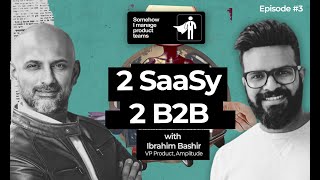
Ibrahim Bashir, VP Product at Amplitude, breaks down why product strategy fails: not written down, org misaligned, poor sequencing, or psychologically unaffordable. He shares how Box pivoted from selling platform to giving it away to cut churn, and explains Amazon decision habits like distinguishing 70/30 calls from 51/49 ones.
Chapters
Hello and welcome to Somehow I Manage Product Teams. I'm your host Naveen Pichandi and I'm on a quest to have conversations with product leaders to uncover how each of them skillfully wield the art of managing people and products. I'm joined today by Ibrahim Bashir, VP of Product at Amplitude. Prior to Amplitude, Ibrahim led products at Box, Twitter and was also part of the team that launched Kindle Fire at Amazon. Ibrahim shares his thoughts on a very insightful newsletter on Substack about building products, frameworks and thoughts from his personal experience. Ibrahim also runs a cohort based program for for scaling B2B SaaS and we'll talk a little bit about it. In the episode we spoke about B2B strategy decision making frameworks and somehow meandered to talk about Windows Phones. We were just having too much fun. Let's get into it for management. Press 5.
If you're really interested.
It is called Somehow I Managed. Hey Ibrahim, thank you so much for joining us today.
Yeah, excited to be here Navid. Great.
Can you start us off with your story and your journey to being a product leader?
Yeah, it's kind of a meandering journey, but I'll give you the condensed version. So I probably in high school, middle school, was fascinated by computers, was fascinated by the idea that you could write code and make computers do things. And so that's, that's what I spent a lot of time in high school doing. Took some computer science classes, you know, through a couple of mentors learned that if you wanted to be a software programmer, you should get a degree in computer science. So start studying computer science as an undergrad. When I was graduating the economy was not very good so I went to grad school for no other reason than it was hard to get a job. And then coming into the workforce, you know, I was very adamant on being an engineer. I actually worked as an engineer in grad school to pay my way and you know, my first real job as an engineer I realized how different it is to be writing code for production with a bunch of other folks versus like as a solo project in a computer science class. And you know, I think I was a good software engineer, but I don't think I loved it or enjoyed it the way I thought I would. And so eventually kind of didn't know what to do with my career and made a complete 180, went into management consulting, did a lot of like technical implementations and technical pre sales type roles. Really just tried to understand how like the modern or maybe even the legacy Enterprise works and just rack up learning while I was trying to figure out what to do with my career. And then eventually got to the point where I realized I really enjoyed the act of building products. And I really wasn't getting to do that in consulting. I would sort of like help people think it through but then depart before we actually built anything. So I kind of latched onto that as the goal I wanted to sort of achieve in my career. Next. And I remember just making a really short list of products that I wanted to work on. So I it wasn't just that I wanted to break into product management, but that I wanted to work on products that I'd be passionate about. And I remember the list was the Amazon, Kindle, Twitter and then Netflix. Those were three products that I used aggressively on my own. I was like I want to work on these products. And so after like a belligerent like nine months of interviewing at Amazon, just aggressively trying to break in, I eventually got an offer. Not on the Kindle team, turned it down, kept bugging them to let me interview the Kindle team. Eventually got that interview and got the job and moved to Seattle and was one of the early PMs on the Kindle ecosystem. Was there for a couple years. So a lot of my philosophies and opinions and biases about product building come from Amazon good or bad. And then did that for a couple of years. Really went from like yet another Kindle reader to like the leader in the market. And all the cool people I had worked with at Amazon started going doing different things and I realized I was not an Amazon lifer. I really just enjoyed the reading experience. So then I went to the second thing on my list which was Twitter. So ended up moving to the Bay Area, worked at Twitter on the platform product team about five years. Worked on everything from infrastructure to reliability to performance. So just making Twitter bulletproof. My team was actually the one that removed the fail whale from the code base. So that was a lot of fun. And then you know, I eventually got tired of sort of ads, subsidized business models and wanted to go do something where product value was more cleanly tied to the end user experience. And so kind of found B2B products as something interesting. And so ended up at Box where I had sort of a general management role where I not only was leading the product team but managed like the analytics org, the dotted line, dealing with like sales and marketing and sort of being accountable for the all up business unit which was a really fascinating role. And give me sort of a 360 view of a product line in B2B. So did that for a couple of years and then now I'm a VP of product at Amplitude and you know, it it. The thing that brought me here was it really just combined my last three experiences. Sort of the strategic discipline from Amazon, the scaling experience from Twitter, and then the B2B products from Box. And then lastly, the thing I love about my day job is build product for product managers. So it really fits with my day job, fits my side hustle, which is like writing, speaking, teaching about product management.
That's actually pretty impressive. And I love the way that you've stitched that thing together and I love that question more so because almost everyone that I know who's in product management had such a circuitous route when they got there. And I spoke a lot about this in my previous episode as well. So it was awesome to hear that. I have a quick question and you, you had a pretty target list of big companies that you wanted to get to. How did you come up with that list? Just. Just curious.
Yeah, I think one thing I learned about myself was I get very energized by the problem I'm working on and I think one of the best ways to find problems you're working on is the day to day products that you use. And so that's how I originally came up with that list. And by the way, I. If you're if for the curious listener. I did interview but got turned down by Netflix eventually. Um, so I, I think I exhausted my list of consumer products and now I've moved on to B2B.
Got it. And when you look back, I think all the dots connect in a way, I guess to where you are right now and how we've used the combination of your experience as opposed. So that, that was pretty awesome. We will talk a lot about the Amazon way of things. I do have a lot of questions there, but I typically like to ask my guests about, you know, how do they go about product strategy definition and things. But I read something in your substack which I found very interesting and it was pretty insightful post of, you know, an interesting rubric to ask possibly a series of questions that help you discern if you have a product strategy. So now I want to touch upon that. So what are those qualifying questions or you know, those aging questions that you can ask yourself or you know, your leadership that help you derive what the current product strategy is or, you know, highlight the lack thereof?
Yeah, I mean it's not, it's not anything sensational. What I'd say is, what I try to focus on is the basics, like who is your customer, what are your primary channels? What is the core use case? What does value look like? How can you articulate it? Why is it differentiated? What do your competitors say? How do you monetize things like that? I just have a series of questions that I ask. I've really refined that list through two mechanisms. One is sort of every time I interview with a company, especially for a product leadership role, you end up having to do sort of a case study on the strategy. So it's helped me refine that every time I interview. And then the second is I do a lot of like mentorship and advising work on the side. And I can say strategy tends to be like the most common topic, like something about the strategy. We don't have a strategy. The strategy is unclear. Nobody's bought into my strategy. Strategy's not working. And so I think all of that has led me to sort of really spending a lot of time thinking about strategy and how it manifests in a company. And I think I've stumbled onto a four part thing which is I think anytime people are like, something is wrong with the strategy. There's actually one of four things that could be wrong. One is the strategy is actually not written down. So so many times people are like, strategy, strategy, strategy. And I'm like, show me the, the three pager. And they've not written it down. It's like visual in one slide. That's not enough of a strategy.
Right.
So my first question is usually, is it written down in a 1, 2, 3 type situation?
Right.
Like here's the user, here's the problem, here's the research, here's our unique point of view, here's how it's different than everybody else who's tackling this problem. The second is, is your organization synchronized? So sometimes there's like an amazing strategy, but the org is designed in a way and set up in a way and cumbered by tech debt in a way that they can't actually execute on the strategy. So there's a big difference between like academic strategy and strategy that can be executed right, because the organization is aligned to the strategy. The third is sometimes strategy. It makes sense, like holistically, but it's not sequenced correctly. Like it's like we have to do A before B, right? And some people are like, we're going to do A and B by the end, so it doesn't matter. And it's like no, you have to do a first. So I think the composition of the strategy matters. And then the last one, and this is the trickiest one for people, is, is it affordable? And not just affordable in like a staffing and monetary sense, but psychologically affordable. If you told people the best strategy is to do the opposite of what you've been doing for three years, that's not an affordable strategy because it means giving up a lot of your sacred beliefs. Right? And so I always try to ask like, how much of your strategy requires people to shed their identity of what they've been doing.
Now if I were to dig in, into that a little bit, what kind of answers to these questions would you say are red flags? Where you say there is a lack of strategy? For instance, sometimes it's easier to give basic answers to some of these. Oh yeah, here's our target segment, Here's a customer segment which may be wide enough, where it may not really be your true customer segment or target segment that you need to be looking at.
The, the way I try to think about it is you should have some clear principles and counter principles. So a good strategy, I think of it as a machine and you just feed it product ideas and it should like definitively tell you yes, no, later, never, right? Like that's how clean it should be. And so having a strategy is another way of saying, how do you say no to.
Right?
And so a lot of times I'll ask people questions and they're like, all of this is fair game. And I'm like, so you don't really. It's sort of a milquetoast strategy, right? It's vanilla ice cream strategy. It's everything is fair game. Anything a customer might ask, anything that is monetizable. And so a real strategy involves hard trade offs and decisions and it requires painfully saying no to things that are useful for things that are high leverage down the road. So that I try to usually paint people into those kinds of corners is like, hey, walk me through a roadmap thing that you would definitively say no to and why and what does the strategy you tell really good strategy. A strategy that is clearly written, well documented, everybody's organized and makes sense and is affordable. You could hand to any product team at any level and they'd say, our roadmap that we've produced now jives with the strategy, right? And I think that's the source of a lot of tension in a lot of product organizations is the roadmap on the ground doesn't jive with the strategy that's on paper and there's a lot of people for that.
Yeah, that's a good way to put it. Now my obvious sort of next question is can you share how you've gone about this sort of strategy definition and your experience at Amplitude Box or Twitter and curious if you could walk us through some real world examples of as much as you can possibly share.
So I'd say in terms of the inputs or the drivers, you know, there's no secret sauce there. I think most product management writing or companies do this, which is you look at metrics, you look at business objectives, OKRs, your staffing level, what the competitors are doing, what the analysts are saying. So there's a lot of input. But I think the real art to product management is knowing which of those signals to ignore for some amount of time and which to really double down like which are going to matter in the long run. Right. So I don't think there's anything unique in terms of the signals that I take in. I think where the secret sauce is is how you apply them and bet and choose. And I think like you were saying earlier, a lot of it is revisionist history. Sometimes you pick correctly and it's like you were right all along, sometimes you pick incorrectly and you tend to like, you know, put those under the rug. And so if you're looking for a specific example, I guess there's two things I'd say. I think every company that's good at product probably has a superpower in terms of gathering signal. So I'd say at amplitude, extremely customer driven. Like nothing is built at amplitude without at least a handful of customers or prospects from customers like itching for that capability. Right. I think when I worked at Amazon, just the deep, deep like customer mindset obsession was a big part of it. And even at Box I think we really understood what buyers valued in a data risk and compliance sense. Right. Like we understood how we were making our money. And it was not, not just things like usability but like compliance, de risking things, automation, proactiveness around content usage. Right. Which matter in the enterprise. So in terms of a specific example I'll give you, I led the Box platform product line for three years and when I originally joined it was positioned as, hey, this is an add on product can be stole standalone. The goal originally was 1 million in revenue, then it was 10 million in revenue and then it was like how do you get to a hundred million in revenue? And you know, this is the tricky part about strategy and domain knowledge. It usually takes you probably a few quarters to wrap your head around the problem. And after wrapping my head around the problem, I realized we were meeting our goals and sort of a healthy team. But the effort to meet those goals from a go to market perspective and from a product perspective was not sustainable. What we were doing was basically building a product that required constant TLC to sustain itself. And every deal was like a snowflake. Right. And so I eventually realized we were sort of so fixated on incremental revenue that we had forgotten the larger story. So we kept running into these situations where we would go to customers and say, hey, you know, you can buy API calls from us and do custom integration around your box deployment. And there were legacy historical customers who had had that sort of folded into their contract so we couldn't charge them, but they were extremely highly sticky and retained. And we did a bunch of number crunching and we realized like putting aside how much revenue generated if people used our APIs and if they used certain what we called high value APIs, like setting up a governance policy or applying metadata to the content, right. They were much, much less likely to churn. And after doing some more number crunching we realized, I mean it's, it's quite intuitive. If you are going to spend your own engineering time as an enterprise customizing your deployment of a tool, you are going to retain. Right. And so the strategic pivot I led, which again was not an affordable strategy because a lot of people had to give up their perception of what they were building on was let's stop worrying about the revenue we generate because you know, 10, 20, 30 million is not the same as if we can be double digit higher retention for the 300 million core account base of box. That's way more valuable. Right. Actually did this pivot of switching away from revenue generating to retention generating and actually giving the product away and helping people adopt and customize so that they would be stable.
That's super interesting. If I just ask one question there with that pivot. I've been in the B2B space and this one's close to my heart. We work through it that kind of a pivot, especially in B2B space. I guess revenue is hard. Anything related that you can draw a direct line to revenue is what is typically highly prioritized metrics around retention and engagement. And things are still, I'd say a little foreign. Probably getting better there with a lot of I guess, B2B products that are more grassroots products in some way. How did you manage to make that pivot how did you actually make that argument to convince? Because it's really hard to evaluate against revenue as dollars.
Yeah. I think the thing you have to look at is the cost to generate that revenue. If it requires a lot of sort of marketing spend to get the pipeline, if it requires sort of a custom specialist sales team to actually close deals, if the amount of pipeline coverage required for every dollar of revenue is like double, triple your other products, something is not making sense. Right. And so it was a very hard lesson for me to learn because I was the first person to be like, I don't want to give up running a business unit to just run an add on product. Right. But I think at some point you have to do what's right for the company. And so the thing I realized was even though you're right, that metric is more foreign to people, it was much, much more valuable. Right. So it wasn't an overnight thing. Probably took two quarters of like strategic debates and alignment with all the top execs and figuring out a plan to sort of like not lose the customers we had while we made this transition to actually pull it off. But I think one of the things that helped me is I fundamentally always believe the whole point of a product team is leverage. And when presented with multiple paths to leverage, you should choose the highest leverage one. Right. And this is one of the reasons why one of the things I do when I teach my classes there, there's always product teams who are like, we're not, you know, we're being challenged to generate revenue. And I'm like, who decided that generating revenue is the highest leverage thing you can do? For example, let's say you run an infrastructure team rather than saying, hey, we're going to come up with a premium SLA that you can sell, what if you could reduce the cost of running your infrastructure by 30%? That's huge free cash flow, operating margin improvement for the company. And while you're right that in certain circles, go to market circles, like incremental revenue might be the highlight. There's plenty of people who value the other metrics. So go talk to your finance team. They'd be very interested in infrastructure savings.
Right.
Go talk to your customer success team. They'd be very interested in, oh, you can help me retain and drive adoption. And so that's one of the things I realized is when you're in product circles, I think level one is you're like, I need to partner with design and engineering. Right. And analytics. Level two is, oh, I need to talk to go to market. But a lot of times people don't get beyond solution consulting and account reps. There's a lot to go to market beyond the sales and pre sales. There is the post sales, the professional services, the customer success, the help desk side of it. I have a friend who has a strange job, basically like chief escalation officer and he's worked at a couple of companies like this. And one of the things he tells all the time is too many product teams, especially in B2B believe that like everything they're doing is gold. And he's like most of the time, based on my vantage point, you could sort of cancel all that and just improve your help docs and it'd be way more useful for them. Right. So that's my bar is like every dollar you spend on product design and engineering, could you just have thrown another sales rep or CS person or documentation or support person and gotten the same value that's you have to beat that baseline level of value.
Yeah, that's like a golden nugget. I feel like Anyone who's in B2B listening to this will probably be clapping on their end because I think everybody will probably agree to that, including myself in products that we build that that makes total, total sense. One more question around this pivot that you made. I'm sure you've had to garner a bunch of cross functional teams to also agree with this kind of narrative and this kind of direction.
Right.
I think you kind of alluded to it where you kind of I think partnered with customer success, who also is probably looking at retention as a metric that matters to them.
Curious.
What are the cross functional teams that you kind of partnered with and what was the opposition that you received for this kind of a pivot? I'm assuming there are a bunch of people who said no, why would we do this? We can't do this. Right. What were their arguments for why not do this?
So in terms of the cross functional team, it's the usual suspects, but maybe some of your listeners are not familiar with the usual suspects. So there is usually a, a sales team of like account reps. Right. At the leadership level you're probably dealing with regional sales directors, PS of certain regions. Right. There's solution consulting or solutions engineering team or sales engineering team, people who do demos and a little more technical and give you like actual feature feedback. There's customer success, there's professional services. These are all the people who actually have to support and customize the product in a true deployment. And I think the really interesting thing we had done at box. And again, this is hindsight in the, in the moment. I didn't know this, but when I, when I was presented with, hey, you're the GM of this business unit, I had two meetings. I had a, I actually had three meetings. There was the product team meeting where the product managers talked. There was the Ibrahim's team meeting, which is everybody who reported into me talked. And that that was more than product managers, architects, analysts, et cetera. And then there was a, our business unit team meeting. So we very early on had this group of people, head of solutions, engineering, head of sales, head of cs, et cetera, where we would work together and what are we all seeing from our vantage point. And so when the time came to actually have this kind of strategic debate and pivot, it wasn't like we were trying to build that muscle. And I always tell people this, like, you don't want to have the relationship when you need it. You want to have the relationship handy in advance. So we had a shorthand and we, we all sort of valued each other's opinions by that point. The other thing is, I'm oversimplifying the story. The trade off was not should we go retention or stay focused on revenue. It was if you want to stay focused on revenue, we're going to actually have to change the company. Like you can't have developer products as a sideshow at the company. Right? Like, are you serious about this bet? We need to drastically invest in infrastructure separated from the core product, be an API first company, think about SLAs reliability, et cetera, have world class developer docs like Stripe. And so the investment envelope to take what was sort of a growing business was in like monumental in comparison to positioning it to do something else. That was actually one of the big debates as well.
I really like this conversation because I feel like building B2B products is a vastly different beast than I think building B2C for very many reasons. Right. However, when it comes to a lot of literature on product management, I feel like there's plenty for B2C. All books all talk about how you need to think about user engagement and retention in some sense and monetization can follow like do these things and monetization can follow in some way.
Right?
That doesn't always work for B2B. And I say that just because I think you've also shared some thoughts around, you know, cultivating a revenue mindset for B2B PNs around connecting your dots back to your, I guess, North Star metric and how that eventually gets to revenue. I'd love to talk a little more about that. How do you develop up that kind of mindset?
So, I mean, so many thoughts. The first thing I would say is just at a very early age I was interested in a merchant mindset. How does money get made, right? And so anytime people present a product to me, I'm always like, well, how does this thing make money? And how can I circumvent how this thing makes money? Because as a consumer, you know, growing up, as somebody who's like, how do I get the free version of the software, like keep, you know, using the trial version over and over, I'm always like, I'm all my mind always goes to the edge scenario, product scenarios. And I'm like, can you truly make money? Because one of my bars is when the product is delightful enough and valuable enough and priced correctly, even the stingiest consumer, which I consider myself, will pay for it, right? And so a couple years ago, I always tell people this. I found a note taking app that was so brilliant I was like, I don't actually care what it costs because it's just so brilliant. And so I pay for this app and it's like one of the first things I would regularly subscription fee pay for for personal use, right? Which in the past I'd be like, never. Just I'll use whatever is free. But to answer your question, I'd say, you know, this, this world we've been living in for the last decade or so where people are just like, you know, I drive usage or growth or whatever never made sense to me because I'm like, but we're building a business, right? Like that's what you should be focused on. So if you don't understand when and how you're going to make money or why you're going to make money, it's kind of fool's gold to me. So I think in a way this wake up call that we've all had, you know, heading into 2023 has, has been good, has been an alarm clock for people to realize like you can't build like mountains of churn or like usage by itself is not valuable inherently, right? Like you gotta have a path to monetization. The way I think about it is the same tactics that you use to build the right product and the right features can be used to think through how to monetize, when to monetize and pricing and packaging strategy, right? So when you're talking to users and you have this whole research script, tack on five questions at the end of like, hey, which of these features would actually compel you to pay? Right? If you had to think about the value of this, how would you think about it? Is it the speed at which we let you operate? Is it the errors we let you avoid? Is it skipping manual steps? And so I think there's a lot of pricing and packaging research that you can do, form a lot of opinions on what should be free ver, what should be paid, what should be paid versus enterprise level plan. All that stuff can be researched and thought through. And one of the most brilliant things I ever heard about pricing and packaging was you're going to get it wrong. So just plan to iterate. And I think so much time is spent in B2B products with people like trying to really nail the pricing and packaging. And it's like just get something out there and make it iterable so you don't paint yourself into a corner.
Right. That's actually great advice. B2B has different ranges. You go B2B down market or B2B enterprise. And I feel like B2B enterprise is a complete different beast from B2B market. And I think amplitude also does a lot of high enterprise level deals in that sense. So do you think that same advice applies for both or do you think they're vastly different there too?
I think what varies is the go to market motion. Right. So you can have a very successful business on the low end and you just need to have a lot more paying customers and you can have a very successful assets on the high end and it needs to be a much more sales led and pro serve based motion. And these are sort of tried and true techniques. Obviously I think with PLG people are trying to reduce the cost on the enterprise side and apply some of the learnings from the self serve side. But I would say my take is where people get into trouble is they convince themselves to be up market and down market at the same time or multi channel at the same time. I think I research this a lot because I teach a class on the side about scaling B2B products. Most companies eventually latch onto one channel and one motion as their primary revenue driver. Right. It's not to say you can't have multiple revenue streams, but it's rare to find a company that's like 25% of our revenue is self serve, 25% is enterprise, 25% is partners and 25% is mid market. That's just not true. Usually you're 80% enterprise, 20%, all the rest, or vice versa. Right. And so most companies you can point to and say they have primarily this type of motion. So one of the companies I use as a case study in my class is Atlassian. Atlassian has primarily a partner driven sales motion. Doesn't mean they don't dabble in those other things. But whenever they're building product they're like how do we optimize for the channel? And the motion that is our primary bread and butterfly. And so I think where companies get into trouble is they're like building for vastly different channels. And for anybody who's done sort of go to market motion and go to market fit reading like you build products for channels you don't like, assume the channel is going to bend to your will. But just to pick a channel that's not common, not B2B, let's say iOS is your channel, the App Store is your channel. You can't decide. Well, in order for my business to make sense, I'm only going to give Apple 1%. Apple takes 30% over whatever it is. Right. So you can't changes your business model when you sort of defy the laws of it.
The other problem that I typically see within B2B is you know, this constant struggle between build what you sell or sell what you build. I'm curious how you've been able to handle that struggle in some way because I think you've probably had to that box as well as now. What amplitude.
Yeah, I think, I mean this is a wild thing to say. You have to ask this fundamental question of do we care that user value is aligned to the money we're generating? Because there are very successful B2B products where people complain about all the time and they're wildly successful businesses. Who has not complained about Workday or Salesforce. But do you think anybody's worrying about that? No, because they're like user perception is not tied to the value we're providing. Right. We're, we're doing something else. We're a platform level play. And so that, that's sort of like I just acknowledging that tension that the, the money you generate and the value you provide might not be tied to the end user satisfaction. And that's sort of the tip of the iceberg. What's really happening in B2B is and very different than B2C is you're dealing with three different people. You're dealing with the person who buys and really understands the value. You're dealing with the person who configures or administers and then you're dealing with the person who uses. And those are three very different players. And so I truly believe when people are like, you know, sales says this, but CSS this and PM says this, those can all be true because they're talking to three different people. And so I think it's very, very important to not to sort of play shell games and say we're going to ignore one or over index on the other, but to just be aligned as a company on like who is our true user? Are we, do we lean buyer, do we lean administrator, do we lean end user? So for example, Slack leans heavily end user. But the flip side of that is you struggle on the go to market side. Salesforce leads heavily administrator and they won people over that way. All strategies can be successful, but you just have to know sort of who your true master is, right? So where companies get into trouble is they're like, well all user feedback is value. And I'm like, it is, but you have to stack rank. And it doesn't have to be a permanent stack rank. But you can say, hey, for the next 18 months we really want to lead into the user, really want to lead into the administrators. And I think there are certain tried and true techniques per type of product. Like for productivity products you really want end user buy in. Figma's not going anywhere unless designers love it. But for security, compliance, governance, enterprise products you really want enterprise administrator buy in. And then for products that are sort of like once in a blue moon type purchase that are like head of IT CIO purchases, you really want buyer level feedback. You want to have a customer advisory board where all these buyers get together and tell you all the things they want and the user voice is drowned out. And so I think that that tension is inherent in B2B and just being aware of it, acknowledging it and steering into it is key.
You're absolutely right in that a lot of the grassroots products that grew from just teams and got adopted with the rest of the company, like Slack and I think Dropbox, I think those are the ones which started with the freemium model where you attract the user, you, you have great user experience and then the rest of the company uses it and they've gone upmarket. I feel like even if you start at that grassroots level, you invariably end up going upmarket and start selling to the enterprise and you end up facing the same trouble as I guess the other enterprise companies that sell directly, just the up market in some sense. So it feels like even if you start on market, you eventually end up playing that same field and end up Having the same set of trouble, I guess to how you prioritize.
I think consumer user behavior creeps into the enterprise and it creeps in starting with like SMBs who self serve and then slowly graduates to, you know, the largest enterprises. Right. Like at the end of the day it doesn't matter what hundred thousand person your company you're working for. Your taste is developed from like the consumer products you use. Right. So I think it's invariable that that stuff creeps up market and it's just something you have to tackle. The other thing I want to acknowledge, though you didn't really ask, is tension in B2B really comes to a head usually between executives and product teams. Because product teams are so user centric. They're like we're doing research, we're reading qualitative feedback, we're looking at nps. I read the survey comments. This is what users are saying is going on with the product. And executives will say, but I'm talking to a customer advisory board. I'm talking to our buyers, our biggest customers and they're telling me why and there's attention. And that actually used to happen all the time at Box. And it took me a long time to realize and a lot of conversations with Aaron Levy to realize like he's doing his own research and he's doing buyer research and administrator research and in some ways his research is better because nobody churned Box because of user feedback, but people definitely churn Box because of administrator feedback. So in a way like leaning into what the administrators want if they're like hey, I want to know like security risk compliance, workflow type stuff and I care less about like how slick searches. He's right about that because he knows like who our true, you know, moneymaker is there.
Yeah, that's actually really good. I guess it's more of a hot take really like this whole conversation. Another one that I would ask is product versus distribution. Would you say when you're more down market, focus more on the product? As you go up market, I guess that lever moves to distribution. Would you agree or do you think that's a little different?
I think distribution becomes much more important as you move up market. And not just more important but like having a tried and true scalable distribution technique. Because the fool's gold in upmarket and I dealt with this firsthand into large enterprises with a solution that was like extremely custom is if you take away the support system, the sort free meal that you're getting in terms of pipeline generation or the lift you're getting from the core product, can you actually survive? Right. So I'll give you an example. I won't name any specific products, but there's a lot of times where a company is like, known for product X and then they start dabbling in product Y and they convince themselves that, like, with 1pm and three engineers, they're going to take down like category leader. They're like, we're entering this category and we're going to take it down. And they're very high on themselves for a while and they're like, we're making so much inroads. And I'm like, what's really happening is your core product distribution is so strong and the desire to do a little bit of vendor consolidation helps you out. You haven't displaced anything. Right. Because if that product had to survive on its own, it wouldn't. What does that mean? It doesn't mean it's a bad product. It means that distribution is helping you out disproportionately in that scenario. Right. So distribution definitely matters. And I think there are times where you can use distribution to get meh good enough products to people. I mean, like Microsoft uses this all the time. Most of their portfolio is good enough. But the distribution power is so strong. There you go.
Right? Yeah. Makes total, total sense. This has been awesome, but I want to quickly switch gears. Some companies shape you and your core operating model in certain ways. Right. And I think having been at Amazon, I think you yourself said that where they're famous for their mental models and decision frameworks and things. How has Amazon shaped you and how you make your decisions today? And second question, is writing a byproduct of the same culture? Is that why you started Substack?
Yeah, I think, you know, I worked at Amazon from 2010 to 2012 and I think I wish this for anybody in their career. Sometimes the role and the team and the manager and the company and where they are in their trajectory just perfectly meets where you are in your journey. And that was Amazon for me in 2010 is the degree to which they were just get things done and the degree to which I was get things done and the principles by which they operated, which is meshed very, very well. Amazon is a very different company at this point. Right. It's become legendary, almost like in a comical way. And I'm a very different at this point. But at that time it was like an ideal match and I really felt like I was doing the work of my life. And even just when I read their leadership principles, I was like, somebody's like reading my. My professional soul here. And so my favorite principle in Amazon, they have one called bias for action, which is different than speed, because speed there can be bad speed, right? Where people are just like, I'm so fast and I'm like, you're making terrible decisions and we're going to have to clean it up later. Bias for action is like, at every possible juncture you choose to move forward, you figure out, how can we move this thing forward. And I loved it. And I got to work on really, really amazing things at Amazon and so treasure that experience. And it's worked out very well for me. But to answer your question, I don't think the writing came from Amazon. I think the fact that I enjoyed writing and that was a cultural norm really helped me accelerate my career at Amazon. And I've always kind of written, I've always journaled and doodled. All that's changed for me over the last couple of years is I just got over the mental hurdle and the imposter syndrome and said I'm just gonna start publishing. And, you know, I. For every like 10 posts that I have, there's one that people will like unsubscribe for or like, challenge the idea. And I think the thing maybe some audience members don't realize is I'm not writing. Like, that's not how I make a living. Right? I'm writing to polish my own thinking and I'm doing it publicly, which takes a little bit of courage. And I'm willing to put up with a little bit of jabbing just to keep iterating on my idea.
It's really well said. I saw this other post recently where I went, took a poll of all hit songs by all these major superstars and divided by the total number of songs that they've made. Apparently even Taylor Swift and some of the most successful superstars out there have like a 20% hit rate. And so even even in music industry, in the entertainment industry, that your. Your hit rate's just like 15 to 20% most times.
You know, it's really interesting you say that. I actually wrote a post about how we don't really think about the back catalog in product. Like, people always say, what's new? But like, do you ever walk into like a. I guess nobody walks into a blockbuster anymore, but like, nobody ever goes into a media store and says, just give me what's new. They go in there and say, I really enjoy X, right? Or what's the best movie in. In action or drama or Romance or whatever. And so it's interesting me then product, we're always leading with what's new. And I'm like, What's used by 80% of the people? And beloved. Tell me about that. And so I think so many times product teams get enamored with shiny new objects, and it's like, what is the essence of your product? And are you making that polished and usable and beautiful and cheap and reliable all the time? B2B products. I've seen it so many times in jobs I have and companies I've advised, which is, there always comes a moment where you're presenting your roadmap to your customer, and it's probably usually an irate customer. And they say, I don't care about anything on this roadmap. I need you to fix critical feature X, bug X. The app is too slow, whatever. And I think most teams don't do that until they've been yelled at. Right? And so anyway, I don't know how I got on the tangent, but, yeah.
That'S an important point, too. Going back to writing, I was more going to say, I think it's just the mindset of just get it out. Don't, don't worry about every one of your posts being a hit. I had to go through that hurdle when I started this podcast because I was more worried about, oh, man, is every episode going to be great? What do I need to do for every episode? I think you just got to go post it out there, do your best with each one of it. Publish every new one that you put better than the last one, and then keep going.
The thing I'll say is, for anybody who's listening, who's hesitating about writing, don't hesitate. I actually have a list of quotes about writing that every time I get down, I'm like, oh, nobody liked this post. Or, you know, people, like, made mean comments on the Internet about it. I go read these quotes, and they inspired me to just keep writing. One of my favorite ones is by Seth Godin, who I think has been writing on the Internet every day for, like, 20 years. His quote is, basically, there is no good writing that was not preceded by bad writing. So anytime it's like, oh, this wasn't ready for primetime, I'm like, well, it's V1. Just. It's V1, right? Don't. Don't get too hung up on it. You don't have to make it beautiful and perfect. You hit publish.
That's. That's a good one. Another, I think a version of that that I heard was all things Ed Sheeran and Taylor Swift apparently just, just write. Which I think gets out of, you know, the creative writer's block of sorts, where you write, write, write to a point where by the time your third pancake is always better than your first pancake, right? So by the time you write, you, you get all of your. If there were bad ideas, your bad ideas go away and only the refined ones come in the end. So you could probably just post the 10 posts that you write. You don't need to publish all of it. So that's again another good, I guess tip that I read online too. I managed to get through this hurdle and start, I guess doing this podcast and hopefully writing more. But yeah, hopefully folks who listen to this also get inspired and start writing or doing whatever they can to express and put it out there too.
I mean, I don't know how this is for other PMs. I've never been one of those people who's good at verbal combat, like ad hoc. So if you like pulled me in and said like, let's debate this idea right now I feel ill prepared. But if I've thought about it, if I've written about it and I've iterate on that idea, then I feel much better prepared. So I do it mostly as a way to like always be prepared because in a product leadership role you're going to get challenged all the time. Why are we doing this? Why are we not doing that? Shouldn't we have done this and you got to like have that thinking ready and for somebody who likes to be prepared, the best way I found to do it is to write and iterate on.
Completely agree. And I've noticed this, my writing even I guess at work was inspired by a lot of what Stripe did. And I think I was also inspired by the six pager from. From Amazon. So I do write these, you know, six pages that work. I've noticed that it's always helped me with, I guess the clarity of thought was much higher when I wrote a full paragraph versus bullet points because there could be a lot missing between those bullet points that you would have never thought of until you actually wrote those full sentences in some sense. And so I'm a big proponent of it as well. So. Completely agree with you there. If I may ask one more question on the Amazon, I guess your history at Amazon. I know there are some decision frameworks that Amazon uses and Jeff Bezos talks about a few of them that he uses too. Curious. Are there any that you Continue to use in kind of how you make your decisions. Quick ones or personally too. Do you go use any of those today?
I think, I mean there's the, the common ones you've probably heard of like one way doors and two way doors. Right. I think one that I picked up when I was at Amazon was really to write out the decision is if it's done and then just put it aside and let it marinate and then come back to it with some distance and some space. And then other ideas bubble up. Like you either you'll feel more conviction, right? Or you'll be like, oh my God, I thought of 11 Ways why this doesn't make sense. Right. And so the, the, I guess the TLDR is like, it's, it's like a, the framework is more a modified version of like hit send, but you have like a timer in your outbox. And so it's like you almost like put yourself in the mindset of I've made the decision now, how am I feeling about this? Right. Another one that I didn't get from Amazon, but I think Amazonians would agree strongly with is what I call, I don't call, I stole it from somebody. I'm forgetting the name of the guy who had it online, but he calls it 5149 decisions and 7030 decisions. And so basically a 7030 decision is. And most decisions are 70 30, which is, you know what to do. The hard part is not the decision, but it's the buy in, the conflict, the rollout, it. So in a 7030 decision, you, you're like, you know what to do. So stop delaying and get to it. Get to the hard conversation. Right? Um, in a 5149 decision, it's truly a coin flip. And those are rare. You know, a lot of times we convince ourselves, I don't know what to do, but I'm like, you know what to do. It's just distasteful, right? In a 5149, it's truly a coin flip. And if it's truly a coin flip, you should just flip the coin and move on. And so in both scenarios, speed matters. And so that's the one thing I've learned over time is speed of decision matters, especially as an organizational leader. Don't get into analysis paralysis. Don't keep sending the team back to get more data. It's like we have what we have. We have to make a judgment call with incomplete information. And you're not judged on one decision. You're judged on a body of work, right. Over a long period of time. And so if you have good rigor in getting the inputs and empowering teams over the long term time horizon, you're going to make more right decisions than wrong. And actually that was a leadership principle at Amazon. It was called Leaders are right a lot.
These two are great. I've heard that leaders are right a lot, but the first one was, was new to me too. That one's super interesting. And I think I think about it too, where sometimes I make a call and then later on when I go back and think about it, I was like, oh snap, I wish I waited, thought about it a little more and then hit the send button, right? So the delayed send is actually a good one. I've never thought about it from that sense. It makes total sense to me. Love to keep talking about this, but I want to spend some time and talk about your scaling B2B SAS cohort program because I'd love to hear about kind of what that course is about and what do you teach and what's kind of the curriculum that you go through there.
So I think you hinted at it earlier, like, at least when I started writing and there was a dearth of a shortage of literature about B2B. I mean, like standard stuff was there and a lot of it was put out by venture capitalists who I guess invest and scale these companies. So I took a bunch of my own lessons, Things I'd learned from advising companies and product leaders, things I was seeing on the ground, questions I would see online. And I basically just started writing online, right? And I think every couple months I would step back and say, like, what is my overall thesis that's developing about B2B products, right? And so I have this evergreen post called the Blueprint where I go in and I update, like what I'm learning on this journey. And so I have certain key pieces that I had belief on, right? And some of those pieces were, I mean, we've talked about several of them on this call. The first is like, in a B2B business, it's not all about revenue. It's also about margins, it's also about retention. So I just kind of created my own framework for measuring value in a B2B business. And you know, every, every PM has a superpower. One of my superpowers is no matter what weird thing your product team does, I can tell you how it connects to the top line or bottom line, or I can tell you definitively that it doesn't matter and your Team should be dissolved. And so I played this parlor trick all the time where people are like, you know, I work on this team, I work on an internals tools team. I don't, I don't have a North Star. And I'm like, internal tools? Why does it matter? They're like, well, you know, we help our sales team capture revenue that is unaccounted for through like loose skus. I'm like, great. There's the operational efficiency for the sales team. Helps margins. You have revenue growth incrementally. There you go. Like you are affecting two of the top level metrics, right? And so that framework, I, it was so intuitive to me, but I realized every time I talk to people, they're like, oh, I, I didn't realize it's this easy to map metrics. So that's a key, that's a whole session in the class is like how to think about metrics and connect the dots to top level metrics, North Star metrics, local levers, et cetera. Because it can be very disheartening for a team to be like, your goal is revenue. And they're like, oh, how do I, how do I generate revenue? That's not how it should work. So that's a huge part of the class. I had studied several concepts, especially at Amazon, like the flywheel concept. In practice, like Amazon, if you think about it, is a set of flywheels, like they have an online retail business on which they sell devices that are then used to buy more digital content that is also sold on there, right? And the more digital content you buy, you become an avenue to sell more physical goods. So all of these flywheels are interconnected. And so I think most businesses, if you sit down and think about it, have like a core flywheel that's just spinning. In fact, I think there's a really good newsletter for a while called the Flywheel where the guy would break down different businesses into their flywheels. And you know, these days people say loops, but it's a similar idea and so talk a lot about flywheels. And I have a bunch of case studies where we break down flywheels of like successful B2B companies. We talk about S Curves. You know, one of the really cool things for me is I would say some of the better literature, although I think it are sure was by Reforge. And I would study their content and I slowly started to realize like their content appeared in like really, really old texts under different names. I'm not saying they, they stole the idea but it was more, I was like, none of these ideas are original, right? They're, they're rehashes of ideas and with better visuals and framings. And so I read this amazing post by like an old, old Amazon guy named Eugene Way called the Invisible Asymptote, which is this idea that your product has this ceiling that you're going to bump into. And there's always like short term ceilings, but there's like an inevitable ceiling that is the ceiling of your business. So for example, at Amazon, that ceiling they decided early on was shipping costs. And you can see so much of their innovation went into how do we circumvent this shipping cost headache? The invention of prime fulfillment by Amazon, their own last mile delivery, they're all like, they're like, we know what the end game is, which is shipping is the mental hurdle. And so I think a lot of times that has helped me in product strategy is like, what is the thing that is between, what is the friction between us and the user, us and the buyer? So we talk about S curves in the class, we talk about journey maps, user journeys, buyer journeys. We talk about the idea of adjacencies, which is not an original idea by me, but like, how do you go from a core audience to an adjacent audience and successfully grow your business? When I first started the class, it's interesting, the platform that I teach the class on, they just reached out to me and they said, you have somewhat of a following, you have some interesting ideas. Would you be interested in turning into a class? And I was like, sure. Because one of my goals is whenever somebody gives you an opportunity where you're like, I'm going to learn something, you should just say yes and figure it out later. So I was like, sure. Now it was a herculean effort to create the content and do the class. And after the first iteration, which was about how to go from single to multi product, I realized I had gone too niche. And really what I was trying to teach people was how to scale, right? So I uploaded a lot of the frameworks, revised the case studies, switched out the guest speakers and into scaling B2B products. Those are some of the frameworks that I teach. And then if you read my newsletter, I've come up with a lot of original frameworks. And that's not to boast, it's more like after hours of like playing and tinkering with things, I've discovered some things that I think are tried and true techniques in SaaS. So one of the ones I teach is called skip step SaaS, which is basically most SaaS products, take a user workflow and say there's something inherently suboptimal and we're going to change it. And then this will become the new normal. And once it's changed, people don't even think twice. But if you tell people early on, they're like, that's crazy. It'll never work that way. Right? So I'll give you two examples, which is I really like this product called Loom, which is like a screen capture and recording tool. One of the things that Loom has normalized is you don't record, save and upload. It uploads while you like. I mean, this podcast we're recording is actually doing that as well. That's become a very common technique. Right. But for a long time, people are like, oh, yeah, you have to create the content. I actually remember having this debate with Box, which is, Box was so focused on all the places people create content, we should be able to move it over and keep it secure and compliant. And I was like, one of the asymptotes this company is going to run into is the mechanisms for creation are not going to be tied to Box. Like, people are not going to think about, I'm creating content, they're just going to do work, and the exhaust of that is going to be the content. Right. And so that's why you can see them now dabbling in things like Miro clones and whatnot. But so I teach some original concepts, some tried and true concepts, a lot of guest speakers. It's taught me how to be an instructor as well, which I hadn't done since grad school. So I've taught, innovated in things like homework and office hours. And it just helps me with what I love to do, which is coaching PMs. And so most of the time, everybody who comes to the class kind of becomes like a person I coach on an ongoing basis.
Sounds. This is phenomenal. The set of topics that you spoke about, I think are very interesting. And I think overall it was sort of an unmet need in some sense. Right. Like I said, there's not been a lot of literature on B2B, so it's great that you're doing this. I'm totally sold. You never know, I may be in your next cohort for people.
I think every once in a while you're like, I have something to offer the world. But the layers of technology or logistics I would have to go to are too hard to overcome. So I wanted to write for a Long time. I was a big fan of Ben Thompson and Stratachary, and I read a post where Ben was like, I use 37 different tools every time I publish a post. 37 different tools. And I was like, I'm never going to do that. I'm never going to have a WordPress plugin. And I basically made a mental note. I have this thing called a spark file where I just write down ideas that I want to do. And I'm like, what's preventing me from doing this idea? And I read it every once in a while. And so when I wrote that, I was like, look, I want to have a blog, but the thing that's preventing me is the hosting, the cost of it, the pricing, the audience management, the email, blah, blah, blah. And one day I saw Substack and I was like, okay, like, you guys bundled it all together for me. I have no more excuses. Same thing with the platform I teach on Sphere, where I was like, look, do I like to teach? Sure, but like scheduling, people, zoom, networking, blah, blah, blah.
The.
I am part of it. How to keep it all secure. They came along and they're like, we handle all of that. You just have to own your content and show up to class. And I was like, great, you made it easy for me. Right. So I, I have a list of things I would love to dabble in if the friction goes right.
Yeah, it's definitely like a golden age for creators and things.
Yeah.
Even this podcast, I use a couple of tools and they're, they're phenomenal for what I do. I almost edit with just a text. A descript does that. And it's, it's phenomenal.
You know what's interesting is people ask me all the times, they're like, the economy is so bad. What's a, what's a domain or sector that you would bet on? I would bet on creator tools. I just think making it easier for people to like, make a living is never going to go out of style.
I completely agree. I think we're living proof in some sense. I'll make sure to add a link to your B2B cohort program as well as your substack. For any of those who have not received that, we'll quickly move to some rapid fire questions. First one is one that I typically ask everybody. Your recent wow moment using a product.
Yeah, I'll give you a very recent wow. And it's unconventional answer. We use this product at work called Navon, which was Trip Actions just worked beautifully. Like my, you know, history with Expense management and travel management software is like. It's just painful and annoying. And it was like I took a picture of a receipt and it was like, I think this is the amount. This is the purpose. This was the trip. I've done it all for you. And then, like, 20 minutes later, reimbursement came through. And I was like, that was, like, genuinely magical, right? So, yeah, that. That's one that stood out to me recently was I was like, whoa, I don't have to, like, think about filing expenses anymore.
I hate filing expenses too. Good to know. I've not heard of this one. That's a good one. Second one. I feel like the tech industry is as much a graveyard as it is, like, a bedrock for innovation in some sense. So many products come and die over time. So if I were to ask you to bring back one dead product, which one would it be?
Can I give you two?
Absolutely. More the better.
So one of my favorite products, I'm a huge music buff, is Winamp. I would have all my MP3s. I would customize the heck out of the Winamp studio and, like, mess with the bit rates and all sorts of stuff. So I absolutely loved winamp. And it was almost like, you know, people changed their lock screen photo. It was like that for me. Like, depending on my mood, I would change the skin of winamp. So I really, really love the product. I don't actually know that it's dead. I just think, like, it kind of went out of style with phones, right? And so now everybody just does Spotify or Pandora or whatever. So that's one the other super unpopular opinion. I was a huge Windows Phone user. Like, loved, loved, loved Windows Phone, and I will die on the Windows Phone hill. I think they had tiles figured out, they had messaging figured out. There's so many things that were just intuitive. Sometimes I'll tell people, like, count how many clicks it takes to make a phone call on an iPhone. Right? Android is just like too many controls. It's like, it's designed for people who want to customize the heck out of it. And so Windows Phone really, really spoke to me as an end user. And I was very, very sad. When it's sort of end of life, it was interesting because people would always say, well, it doesn't have any apps in the App Store. And I'm like, it has the app. It has a browser that can do everything. So worked really well for my use cases. But I. I was made fun of a lot. I really enjoyed the product.
That's. Those are good, good. Two products. One serious question on WinApp, did you use the 3D visualizations that used to, like, bounce around when you.
I did, yeah.
Absolutely, yeah. Anyone who's used it will absolutely sort of recognize what we're talking about. And the second one, Windows Port, is an interesting one. I've never heard that one. And it's interesting because I. I saw this video on YouTube where someone was arguing that Windows Phone was too early for its time because the design paradigm and all of that was so neat because they had a flat design from the beginning. Did it have this skeuomorphic.
Well, you know, sometimes things resonate with you and you don't quite understand. And I was so into Windows Phone that I actually went and read up on the design language of Windows Phone and it's called Metro. And I just, I thought, oh, the, you know, designers pick cool names. But then I researched it a little more, and they called it Metro because it was the same type of typography and color scheme that you would use in a Metro, like in a subway. And it was very much modeled off the London Underground, the colors and the shapes of it. And they've done a lot of research where, like, these things are very easy to remember, easy for people to, like, remember the action they took. They put a lot of thought into it. And the reason I bring that up is as a child, I spent a summer in London and I, like, fell in love with the underground. I was like, I can go wherever I want. I can figure it out myself. I had a subway map that I kept for, like, 20 years. And so I was like, I. Without realizing, and I was like, Windows Phone was bringing me back to my joy of, like, reading my subway map. Right. So, yeah, I. Again, huge fan. Really sad it went away, but it lives on in. In many different ways. My usage did end in, like, very sad fashion where my Windows Phone stopped working and Microsoft Store wouldn't support it. And I had Retweet, where I tweeted at Microsoft and Windows Phone and I said I was your only user.
Well, do you still have your Windows Phone? You should probably keep it in.
No, I mean, I. I have this really bad habit of breaking my phones and cracking the screen because I just use my products very aggressively. And so I must have gone through, like, seven or eight Windows Phones in two years. And the last one, like, the screen cracked and they just were like, we don't have this phone anymore. We don't have any phones. Like, we have one model that's display, and, like, we're just. We're out of the Windows Phone.
That's also crazy. Seven to eight Windows Phone. You're probably the most revenue generated from a single user that probably had. That's. That's awesome. Last question. You had the attention of the whole world for two minutes. What would you say?
I would say, take a breath. I think everybody is moving a hundred miles an hour and holding their breath. And I feel very anomalous in Silicon Valley, where everybody's just, like, looking at their phones and heads down and, like, sprinting from one thing to the other. And I'm just observing and walking slowly. And a lot of times people are like, well, you seem so common. I'm like, you can too, just stop and take a breath and, you know, really just decide what you want to do. One of the things I do every morning is I wake up and I say, what is the one thing I have to get done? That's it, one thing. And I put 2 and 3 on the list. They're like stretch goals. If I get the one thing done. I had a good day, right? And I think too many people put 14 things on there, and then they beat themselves up about, I didn't get anything done. And it's like, you're not designed to do 14 things a day. Like, one big decision, one big accomplishment. Moving an inch forward in a very long race is more than enough. So I would just encourage everybody to take a breath.
I love that. That was almost like a good punch to end that. This was awesome. Ibrahim. I think I absolutely loved. I think we jumped through different topics, but it was great to talk a lot about B2B SaaS, because, I mean, that's the world that I come from. And like I said, there's not been a lot of folks who talk about those topics. So I absolutely love that. And I also love that you're doing this course. Like I said, I may very well be part of your cohort program. The next one. Where can we find you on the Internet?
Yeah, so I'm on LinkedIn like every other knowledge worker. I have a short URL that I finagled when I worked at Twitter. So t co ib tico, slash ib will take you to my LinkedIn profile. I'm on Twitter @ibscribe. Like scribe, like a writer. Ibscribe. I got that handle maybe 10 years ago, and people were like, why did you get that handle? And I was like, I'm going to be a writer. And so ibscribe on Twitter. Also on Instagram, although I still trying to figure out Instagram I have a substack called Run the business. Just Google. Run the business and you'll find me. And I'm sure I'm on many other defunct social media platforms as well, but those are the big ones.
Great. I was going to ask, were you on Google too, given you were a Windows Phone? I think you were funding the less popular platform.
We were all on Google because at.
Some point you forced into it.
Yeah, you're forced into it. I thought I was on about me, flavors me. Anything else? Lately I've been looking at linktree, which everybody seems to have. So I'm like, maybe I need a linktree account.
That's true. That's true that linktree is such an interesting product. Just because I was almost thinking about how and why is this product exist? It purely exists because of a force limitation within Instagram because they were like, we don't want to give you hyperlinks. You only get to put one hyperlink in bio. And a whole new industry got formed. It's not just LinkedIn. I see so many that I see launch and products that. Such an interesting thing.
Yeah, I mean, it's basically a landing page. Right. So I think it is interesting that so many people have used other product. Like people have tried to use Twitter as their landing page or their blog as their landing page or something. So I think there is a market for it. I think the Instagram thing makes it more relevant than ever. But like I always worry about a product. It's like if somebody changes their policy, your product doesn't exist anymore.
Yeah, true that. That was the one that I was more fascinated about with linktree. I was like, what if Instagram just gives you the hyperlink in each post? Would this die? But to your point, I think it's. It's. The whole concept has sort of evolved in everyone's mind is it's more of a landing page. It doesn't. It's not just tied to Instagram or anything.
If I were, if I were to get out of the Instagram like link business and, and expand what you can do with the landing page. Right?
Yeah, no, that sounds interesting. Like I said, I think we pick topics I feel like we can keep going on. This has been awesome and such a fun time. Thank you so much for, for joining us today and wishing you all the best on all the indoors.
Yeah, no, thank you so much for having me. I had a blast and looking forward to the episode.
Okay, thank you.