Top AI Creators Ole Lehmann, Igor Pogany, & Linus Ekenstam Give Advice at Imagine AI Live 2024
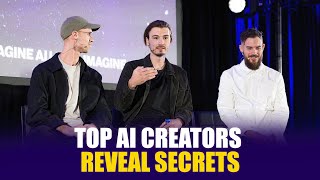
Ole Lehmann, Igor Pogany, and Linus Ekenstam share how to build an AI-powered content operation. Repurpose long-form recordings into clips, talk to real customers to learn what they need, and use Claude, GPT-4, and Otter for transcription. They agree AI will automate commoditized content, but human authenticity and personality still matter.
Questions this video answers
175,000 followers
31,000 newsletter subscribers
Over 200,000 subscribers
Chapters
All right, we're going to have a panel discussion with our AI creators here. I am very happy today to have Ole Lehman and Igor Pagani and Linus here on the stage with me. Ole, also known as the AI Solopreneur, is a prominent figure in the AI and tech industry with 175,000 followers and 31,000 newsletter subscribers. Igor Pogani is a leading AI educator and the host of the AI Advantage, a popular YouTube channel with over 200,000 subscribers that delves into various AI topics. And Linus just gave a great speech, so thank you all for being here. I'm geeking out right now because I used to just follow these guys on Twitter and now I'm on stage talking with you. So most people here are probably not content creators yet. You're running businesses and you're thinking about content. You might have some social media pages and you're trying to get stuff out there. I want to open up with more of a general question, is what advice do you have for these types of people that are thinking of getting into content creation? Ola.
Yeah, so first of all, I think most people kind of get it wrong because they think creating content is about going viral. You know, they see someone popping off and then they start to create content, but it's not going anywhere super fast and they get discouraged. And in my opinion, creating content, especially for businesses, should be about educating people that are already customers that already know your brand. And because content has this immense power of delivering value at scale. So what I mean by that, for example, I think a kind of easy way for most businesses is to think about what are maybe four or five little things I could teach in an email course. So I do that a lot. So if you have any kind of business come up with five little things you could teach your customers, for example, because most businesses already have email addresses, right? So instead of offering someone a 10% discount to get an email, for example, on the homepage, you go on a homepage, they offer 10% discount. Don't do that. So what I would do instead, for example, is think about something. You could offer them of value. So instead of asking for an email address for 10% discount, give them your five tips about your products and get the email address for that. So you always lead with value. So if you create content, think about what is something valuable I could give to my customers. That's always something I would give as advice and then just go from there.
Thank you, Igor.
Yeah, it's a good question. It's not an easy One, because I don't think everybody should be a content creator and it's a thing.
Right.
I think for a lot of businesses they should have different goals. They should just have the goal of raising awareness and having a presence online and that is fine. But I do want to speak a little more concretely maybe to the video side of things, because I represent that here, I guess. So. I think there's one strategy now that came up and that I've seen some businesses do that actually works really well. And that is when either the CEO or maybe the best communicator on the team.
Records long form content. This can be a podcast, it could be a meeting recording, heck, just long form, unedited recordings. And then you can throw it into one of these AI tools that chop it up into shorts, does the auto subtitling. And all you have to do is a little bit of quality control of like, this works, this works, this works. And then you have a video strategy that's really the lowest effort thing you can do. Going down the route of trying to do it full time. My first recommendation would be don't. No, really, like it's the same. It's like all the entrepreneurial advice, if you want to become an entrepreneur, don't. Right. And if that doesn't stop you just, then you're made for it. But it's like a treadmill that is emotionally exhausting. It's hyper competitive.
It's not an easy thing to get into in 2024, I think. But if your goal is awareness, it's a whole different game. Right. You're not trying to make this your full time thing where this is where all your income comes from. No, you're just trying to have a presence on the Internet. And I think this video strategy of, I mean, just try it. Just record one of your internal meetings maybe once, maybe a meeting that kind of includes things that would be interesting to your customers, maybe the internal long term financial planning or something, and then throw it in one of these tools and you're going to be surprised that some snippets in there, like those 30 seconds clips of you maybe giving guidance to the team or presenting the vision for the company, they're great content. It's surprising. So that would be my advice.
Thank you, Linus.
I'm going to try to keep it short. So my best advice is to start talking to your customers, clients, whoever it is that you're trying to make content for, and ask them simple questions. What do you want to learn? What do you want to do? What do you want to be improving on? And then you sit down and you create that and you give it away for free, and that's it. I think if you do that and you do that well, you can repeat that, then you'll ultimately build some sort of audience. And the size doesn't matter. I think it's a vanity metric for most of us. Like, you have followers. Yes, it means something. But in the end, the content you make can go viral without audience and it can reach the right people without an audience too. But it becomes easier when you grow, of course.
Thank you. And I just want to build on Igor's point of finding somebody in your business that would want to be the face of your brand, of your business. It's really important to have that. Just from YouTube thumbnails, I think you can all agree if you have a face, it's way more engaging than not having a face. So finding somebody that's comfortable and putting themselves out there. All right, so we're here at an AI convention. What AI tools are you noticing that businesses should use in this content creation process? If you had to pick one or two.
So for me it always starts with the classic ones. So I mainly use Claude for everything that's copywriting based. I think it's the superior model by far right now. So that's kind of the first thing I always go to especially for writing would be Claude. Another tool that I use a lot is Oda AI, which is basically a kind of a note taking app. And I really like the idea of content creation being kind of the sawdust of your life. So you just live your life and while you live it, you try to capture the ideas that come up. And especially if you run a business, there's so much stuff that's happening. Right. So if you have a meeting, what I do, I just record them. And then I would ask Otter afterwards were there any insights, any interesting conflicts in the conversation. And I would just take the content ideas out of that. And I think most people who run business, they don't have enough time to sit down each day for two days thinking about content. But as Lionel said, all of you talk to your customers, hopefully, and there's so much in there. And using tools like Otter, like any kind of note taking app to extract those out of meetings with your employees, out of your customer interviews. And this is like a gold mine for content because it's made from living your life, basically. So I really like to use that as well.
Thank you, Igor.
Yeah, so I'm still on GPT4 just because I have so many custom GPTs in there with custom data that I built over time. But I think what you kind of have to realize is that there's a lot of insights that you can kind of extract from prompting that are not obvious. So for example, what I do is I go into YouTube analytics and export all the analytics. They give you a CSV export of all the data. And there's more than any human could really handle. And if you know how to ask the right types of questions, you're going to arrive at interesting insights. So a good one, for example, for YouTube is like looking at how many new people tune into a video and how many of those people stuck around and became returning viewers. That's a massive one. As Linus said, subscribers are just a vantage metrics these days, vanity metric. It, it really matters like how many people return and some people return to 1 and 10 videos. You can look at all that, but it's not that easy to look into. So data analysis in GPT4. I agree that Claude is superior for copywriting and like everything like writing wise and matter of fact this I think I'm uploading a video on it today. But this week Gemini 1.5 Pro came out of early access, so everybody here can access it. It's completely free. And I know, I know Gemini pr good points, but you can upload a million tokens of context into it. In other words, you can go to a podcast like Colin and Samir show where they interview all the best creators and they talk about analytics and they talk about all these things that you might not be thinking on a day to day basis. I mean Twiz, you gotta like that's very niche stuff. And you could upload transcripts of 20, 30, I think it might be like 60 hours in total. So you could upload like 15, 20 episodes. That interview, you could upload all the Mr. Beast interview, all the like you could just go through their upload schedule, right? And they have, they have these two hour videos and you don't have to watch all of them, you can just get the transcript. You just go to open the description, view transcript, then you remove the timestamps and you just copy paste that into Gemini 1.5 Pro. You do that 10, 20 times. Might take you, I don't know, 15 minutes, right? And then you can talk to 40, 50 hours of creator podcasts and ask like what should I do with my YouTube analytics, right? It could be one good question and then it's going to give you, oh yeah, an episode, this and this. They brought up that these metrics are good to compare.
Mr.
Beast here said this you could do that and like transfer that to Twitter, to Instagram, whatever you want. Right. This is just like kind of my niche that I live in. But yeah, just analyze podcasts, find insights from there and then work with tools like data analysis and take the questions and kind of the knowledge you extracted from that long form content and apply it through tools like data analysis. And yeah, I think you're going to get a lot of interesting insights.
Linus, anything to add to that?
I think research, I use perplexity a lot research subjects and I'm very polite with my AI assistants. Like I speak a lot to them, I use voice a lot said is very interesting. I use similar kind of way where I record most of my things and I have a running note taking place. So that just is noise in there for me. But I run it through an AI and then it helps me clean up all my random thoughts and distills it down to things that are useful for me to then create content about.
Wow.
So you're speaking out your thoughts and your note taking process and it's all recording there and then you can search that and keep it to your catalog.
He said it. Yeah, he uses Otter for that. That's a great workflow. Just brain dump.
Yeah. And I use Fireflies, but it is very. I'm very unstructured. Like nobody saw my desktop, but there's like 10 layers of items on my desktop.
Same here.
Yeah.
So it's insane that I can actually create content because I'm so disorgan that unbelievable.
Ola, how do you organize all that?
Well, do I organize it? I'm in the same boat as Linus and I think if you're maybe more like a creative person, that's where AI is really, really helpful because same thing for me. I just record basically my whole workday on loom, whatever I do. And so for me, AI really helped me to structure my thinking as well. So it's like the one way around if you want to use an LLM, you have to structure your thoughts. And I would always just dive into something, right. I find something new, I get obsessed, I just sit down and work, work, work, do, do, do. But it sometimes led me down this route where I super unorganized. And so now using AI for that, it's just helpful to just basically structure everything for me and also give me the creative freedom to do what I like most. So if you feel like you're not the kind of person who likes sitting down and thinking about 20 ideas and being this very structured systemized person. That's perfect because you can just use an AI workflow for exactly that. And I have a friend and he builds these little workflows inside Zapier, for example, same thing. He just goes on a walk, talks into, uses AudiOpen, which is another app, and you just build this very simple Zapier automations and it has a prompt in the back end and it will turn his thoughts into different content ideas for different platforms, into an airtable. So when he's sitting down at home after he took his walk, everything's already there. Like 70 or 80% of the work is done. But then it's all about kind of the human editing process, which I still think. And I sat down today and thought about it for a very short amount of time. What is actually the important part of the human interaction if you work with AI for content? And I think for me it's really getting into the state of is this making me feel something? That's for me, for content. If you look at your content and Sean Puri had a great framework which is content should make you basically feel three things. It's omg, what the fuck or lol. So it should be entertaining, it should be something kind of mind blowing and that's content that people will share and it should evoke emotion. So do not go on a big rant here, but I think that's super key. If you work with AI for content to still have that in mind, is it evoking any kind of emotion in your viewer? And if you're educational, it could be inspiration as well, for example, as an.
Emotion, I think that's really good advice. So seeing all of this transformation in the AI space and all of this text to video creation, there's AI creators, there's going to be plenty of accounts that are just posting AI content. Will AI replace human content creators?
Dude, I think it's a great question. I just gotta cut you off for a second because these guys have a serious problem. And I have the same one, which is like desktop files. Guys, I have a hack for you and it's like it doesn't involve AI. I hope many people are gonna apply. You create a folder, you name it Desktop with today's date, select all and dump it into there.
I do it once every three months and it actually works and it cleans it up. And then if you need something, it's there. But like you open the desktop and it's a new day.
I'm old enough to have written my old little automation for it to actually have it, but I turned it off because I kept forgetting which date things were in. So I was finding myself navigating to different dates. So now I just don't use the desktop anymore. It's interesting the thing that we're doing because we're using AI in kind of assisting our creation workflows and in similar ways that you can translate into kids using AI to improve their learning with a private tutor or teachers improving their teaching with a private ta. So what we're doing is just one thing that can be imposed into all the verticals of work. If you're working in a company selling something now, you can have your own virtual assistant as well to solve your problems. So I think this is very universal. I think we're just solving it for our use cases basically. But the tooling is very general.
So Human versus AI Content Creators Will AI content creators and AI content surpass human content?
That's a really difficult question. I think that's the kind of, a little bit the controversial one. We talked about it yesterday. I think it really depends on the kind of content. There will be a lot of commoditized content, basically completely automated talking head using something like hey Jen, text to speech, all of that, and it will also flood. But I think in the end, again, good content should evoke something in you. And I think having some kind of human emotional quality control to content will still be like a very, very important part of it. That being said, I'm probably dumb and I probably can't imagine how crazy the future will get. And we already improved so much on the how realistic can a video, for example, look? Linus posted something on Twitter I think three days ago of someone who looked like a UGC creator, like a user generated content creator. And it looked amazing. So I think for the time being right now, having an authentic human feel that's maybe more on the esoteric sphere of what that means will still kind of reign superior. But I think the big big unlock is as Lino said, like really leveraging yourself using AI as a creator. So some people, they might don't have the imagenetic qualities of coming up with ideas. They will use it for more idea generation and some have problems executing sitting down and writing. They use it for that. So for me again, it's the same thing like in every other niche. It's just really just supercharging your output, being able to create more, created faster and also don't sit down and stare at a blank page. So for now, I think it's really the combination of the two of them being human but also being able to use AI.
Yeah, I think you said a buzzword there, authenticity. And that is what many viewers are craving and it's the content creators that they get behind is for their authenticity. Igor, do you have anything to add?
Yeah, I think it's a very big question. I think we have to isolate some variables to talk about it because it really depends if you're talking about X or you're talking about YouTube or you're talking about Twitch or you're talking about TikTok. I think it makes a massive difference if you're doing 140 character tweet or if you're recording a two hour podcast. Right. There's, there's, it's not the same thing. So I think for video, for myself I can say like, for the videos I create on a day to day basis, 15% of that is maybe like AI assisted. You know, I help it to like idea titles. We maybe generate like thumbnail ideas and drafts and sometimes even use that. I have a whole automation that kind of takes the transcript automatically of the exported video whenever it goes into the export folder, changes it to MP3, creates a transcript, it runs like 2012 prompts on it. Fact is, we don't use that on every single video. Yeah, it creates Twitter threads from it, it creates descriptions, keywords and all that, but we didn't use it every single time. So it's not this huge unlock in video at least. And over time.
I think it will affect other platforms. First would be my guess. I mean, obviously text first, where you have anonymous account and you don't have a face associated with it, that's way easier to replace than a human presenter. And I think live streamers are kind of last on that list because there it's really most about the human connection there you have the most loyal communities because you have the largest connection. If somebody's streaming for 12 hours a day, it's just a different type of connection. But another variable to round my point out is not the platform, but it's the timescale we're talking about. Because if we're talking like 15 years from now, who knows? Nobody knows.
Right.
And anybody who pretends like this knows is full of shit. But no, it's a fact. But if we talk like now or like three years from now, I think that humans like humans. Sam Altman brought this up in a podcast recently. It's a great comparison with chess, right? Like chess got solved by AI, but we're not watching chess. AI tournaments, nobody cares. Like, okay, cool, two computers playing against each other. We're not even watching tournaments where AI is playing versus humans. Like we don't care. We want to see two humans battle it out. And I think in that same sense, for example, YouTube, I can talk to that because that's what I know is a platform where people tune in for the personalities, they tune in for the person. I think there's going to be a lot of staying power with a personality being there, but I don't think it's infinite. I think there comes a point where the hyper personalization becomes so effective, where every single person in this audience, every person has different preferences. One person might be aware of a new prompting technique in midjourney because they consumed it two days ago. And if your browser history is going to be fed into the context window of the AI, it's going to realize that you've seen that already. And it might Curate your weekly YouTube news update in a way where it doesn't include that. Maybe it knows that you prefer more concise content and you only have like 10 minutes a week to stay up to date. So it's not going to give you a 40 minute news update video. It's going to personalize it to you. Maybe it's even going to emulate your accent so it feels even more relatable. Right. So if you go down that rabbit hole, yeah, hyper personalized kind of news updates just like that thought, I think that's something that would be effective. But we have to get to a point where the cost of it goes to a point where this can be feasible. But yeah, a version of YouTube where every single video is hyper personalized to you. That is something scary.
Wow, thank you, Igor. That's a whole nother topic. We do want to get into some audience questions and lunchtime officially starts now. But we're going to hang out here for another 10, 15 minutes and take audience questions. So who has a question for this amazing AI creator panel? George, I remember your name.
Thank you. So my everyday I'm speaking about FTEs, how many kids we are losing their job and replaced by AI, but we are creating everyday new FTEs. So your job is a new FTE type. So can you imagine in a year time what will be the job that doesn't exist today but will be sourcing from AI? Thank you for that.
What job AI is going to create that don't exist?








