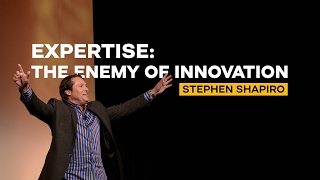
Stephen Shapiro argues that expertise can inhibit breakthrough innovation: although 70–80% of internal innovations are produced by experts, experts may frame problems in limiting ways. He illustrates this with a UK dental-team example: instead of developing abrasive or bleach-based whitening toothpaste, they asked who else makes "whites whiter" and learned from Unilever’s laundry unit that adding a blue dye creates an optical illusion that masks yellowing—leading to a blue-dyed toothpaste. The talk emphasizes reframing challenges and looking across domains for fundamentally different solutions.
Chapters
Expertise can be the enemy of innovation and in particular, the enemy of breakthrough innovation. Because here's the reality. 70 to 80% of innovations that take place inside of an organization are in fact done by experts. I'm not saying throw expertise out the window, but sometimes we have to ask ourselves, is there a different way to look at it? And I'm just gonna. Actually, I'm gonna give you a little example here. I like this example. If you go to the supermarket or the drugstore, one of the things you're going to find is that pretty much every toothpaste there has one thing in common. They whiten teeth. The way most toothpaste whiten teeth is they use some form of abrasive or bleach. And so this team of dental experts in the UK decided they wanted to create a new type of whitening toothpaste that didn't use abrasives or bleach. Now, think about the question they would probably ask themselves is the question you would probably ask yourself, how do we, the experts in dental hygiene, create a toothpaste that doesn't use abrasives or bleach? And in asking this question, they didn't get very far. So they stopped and they asked a different question. They asked the question, who else has solved a problem like this? Who solved a problem like this? And what? They realized that instead of trying to focus on creating white teeth, they wanted to find out who else makes whites whiter. Who else makes whites whiter when they're not using bleach? Tide laundry detergent. Yes, it's laundry detergent. So as it turns out, Unilever, the company that I'm talking about, well, they have a business unit that makes laundry detergent. They've never in the history of the company talked with them. They thought this would be a good time. So they go over and they ask them, ok, when you aren't using bleach, how do you guys with laundry detergent make whites whiter? And they were told something fascinating. They were told, we don't. That's the end of the story. No, they were told, we make whites blue. Laundry detergent is blue for a reason. The blue dye in laundry detergent creates an optical illusion, an optical effect that prevents the reflection of yellow. Your clothes are still dingy yellow. You just can't see it. So they thought, this is a pretty cool idea. And they went off and they created a toothpaste. And I usually carry one with me, but I don't have it with me right now. So it's a toothpaste that has a blue dye in it that creates the illusion of white teeth. And the reason why I tell this story is not so much about the innovation itself, it's about the thought process. If you ask yourself who else has solved something like this, you might find fundamentally different solutions. And if you're in a large organization, I would bet you anything that someone else inside your organization has already solved the problem like this. It's all in the reframing of the challenge. The question you ask has a profound impact on the types of solutions.