Personality Poker for Successful Team Building | Stephen Shapiro
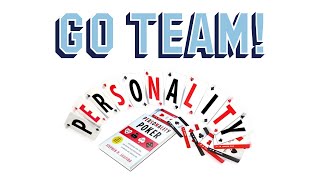
Stephen Shapiro uses playing cards to map four innovation roles: Spades for data, Diamonds for creativity, Clubs for execution, Hearts for people. Balanced teams need all four suits to move from defining a challenge through implementation and engagement.
Chapters
The point of personality poker is to recognize since opposites do not attract, we need to be able to find out who we are, who we are best to partner with, who we are unlikely to partner with, and how do we create high performing innovation teams and organizations. So I want you to start off by looking at the words on the cards in your hand and I want you to sort the cards from most like you to least like you. All right, so everybody's going to stand up, start moving around, trade cards with other people. We'll get some poker music going for you. All right, so we're going to do a second round of trading. This is based on a game that I'm sure all of you have played at one point as a child. It is usually something you did to torture your sibling. And it is a game called 52 Card Pickup. We have literally, I don't even know, it's got to be like 5200 card pickup that we're about to play in every corner of this room. We'll be throwing cards on the floor in a moment where allows you to improve your hand while you're on your hands and knees. If there is a card with a word that describes somebody that you know in this room, pick it up and give it to them. It will give you an opportunity to see not just how do you see yourself, but how does the world perceive you.
On a train bound from nowhere, I met up with a gambler. We were both too tired to sleep, so we took turns staring out the window at the darkness.
So some of you who are observant look at your hands and you're probably wondering, what does this mean? Do the suits have meaning or do the colors have meaning or do the numbers have meaning? The reality is everything has meaning. How many of you have spades as your pro primary suit? Spades are your primary suit. Put your hands up high. Great. Shout out the words that describe you. What are the words that describe you? Rational, connected, realistic. Usually it's logical. What we find is that people who are spades, they like facts, they like data. If you're a person who likes Excel spreadsheets, it's a clue that you might be a spade. If you were one of the people in the room with your arms crossed and you were wondering about the scientific validity of personality poker, trust me, you are a spade. So I said, the numbers have meaning. With the spades, the numbers are the least different between them. The 5 through 9 of spades, the 5 through 9 of spades are people who are really smart the 10 through Ace of spades. These are people who are really smart and they want everyone else to know that they're really smart. So there are two types of hearts. But of course, what all hearts have in common is they are people who like people and Barbra Streisand songs. When we talk about somebody who's creative, they tend to be the 5 through 9 of diamonds because they are into ideas and in particular, new ideas. So diamonds are into novelty. Spades are into knowledge. Clubs are about planning the work, working the plan. Hearts are about people. Diamonds are about novelty. The 5 through 9 of diamonds are about novelty of thought. As I said, I'm pretty much a diamond, primarily a 10 through Ace of diamonds. I love new experiences. I've got a little bit of spade in me. I used to go to a skeptics convention in Las Vegas. It was 1600 nerdy people talking about science and logic. I loved it. I would eat it up, but it's not my natural state. I'm also a heart, admittedly a high heart. I know people everywhere in the world. But here's the thing. I know more than anything else. I despise plans and planning. I find them restrictive. I find them limiting. And the odds are if you are a person with even one club in your hands, I'm not going to like you. Which I think is about three quarters of this room. So here's the important point though. The person you like the least, the person you need the most, the cards you do not have in your hand represent your blind spot. These represent the people you need on your team. But remember, opposites don't attract, they detract. And as a result, we tend to surround ourselves with people who are similar to us, not recognizing that we need to bring others onto our team. What we're going to do is we're going to reconfigure the room. If you had five black cards, I would like you to go all the way over to that wall over there. If you had four black cards, sort of right around here, three black cards here. And then on this side of the room, we'll do three red cards, four red cards, and all the way that wall, five red cards. As quickly as you can, let's reconfigure the room and see what we have. We're going to talk about the black cards and then we'll talk about the red cards, the black cards. People might call you left brained. It's not true. You have a perfectly whole functioning brain. This left brain, right brain thing, it is a myth. You are the ones that I affectionately say put the no in innovation. Think about that. Now at this point, some people have asked is that no n o or no kno w? And I say choose because it will be the clubs who are the nos, because they see all the complications of implementation and what's going to get in the way. And the spades will be the knows. Because you know a lot. You have the data, the statistics and the information. So there are two words that commonly come out of the mouths of people with black cards. I want you to fill in the blank for me. Yeah. Oh, that was good. That was beautiful. So at this point, the people on this side of the room, on the red side of the room are thinking we're awesome. I want to come back to my definition of innovation again. Innovation is an end to end process that starts with an issue, problem, challenge or opportunity and ends with the creation of value. So if it starts with an issue, problem, challenge or opportunity, who will be the people who have the information, the analytics, the data, the statistics to make sure we're even working on the right problems and that we don't just move in the wrong direction. Who's that going to be? It's going to be the spades. And if it's about having the right problem that creates value, who's going to implement? It's going to be the side of the room, the clubs. So we need to recognize that innovation and creativity aren't the same thing. In fact, from my perspective, creativity is killing innovation. As you're going to see in a moment. We don't need more ideas, we need more important, better problems that we work on collaboratively and solve them. So let's go to the red side. Red side, people might call you right brained. Again, it's not true. You have a perfectly whole functioning brain. As a person with five red cards, I can say this with quite honesty, which is that we are the ones who put the fun in dysfunctional. I will also say that if the leader of your organization is a red, the business could end up in the red. Because here's the thing, I know about red cards. We love to chase bright shiny objects. We're working on this, but oh, this is so much cooler. You want to hire in pairs, you want to lead in pairs, you want to recognize that the people who are your blind spots are the people you need the most. Everybody can take a seat. All right, so as you're sitting down, I'm going to continue the conversation, talk a little bit about culture Because I think culture is a word we use a lot. But it's sometimes hard to quantify or qualify what our culture is. And for me, I look at culture as a personality. People have personalities, teams have personalities, organizations have personalities. And so when we look at culture, we want to better understand what's the personality of our organization. This is not based on who we've hired. It's not based on the composition of our teams. It's based on what is valued, what gets valued. So if you were to look at the cards, instead of trying to look at them from a personal perspective, look at them by what gets recognized, what gets rewarded, what gets promoted. Look at your performance management system. What are the measures that you use? Go through that whole process and start to understand your personality. Because as you choose the cards that stick with what you value, you will start to see that cultures aren't good or bad. They just create blind spots. So I want to dive now into the process because this is where we're going to spend the rest of our time. As I said, personality poker was built around the innovation process. Four steps, four suits, four styles. The first step of the innovation process is to define the challenge. Define the challenge. Remember, it's an issue, problem or opportunity. And that's the domain of the spades, because the spades will have the data, the information, the statistics, the analytics to help us identify, define and refine the challenge. If you come back to that World Economic Forum report, that complex problem solving is part of it, but I think it's complex problem formulation is where we tend to go wrong. The next step then is to find solutions. Finding solutions basically means that once we have the problem defined, we use a variety of techniques to be able to find solutions. This is where the diamonds shine. Steve Jobs once said, creativity is just having enough dots to connect dots being ideas or experiences. And the reason creative people are so is they've either had more experiences or, or they've thought more about their experiences than other people. So again, it's about connecting the dots, those ideas and experiences. That's the domain of the diamonds. They are into relationships of ideas. Of course, all the great solutions that don't get implemented don't create value. This is where we need the clubs to plan and execute. And actually throughout the entire process, we'll have the hearts. Because this is about engaging the hearts and minds of people. Innovation is a team sport. We need everybody involved, emotionally involved. As you've heard all day yesterday, we need to engage people and the hearts are great at engagement. So it's four steps, four suits. If you are missing any of these suits on your team, if you are missing any of these suits in your organization, you will have a faulty form of innovation. As you heard when Rachel introduced me back in the mid-90s, I made a commitment to not help companies shrink, because I didn't want to be responsible for one lost job, but I wanted to help companies grow. And hopefully, that is my gift to you today, is to help you innovate, to think differently, to work your magic. Because I think you are the magicians who are really making this a better place. I thank you for everything that you do, and I hope to see you throughout the rest of guild. Thank you very much.
More from Stephen


Transform Your Team’s Innovation & Collaboration in 60 Minutes With Personality Poker®


The Innovation Room E20 - Innovating Around What’s Pivotal with Stephen Shapiro

Preview of Interview with Joe De Sena - host of CNBC's No Retreat: Business Bootcamp





