How to start a startup? Building Pipeline CRM with Sudarshan Sridharan CEO, Pipeline - Interview #10
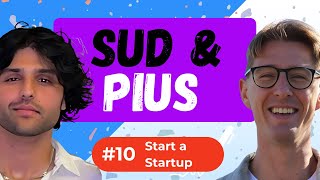
Sudarshan Sridharan pivoted from a firefighting-drone startup to Pipeline, an outbound sales platform for B2B SaaS. He started with an agency model to validate demand, then built AI copywriting and sales automation deliberately simple for early-stage founders. He uses Pipeline itself for outreach and advises founders to pick boring, large-market B2B businesses over world-saving ideas.
Chapters
Hi Suds, nice to meet you here again. I mean, we met already in person a few weeks ago. So thanks for joining our podcast at Subscribe. So tell us a bit about yourself. Who are you and what do you do these days?
Yeah, thanks for having me, Pius. I'm the— my name is Sudarshan Sridharan. I'm the founder and CEO of Pipeline. Most people just call me Suds. Pipeline is an all-in-one outbound sales platform for B2B SaaS startups. We provide a prospecting database that helps you understand who should I sell to and gives you their contact information. We have an AI-generated copywriting platform that tells you what should I say to them once you find a person to sell to. And then finally, we have a sales engagement platform that lets you automate your outreach across email and LinkedIn. So you can always reach your customers wherever they are.
I have to say, I'm always impressed how well-spoken you are and how you nail your messaging. I also test your platform. It's also as great as you bring it across. I have to give you credit for that. You actually are using it here. What?
My girlfriend designed it. Yeah.
Oh, wow. Okay. So you're kind of like the next Canva with Merlin Cliff, like building a unicorn. Is that the bet?
Hopefully, but she's done it fully altruistically with no title or anything.
Okay. So you spoke about your company. So what motivated you to create this company? Was it like, oh, you woke up and it's like, this is the thing I want to create? And then you created this WithPipeline, I think it's called. You created this platform from day one, or was it, what was the different story to it?
Yeah, so our website is withpipeline.com, but we call ourselves Pipeline because pipeline.com is roughly $4 million. So anybody listening out there wants to lend me a penny, we'll get it bought. But anyways, yeah, so I, this was not an immediate overnight, just yes, let's do this. It was a. Longer multi-year grind. I started by building firefighting drones and software for firefighters. We reached about 1 in 5 firefighters nationwide. And just before fire season last year, March 2023, about 2 and a half years into building Phyon Technologies, we'd raised from over 80 investors. We had tens of thousands of signups for our app. We ended up having to pull it and just shut down because we were running out of money. It was clear that more importantly than running out of money, it was clear that there was not a venture-scale market in the wildfire space. The government only spends about $3 million a year on software, including mapping software, communication software, et cetera, for specifically for wildfires. And so it just wasn't a venture-scale market. The total spend on wildfires is about $1.1 billion in the budget, another $2 billion out of budget. When really bad fires happen. So it's just not a market that was sustainable at a venture scale where we could reach $2 million of ARR and then triple for 3 years to $100 million from $2 million and then double, double, double to like $200 to $400 million of ARR. Right. And so it just wasn't a market that we, I saw a venture path in. And so I started looking out, you know, by like October of 2020, I started looking at like what can I actually do? What can I build here with what I have? Right? And like, we had enough money left over, like, for a proper seed round or a pre-seed round of financing for whatever next idea we tried. And so I started looking at who do I want to work with, first of all? And I want to work with founders and I want to work with startups. Initially, it was just early stage. Now it's just like, I like being around that innovation. I like being around companies that are growing. And so it was like, We can work with anybody that's really, you know, trying to build something and make something happen from nothing, right? And disrupt the market. And so that was step 1, identifying who I wanted to work with. Then step 2 was figuring out what kind of business model I wanted to have, right? And I wanted to have a product that I could start as an operationally intensive business that could be run fully by humans and on Excel spreadsheets, almost like an agency. And then I could build software to automate all of that. And I thought running it that way, one, would allow us to validate people. There was a problem that people were willing to solve in the market. Two, uh, it will allow us to cash flow, which is something we had not done previously. And three, it would allow us to really deeply understand what we were building software for instead of just looking at other existing solutions in whatever market we chose to go into, um, and try to build software there. And so with that criteria, understanding I want to sell to founders and fast-growing companies, I want to sell to, um, I want to start with the agency-type model or something that's very manual and turn, automate that into a vertically integrated a platform within 6 to 18 months of starting, I was pretty, you know, that locks me and it has to be in a very large market, right? So I was looking at fintech, wealth management, banking. I was looking at software for financial firms, spent a lot of time there and spent a lot of time also looking at, I've invested in almost 70 startups. So normally as the first investor or like one of the, like in the first round of funding. And so it was like, what do I do for these startups? I help them recruit. I help them fundraise and I help sell. And so I started looking at what in 2023, March, 2 days after Silicon Valley Bank went down, I started looking at where do startups really need help. And in that time, sales really made a lot of sense. And the through line between fundraising, sales, and recruiting is, you know, if I have, if I know who to sell to, what to say to them and where to reach them, I can also do the same for recruiting and I can also do the same for fundraising. And so basically all that led to starting Pipeline. As a very aptly named, you know, we're going to grow your pipeline, get more leads, close more deals is the slogan on our website. And it's stayed the same the entire year we've been around. And we started with an agency and by August we knew what software we had to build. By November we had the first version out and by January we had it in the hands of our customers. And now we have companies such as Trex that we can count as customers.
Congrats. Wow. That's a big milestone. So I like your story, but now let's go a little bit deeper in what motivated you to become a founder. Looking back in your childhood, if you want to share it, obviously, I mean, for me, it was like, yeah, I was surrounded by people who build stuff. So I always knew I want to create something. What do you remember a moment in your life where you're like, oh, I know I want to build something very long time ago, or was this something that you just evolved later in your life?
Okay, so you cut out for roughly 10 seconds, but if I had to get that question, the gist of it is why am I a founder? When did I know I wanted to be a founder? How?
Hello? Yeah, exactly. Exactly. Yeah.
Cool. And so yeah, like, no, I did not immediately know I wanted to be a builder. It came about very roundabout. I, you know, was always good at investing, always interested in like politics and news and all that. So I was always more focused on, you know, at the time, just public markets investing. I got into crypto really really early on, um, you know, I had a lot of odd jobs, but the main thing was I was, I guess, like always like very like builder, like I, I don't know how to code, but I was always getting things built. Like, you know, when I got to, uh, you know, when I was like 14, 13, I started like Investing Blog. When I, you know, as that grew, I started like productizing things and having people on Reddit and Twitter like build out tools for the blog, um, like stock trackers and screeners and all that. And I started, you know, I was like always trying to do more things and my break sort of came when I was 16. I realized I couldn't play video games. Like I was like, had never played them, so I wasn't any good, but I wanted to be involved. So to me, naturally, the very next thing was, okay, if I can't build it, then I can just, or sorry, if I can't play it, then I can just build a team, like manage a team, own a team. And so I just started one. And that did really, really well. We were playing mobile games, whatever, but like made a little bit of money, but more importantly, it showed me like, oh, you can build things. And then my real unlock was somebody mentioned that, oh, you're like building a company. It's like, no, no, I only invest in companies. I don't know anything about building. Look at your esports org. And so from there, that like very rapidly went from, okay, I don't actually want to be at the top of the capital stack, meaning like I don't want to be like just investing in companies. I actually want to be building them because, you know, being in Virginia, being in North Carolina and South Carolina where I grew up, like it's not actually, that's not something people think about. Right. I guess after The Social Network or whatever, more and more people started thinking about, oh, you can be a founder. But really for me, it just, I fell into it because I wanted to do something. And the only way to do it was by building it and owning it. And so then I realized like, okay, I could, if I was from money, then I would be like, you know, buying companies or whatever, but I'm not. So I can build them, start them. And if I have an idea, I can actually like see them come to life. And so, you know, I—
How was growing up in Virginia as a founder with your— I mean, it's like, you know, I imagine Virginia, I'm from Austria, you hear it from my accent. So Austria is like, originally, as you imagine, like everyone is like quite reserved, direct, not a lot of innovation there. I mean, now there is slowly, but it's kind of tough, I think, in Austria to break through and do stuff. I think also in the community, I think you don't have as much support. How is it like in Virginia? Is it like a big community that supported you or was the resistance on? You doing what you wanted to do?
Yeah, I mean, when I was still living in Virginia until I was 15, I didn't— there was— I wasn't necessarily building things, but I certainly didn't have any support. I was always in trouble. I was always, you know, getting— I was just very vocal, very loud. I'm very tall as a person, big as a person. So I just took up a lot of presence and a lot of room, and that just ended up getting me in trouble a lot. Um, something that I thought, like, okay, yeah, well most founders aren't like that. But as I've met more and invested more, it's very clear to me that it's not like a rebellious streak. It's just more like if you're misunderstood or like what you're looking for doesn't exist, then you sort of try to go out and make it happen. And that just not having that ecosystem, that environment, anybody understanding what I was really wanting was really difficult. Right. I wouldn't say any part of the Southeast has that environment, but at least nowadays I've started seeing more and more people, communities, areas, like trying to, you know, foster that sort of like innovation. Um, but that just didn't exist when I was growing up. So it was tough, but by the time I got to North Carolina, I was a well-established denizen of the internet more than anything. And so I was able to meet a lot of people where I was living has a lot of banks, Wells Fargo, Bank of America, SunTrust are all headquartered there. And so it was like, there was an ecosystem around that of like venture capitalists and finance people. And you know, it wasn't the Silicon Valley level and certainly not New York or Miami or anything like that, but it had an ecosystem where money existed and professional sports teams existed and wealthy people existed. And so I was able to like at least keep meeting people and go up. And you know, I had my first job when I was 16, or one of my first jobs when I was 16, at a VC fund, right? And I learned all about fintech and crypto and blockchain there. And so that sort of like accelerated a lot of what I was doing. But I will say also, like, to Virginia's credit, I was really good at investing, and I got my first, first job at a hedge fund or a private wealth management firm called American Capital Advisors. So it's like, uh, you know, I was 14 years old when I was doing that, right?
So yeah, good job. Good job, I guess. Definitely good job. Well, so going back to your product now, uh, as we covered a bit of your roots, but How have you ensured your product stands out to this day? I mean, you have already customers. So what did you do to make sure that your product is actually gonna be different than other products? I know your product is unique. There's no comparable product, at least I don't know about it, but I'm curious about it. How did you make sure it stands out?
Yeah, no, I mean, good question. We, uh, you inherently, there's a, there's a like inherent reaction people have when they hear what we're working on, which is why, why does another sales tool have to exist? And I I just say because like the first good one does still doesn't exist, right? As a founder trying to reach other firefighters, trying to reach other people as an investor, investing in all these B2B SaaS companies and investing in all these just, you know, companies in general that need to sell to startups. One thing I realized was that there just wasn't a platform that was easy to use, right? All these platforms are targeted towards those companies that are already on Salesforce. They're Series B, Series C, you know, they're like publicly traded companies, enterprises that have of thousands of employees that are going to be using those tools because they're trying to sell on a per-seat basis. With AI, I realized, okay, there's an opportunity to build digital workers. And so how do we actually turn around and, you know, build the platform, build this from the ground up in a way where one, founders can get benefit from it. Then two, we can increase the throughput of later stage company sales teams so that they're 10x faster with the Copilot. And then three, We can take all those tools we built, automate it, and turn into an automated sales rep. And so those are like the guiding principles. And I realized like, okay, first, when we say there is no good platform, what does that mean? It's just not accessible for startups, especially founders and early stage teams. And so I tried, I worked really hard to build a UI, or my girlfriend did, uh, to build a UI that was just, um, very, uh, sleek, right? And so people conceptually are like, okay, it makes sense. I know it's going to make money. I don't get why it should exist. Right. But when they look at the platform, they go, wow, this is like really, really powerful, but really, really easy. There's a sidebar with like 6 things on it. Those are the only 6 things you can do on the platform. But inside of those, you can unlock a lot more features and capabilities. And, you know, whether it's a LinkedIn automation or the prospecting tool or the email campaigns or email master inbox, right? Like everything has a place. It's very easy to use and accessible. It's not hidden behind tons of menus and the power is right there, right? Like you can see, you can imagine a workflow, you can get on the platform and you can just set it up in under 30 seconds to a minute. And so the goal was how fast can we enable a team to get on, get live and start using the platform. And once they're using it, how fast and how quickly and efficiently can we get them results without them having to go through a lot of pain, right? And so I think it's just a visual. Experience. Once you actually see a demo or you walk through the product, you all of a sudden are like, okay, I have this problem. I'm in the market or I might not even be in the market, but I know I'm having all these problems with my existing 7 different tools that, you know, Pipeline integrates into one and you just decide, okay, like this is a better solution. I should just use this instead of using all these other tools.
What challenges did you face building it? I mean, it sounds like You have a ton of features there and it was easy breezy to build. Was it?
It was not easy at all. It still is not easy. We have to, you know, we do not scrape LinkedIn or anything like that. So we had to figure out how do you, without breaking terms of service, build a product that can legally automate sending connection requests and follow-up messages, right? We had to figure out how do you, we still have to keep negotiating with the data brokers that we're built on top of for our databases of prospecting. data, like we have to keep negotiating with them and there's always a new wrinkle, a new price point, a new whatever that we have to get around. Right. And, um, you know, like even just technically all the microservices were built on top of the APIs. Like it's all just technical work. Um, and then thinking through all the edge cases, thinking through, okay, do we need to build this or not? How do you prioritize this thing? Like, you know, you have to really tie each feature and each product and each iteration down to ROI. And a direct end customer that's paying you for it. And all those things are hard-earned lessons that like, you know, just took a lot of time to figure out because we wasted a lot of time building.
Yeah.
I didn't need to.
How do you know what features to prioritize if you don't have any paying customers yet? I mean, obviously you can talk to people, to potential customers, they will tell you stuff, but let's be honest, no one knows if they're going to pay for it or not. Right. So is it like, how much intuition How much intuition do you put into those decisions?
Yeah, there's a good chunk of intuition, but, and founder instinct, but also it's just, you understand the customer pain, right? Um, we started an agency for the reason of we needed to understand the customer pain. And so I always think back to our agency days anytime I need to prioritize A versus B, anytime I need to figure out what workflow do we want. And we're still very ear to the ground. We still work with all of our clients every so often. If they need help, you know, writing, creating a campaign or writing the copy or whatever it is, right? Like, and so we're able to see, oh, email deliverability rates fell 5% across the board last week. Google's clearly, you know, made a change to their spam filters. That is priority number one. Like, we have to make sure that, like, emails are getting delivered, right? And so we'll drop everything and go fix that. But if it's something that's like what we're dealing with right now, Do we add one more feature to the LinkedIn tool? Do we stabilize one existing thing in the platform or that very few people use? Or do we add two more filters for prospecting? That is a very clear business decision, right? It's, if it's not impacting the platform immediately, then it's a thing on who's going to pay us for what. And we know, and you always have to be talking to customers. You can't be building a company without having at least a few people you're building around, right? Like if you have a instinct, the gut instinct or intuition, then you should be reaching out to people, you know, use Pipeline to find the next 10 people you might reach out to and write them personalized emails, right? And be like, hey, can you give me some feedback on this? Whatever. And then they say, I love it. I, you know, you say, all right, what do you need to pay for this? Right? Like, at what point would you pay me? When, why would, when would you use this? What does it need to have? And once you know what it needs to have. You can turn around and, you know, build those tools for them.
Or if it's already something you actually did, you used your own tool to reach out to future customers and ask them about one specific thing.
Yes. We reach out to 100 people a week on LinkedIn and probably 100 people a week on email. And we close about 20, 15 to 20 new customers a week.
I mean, that makes sense, but I guess if you create a feature, would you then cold email outreach to to kind of keep on saying like, hey, um, we're building this. Um, do you like it? I mean, I don't know how it works.
Yeah. Yeah. Like right now we use our existing customers and we ask them, like, we were trying to decide between do we generate AI copywriting, right? Like, do we create, what do I say to people? Or do we build a better AI prospecting where you type in that, which here's our product, whatever. Um, and then it tells them, right? Like, here's who to reach out to. And unanimously, everybody said, I need the copywriting tool. I would rather personalize my messages. I'd rather, you know, have a way to just very quickly breeze through what I'm saying to people. And like how that on a one-to-one basis, rather than having to spend all this time, you know, figuring out what to write and just generic questions. And so that's the kind of thing where we have a customer base. We're obviously going to leverage that. When we didn't have a customer base, we started just by texting all the founders I knew and figuring out what do they need to even be be willing to pay us for the—
Yeah. Okay. Wow. Okay. I'm taking notes here. Notes here. A lot to intake. What are your favorite subscriptions tool after Pipeline? Subscriptions. Top 3, either personal or private. It can be Netflix. It can be finance. Superhuman.
I mean, I don't pay for Superhuman because I was a COVID first responder, so they gave it to me for free for life. But Superhuman—
You were what? You were a COVID first responder?
COVID first responder.
Okay. Oh, wow. Okay.
Yeah. So that, I mean, it's a phenomenal product. I probably, I probably made them, gotten them more business just by them having given this to me for free than if they had, you know, charged me for it because I'm too cheap. I never would have paid. The Information, I spend $200 or $400 a year, but it is absolutely the best. It's the best news. Like, it's so worth it. Like, yeah, no, I sound so smart.
It's interesting. I see a lot of articles recently about The Information that are well written and researched, particularly around the tech and VC space.
Yeah, that is what it is. It's the, it's like if TechCrunch didn't hate tech. It's written by, it's started by a lady whose husband is a VC and they both live like 2 miles from me. Interesting. I know.
I was like, why are they writing so great stuff? I mean, I used to love TechCrunch like 12 years ago or 14 years ago when I started at TourRadar, the first startup I worked with in Sydney. TechCrunch was kind of a cool thing back then. I mean, it still is. I don't want to talk bad, but it's kind of strange now. For me to read the stuff there.
Um, I haven't read a TechCrunch article in God knows how long. But, um, the last tool—
sorry? What happened to TechCrunch? That's my question.
Make TechCrunch great again. Oh yeah, the last tool is either Notion. Uh, Notion's not good, but like I spend all my time on Notion. So probably Notion or Slack or Spotify.
It's a tough one.
I spend all my time on Slack, Notion, and I listened to, I listened to 40,000 minutes of podcasts last year, but it's not like, it's all just like tech and VC podcasts.
You're insane. That's just insane, man. I spend around 0% listening on podcasts. I don't know what, um, I don't want to be told what to do anyway. No, I'm kidding. Um, for, uh, do you pay for Notion?
Um, do I pay for Notion? Uh, yeah. $10, $20 a month for premium.
Yeah, Notion is a powerful tool, right? It kind of brings together a lot of different things into one. Um, do you eat a lot of completely replaced it with Apple Notes? Oh, seriously? Yeah.
Yeah. You asked for paid, but Apple Notes is probably Apple Notes, iMessages, Slack are like where my entire life runs and Superhuman. Yeah.
Yeah. Superhuman. Interesting. What's the next, what's the next frontier after email and LinkedIn? What's the next channel people need to nail?
We onboarded a— well, yeah, there's a lot of AI tools, right? Like we need to build just like the AI-generated copyright. Well, we built that. So now it's more like making that publicly available and increasing the throughput of sales teams. And then finally building the autopilot tool or like just, you know, saying, hey, you tell us what quota you want us to hit and we will use our tools the same way your other sales reps use to hit the quota. And if we do it, pay us $20K a year. If we don't, then you pay us nothing for that month, right? Whatever it is. And so that's like one of the things we want to do. And then we just signed a VC fund's talent arm that is doing recruiting for their portfolio companies. We just signed them up as a customer for Pipeline because—
Oh, that's awesome.
Turns out we have enough of a platform that they can do recruiting directly through our prospecting tool and LinkedIn outreach and email sender. So, okay, damn expansion.
And if you had a choice now, would you create a $1 billion revenue business bootstrapped or, um, $10, let's say $20 billion value business, revenue business, uh, I'm not sure if it's in, but $10 billion revenue business VC funded, profit margins are equal, equally high.
At that, at that scale, uh, strength leads to strength, right? And size leads to more size. So you, at that scale, it doesn't really matter if you have 100% of a billion at 30% EBIT or because like, or 10% of a $10 billion business at 30% EBIT or 5%, right? Yeah, I mean, yeah, it'd be very hard to unseat a $10 billion a year revenue business. Yeah, definitely go with that one. $10 billion. Okay.
Well, this is awesome. Yeah. Is there one thing one thing you wish you knew when you started to become a founder that you want to like, not advise, but more like one thing you wish you could tell yourself when you were young and started with your startup journey?
Stop trying to save the world, go run some boring businesses and that make money. And nobody knows what they're doing. Like, go around. A lot of people know what they're doing. Yeah, run, run a boring business. Right? By boring business, I mean something that is like B2B SaaS infrastructure, productivity, like, you know, basically what I'm running or what you're running.
Spend management. Spend management. Spend management.
Very boring, but very big. Well, unless you're Expensify, then very small too, but otherwise big businesses. So I, yeah, I mean, yeah, like they're very rarely does a SpaceX or Tesla or whatever work out. Though that's, that's like the cooler thing to be working on. Yeah.
Even Tesla didn't start that sexy. I mean, Tesla was like a battery company, you know, in hindsight, in hindsight, you always tell the story on how it becomes the thing, but do people really know when this starts? Like, you know, the success story, it's always good. Like speaking about success is how you got there, but do people really know? I doubt that. I think in the moment when you create the Airbnb and you put out the mattresses in people's houses, I think it's really hard to envision the end state. You know what I mean?
Yeah.
So the story is always nicer.
I think you shouldn't start a company unless you have an idea of what those like 3 or 4 end states could be.
Yeah. Hey, sorry I interrupted you, but you said no one knows what they're doing and run a, sounds boring, but run a business. Um, it's just run a business, I guess. Yeah. Something fast.
Yeah. Make money, make a lot of money, run a boring business in a big market. And I have to amend my statement. A lot of people know what they're doing, but things are always a mess. So you just have to be able to prioritize. And very few people know how to prioritize. That is what I meant. Yeah.
Yeah. Yeah.
Okay.
That makes sense.
Okay, cool.
Last question. One thing you want to share with our audience through our channel is the one thing that you want to say about your product, about— How big is your audience? It's like very big. 50,000 people a month. Now it's— we're just getting started. It's not that many people on YouTube. but it can, it can get very big.
This will go viral. This will go viral in like 2 years when, when everybody's thinking about that.
It will. Once your company is like a $10 billion company, find them.
Yeah. Oh, withpipeline.com. Go check us out. My girlfriend's redoing her website right now. That's, that's the only thing I've got to plug.
Who are you, who are you most thankful for, uh, in your life? You spoke about your girlfriend a lot in this interview. Our podcast, and I actually, my girlfriend is a big support for me too. I don't know why, but she just helps me all the time in different things like art designing. So what role does your girlfriend play for your business and you as a founder?
She keeps my head screwed on straight. She designed the entire product, is continuing to design the product. For free. And, uh, she, you know, just helps with recruiting, helps with fundraising, helps with, you know, everything. So it's the other co-founder. I'm a solo founder, but not really.
Yeah. Well, let's say, let's end this with saying thanks to our partners, I guess. Um, not just our own hard work, but yeah, really appreciate the time. Uh, I'm gonna stop recording now.
More from Sudarshan
Episode 193: Demonstrate Ambition Before You Ask Investors to Believe in You | Sudarshan Sridharan

How VC diligence works at different stages + Fion's Sudarshan Sridharan on wildfire tech | E1522