Retire Early Through Real Estate Investing (Webinar)
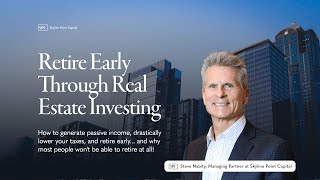
Webinar hosted by Jake Prieur (marketing lead) and Steve Navity (managing partner of Skyline Point Capital) introducing real estate—particularly multifamily—as a strategy to accelerate retirement and generate passive income. They frame the problem as four structural headwinds to retirement: insufficient stock-market returns, increased longevity weakening Social Security, CPI under-reporting of real inflation (they cite the Chapwood Index), and rising healthcare costs. The speakers argue multifamily real estate in Sun Belt markets (Dallas–Fort Worth, Nashville, Charlotte and nearby metros) provides lower volatility, multiple income streams (rent, ancillary income, appreciation), faster rent re-pricing, inflation-hedging, and strong tax benefits via cost segregation and bonus depreciation. Specific examples cited: 24-unit Empire Apartments (bought 2018 for $1.1M, sold 2022 for >$1.8M — described as a 4.4x gain with ~69% annual return), Lux at Indian Lake Village (94-unit Class A in Henderson/TN, bought Dec 2022 for $26M; $670k capex projected to add ~$3.8M value; converting amenity space into rentable offices added ~$1.2M in value at $700–$850/mo per office). A tax case study (“Dr. Sam Smith”) shows a $150k passive investment producing ~8% cash-on-cash (~$12k/yr) plus a first-year non-cash loss (~$121k) from bonus depreciation that offsets a $250k K-1, reducing taxable income and saving roughly $45k in taxes in the example. They outline a five-year portfolio-build scenario where repeated investments and tax-driven reinvestment can grow a portfolio toward ~$880k with increasing passive income.
Chapters
Good evening, everyone, and welcome to the Retire Early Through Real Estate Investing webinar. We're going to get started here in just a few minutes. We're going to let some people roll in here, so just take a quick break and we will check back in here in a minute. All right. Hey, in the meantime, we'd love to hear from you in the chat. It's open. Let us know where you're viewing from. If you're from Omaha like we are, or if you're in Alaska, wherever, we'd love to hear where you're from. We'd also like to know where you are in your journey investing in real estate. Whether you're just getting started learning or you're a seasoned investor, let us know. Either way, though, we're glad that you're here tonight. Also, if at any time you have any questions, please feel free to drop it in to the Q and A section and we'll make sure to do our best to address that at the end of the webinar. Lastly, after this webinar is over, we're going to be sending you to two things. Number one, we're going to send you the recording of this webinar so you can watch it again if you need. And number two, we're going to send you our new and exclusive ebook that will walk you through how to get started passively investing in your very first real estate property. Now, we want to make sure that neither of these get spammed like spam does. Our spam folder collects everything, so if each of you could take us a quick minute before we get started to check your email inbox. Steve Navity, the handsome guy on the slide right in front of you, just sent you an email titled add me to your contact list, very generic, to make sure it doesn't get spammed when we send you the ebook. I'd suggest you open the email that he just sent and add them to your contact list so that you're guaranteed to receive the recording and the free ebook. And we put together a little slide for you with some easy instructions so you can see right here whether you have Gmail or you have Yahoo or Hotmail. It's super simple. It'll take three seconds. And again, it'll allow us to make sure we get the ebook to you and the webinar so you can watch them again and review those whenever you want. So I'll give you a quick second to do that. And again, people are are rolling in. I can see we've got a fair amount of people showing up, so we will let them keep coming in. And again, I highly encourage you guys to. To add Steve to your contact list so we can get you that ebook and the webinar recording. All right, with that, let's get started. I'm really excited for tonight's webinar. We have a great group of people on tonight that the list looks like the attendees continues to grow. Um, and people are interested in learning about real estate investing and how it can help generate passive income, drastically reduce your tax. Your income taxes, and even help you retire early. I know that sounds too good to be true, but I promise you it isn't. By the end of this webinar, you'll see that it's. It's actually quite attainable. I'm sure we have a number of people on tonight who are also worried that they might not be able to make it to retirement or, or they might not think they can retire on time. Those are real fears that people have nowadays, so we want to address those as well. But before we dive into any of that, I first want to introduce myself. My name is Jake Preer, and I oversee the marketing operations at Skyline Point Capital. As you can see here, we have the ubiquitous disclosure slide. Every one of you have seen this, so our lawyers have said we have to read this, so please bear with me. Continue to to add Steve to your contact list while I read through this. We are not investment advisors and this seminar is provided for your educational purposes only. Our investments involve different degrees of risk. You should be aware and consider your risk tolerance level and your personal financial situation at all times. You are free to reject or accept all investment recommendations made by us. All services that we offer are subject to market risk and may result in loss of your investment. Do not invest your money on any recommendation alone or on our recommendation alone. Consult a professional advisor. Past performance does not determine performance. And please consult your CPA about your personal tax situation. I felt like that was the end of, like a drug commercial, but we've got through it. So let's move into the actual content. People are still rolling in. I love to see it again. Use the chat if you guys want. We'll address them as they come up. So let's get into why we're all here. Based on what's going on in the markets today, there's a real chance that you may not have enough to retire when you get to 65. And we'll go over why that is in here in the future. And that's a terrifying thought, right? That you might not be able to retire at all, or at least on time. I know we have a number of physicians on here tonight, but I'd wager a guess that these newspaper cutouts are resonating with almost everybody in here. And we've got a good mixture of people who are physicians and some that aren't. And I think this is going to resonate with everybody. You're likely experiencing having to work longer hours. Perhaps you're even better burnt out. And some of you are wishing that you had the ability to have more control over your work life balance. I totally get that. All right. And when looking at your retirement savings, you might also feel like the rewards from the hard work you put in over the last few years have shrunk given the current economic climate and the rampant inflation. Some of you again are even wondering, is retirement in the cards for me, let alone when can I even retire? And your fears are well founded if you just take a look at these news clippings. 56% of Americans can't cover $1,000 emergency expense. Retirement savings are at a low nationwide and the stock market is continuing to be problematic. I can see here that some people are saying the chat is disabled. I apologize for that. Feel free to use the questions and answers question answer area. That way we'll, we'll address those there. So again, apologies for the chat. Well, we've won over all those things that you guys might be feeling and the fears that you might have about retiring on time. But that's why we wanted to put together this webinar tonight. So let's jump in to our agenda. Let's quickly review what we're going to be covering tonight. First, we'll go through our introductions. Then we'll review the problem, which is the current state of the economy and retirement. Next, we'll discuss the solution, AKA the benefits of real estate investing. Then we'll walk through our first case study on how you can lower your taxes and keep more money through real estate investing. Next, we'll review how to build a million dollar real estate portfolio in five years. I know that sounds clickbaity, but it's actually possible. It really is. Last, we'll talk about ways you can get started generating passive income through real estate. First, I'd like to introduce our other speaker for the evening, Steve Navdy. Take it away.
Thank you, Jake. My name is Steve Navity and I'm managing partner of Skyline Point Capital. I started investing in real estate in 2006 with a small retail strip center. Currently Skyline Point Capital is invested in over 4,000 multifamily units commercial, retail, industrial, mixed use development projects. I've been married to my high school sweetheart for 44 years and I live in Elkhorn, Nebraska. Thanks for joining us tonight and we look forward to helping you learn more about real estate investing and ways to create passive income and generate wealth.
And as I mentioned before, I'm Jake Preer and I oversee marketing operations for Skyline Point Capital. Formerly I was the CEO of a content marketing agency in Omaha, Nebraska which I started, scaled and sold. And I've grown up around real estate most of my life, so I can speak firsthand to the power of participating in real estate to help generate passive income and lower your taxes. Just to tell you a little bit more about our group, SBC is based in Omaha, Nebraska, but our portfolio of real estate assets can be found in some of the fastest growing metro areas like Dallas, Nashville and Charlotte and other southeastern states across the Sun Belt. Alongside our investors, we've invested in over 4,000 units across the U.S. all right, we've already touched on a little of what the problem is, but let's go a little deeper into why most people aren't going to be able to retire on time, if even at all. There are four problems. Number one Problem one Stock market returns are too low to get you to retirement on their own. Now this is one that you probably have not heard of a lot and we're going to review why this is a real problem. Since this is where most people are banking on their retirement coming from. Let's take a look at the stock market return calendar or calculator you can see here. And I've got the link up there in case you want to check any of this math. This calculates lets you find the annualized growth rate for the S P500 over the date range you specify. We took a 15 year look. That's an arbitrary number. You can use 10 years, 5 years, 20 years. There's a lot of up years, a couple down years and so it usually is about the same return. This calculator lets you find the the return that you want for that time range. So if you invested $1 in January of 2008, you'd only have $2.51 today. And that's taking into consideration inflation and dividends. Two and a half X in 15 years is not enough growth. That'll last you a few months, maybe a few years in retirement. It doesn't matter what you put in 15 years. Two and a half X is not enough. There's no evidence that the stock market is going to take you to take anyone to retirement on its own, unless you bought Amazon stock in 1996. And if any of you have who are here tonight, then I applaud you. Unless you did that. This is what the stock market is really going to make you in the long run. This just isn't going to do it. And now, that's not to say you should not invest in the stock market. Steve and I are both are. You should do that as well. But this alone should not be counted on to get you to retirement. To be honest, you need that buck, that $1 2008 to turn into $20 to retire comfortably. So that's problem number one. Problem number two, people are living longer. And the Social Security system hasn't changed enough to keep up. Social Security was designed somewhat in the 1930s, I think, around the New Deal. Most of it was done in the 60s. And the problem is that people are living longer today than they were in the 60s. Social Security was designed for its time when people were living to the ripe old age of 69 years old, 70 years old, that's four or five years of retirement. It was made for that. Nowadays, people are regularly living to 79 and above. That's 14 years past retirement. Now, that's great for that individual person, but for Social Security, it wasn't designed for that. And it's not designed to support somebody that long. Many people, many specialists and experts believe that if you're under 50 years old today, you're likely not going to see the benefit of Social Security. Now, the reason why we say that is you likely won't be able to rely on Social Security during retirement. Now, if you get it, awesome as just spending money for you. But the stock market alone ain't going to do it. And Social Security is not going to be enough to help you in retirement. All right, problem number three. This is the big one. This is a real big one for today's economy. Number three is the Consumer Price Index. The CPI doesn't represent an accurate inflation rate anymore. What was once a fairly accurate index is now being drugged down by items and that we don't actually consume. That basket of what used to be about 5 to 800 products is now over 80,000 items, many of which aren't a good representation of what we actually consume every day. Most of them are products that you've never heard of and definitely do not use what you should be using. And what we use is called the Chapwood Index. You can See that in the slide here? And it measures the top 500 items you actually use, like shaving cream, bread, X this, eggs, excuse me, the Starbucks that you consume once or twice every single day. That is included as well. Now, this is painting a completely different picture of what our inflation rates are today. A shockingly different picture. And to, to this, to point something out, these numbers don't represent inflation for like, like they're not stacked upon each other. That's every single year what the inflation is. So this is the top 10 markets in the country. You got New York, Los Angeles, Chicago. You can see there, New York, 2016, 10.8%, 2017, 11.2. The average at the far right is the average of those five years, 13%. You will not hear that in the news. Right. That is way more than was being publicized. So unless you're getting a pay raise of 10 to 15% each year, which kudos to you if you are, but unless that's the case, your purchasing power is diminishing quickly, and that includes your ability to buy, save and invest. All right, I can see here someone says that the volume might be a little low. Apologies. I'll move my mic up a little bit, see if that makes a little better. The last problem is health care. Now, there's, there's a lot of physicians here on the call, and you are all intimately aware of, of healthcare costs. Number four for the problems is premiums and deductibles are outpacing wage growth. Most people don't talk about this, but I bet most of us are actually feeling it. Deductibles alone are skyrocketing at a significantly faster rate than wage growth. What this means is that when you need medical care most in your retirement years, it's going to burn through your cash much faster than you think and can afford. Right. When you need it the Most in your 60s and your 70s, it's going to cost the most, especially if this trajectory continues the way it is. Right? So to recap the four problems, the stock market and Social Security isn't going to get you there alone. And inflation, healthcare costs are going to bleed you out over time. All these factors leave us in a place of needing to find ways to fast track our retirement investments through higher returns so we can actually reach retirement comfortably. With that, let's review the solution of real estate investing. Now, it's not the only solution, but it is a darn good one. So we're excited to be able to, to share with you today. We're going to share about the solution of real estate investing and how uniquely its unique benefits can provide you with returns that you need to comfortably retire. All right, Steve, I've talked enough. Let's jump over to you. We have almost 50 people signed up for tonight's webinar that are interested in learning about real estate investing. But let's start with the basic is in case there's anybody here who's not that familiar with real estate, why real estate? And how can each of us benefit from having it in our investment portfolio?
Thanks, Jake. There are many benefits that investors see when investing in real estate. Let's start out by discussing some of our favorites. First off, real estate investments allow for portfolio diversification. Returns on real estate investments have little or no correlation to the stock market, which is a huge benefit to investors. There's also a very low volatility with the private real estate market investments compared to the stock market or other investment classes. For instance, when stocks drop 20%, real estate investments typically continue to hold their value. Real estate investments also offer very stable multiple income streams. This is what I love about real estate. First off, you have cash flow from the tenant's rent that comes in on a monthly basis, very consistent and spread out among many of the units to mitigate risk. You also have other income like laundry income, pet income, reserve parking, and many other opportunities. The third income stream comes from the appreciation in property value. When a property is sold or refinanced, the profits are then distributed back to the investors. Also, real estate investments are a huge against a hedge. Excuse me, a hedge against inflation. This is extremely important in today's inflationary environment. And then the tax benefits, which are fantastic with real estate investments as well. Through cost segregation and bonus depreciation, investors have the ability to lower taxes through depreciation losses. And Jake talked about that earlier. Lastly, by paying down the debt, you are increasing the equity in your property.
Yeah. And we're going to talk a little bit more about the tax benefits. Stay, stay, keep watching. It's going to get. You're going to see the power of real estate and especially multifamily investing real estate and how it can drastically reduce your taxes, even to the point of paying no personal income taxes. I know it sounds crazy, but we'll, we'll talk about it. Thanks, Steve. That's super helpful. Talking about, about why we love real estate. But can you talk about the relative performance of real estate compared to the market? I'm assuming most people want to know that if they take their money and put it in real estate Instead of the market, what's the outcome going to be? What's that going to look like? You compare the two for us?
Absolutely. On this chart you can see the comparison of average annualized returns over the last 20 years between rates and the US stock market. REITs have significantly outperformed the US stock market over the last 20 years, which you can clearly see on this chart. The Gold line is showing the returns REITs have experienced, whereas the brown line shows the US stocks. Now for those of you that aren't familiar with what a REIT is, it is basically a real estate investment trust. REITs are typically fairly large companies that own multiple income producing real estate assets across many sectors. One thing to consider is that real estate syndications, which is what we'll be talking about later, typically outperforms REITs. And that's because syndications aren't loaded down with the expenses and payroll which many REITs have in their business model.
So Steve, let's talk about inflation. I talked about it a little bit earlier on. We're seeing massive inflation here in the US Even more so than what's being reported through the news, the news channels and newspapers. Inflation's eating into our purchasing power and lowering our, our real returns. How does real estate hold up in these situations? Jake?
That's another great question. As I mentioned before, real estate is a great hedge against inflation and this is extremely important now than ever with inflation hitting approximately 8 to 9% recently. Keep in mind the consumer price index does not factor in food, energy, owned housing. So inflation is actually significantly higher than 8%. I'm sure everyone on this webinar is well aware of what's happening with inflation right now. When inflation is high, real estate investments see substantial increases in rent, which increases the cash flow and the value of the real estate asset. We have seen this firsthand in our portfolio over the last 12 months. We have seen 10 to 10 to 12% rent growth in Nashville and Dallas Fort Worth, which is where the bulk of our portfolio lies. Now to give you a quick example how powerful this is, consider a property that has a million dollar of net operating income. If you can increase the income by 10%, the income would no longer be 1 million, but 1.1 million. Our value would go up by almost $2.2 million if you use a cap, a 5% cap rate and a cap rate for those that don't know, is how multifamily is valued. It's calculated by taking the net operating income and dividing that by the purchase price. So I want to Iterate one more time. We have seen substantial increases in value amongst the portfolio due to high inflation within what's happened in the US recently. I really hate to celebrate inflation because I hate seeing the price of eggs, meat, gas and et cetera go up. But it's more than made up for our real estate returns.
Yeah, thanks Steve. All right, let's talk about the different types of real estate investing and why. Particularly love multifamily. You know we, we're a big proponent for all real estate, but man, multifamily is just what we, we harp about. Let's talk about why that is. A couple of the benefits of multifamily real estate investing is that multifamily housing provides risk mitigation through tenant diversification and provides for faster lease rate adjustments as you can see on the left hand side of this slide. Why this is so important is that since multifamily leases are usually 12 months or sometimes a little less, the owner of the property, like us, can, can quickly increase the rents to match the market. So if the market and say Nashville, the rents are increasing, we can adjust more quickly than most other types of real estate. So if you own property in the Sunbelt areas, we've seen rate increases of 15 to 25% year over year recently. Another great thing about multifamily investing is your risk is mitigated by the diversification of the number of tenants. In this example, if you lose two tenants of your 24, that's only 8.3% of your revenue and it will have a much smaller effect on your overall income. With commercial real estate, the middle section there, lease terms are usually a minimum of five years and can be as long as 10 years. So there's a lot less flexibility there to be able to get to the market faster. And that counts drastically less than multifamily. In this example, if you lose two tenants out of your eight total, you've just lost 25% of your revenue. That's a big problem. By losing just one tenant, your profitability is at risk because you have fewer tenants and each tenant makes a larger percentage of your total revenue. And the last category, the one on the far right, is industrial. Industrial buildings may have one to maybe two tenants for the whole building as compul compared to multifamily. So in this example, if you lose one tenant, you've lost 50% of your revenue and you better have a lot of cash reserves because that's going to be a big problem real fast. So as you can see from this slide Investing in multifamily provides the least amount of risks associated with tenant occupancy and also allows owners the ability to adjust lease rates to market conditions quickly, making multifamily the logical investment choice. Now, we don't, we didn't point out single family here, but it applies as well. If you own a single family home as a secondary investment for you, as soon as someone moves out of that, you have zero income coming in. That's a huge risk to you. Again, unless you've got cash reserves on the sideline. But that's, that's just not a great way to invest your money in real estate. Multifamily is the lowest risk out of all these. All right, we've talked a little bit about the current economic challenges, so let's focus on how multifamily historically has performed in challenging environments. All right, as you can see here, inflation is at a 440 year high, which again, we're going to beat that drum. That's incredibly important because it fuels rent growth for multifamily and it drives the value of the property up, which then drives your return on investments. That's a huge thing, right? Rent growth is at a near time, a near all time high. Occupancy is at a near all time high. There's a lack of supply in most of the markets, especially the Sun Belt where we invest. There's a lack of supply over the next decade, meaning we can't build enough houses fast enough. There are not enough houses on the marketplace. And so people are naturally having to go to apartments to live. And when that happens, occupancy goes up, and when that happens, or rents go up and when that happens, the value of the asset goes up and then you get a higher return on your investment. Debt is still relatively low even today, or, excuse me, relatively inexpensive, but it will decrease over time. So you're still able to buy great apartment complexes even today. And the tax benefits, like we said, are some of the best of our lifetimes, folks. Overall, the multifamily market trends remain very favorable for someone interested in investing in multifamily real estate. But it's easy to say that. Let's actually review some multifamily deals to see just how these benefits pay out in the real life. Steve, can you walk us through some of some of the recent examples of some of our past deals?
Absolutely, Jake. I've got a couple examples, and the first one I want to show everyone is a small 24 unit HUD apartment complex we purchased in 2018 called Empire Apartments in Fremont, Nebraska. And the reason for showing you this is if you buy right and, and sell right, you as an investor can get a great return. We purchased the property for 1.1 million and then sold it in 2022 for over 1.8 million for a 4.4x gain with an annual return of 69%. I'm not going to say we can replicate that performance in the future, but there are great black swan properties out there. You just need to be patient.
Yeah, this is where that disclosure line comes in where we said past performance is not indicative of future performance. That 4.4x return is astronomical and we always shoot for it. But we're hoping that for each one of our future properties, but it's not guaranteed.
Jake the next one I want to talk about is the Lux at Indian Lake Village in Henderson, Tennessee, a suburb of Nashville. We really like this Nashville property. The lux is a 94 unit class A property that we purchased in December of 2022 for 26 million. And what we liked about the Lux is that number one, it's located in a high growth area. The tenants have higher incomes which we all like. They pay their bills. It's close to the interstate and 20 minutes from downtown Nashville. It's also adjacent to an outdoor mall with restaurants, movie theaters and more in the area is well kept up and the Capex budget and strategy was easily implemented with a capital improvement budget of 670,000 for both the interior and exterior will raise the value of the property another 3.8 million. Jake, one of the interesting things we learned from our new property management company for the Lux, there's a trend for apartments to put in small offices on the properties. For the stay at home worker, we had a very oversized exercise room and we took some of that area and converted the space into rentable offices. Each Office rents for 700 to $850 a month and this has added $1.2 million to the value of the property. And the takeaway from this is if you listen to the market and you think creatively, you can come up with lots of ways to increase the value of your property.
Steve, are there, are there markets that are more desirable than others?
Absolutely. We love the Sun Belt for the reasons you see here. But there are a few markets we really love. That's the Dallas Fort Worth. As I mentioned earlier, Dallas is growing like crazy. According to Biz Journals, DFW is ranked the number one the best job performing market in the US and the last 12 months they added over 196,000 jobs. The rent growth year over year was 12% in Q4 of 2022. The market is extremely resilient and it shows as 90% of local jobs that were cut during COVID shutdown returned by July 2021. And I can't say enough about Nashville. It's another market we love. According to the Wall Street Journal, Nashville has a second hottest job market in the United States behind Austin, Texas. There is no state income tax in Tennessee and that attracts job seekers and businesses. Nashville was ranked to have the most economic growth in 2021. Number one is the most promising real estate market, number one and metropolitan economic strength. And number one is the top city for job seekers in 2020. So that's a little bit of why we. Why Dallas and Nashville are two examples of major growth markets we like to buy in. It sets us up to have a very strong tailwind to assist the organic growth and force appreciation of our properties.
Thanks, Steve. Yeah. As you can see on the slide, these are the real criteria we target in the Sun Belt area. Nashville and Dallas hit all of these criteria before we can move on. I can see a couple of people have raised their hand. Feel free to use the question and answer to ask any questions or make any comments. I know the chat's disabled, so feel free to use the Q and A if you have anything and we'll try to address them at the end here. All right, we've walked through the problem with retirement and the general benefits of investing in multifamily real estate. Let's crunch some numbers and give you a more concrete example and case studies of the power of real estate. So section number three, let's first talk about how you can cut your taxes with real estate. I promised you this was super impactful and I'm going to show you why. Now, let's take the situation of a fictional doctor, Dr. Sam Smith. You can see it's a very generic name. He's a radiologist earning close to half a million each year. But he's also a partner in a practice and receives partnership income in the form of a K1 every year. And at this level of income, he's in the top income bracket and pays a lot of taxes that you can possibly imagine. So even if you're not a physician, this, and you're not at this income level, this, these case studies will still apply to you. This, we just want to give a clear cut example of, of, of the benefit of real estate on your taxes. So again, if you're not a Physician. Don't worry. This still applies to you. All right, let's take a look at the depreciation schedule of a traditional asset like your home. When you purchase or invest in a fixed asset, again like your home, the government allows you to expense the useful life of that asset over a specified period of time. That's called a depreciation schedule. Typically those schedules are 27 and a half years for hard assets. Don't ask me why it's 27 and a half. I don't know. But it's 27 and a half years and it's evenly spread across those years. You see that in the graph there? Every year the same amount depreciated. This is just like if you're in a private practice and you have medical equipment. This is a non cash expense that you can use to reduce your taxable income. I'm going to oversimplify this a little, but let's pretend that we bought a multifamily complex, an apartment, for $20 million. With a 27 and a half year depreciation schedule, we can expense over 700,000 each year in depreciation. So if the property generates, let's say 2 million of revenue, has expenses of 1 million, that means it's left with a cash flow of 1 million before taxes. Right? 2 minus 1 equals 1. We can then deduct the depreciation expense to make our taxable income just $273,000. Now that's really helpful to relieve some tax burden. But here's the good thing. The IRS realizes that not all fixed assets have the same useful life. For instance, a dishwasher is not going to last as long as a roof. We all know that roofs last, God willing, 20, 30 years, your dishwasher, probably five to eight years. So the IRS knows this and they allow us to do an itemized in to do a cost segregation study that allows us to move this, that depreciation schedule up further in a shorter time period. You can do this again through a cost segregation study. And what that does is it pulls forward more depreciation into the first years and creates a non cash loss on the property. So again, your. If you have a 200 unit apartment complex and you've got 200 dishwashers that only last five to eight years, well, that's going to be depreciated over five to eight years rather than the 27 and a half year return. Right. These losses are passed through to investors in the form of bonus depreciation and can be used to offset other types of passive income that you might have, like a K1. So let's review the same scenario, but now let's use the bonus depreciation on the chart below. So the Property still generates 2 million in cash, has expenses of 1 million, and still has a cash flow of a million left over. We can then deduct the depreciation expense to make our taxable income. Negative $700,000. That's not a typo. Negative $700,000. This is a completely legal mechanism to offset other sources of income, lower your taxes, and most importantly, increase the velocity at which your money can be invested and grow. Layman's terms, you can now take those tax savings and roll them into your next property or your next investment, or you can just pocket them and keep them for a rainy day. All that means is less money going to the government, more money in your pocket. This is something that SBC does on all of our investments to help our investors lower their taxable income. All right, so let's roll back to Dr. Smith. Let's pretend Dr. Smith invested 150,000 into a multifamily syndication with Skyline Point Capital. Naturally, that was leveraging cost segregation and bonus depreciation studies. Because of that non cash loss in the first year on the property, Dr. Smith receives a non cash loss of 121,000. Just 120, $122,000. That 121,000 can be used to offset the 250,000 he receives as a partner in his K1 in the radiology practice and actually reduce his taxable passive income from 250,000 down to $128,000. Again, everybody's tax situation is different. But if he's paying taxes at his marginal rate, that is roughly $45,000 that is going right back into his pocket. If you didn't follow any of the math I just said, just know this, that is a lot of money that he would have given to the government that is now remaining in his pocket. It's a huge win. So as you can see, the tax saving aspects of real estate investing is incredibly powerful. But that's not the only major benefit. All right, let me walk us through how someone could build a million dollar real estate portfolio in five years, building off of the scenarios we've already reviewed. Now, again, if you don't make the kind of money that Dr. Smith makes, this will take a little bit longer. But we want to use this to show you that it actually is quite conceivable that in five years you could have a million Dollar portfolio. Let's review it. Let's go straight back to Dr. Smith, right? And follow what happens with his investment of 150,000 in year one. Let's pretend that the $150,000 that he invested is doing three things. First, it's paying him at 8% cash on cash return every single year as of last year and the years before that. That's actually about what people could expect from cash on cash returns. It's a little less this year, but just for this example, we'll use 8%. So for his $150,000 investment, he's getting 12,000 a year in passive income in the form of quarterly distribution checks, meaning we're sending him checks right to his door every quarter. Passive income, $12,000. Number two, the investment is also appreciating, just like your house, over time, the value of the real estate asset grows each year. And number three, because of that bonus depreciation, it's allowing him to offset his other income and get the tax benefits. I talked about the velocity of money, but this is allowing him to speed up his ability to put his money to work. And let's play this out, because this becomes sort of a snowball effect and it's really exciting. Now, let's say he does this every year for five years. So in year two, he invests another $150,000 in a similar deal that pays him a similar cash return, appreciates at the same similar rate, and gives him another tax benefit by helping him offset his other sources of passive income. He's now receiving $24,000 of passive income. Remember, $12,000 a year, getting another $45,000 tax benefit that he can just roll into the next one. And he has two properties that are appreciating in value. You can see how this flywheel starts turning and speeding up. If he does this every year, and if he continued to do this each year by reinvesting, let's say he does it for five years by reinvesting that tax benefit and putting additional capital into real estate. The value of his real estate has grown to just shy of $900,000. You can see it there. $879,999, 990. He's received 180,000 in investment income, passive income just coming right to his door and taking advantage of the bonus appreciation. Each year he's done another investment. Each time he's done an investment in the tune of $225,000 total. All right, that was a lot of numbers. I'm sure I've lost a couple of you. That's okay. Let's focus on the main point. The main point is, what was his return on his investment over those five?