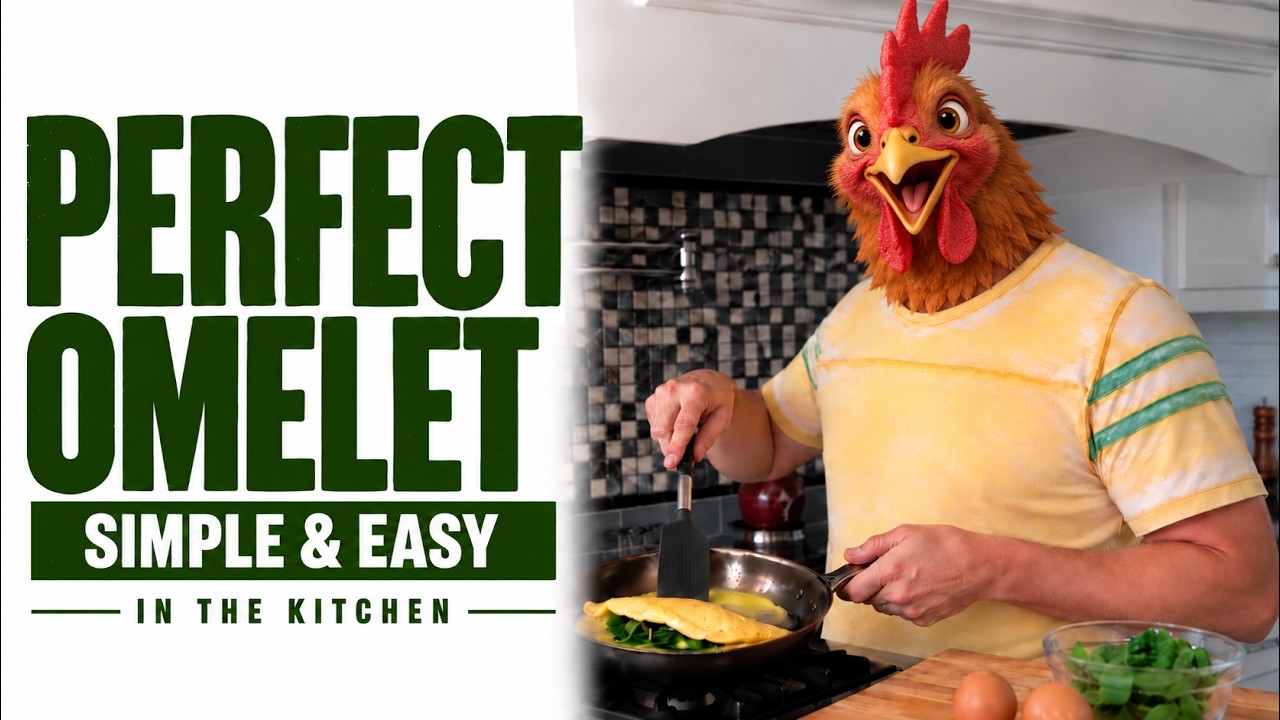
In this cooking tutorial, Chef James (Speaker A) demonstrates how to make a spinach and sun‑dried‑tomato omelet while co‑host Speaker B shares common omelet frustrations and highlights the upcoming tips. The video walks through every step: selecting and pre‑cooking fillings, preparing the pan (heat and fat), handling eggs (cracking on a flat surface, retrieving stray shell fragments), determining the right number of eggs and butter amount, cooking the egg mixture (stirring, letting uncooked portions settle, edge‑moving techniques), choosing a folding style (French tri‑fold vs. American fold), and final seasoning (adding salt and pepper after cooking). Throughout, James offers practical, experience‑based tricks aimed at preventing sticking, avoiding a scrambled texture, and achieving a clean, restaurant‑quality omelet.
TranscriptAuto-generated · 5 min
So when making an omelet, first thing is what you're gonna— you have to figure out what you're gonna put in the omelet. So what type of omelet it is. Today we decided to make it a spinach sun-dried tomato omelet. That's one of my favorites. And what you need to do is, for an omelet, cook whatever you're gonna put inside the omelet first.
Now I don't know about you, but I have always struggled with omelets. They stick to the pan, they don't come out right, they always turn into a scramble. So until I learned some nifty tricks from Chef James, so he's going to show you how to do those tricks today.
One of the keys to having food not stick to your pan is making sure that your pan is hot before you throw the food in. Secondly, you want to make sure there is enough fat in between the food and the pan. So for right now, I put in about a teaspoon of of butter. You could use ghee, you could use coconut oil, whatever saturated fat you want to use. And then I put in the sun-dried tomatoes. I'm going to put in the spinach. We're just going to sauté those a little bit. And then once those are done, we're going to put them in a bowl, and then we're going to start our egg process. Okay, so these are some eggs that I got at the local farmer's market, and they come from pasture chickens, Which means they're getting to roam and eat bugs, just like a normal chicken. So, one of the tricks to cracking an egg, a lot of people think that you should crack it on an edge, and actually it's better to do it on a flat surface. So, see how it then creates this indent right here, right? So, with that indent, I just stick my 2 fingers in there and boom, it comes right out, and it comes out real clean. Now, the other trick though is if for some reason a shell does go into the mix, The egg always wants to go back into the shell. So, if you get a shell in there, don't try to get it with your fingers, you'll be there all day. What you do is you stick the shell in there, and the shell, the little piece that fell in there, will actually just gravitate right back into the other shell. So, that's just a tiny little trick if you do get shell bits in there. So, let's crack this other egg, get it in there. Now, normally, depending on the pan size, you might need 3 eggs for an omelet. It really depends on the size of your pan. For this size pan, We should be okay with 2. I'm going to put in about, this is probably about a teaspoon, maybe a teaspoon and a half of butter. You don't want it to be too high or the butter will burn. And then now I'm going to just scramble my eggs a little bit. Okay? Pan is nice and hot right now and it's covered with the oil, or the butter I should say. And now I'm going to add my egg. And here's the insides that I'm going to put in. This is the spinach and the sun-dried tomato. I did that earlier. And then here what you want to do is you want to kind of allow for the part of the egg that has not cooked to get to the bottom. And you can do that a few different ways. You can move the edges in or you can actually Kind of do these little— adjust these little curlicues inside to break the bottom so that it fills with the other stuff. You can do either one. I also like to do this a little bit. But you got to make sure it settles. If you don't— if your egg hasn't settled, then you're not going to have the best-looking omelet. Okay, and basically what I do is I just kind of make sure that the egg is, that the egg is not sticking to my pan. I'm gonna add the ingredients. Now there's a couple different types of omelets. You can do a tri-fold omelet, which is more of the French style. So I can fold one edge in and then the other edge, and then you have this kind of crepe-looking omelet. Or the American style is where you just fold it over as so. And voilà! You have your egg, and the pan is fairly clean, and there you go. And now, now is when you would want to maybe salt and pepper it. You don't want to salt and pepper it when it's actually cooking. The salt actually affects the egg a little bit, so it's better to do it after you After you cook it, and, uh, there you go. Voilà! An American-style omelet.