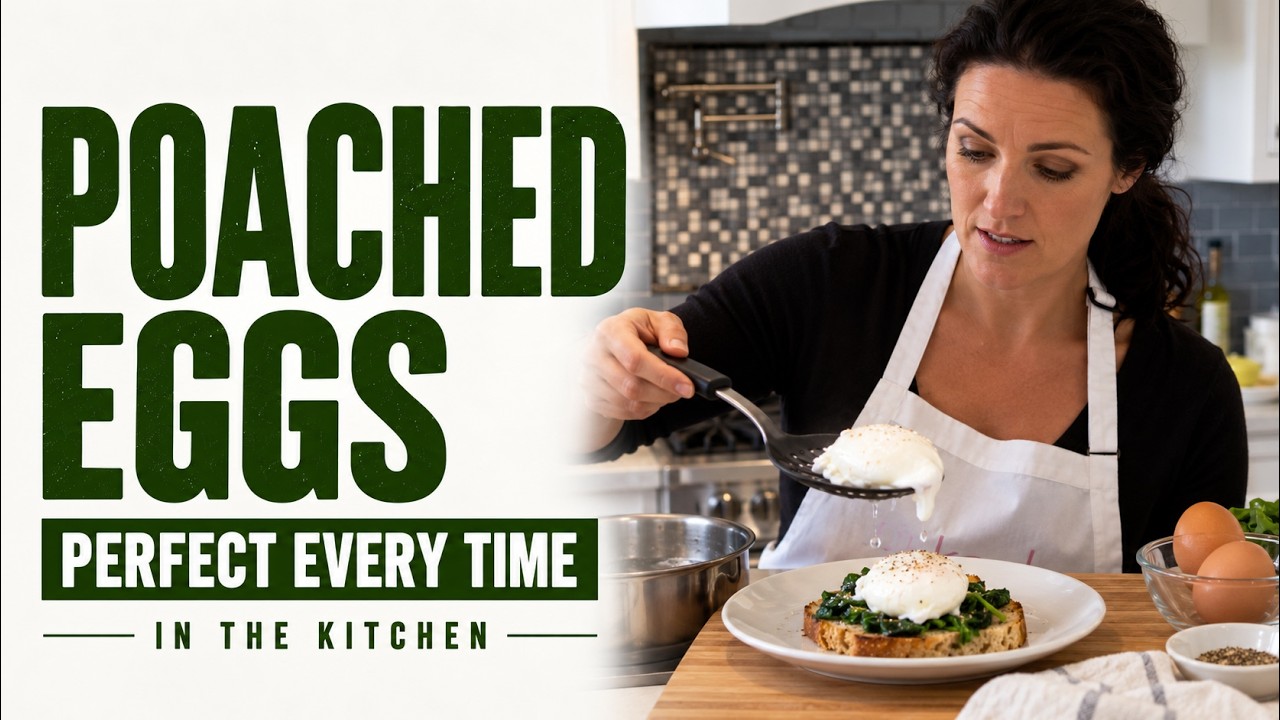
In this informal, step‑by‑step tutorial, the presenter demonstrates a no‑gadget approach to poaching eggs using only a deep frying pan, water, a whisk, a slotted spoon, and a splash of mild vinegar. He fills the pan almost to the rim, adds a capful of distilled white vinegar to help the egg whites coagulate, brings the water to a rolling boil, then reduces the heat slightly before cracking the eggs directly into the water. The eggs cook quickly—typically 2 to 4 minutes—so the presenter explains how to gauge doneness by tapping the yolk, feeling its firmness, or giving the egg a gentle jiggle. He notes how to achieve soft, medium, or hard poached eggs based on personal preference and cautions against breaking the yolk when removing the eggs with a slotted spoon. Finally, he plates the poached eggs on a bed of steamed Swiss chard, seasons with salt and pepper, and serves them as a simple breakfast, mentioning a friend named Judy who enjoys the dish.
Chapters
Today I'm gonna teach you how to make eggs in one of my most favorite ways, which is poached. Really, really easy. Now I know that there are all sorts of different sort of kitchen gizmos out there to help you poach an egg, little cups that you put in water, whole things that you put on top of pans. I honestly don't think you need any of that. All you need is a frying pan. And a whisk. A deep frying pan, not a really shallow one, a deepish frying pan, a slotted spoon, and a little vinegar. Some kind of mild flavored one. This is just plain old distilled white vinegar. It really doesn't matter. It's just to hold the eggs together in the water. So you don't want to use balsamic vinegar because that will add too much flavor, but just any kind of basic vinegar. Okay, so I filled this up with water. You can see it's almost at the top, not quite, but as full as it can go. Basically enough to, once you break an egg into it, the water will cover the egg. So I just take a capful of the vinegar. You're not using it— really, the reason why you're putting it in here is it actually keeps the eggs together when you drop them in. Okay, and now I'm gonna go put it on the stove and get it to boil. Okay, so I've got my frying pan. I've got water in almost up to the edge of the pan, not quite, about half an inch away from the top. A nice rolling boil. I actually turn it down just a little bit. And I break the eggs right into the water. Look at that. So easy. Now this— these don't take very long to cook at all. And in fact, you can see they're already— they cook really, really quickly. Now I don't even know how long they take. Maybe 2 minutes, maybe 4 minutes. There's ways to tell though. So you take your trusty slotted spoon. Now of course I just put these eggs in, so they're nowhere near done. But if you see, if I tap Tap the yolk. See, if I tap it, it's really soft. Okay? I don't know if you can see that with all these bubbles, but it's really soft. So what we want to do— that's basically our gauge of when they're done. So I'll let them cook for another minute or so, and when they are a little bit firmer, that means they're ready. Now, if you like your eggs poached hard, you'd wait until they were quite firm. And of course, if you like them done medium, you'd wait until they're soft. Somewhere between pretty squishy and the hard. You might have to experiment a couple of times. Poached eggs tend to be something that you need to try a couple of times before you get it right. But no worries, it's hard to screw them up. The biggest thing you want to make sure when you go to take them out is you don't want to break that yolk. Okay, so these are looking about ready. If I give them a little tap, they're still a little soft. I like them a little soft. So I'm gonna pull them out. Now, the most important thing— see, if I give them a jiggle, that's another way you can tell. It's still a bit jiggly when I give them a jiggle. Now, I just try very hard not to break the yolk. Now, you'll see I'm putting these on a nice bed of steamed collard greens— or not collard greens, excuse me, steamed Swiss chard, which is one of my favorite ways to eat eggs. And I'm just gonna poke these, show you— ooh, look! See, that got nice and runny. Yummy! A little bit of salt and pepper, and you are good to go! Sounds like breakfast to me! Yum! Doing my stuff with Judy. She loves her eggs.