Nature's Multivitamin for the Sensitive or Picky Eater With Chef James Barry and Dr. Achina Stein
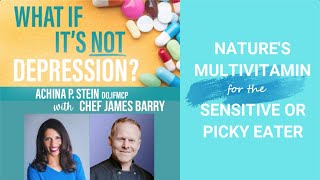
Chef James Barry and Dr. Achina Stein discuss Pluck, a powdered organ-meat seasoning designed to make nutrient-dense foods accessible to picky eaters. Barry explains nose-to-tail eating and practical ways to introduce organs: sprinkle Pluck on food, grate 2-4 tablespoons of frozen beef liver into ground meat per pound, or try chicken hearts and beef tongue. The conversation covers sourcing options and how organ foods can retrain your palate and support your microbiome.
Questions this video answers
October 21, 2021.
16 years.
Liver, kidney, spleen, pancreas, and heart.
10% off with the show-notes link for the first purchase.
Website: eatpluck.com. Instagram: Chef James Barry (James Barry with an A) and @eatpluck.
Chapters
Foreign. Welcome to the what if It's Not Depression podcast. I'm your host, Dr. Achina Stein. And today I am interviewing chef James Barry, who's been a chef for 16 years and has produced his first functional food product called Pluck. It's an organ based all purpose seasoning and it's the first of its kind and it's really amazingly delicious. And it's a great way for people to get organ meats into their diet. And that's what this looks like. And I find that it's delicious. I want you to know, you're probably thinking, why are you interviewing our chef today? And I want you to know that the reason is because I have had a number of patients who understand that in order for them to resolve their symptoms of depression and their root causes is to first and foremost change their diet. Food is medicine. Food is the first way to really shift the microbiome to provide all the nutrients that the body needs in order for it to heal. And it's also removing all of those foods that are highly inflammatory. And so sometimes what I do in order to help people in that transition of changing food, which takes time, it takes time to change that diet. It's hard that in order for people to meet their goals faster is to provide supplements. And supplements are a bridge. They're not something that I necessarily want people to take for the rest of their life. Unless we find that there are certain supplements that they just can't take through food or for other reasons. Genetically, they might have reasons to continue taking supplements long term. But that being said, some people can't even tolerate supplements or they're having side effects. They're either not absorbing them or they're having side effects from supplements. And so I always go back to food. How can I get nutrition through food? And again, it's really hard. So when I see a functional food that can actually make a difference, and really the best way to get the most nutrition is really eating organ meats. And people are like, ugh, I don't want to eat liver, I can't eat this, I can't eat that. And it's like it just kind of turns their stomach. So I find that I try to find other ways. And anytime I see a product that like, wow, this is fantastic, I want to know more about it and try it myself. And I've actually had a couple of patients who have improved in actually switching going back to food and actually eating organ meats, really eating organ meats. And so this is a delicious way to get Organ meats into your body. So that's my reason for bringing chef James Barry onto my podcast, Vodcast. And I love to hear what you have to say about it.
Yeah. Well, thank you for having me, Achina. I'm really excited to talk about how food affects our body. This link to me is broken in our society, and sadly, I think it's been broken for a long time, and I'm not sure why. I think there's probably lots of reasons, but as you're saying, I mean, organ meats, right. Organ meats are one of the most nutrient dense foods on the planet, and yet the majority of people are not getting them in their diet. And yet our ancestors did. And when I say answers, I'm just talking like our great grandparents. I'm not talking like, you know, you know, Paleolithic times. I'm talking just like a few generations ago, like they were eating organ meats. My, my. You know, I'm in. I'm in my late 40s, and, you know, I think we're similar age. I know, I know you're a little older. I know that you look. You look younger. You look fantastic. But point is, I think we're in that same generation where it's our grandparents. Our grandparents ate this, and yet our generation and younger are not eating it. So what is going on? What has changed? So I love this topic. So thank you for having me on.
Oh, you are welcome. So how did you even get into this? Is there a story behind how you even found or came up with this product?
Well, so cooking, I guess. I guess it ultimately starts with cooking. So cooking for me is how I express my love for someone. I mean, I think. I think early on I learned that. I learned that I'm, you know, you know, there's the five love languages or whatever, you know, and I think one of mine is acts of service. Like, I really enjoy doing things for other people, and particularly when it has to do with their health. If I know that I can give them some healthy kind of food and help them and flourish, like, that just fills me. But I've always loved cooking since I was a little kid, but I never connected that it could be a career. So I didn't actually embrace culinary school till my 30s. And so by the time I was ready to embrace culinary school, I was really clear on what I wanted to do in the field. Like, I was like, okay, I want to work one on one with people. So. So I knew I wanted to be a private chef. I knew that I wanted to look at food differently than just, I want it to taste good. Like, I wanted to look at, well, what, what oils should I be? How should I be cooking it? Should I be preparing it in a specific way to promote nutrition? You know, like for example, soaking grains and nuts and seeds. Right? Soaking helps you absorb, like, brings out, lowers the defenses of the grain and nut or seed and then allows you to absorb the nutrients better. Right? So there's ways that you can properly prepare food that actually enhance the food, make it more digestible, make it more absorbable. And I was, that's the piece that I was really into. And so I got out of culinary school, went right into Private Chef and I was really fortunate. And I was living in LA at the time and I just immediately started building this resume of really big named people, celebs and working intimately with them. And I was seeing that what I was doing was working. And I was working not just for celebs, I was also cooking for families and I was working with mothers who, who had had their babies two years before and couldn't lose their, their, the baby weight, right? And then they started eating my food and they were losing it. So I was, I was seeing direct effect physical response to just this clean way of eating. And then it kind of progressed where I was like, okay, I don't want to just cook for wealthy people. I was like, I want to help more people. And I started a meal delivery service and I ran that for eight years. And then I moved from la and now I live in Portland, Oregon. And, and I have two kids now. And, and it really, you know, I was seeing some of the pickiness or I was seeing things play out with my kids. And I was realizing like, as a parent, all I want is to do good for my family. Like, that's, that's really it, it's that simple and that hard, right? I want to just do good for my family. I want to make sure that my kids are healthy, that they're robust, that they're, that they can get out in the world and they can be, you know, resilient, but they need to have that foundation of health so that they can be resilient. And I, I just started mining, you know, like, okay, how can I get these nutrient. Well, a, I was like, what is a nutrient dense food, right? And B, how do I then get into their diet and, and kind of like divert or move away from any pickiness? You know, like, how do I get into their diet and I don't have to deal with the emotions of it, you know, like, like where I just slaved over the. I think all the parents listening can identify with this. Like where you've slaved, you know, you've cooked your meal all day and then, and then you put it in front of your family and your kids just go like, well I don't, you know, they start yucking your yum.
They're just like, I don't want this Yucking your yum.
Yeah. And they're like, you know, they're just frowning on what you're eating. You, you just feel like, you know, a piece of garbage. You're just like, ah. You know, I like, why are you being so ungrateful? You know, and you just, you know, you feel so upset and so I didn't.
Husband would be totally right there with you. Yeah, husband's the cook. I don't, I don't do the cooking, but he does the cook and he totally talks about that. It's like, no complaints, just eat it. I don't want to hear what you have.
You don't want to hear it. But then there's the other side of that coin. Is that okay? You're so one is that you just put a lot of work into it. The other side is you're so tired you didn't meal plan and now you, you just ordered pizza out. But either side you feel like garbage. One is you feel like garbage if your kids are complaining and not eating the food you cook. The other you feel like garbage because you feel like you're not being a good parent. Like you just bought them nutrient void food deficient food, you know. And so that's where this idea came from. I was like identified the organ meats are the most nutrient dense food out there. And then so it's an ancestral food. And, and it's, it's incredibly nutrient deficient or incredibly nutrient sufficient. And so then I was like, well, how do I get that in a diet where I, where it's not an issue? And that's where I identified that. Well, what's in the capsules? Like when you're buying an organ caps encapsulated organ, it's freeze dried powdered organ meat. So there's, it's not cooked really except for the freeze drying. There's no agents in it. There's no, there's nothing added. It's just, it's just the organs that had been dried and then powdered and it's then encapsulated. So I was like, well, why don't I take those and Compliment them with herbs and spices to offset that kind of organ taste that so many people are avoiding.
Right, right.
And that's when I came up with pluck. And I'm happy to say, as you, as you, so beautifully articulated, that it really is delicious. Like, it's like, it's like you don't even feel like you're eating organs. So. And. And I can truly honestly say that my kids love this stuff. Like, they put it on everything. And so it's just a win, win. Now even when I order pizza out, like, we put it on the pizza, and I feel like, all right, I just won. Because, yeah, they're eating pizza, but they just got organ meat. We put it on popcorn. We're eating, you know, family night movie or something. We're eating popcorn. It's on the popcorn when. You know what I mean? So it's like, it's just a win, win.
Yeah. So let me ask you this. Obviously this is an end of one or two. You know, did you notice a change in your children's behaviors? The pickiness? Are they more accepting of foods that they. That. That maybe they. Maybe they're less picky about and maybe have more of a taste of the foods that are in the organs. And the reason I'm like, Let me preface that. So what I tell my patients who bring little kids into my office who are picky eaters and they have behavioral problems and anxiety, agitation, add, restlessness, temper tantrums, is that they're really picky about what they eat. And it's impossible for some of these parents to get them to eat the healthy foods or to choose those things. It becomes this vicious cycle. What I say is just, even if they take small amounts, even crumbles of broccoli, of all of the rainbow variety of vegetables, what we want to do is introduce, even introducing teeny, tiny amounts of that to the microbiome, causes it to flourish and grow those good bacteria, and then it changes the taste buds and the child will want more of it because you've introduced it in micro amounts. I almost wonder with the plaque where you're introducing in micro amounts the organ meats, if your children's taste for organ meats improves, but also ultimately, has it even changed their pickiness?
Yeah, I love this question, because ultimately, what we're talking about here is the palate, and we're acknowledging that the palate can change. And I think a lot of people don't realize that the palate. We talk about the gut being the second brain. Well, I look at the palate as kind of like this living, breathing thing that can absolutely fluctuate depending on what you're eating and what environment you're in and your stress levels. So that's one piece of what you're asking, which I love. And then the other thing is that, yeah, you're talking about small doses. Infrequent use equals a cumulative effect.
Right.
Which is. Which is very legitimate, you know, and it's no different than when you're. You know, when you. If you have an animal and you're trying to switch their food, what do you. What. What do the veterinarians recommend you do? Well, they say have their old food, but now start to slowly, incrementally increase the new food eventually till the new food is more dominant than the old food. And that is absolutely how I would handle, you know, picky eating. One thing that's really important to remember, that parents need to remember, is that there's a couple of things that come up for me is one is like, I've had parents come to me, say, like, my kid is addicted to Cheerios. And it's like, okay, totally get it. I totally get it. Cheerios are addictive, but Cheerios don't grow on trees. Right? It's not like your kids walking out your door and going to the local bush and picking Cheerios. Like, where are they getting those Cheerios? So I think that ultimately, as a parent, we have to start with, what choices are we making at the grocery store? And I just recommend people don't fall asleep at the cart. Like, really don't fall asleep at the cart. Like, really make sure you're reading the back labels. Really, like, really think about, okay, I know I want to, like, reward my kid, and I want to give them something that they're going to like. And I want to be the, you know, the good parent. You know, the parent, the favorite parent. You know what I mean? But is it to my advantage to bring this ice cream in the house? Is it to my advantage to bring this processed food into the house? And it's got to start there. So just the consciousness, the awareness of what you're bringing into the house, and then from there, like, for example, I know for myself, if it's in the house, I'll eat it. So we just. I don't bring it in, don't have.
It in the house.
I don't have it in the house. And so then it forces me, okay, if we want, as a family, a treat, we have to go out and get it. Like, we have to go. And it's a. It's an event.
Event.
And it's like we eat it out and then it's done. We don't bring it back to the house. And that's. To me, it's a win for. Because we don't do it very often. It's. It's not. It's a non issue because it's not like your kids are going like, I want that ice cream that's in the refrigerator. And you're like, no. So you don't have to say no all the time. It's just like, there is no ice cream. Sorry. There's nothing in the house for you to eat except a banana, you know, so eat the real food.
Right. And to not use food as a reward, as a reward, that in itself causes huge problems down the line.
Huge.
I mean, we know the emotional eating is a huge problem because they've been trained as a child as using food as a reward, you know, Totally.
And so then. And then that carries into the overall topic, which is. Which is sometimes you. If you're not being conscious about what you're bringing in your house or the choices you're making around your food, you can be in a. In chronic distress. Like, that your norm is this kind of low level, like, kind of like acceptance or this kind of toxicity that you're not even aware you're in. You know that. And it connects to the palate, too. Like, so. I always think of this example, like, so I grew up on Skippy peanut butter. Skippy peanut butter has a heck of a lot of sugar in it.
It does.
A lot. Okay. And. But you don't know it. If you only are eating Skippy peanut butter, you don't know that you think peanut butter tastes like this.
Right.
And then you go and get like, a natural peanut butter that has nothing in it, and you're like, whoa, this is so plain. Like, you don't like. It doesn't taste good to you. Right?
Right.
But only once you fully remove Skippy from your diet do you start to realize, oh, the natural peanut butter tastes the way it should if you're eating peanuts. And then you go to try the Skippy and you're like, wait, this is a candy bar. Like, this is. It's so sweet. But you don't know it's sweet until you remove the sweetness from your diet.
Absolutely. And that takes time.
Oh, totally.
Takes time to retrain your palate. And I always say that the microbiome actually influences your palate because they're telling Your brain, what it wants. Candida in particular, which is a yeast fungus that wants sugar. And it will say it's what drives cravings. And it's really. At least that's my experience. I haven't seen research that supports that, but it's been my clinical experience over and over again that when we actually remove or, you know, decrease that overgrowth of candida colonization that people don't have, that those sweet cravings and their palate completely changes. So it's influenced by the microbiome, it's influenced by many things. It's influenced by your sense of smell too, obviously. So if you've lost your sense of smell, then that's also going to change your, your sense of taste as well. So it's that combination of things.
Absolutely. And ultimately it does start with, okay, what choice am I making? You know, what am I bringing in the house? But the awareness that the palate can change is really key. And going now back to your original question about how does organ meat affect the palate? I find it's really similar to salt. So in the sense that, okay, if you're deficient in sodium and you've put your finger in salt, particularly a good, you know, sea salt, but it honestly, your body won't know the difference at first. And you start to put your finger in there and then lick it. Your body, if you're, if you need that salt, your body be like, oh, oh, give me more. And it will want more. And then at one point, your body like, nope, done. It just. The salt will start to taste different. Right. Like, so that is a perfect, you know, cause it, like right there, that is a perfect example of how your palate, your body a knows what, it knows what it needs and it will immediately inform your palate once you get that food in your mouth. And I find that to be true with, like when I drink bone or meat, meat stock or bone broth, like, I feel like my body is like curling over it. Like when it's just so nurturing and nourishing. And I just feel like it's. This warming is happening in my body's just like, oh, you want more and more and more until it says it's done. Yeah. I find the same thing happen with organ meat. So when I see kids particularly eating pluck, what happens is that initially you'll. You'll put it on food and they'll eat it and they'll realize it's good and you don't even have to tell them what it is. But what happens from Parents reporting to me is they say then their kids start sticking their finger in the spice and eating it, and they don't want to stop.
Oh, wow.
And to me, that's a testament of, okay, these kids need this organ meat in their body. Their body is telling them, I want more, more and more.
Right. That's really fascinating. And I wonder if they could use the pluck on vegetables as well to get them to eat vegetables.
Absolutely. It's kind of like the thing of, like, well, you want your kid to eat vegetables just covered in cheese, you know? You know, it's like. But it's. To a degree, it is like that once you get them acclimated to a seasoning that you can tell, they really gravitate toward that. They like to start putting on everything to say, hey, here's. Here's that broccoli, or here's that. That vegetable salad. You know, I think you and I both said we put. Put it on our salads, right?
Yeah. I love it on the salads.
Yeah. Because what, what avocado?
Just get, you know, nothing else but pluck on my avocado is so good.
It's. It's great on eggs, too. Anything with butter, it's so good on. But yeah, ultimately, that. That's. That's it, right? And pluck. Pluck. What it has is new mommy. And umami is what they call the fifth taste. So we have bitter, sweet, sour, and salty. Those are the four common ones that are pretty much in everything. You know, I mean, rarely, I think you mostly get salty and sweet in packaged foods, but if you eat, like, cultured vegetables, you're going to get the sour. There are foods that have bitter and sour, particularly if you're eating winter vegetables, they have a lot of bitterness to them. But those are the four we usually get. But in Japan, I think it was in the early 70s, late 60s, they identified Umami. And umami is a completely unique taste. But what it does is because it's unique and we don't get it very often. It inspires the other taste, so it actually makes everything else taste better. And so that's possibly what you're also experiencing when you eat pluck, because pluck is very. Organ meats are very naturally umami. And. And so it makes every. We haven't found one thing it doesn't taste good on. It makes everything else taste better.
Wow.
In our experience. But umami is really. I mean, the. The industry. The food industry identifies umami. They get it. They're like, oh, yeah, umami is A is an addictive flavor, like it makes things taste better and it almost inspires that part of our brain that's addictive. And the way that it plays out in packaged foods is they, they, they put MSG in a lot of products.
Right.
And MSG is umami. The only reason they're putting MSG in products is because it's tapping, it's triggering that umami taste. And then the addictive part of your brain.
Yes. And MSG is, is synthetic because it's.
Well, it depends on where it's coming from. Because, like, for example, there is natural MSG and in meat and it just depends on, you know, mono sodium gluten, glutamate is where MSG comes from. Now, back in the day, that is kind of where they came up with umami is when. Because MSG was created, I'm pretty sure it's in Japan and they used to prescribe it almost as a supplement. They would take little like MSG tablets and they will say that there's no health issues around it. But in the US we definitely seem to.
Oh, tons, yeah.
You see tons, you see headaches, you see lots of issues around it. So the form that's showing up in the processed foods is synthetic. Yes, Right.
That piece of it is synthetic. So let's, let's back up a little bit. Let's talk about what's in pluck specifically.
So pluck, the actual product has five organs. So it has liver, kidney, spleen, pancreas, and heart and organ meats in general. The reason why we're saying these are so nutrient dense, so they have lots of nutrients is, is they're kind of like Mother Nature's multivitamin. So, you know, I'm sure, I don't know if you've talked much about this, but, you know, in the functional world, we're very aware of that grass is something that we humans cannot eat, but it's incredibly nutrient dense. And you're taking something that we can't eat, but that cows can, and then they are able to convert those nutrients from the sun and the grass, and they're able to convert that in their four stomachs and it goes into their meat and their fat and their, and their organs. And so you get these in this incredible amount of nutrients in this animal product that we could not create if we were eating grass. Right, right. And so these organs have things like vitamin A, vitamin B, which is really important, particularly if we're talking about mental, you know, your, your capacity, you're able to, your ability to deal with stress and anxiety. Right. Vitamin, Vitamin B is huge. All the vitamin B's are really important. Vitamin C, vitamin D is really important. Vitamin E, vitamin K. And then you have essential minerals like calcium, copper, magnesium, phosphorus, potassium, selenium, zinc, folate. Right. And folate is really important. And it's not easy to get because it's not in everything. So folate is in beans. So if you're eating paleo diet, you're not getting lots of folate. And then it's predominantly in organs. So it's predominantly in beans and organs. So if you're not eating either of those.
Right.
You're not getting a lot of folate. And folate's really, really key. I mean, it's, it's, it's, it's key for basically the, the biological things that are going on in your body. Right. So it, you know, the heat, the heme iron, you're getting, for example, from the liver and from the spleen. I mean, heme iron is absorbable. It's the truest form of iron that you can actually absorb.
And it's very hard to get that in vegetables. Iron, I mean, you can extract iron from vegetables, but it's non heme.
Yeah. And it's not as absorbable. Exactly. And then, and then like the heart has coenzyme Q10, which is key for oxidative stress. It's prevention of oxidative stress.
Right.
You know, for chronic health conditions. You know, usually chronic health conditions indicate that you're deficient in something. And so these organs, you know, and what I like to look at is like nose to tail eating that is severely missing from the current diet, particularly in America.
Absolutely. Most people eat muscle meat and not really. So talk a little bit about what that means because I don't think most people understand nose to tail. I do. But you might want to expand. Most people who get meat are just getting muscle meat. So when you get ground beef, that's muscle, you know.
Yes. And so what organ meats are, is. And another term for it is called offal. A O F F a L. Not a great name, of course, but it kind of, it kind of. Right. But it refers to, they. The awful. Kind of refers to the parts of the animal that fall off. Awful. So they fall off the animal when it's being butchered. And there's other names for it. There's also variety meats. That was a term that came out around World War II. Of course, then we have organ meats and pluck actually means animal organs as well. So that's where I got the name for the product. But awful will refer to, like, the thymus and pancreas, which is known as sweet breads. It refers to bone marrow. It refers to, like, tongue, lips, ears, skin, tail. The blood which you see in blood sausages and blood pudding. Liver, kidney, heart, spleen, testicles, ovaries, brain tripe, which is stomach lining, which is in the Mexican culture that's called menudo. That's the dish that they make, chicken feet. You see that in a lot of Chinese food. Chitlins is a. Is a Southern term, and that refers to the intestines, pig intestines. So if you ever order chitlins, that's in there. So there's a lot of cultural foods that actually include organ meats. Sadly, not in the U.S. not in.
The U.S. i mean. I mean, there was a time, I remember being a little girl when people would talk about eating liver and onions, you know.
Oh, yeah, yeah.
And like, lots of people used to eat liver, you know, and the closest. Yeah, and the closest thing that I see that people eat potentially is if they're influenced by the French, is to eat pate, you know, and so that's duck or goose liver. Right. Generally. And I love pate, so I try to get people to eat pate because of that. You know, it's sort of the. I think the best way to introduce people because people have heard of pate, don't really know what it is, and it's delicious, you know, so in my opinion, anyway.
But yeah, yeah, but it's hard to get a kid to eat it. Kids don't all. Unless you introduce it to them really early. Is, you know, for babies, first foods.
Right.
And a lot of pates have alcohol in them, you know, minor amounts, but. And some of them have some kind of sweetener to offset the. The organy taste. But yeah, pates is kind of the most common thing you see. But that's kind of why. I mean, that. That is what I was trying to solve with pluck. Because ultimately, why are people not eating organs? Well, I hear of a few reasons. I usually hear because they think it tastes icky. A lot of people haven't even tried them. They just go, oh, organ meat icky.
Well, yeah, I mean, I kind of think about that when. With like, eating eyeballs, you know, like. Like there's just certain things that turn you off or turn me off, like. And it's only because of the culture. You see things, you know, in. In movies, you know, you exposed to something, you Know like eating brains and eyeballs and.
Yeah, well, you're making me think of, you're making me think of India. You're making me think of Indiana Jones. Right. A lot of us grew up with that movie. And it's funny, you know, that movie was highlighting these foods like the monkey brains and the bugs, but ultimately that is eaten in other cultures. So they're making fun of it.
Cultures, exactly.
Yeah. But ultimately, you know, now our woke nation, hopefully people wouldn't be making fun of those foods nowadays. But, but, but like, but that stuff is legitimate and you know, in many ways, many of the cultures that are eating those things are a lot healthier than us.
They are, they are.
So it's something to look at, you know. But that is nose to tail eating. So the concept of nose to tail eating is eating every part of the animal. And why that is potentially important. And there's not tons of science on this, but historically we've seen that there is this concept of like supports, like. So if you have heart issues, well, then eating heart will support your heart. If you're having liver issues, eating liver will help support your liver. So like supports, like is a con. It's an ancestral concept, but it's one the Native Americans definitely believed in. And you know, if anything is, you know, when I think about what's going on now, particularly around our agricultural systems, I mean, we have severe issues going on in the agricultural system. One of the reasons why we' seen so many chronic issues is because there's so much nutrient deficiency.
Right.
And the reason why there's so much nutrient deficiency is, yes, it's food choices, but it's also that our food is not as nutrient dense as it used to be. Our foods have changed, our soils are different.
Right. And it's also fortified with synthetic, it's processed and fortified with synthetic vitamins and minerals, not real vitamins and minerals. So there are people with certain genetic snips whose bodies absolutely cannot utilize those nutrients.
Oh. And in some ways, sometimes those fortified products, you're getting an abundance of those synthetic vitamins and some. So sometimes your body's getting flooded with stuff and that. So you're putting yourself in a kind of a danger zone there. And, or you're, you're thinking your, but your, your body thinks it can get something that is not, you know, so you're still deficient. And so the agricultural systems. What I was going to say is that what, what I know is that we're now talking about regenerative farming. We're talking about how that regenerative farming is now, what's going to save us? But you know, who used to do regenerative farming? The Native Americans.
Right.
So to me, it's like, hello, Native Americans. Did we should probably be doing so if they thought, if they supported, like sports, like, we should probably also. Because clearly they were doing something. If we're now, you know, 100 years later or more, whatever, hundreds of years later, we're now realizing we need to go back and do the things that they're doing because we're killing ourselves.
Yeah, I completely agree with you. Yeah. So, you know, when I, when I hit roadblocks with certain patients, I do, you know, I am, I am forced to go back to the drawing board. It's like, like food is medicine, but finding ways to get nutrient dense foods into people is the trick. And so I, you know, it's why your product totally intrigued me and I think it might be. It's certainly going to be a way that I'm going to tell my parents who bring their children in as patients for me to try pluck. You know, use pluck to try to enhance your children's taste buds and, and turn them on to foods while you're slowly feeding, you know, these nutrients from these organ organs that. That's in the product. So, you know, I, I'm so happy that you created this product. And, and I'm. I hope there's that my audience will, you know, take a look at that product and try it on their kids. It's just one more tool, I think, to be able to get their children to eat healthy because it's very, very, very hard in our culture to get away from the sugar, get away from the processed junk food. It's so hard to do that.
And I would offer, so I would offer that. So we're talking ultimately about how do we get these real foods into the diet. And we're focusing on organ meat. So here's my kind of tip to getting more organ meats in your diet. I would absolutely start with pluck. And I know I might seem biased, but it really is the easiest way because you don't need to know how and you don't need to taste organs. You don't even have to think about organs. You just sprinkle it on your food as you would salt and pepper, and you just got organ meats in your diet. So that, to me is the gateway. That's the easiest solution, but it shouldn't stop there. Like, I really advise people, continue to get organ meats into your diet. And so the next tip I would offer is buy some beef liver, okay? And usually beef liver will come frozen. Keep it frozen, and what you do is you keep it in your freezer. And then let's say when you're making hamburgers or you're making anything with the ground meat, okay, the key is that it has to have ground meat. Anytime it has ground meat, pull out that frozen beef liver and grate some of the liver into the ground meat. You don't have to add too much. Add a tablespoon here, you know, add a fourth of a cup, whatever, you know, let's say to a pound, a pound of ground meat. You know, add, you know, literally add a fourth of a cup or an eighth a cup, which is two to four tablespoons, basically.
Cool.
And. And then put it back in the freezer. So then it's preserved and it's not going to defrost. You don't have to be stressed about how to cook it. All you're doing is grate it into the ground meat, fold it into the ground meat, and now make your hamburgers or whatever you're going to do with it. No one will know what's in there, I promise you. No one.
Wow. What a great idea.
But so, and then from there, when you're ready to graduate even further, then get a hold of like, like I would say, I would say stuff like chicken. Sorry. Like I would say beef tongue is a good option. Now, there is some learning curve with bee tongue and that it has this sheath on it that's a little overwhelming for people. But the reason why I recommend early on beef tongue being an option is because it's the closest to muscle of all the organs. And when you shred it, it comes like you cook it like you would like braised meat. And after you pull off the sheath, which comes off really easily underneath, it just shreds. It shreds just like carnitas or something like that. And it's amazing in tacos. Amazing. And usually you'll see this at a, you know, really good Mexican taco places or something, you'll see it as lengua. And it's so good. So I recommend trying that because even though if you can just get past the name or get past the idea of it, it doesn't taste like anything but muscle meat. So that would be another one. And then when you're really ready for organs, like, to truly dive in, I would start with chicken hearts because they're really mild. They're also very Similar to muscle meat. The texture is, but they're really, really mild. They don't taste like an organ. They're just. They're really good. Like even, you know, we have the holidays coming up. I would even recommend buying some chicken hearts and adding it to your stuffing. Just chop it up. No one will really probably know. If anything, they'll just think it tastes really good.
Wow. Great tips. Great tips. I'm so glad that you mentioned those. I would never think of that. And I certainly wouldn't even know where to buy those things. Is there, Is there. I mean, are these even in the grocery store or you have to go to a special food store store for that?
Most of them are the ones I mentioned. Most of them are available. Like, you can usually find chicken hearts at like a Whole Foods, any. Anything that's a little bit kind of health oriented. But you also can find them at farmers markets. And if anything, talk to your farmer. Like, talk to the local farmer that is at the farmers market. And even if you don't see it, ask them, say, hey, can I get the tongue? Or can I get this or that? And most of them will, once they realize there's a market for it, will start bringing it. And then the last resort would be just go online. There's. There's so many purveyors online that will send them to you. US Wellness Meats sends out organ meats. You won't be able to get everything, but you should find, you know, the mainstays. Liver, heart, kidney, tongue. Sometimes you can find the testicles if you want to delve into that. But those are the main ones you're going to find.
What was the online source?
US Wellness Meets.
Okay, great.
That's one of them.
Excellent. Yeah. So I know we need to end. I could continue this conversation forever. And I'm sure we have. I have a multitude of questions, but I know you need to go. You have a time stop. And we've already actually gone over that time. Apologize for that. But I want to make sure that my listeners know that they can get in touch with you on Instagram at Chef James Barry.
Yeah, with an A. That's Barry with an A. And. And then you can follow Pluck it at Eat Pluck and that's PL U C K. And then if you are interested in purchasing Pluck, that's at. Also at eat pluck pluck.com and. And make sure to follow us. And if you do get Pluck, share with. You know, tag us and let us know what you think because it's really we're really on a mission to not only help and support people's health, but we want to dispel this idea that organ meats are gross. Like, you know, like, share with people how good it is, because it really is.
Right. Great. Yeah. And just so everyone knows, if you use the link that's in the show notes, you'll get a 10% discount. Discount on your first purchase. All right. Thank you so much, James. It was so wonderful to talk to you about your product and how we can try to have the children, you know, who have mental health issues and behavioral issues, picky eating issues, perhaps, you know, have a different way of looking at food and a different taste, ultimately.
All right. Well, thank you for having me.
Okay, take care.










