The Gut Doctor Reinventing Coffee | Behind the Brand
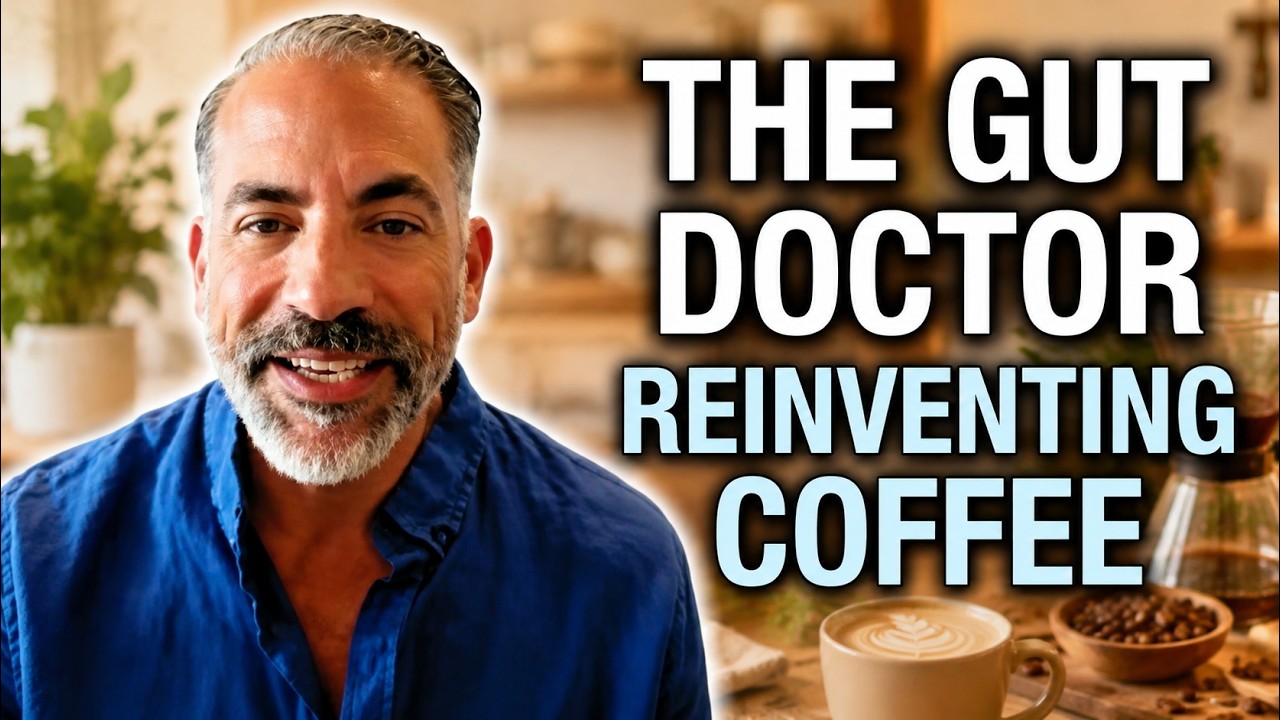
In this interview, host SPEAKER A talks with Dr. Vincent Pedre, a functional‑medicine physician who became a gut‑health specialist. Dr. Pedre explains how his love of science, meditation, and exposure to alternative‑medicine thinkers led him away from conventional internal‑medicine training toward functional medicine, acupuncture, and a focus on the gut microbiome after personal struggles with antibiotics, IBS, and gluten sensitivity. He authored the book Happy Gut, which grew into a brand aimed at educating the public about the foundational role of gut health and the modern factors—antibiotics, processed foods, artificial sweeteners, mycotoxins, pesticides, and chronic stress—that damage the microbiome and cause leaky gut. The conversation then shifts to coffee: after a 28‑day gut reset that required eliminating coffee, Dr. Pedre experienced dramatic health improvements, prompting a seven‑year coffee hiatus. Partnering with a decaf Swiss‑water roaster sparked the idea of creating a gut‑friendly coffee. He details the development of Happy Gut Coffee, a low‑acid, mold‑free, pesticide‑free, organic blend roasted with a German air‑roasting system that reduces chlorogenic acid while preserving beneficial polyphenols, resulting in a smoother, less bitter cup that avoids jitters for slow caffeine metabolizers. The brand currently offers a medium‑to‑dark caffeinated blend, with a possible future decaf, and promotes its product via Instagram @drpedre.
Chapters
Here we go. Vincent, my friend, so good to have you as part of this challenge. I'm, I'm, I'm just, you know, I love bringing good people, good products to everyone that joins us on this challenge. And you are good people. Um, please, please, please share with us. Well, we'll first share some background because you're not just some person who just randomly came up with like, hey, I'm going to put out a coffee. Like there's history to who you are and why you got here. So can you just first of all share a bit about, you know, how you became a doctor, first of all?
Oh, man. I think it was really the marriage of my love of science with my desire to help people. Those were kind of like the 2 driving principles in my teenage years and the nobility of the profession. You know, I've, you You know, growing up, I felt like doctors were, were people that you both admired and feared at the same time. They, they were the keepers of knowledge that was the key to unlocking your health, you know, and to getting better when you're sick. Little did I know that I would end up where I'm at now as a doctor. I could have never envisioned the path that I took. Even though a lot of it was already kind of like the, the makings of it were already set up, you know.
What path did you take? Like, what— so what kind of doctor path did you go down?
So I went to regular medical school, so I, I got an MD, but it didn't all feel quite right. And during that time, I had taken up meditation, breathwork, Yoga. Yoga was like the thing, the balance that got me through medical school. And I was very fascinated with all the, at the time, alternative medicine— Andrew Weil, Deepak Chopra, Mark Hyman. So I would read their books, and, and I knew deep in my heart that the type of doctor that I wanted to become was more of a holistic doctor, even though I was in a standard Western medical school where you barely learned anything about nutrition. And, and even if you learned underlying root cause biochemistry, you eventually just jump to what medication to give what patient for what symptom. So basically a Band-Aid remedy type of education. And it wasn't until after I finished, I felt kind of lost when I— not, not after medical school because I was really in love with medicine and with the intellectual challenges of being an internist that had to know about everything. But at the end of my residency, I was really, really lost. And I'm like, this is not what I signed up for. And that was about the time that I started branching off. I took a training in medical acupuncture. And that was like an eye-opener because That opened my eyes to systems biology, how everything is related to everything else. Whereas in internal medicine, if you were talking about the lungs, it was like the lungs by themselves, or if it was the heart, it was the heart by itself, or it was the kidneys, the kidneys by themselves, or the, the, the liver, the digestive system. But no one was putting everything together. How is the whole balance happening? And then I'm studying Chinese medicine, acupuncture, and everything is about how this system affects this system affects that system. And then at that point, functional medicine started making sense to me because it had been on my radar, but I didn't quite get it until kind of acupuncture opened my mind to that inner balance that we are all striving for. And, and then I just went into functional medicine. And because I had suffered from so many gut issues from having been on 20-plus rounds of antibiotics as a child into my teenage years, I really wanted to heal my gut. And I didn't know that functional medicine would give me the language and the knowledge to understand the digestive system for the first time. Actually, in, in a significant way, because we didn't even talk about the gut microbiome in medical school. And we didn't understand the, the significance of the gut as the root system of the body, the foundational system for your entire health. You know, everything is dependent on the gut. So as I got into functional medicine, it wasn't like I was trying to become a gut expert. It's just, I was doing what I found to be interesting and what I thought was most challenging. So I started really dialing in and focusing in on patients and their gut health issues and all the gut-related health issues that they had. In the meantime, I had healed my IBS, figured out that I was gluten sensitive, and had worked on restoring my gut microbiome from the destruction that it faced as a teenager. And, you know, one day I woke up and I was like, 30, 40% of my practice had become gut health patients. And I'm like, well, I guess I'm becoming a gut health expert. It's not like I never wanted to be a gastroenterologist, even though I did my residency at Mount Sinai. And I got approached by the chief of gastroenterology after he spent two weeks rotating with us when I was a resident, and he personally came up to me and said, "If you want to become a gastroenterologist, please see me." Wow! He was so impressed with me, and I thought at the time, like, yeah, I don't want to put tubes up people's butts and into their mouth. Like not, not my thing. And actually, I really didn't even think. Think, like gastroenterology was the furthest thing from my radar. I really didn't think I was gonna go that route, but I'm so happy that I ended up as a functional medicine gut expert instead. That led me to write my first book, Happy Gut, realizing that there was just— I felt like it was the tip of the iceberg. Like the patients I was seeing, I was just thinking there are so many people out there that need this information, that need this help. And that's when I wrote my book Happy Gut, which the naming of the book basically became my brand.
It's a great name.
Initially, it was going to be called The Ultimate Guide to Irritable Bowel Syndrome. And we decided that that was too clinical, too boring. And then we were playing on the words happy Happy, happy wife, happy life. And so we were calling it Happy Gut, Happy Life. And, and then because, you know, humans, we're lazy, we don't want to say too many words. We just started it as I talked to my publisher about it. We were just saying happy gut, happy gut, happy gut. And then, and then one day my, my publisher reached out and they're like, why don't we drop Happy Life from the name and just call it Happy Gut? And I was like, you know what? That's great. Let's do that.
What what is it you're so happy gut the book and now your brand is is really about helping people have better digestive systems, better guts. But what is it that everyone's doing that's contributing to bad gut? You know, to having these IBS issues.
I mean, it's basically just living in our current world. surrounded by all types of toxins, dietary insults to the gut, all the artificial sweeteners, the processed foods, getting exposed to antibiotics without doing any sort of gut restoration. And, and also like the hidden dangers in foods like coffee that might be contaminated with ochratoxin-A if it's not sourced correctly. So Yeah, I mean, basically, if you're living and breathing, and you're not being really careful about what you put into your body, you're going to cause problems with your gut microbiome. And on top of that, if you are stressed, that's also going to have a negative effect on the gut microbiome, on the gut lining, causing something that we call leaky gut, which is an increase in the permeability of that semi-permeable membrane. It's almost like a coffee filter, and you want it to let good things in but keep the bad stuff out. But when the gut becomes leaky, then bad things from the gut start getting into the body, causing inflammation. And it's the root cause of almost every disease, every chronic disease, including weight gain and putting on fat in the middle, is all connected to leaky gut. So When you really start digging deep into it, the gut is the foundation for everything. And if you're going to start anywhere with working on your health, the gut is the first place.
Now, what made you focus on coffee then as kind of your first? I mean, I know really your your happy gut brand is so much more than just coffee, but coffee seems to become kind of like the. The vehicle to get all the other supports in.
Yeah.
So what made you choose coffee?
Like when I launched my book, so my, my book Happy Gut was a, and still is, it's actually its 10-year anniversary will be December 29th, 2015.
10 years. Congratulations.
10 years since it got published and it was a 28-day cleanse and in that cleanse, You take coffee out of your diet, and let me tell you, people just look at me like what? Like no coffee? Yeah. And so the question was always like when can I put coffee back in? And and honestly, like I grew up Cuban, so coffee was a big part of my culture growing up. It was the way that we came together, created community. It was the way that you. you know, when, when someone came over to visit, the first thing we offered was, would you like a Cuban coffee, an espresso? Like, that was just standard.
Yeah.
And I loved coffee, but coffee did not love my gut. And as much as I loved the scent, the smell, it always made me sick to my stomach. I was running to the bathroom. I would get heartburn. I would get stomach upsets. So I had kind of like this tenuous relationship with coffee. I wanted to have it, but it just didn't sit quite right. So in 2017, when I led a group on my 28-day gut reset, I gave up coffee. I did the reset with them. I'm like, I'm the type that walks his talk. I'm like, if you're giving up coffee, I'm giving up coffee. I felt so much better. And mind you, leading up to that, I had gotten into the Bulletproof. I was doing the butter and the MCT in the coffee and I actually was starting to become kind of addicted. I was crashing in the afternoons and I had to have another coffee. So now I was at 2 coffees. So I thought, you know what? This will be great for me. Let me get off coffee and when I got off of it, I decided that I was not going to drink coffee anymore and so for 7 years, I didn't drink coffee except maybe minor exceptions here and there. I was mostly green tea, matcha, and then I got reached out. So this brand wanted— was interested in working with me, and they had a decaf Swiss water process, like non-toxic, and it's supposed to be good for people who get the jitters with coffee, which also was one of my issues with coffee is getting jittery. My hands would get shaky because I'm a slow metabolizer. 50% of people are slow caffeine metabolizers. So caffeine should only stick around for 6 to 8 hours in your bloodstream. But for me, it can stick around 12+ hours. So they sent me this decaf. And the first day I brew it, I mean, just the smell of coffee for the first time in my apartment in 7 years, and then tasting like Oh, I miss coffee.
He came back to life there.
So that didn't work out, but I started thinking, you know, is there a way that I could bring coffee back? And I started really diving deep and researching, you know, what are the, the bad things in coffee and how can we make them better? And that's what led me to develop Happy Gut Coffee, a low acid, mold-free, mycotoxin-free, pesticide-free, organic coffee blend. We are in our second iteration. So we started with a roaster in New York State that was just pure Colombian. And then I decided that I wanted to look into something a bit more sophisticated and, and also just kind of more complex flavors. For the coffee. So we are now working with a new roaster that instead of drum contact roasting, which can generate certain chemicals that will cause aging, cellular damage, potentially DNA damage, we, we were working with an air roaster that uses a German air roasting machine. It's probably less than 5% of coffee in the United States is air roasted. It's really amazing because the beans never touch the hot surface. They're circulating in this convection oven, let's call it, where they're just getting roasted in the air. It's sensing the temperature inside very carefully. The beans get evenly roasted from the outside to the inside, whereas when you're doing contact roasting, like on a drum roaster, the outside of the bean will cook first before the inside. So you get uneven roasting of the beans. But the, the reason that I went not just to get a better tasting coffee, which is always the, the goal, you know, and I think we've come up with the healthiest coffee on the planet combining Guatemalan, Colombian, and Ethiopian beans. But more importantly, it takes the polyphenol in coffee that actually triggers the release of stomach acid, chlorogenic acid. And through the air roasting process, it lowers the chlorogenic acid in the beans while preserving it because it is an important polyphenol. But we do a medium to dark roast that preserves the polyphenol while also lowering it to a level that it doesn't upset the stomach anymore. So then it creates a low acid, but not only low acid, but also not bitter.
Yeah.
Because a lot of coffees might be low acid, But they're still high in bitterness, and part of that is the chlorogenic acid. So yeah, I did a lot of research to bring a product that I can be proud of, that I can personally drink myself, that even though it has caffeine, for a slow caffeine metabolizer as myself, it causes zero jitters, and it also doesn't cause a crash. And I think a lot of people who are crashing from coffee might think they need a second cup, but really they're crashing because of the toxins in coffee, the mycotoxins, the pesticides. It's not just the caffeine that's causing the crash.
This is awesome. So everyone, you got to check, check out this coffee. You got to go to Happy Gut. Is it happygut HappyGotCoffee.com.
Super easy. Yeah, super easy to remember.
And you have just a caffeinated and a decaf yet, or just— or do you have both or just one?
Just caffeinated. We had with our original roaster, we had produced a decaf. But the truth is that the majority of people are caffeine drinkers. And because we are a medium to dark roast, the caffeine is a bit lower. So Now we're just focusing on that, and maybe if we get enough people complaining and asking for decaf, we'll we'll bring that back.
Well, I'm so glad that your journey took you here. It's a fantastic coffee. I'm excited everyone's going to get to try it. So please, everyone go to happygut.coffee.com, and then where can they find you on socials?
Easy. Instagram is my main @drpedre d r p e d r e.
Excellent. Thank you so much for joining us, Dr. Vincent Pedre, and thank you all for watching. Enjoy your January 26th.
All right.










