The Truth About Organ Meats | James Barry Explains Whole-Animal Nutrition
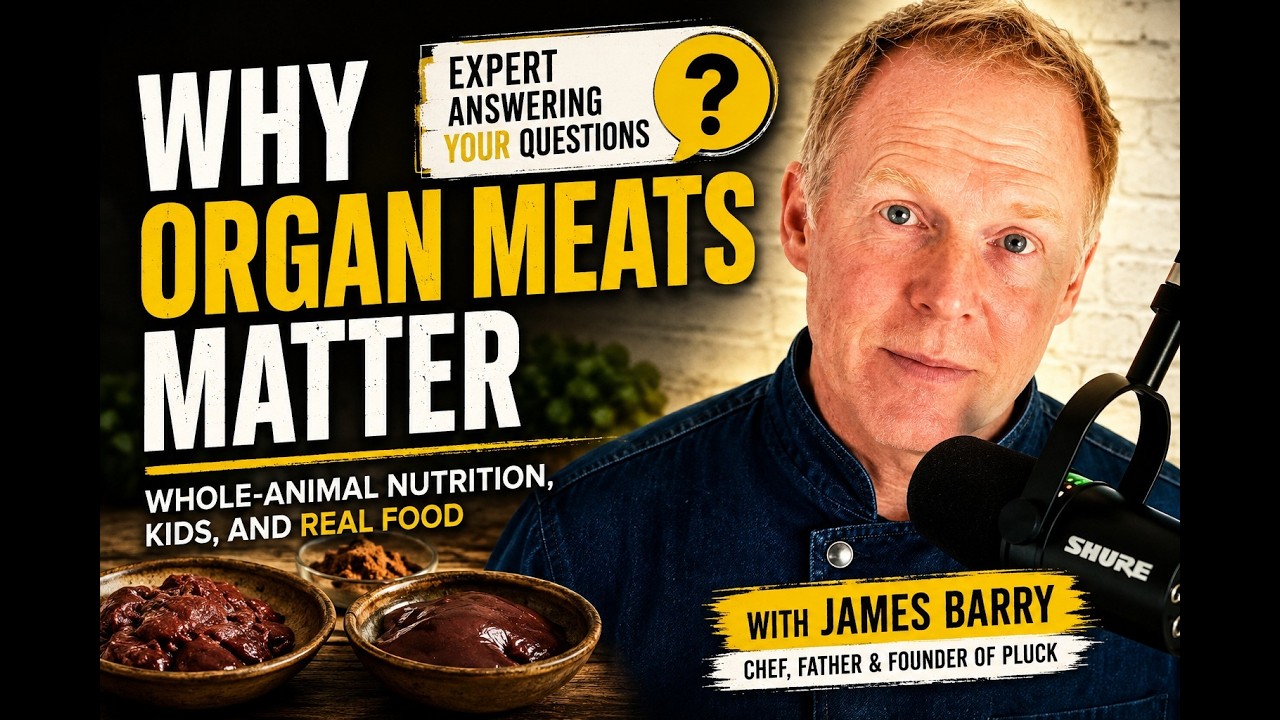
In this solo presentation James Barry, a chef‑entrepreneur and founder of the nutrition brand Pluck, argues that organ meats are the most nutrient‑dense foods on the planet and that modern Western diets are failing because they ignore the whole‑animal. He recounts a personal catalyst – his two young daughters contracting a severe Shiga‑toxin E. coli infection – which spurred his quest for a food that could quickly restore health. From that moment he researched nutrient deficiencies in the U.S., discovered that 96 % of Americans are micronutrient‑deficient despite being calorie‑rich, and concluded that the solution is to re‑introduce organ meats. He explains the evolutionary and cross‑cultural precedent for whole‑animal eating, outlines four barriers that keep organ meats out of the mainstream (perceived grossness, over‑cooking, sourcing uncertainty, and supplement fatigue), and describes how Pluck addresses each by offering freeze‑dried powdered organ‑meat seasonings that are flavored, convenient, and shelf‑stable. Barry walks through his product tiers – everyday seasoning blends, mid‑tier “daily boost” blends (e.g., cinnamon brain, lion‑salt), and high‑dose 100 % organ blends – and gives practical dosage guidance (micro‑dosing ½ tsp to 1 tsp equals 2 oz of fresh organs). He shares anecdotal health outcomes reported by customers: increased energy, better sleep, skin improvements, weight loss, and enhanced focus, as well as specific cases of organ‑specific benefits (e.g., lung powder for respiratory issues, testicle consumption for testosterone). He debunks common myths (organ meats as “detox” organs, vitamin A toxicity, and the idea that they are only for low‑income people) and explains why the body regulates intake via taste and physiological signals. The talk also covers the historical decline of organ‑meat consumption in the U.S. (centralized meat processing, WWII propaganda, socioeconomic stigma) versus its continued use in many world cuisines. Barry offers parenting strategies for introducing organ meats to picky children, emphasizing subtle incorporation into familiar foods, leveraging umami, and respecting a child’s safety foods. Finally, he discusses Pluck’s pricing model, subscription discounts, and the broader mission to shift consumers from calorie‑dense, nutrient‑poor foods to whole‑animal nutrition as a preventive health strategy.
Chapters
The most nutrient-dense foods on the planet, which are the organ meats from the animals. We're already eating the muscle meat, but we're not eating the complete animal, and it's the whole animal that gives us the nutrition we truly need. We think organ meats are gross here in the US. We don't cook them, so thus we don't know how to cook them properly, because hint hint, one of the reasons why they're so gross is because— They're not cooked properly. Hello. Hi, I'm James, James Barry. So I'm a chef, father, and the CEO and founder of Pluck. For those that don't know, Pluck is my solution for our modern diets. Basically, our food is failing us. I mean, Look at the chronic issues that are going on. And I've always been about flavor as a chef. I really think flavor is what makes the world go round. But it was when I became a father, that's when it got serious. My 2 daughters— so I had a 1-year-old at the time and a 5-year-old and we had gone on this trip to Canada. And both kids came home and just were violently ill. And fortunately, my wife was smart enough to just do a stool test because she just instinctively felt like something's off here. And we discovered that both girls had what's called Shiga toxin, which is a form of E. coli, and it's deadly for the elderly and for the very young. It's basically where your body can't hold on to anything. You can't even take antibiotics, like you could actually make it worse if you did. So you're just kind of told to just let it play out. And for most people, it plays out pretty quickly, you know, like my oldest daughter, it passed in about 3 days. It was my youngest daughter, though, that it just lingered and wouldn't stop. And I had to go out of town and I thought it was on the mend. We were about 8 days in. And I thought, okay, she's finally turned a corner. And I came back from the trip just two days later, and and she was just skin and bones and still in it. And there's you know, let's just face it: there's there's nothing worse for a parent than a sick child, a child that is struggling, and you don't feel like you can support or help them. And Fortunately, the time I got back, maybe a day or two later, she did finally hold something in. And she was truly skin and bones. It was really intense and scary. But she finally was able to eat a food and it was toast. It was gluten-free toast because we're gluten-free, but still, it's just toast with butter on it. And what happens when someone is so sick and then they find that one food that they can eat, they get very addicted to that food. So she would only eat toast and butter. And this went on for a long time. And I just remember looking at that toast and just thinking to myself, I wish there was something I could sprinkle on that toast to make it more nutritious. And to give her what I know she needs to thrive. So that's where the idea came from. That's what motivated the idea. I also really— becoming a father also got me really thinking about, well, what about my own longevity? You know, we are a nutrient-deficient society. Like, I think it's something like 96% of Americans are nutrient deficient, but we're not Calorie deficient. We are obese and we have huge issues. We're eating lots of food. So it's not an issue of not getting enough food. The issue is that we're eating the wrong food. So we're eating foods that are rich in calories and not so rich in nutrients. So that's where Pluck came in. So Pluck is a— it's my way of getting what I Deemed the most nutrient-dense foods on the planet, which are the organ meats from the animals. We're already eating the muscle meat, but we're not eating the complete animal, and it's the whole animal that gives us the nutrition we truly need. And same goes for fish, it's the whole fish, not just the fillet, not just specific parts of the whole fish. This is absolutely a practice that happens around the world. You go to any society and they are in some way or form incorporating organ meats, and you go to even more kind of traditional or ancestral societies and they're truly using the whole animal to the point where if you go to a tribe and they've killed a goat, the eyes of the goat are reserved for the leader of the tribe. And if you're a guest, they'll give you one, that kind of thing. I know many people who have done that and they've been offered the eyes. I mean, it's a huge honor. But these are seen as very powerful foods for good reason. And this is how it shows up around the world. Even in points of Alaska where they can't grow vegetables and fruits year-round, on their nutritional guidelines, they'll say next to fruit and vegetables, they'll have organ meats. Because they're giving those concentrated nutrients that you can get in some forms from vegetables and fruits, they're giving it to you as well. So they recommend when you can't get fresh fruit or vegetables, you're also eating organ meats. So that's what Pluck is. So Pluck is a way for me to get those organ meats. So how I did it was I realized, well, we already have freeze-dried powdered organ meats. I recognized though that there were really 3 big hurdles. Think organ meats are gross here in the US. We don't cook them, so thus we don't know how to cook them properly, because hint hint, one of the reasons why they're so gross is because people are overcooking them. When you cook them properly, they're not so gross. And then the third one I would say is that people are not clear on where to source them or how to make sure that they're good and clean and whatnot. So, And then I would say there's maybe a fourth hurdle, which is you already know, okay, I need to be getting this real food nutrition in my diet, but I am taking capsules and I have capsule fatigue or I'm not consistent or I'm just kind of done with doing all the supplements and capsules. So those 4 hurdles were what I set out to solve. And so what I did was I took the freeze-dried powdered organ meats that we're already using in the capsules. It's the same Orgamates, and I worked the blend because I wanted to supply as many organs as I could. And at the time, I was able to source liver, heart, kidney, spleen, and pancreas. Those are kind of seen as the complex, the organ complex that provides you a multitude of nutrients. So I was able to get those five organs, and what I did was I I made them taste good. So I added salt, I added organic spices and herbs, and My thought was, if I can make this taste good and keep it in that seasoning form where it's so easy to just incorporate into our food, then we'll do it. Because when things are easy and delicious, then they're not so tied to our emotional states. They're what I call lifestyle. So that was the thought. Of course, no one had done this before, so I had no proof. So I set out to just kind of start making it, you know, for dinner parties. And it was really fascinating. Pretty much I wouldn't tell anyone it was in it. So I would just make a full meal and I would add it to many of the different foods I provided. I didn't tell anyone until the end though. And everyone was saying, oh my God, the food is so good today. It's like, what's going on? It's so delicious. And I was like, well, you guys just ate organ meats. And everyone had that reaction, which is probably What some of you watching this have when you hear about arguments, you make that ick face, right? So that's how they reacted. But they then they were like, but it was so good. Like how how did you do that? And so I shared with it, and then I just continued to work with it for many months and realized, hey, I think I'm onto something here. Little did I know though, once we actually created the product, here's here's a couple of them. Here's our original. This is the first product we came out with. That's why it's slightly different look than all. The others. And then our second product that we came out with— so this is original, this one's zesty garlic. But when I started to come out with it, I really learned a lot of things I didn't know. So, so as I mentioned, I went into it with, I want to make sure that I'm around long enough to see my daughters grow old, and I want to make sure they're thriving. So basically, my goal was to support all of my family and thriving. I also didn't want to fight because as a chef, I'm a professional chef of 22 years, I have seen it all. I've seen diets come and go, I've seen trends come and go, I've really seen what works and what doesn't work. Because the reality is we can talk till we're blue in the face about what diet or what we're thinking we're going to do, but we're human. And humans are incredibly inconsistent and we're very emotional and we— over time, you start to see similar patterns. And what I found was that the diets came and went, but ultimately real food always wins. So, I was really aware that, okay, if I can keep this in a seasoning format, then what I have is I have A tool, a health tool for people that also increases the flavor of whatever you add, but it doesn't require a new habit because we already season our food. It's something we naturally do. So I saw that as a real big plus because I know that when stuff goes wrong, when we have a hard day, when there's something going on in the world that feels out of control, we default As humans, we default to our comfort zones. So if I could remove the new habitness of this, if I could remove this and being something different than what you already did, then maybe once again it would become lifestyle. And in my judgment, if something isn't lifestyle, it's kind of not worth it. Because what's happening is most of us fall into these trends or these, these, uh, Kind of health tools and we'll buy them and we'll use them for maybe like a week or 2 or even maybe a month. And then they just kind of fall off. And we can look back at time and we can really see that. I mean, even in my lifetime, I think about the ThighMaster. That was a Suzanne Somers tool for, you know, getting fit. The ThighMaster. I'm literally, I'm doing the movements with my legs. It's so funny. So that device was hugely popular. Millions of them were sold. And yet no one I know is still doing it. Not a single person I know is still doing the ThighMaster. They very quickly were sold at yard sales. And to me, that is a perfect example of what most things that were being sold are. They are Snake oil, or they are things that sound really good but are not practical. And I'll fully admit I am a very practical person. I don't even like owning things in my house that I don't use or don't have some purpose. I just I really feel strongly about the movers of health are the things we actually will do. So that's what I set out to create, and I'm very proud to say. That's what it does. It really is easy. Now, we get lots of questions though all the time, and so I thought I'd take this time to answer them. So I'm gonna just read some of the questions I've been asked recently, and then I'll take some time to answer it. Let me first start by because someone asked what is organ meat? Organ meat is ultimately every part. So every part of the animal except muscle. And bone are considered what we call offal or offal. I say you can hear it's kind of like potato, potato, right? Some people call it offal, some people say it's awful. I more and more try to say offal because when you say awful, it's just, you know, perpetuating the mindset of like, uh, it's gross, it's awful. So offal is every part except the muscle and the bone. So you'll see things like the tongue considered offal, you'll see the tail, the lips, the eyes, of course the things that we commonly think of offal like the liver, the heart, the kidney, the spleen, the lungs, the stomach lining. There's so much to an animal and sadly we are moving away from that intimacy with our food and this is really unprecedented if you think about it. Yeah. The world is caught in this place of convenience, but in that place of convenience, we are now not like we have kids that don't even realize bacon comes from a pig. We have people that only think of chicken as skinless and boneless, so completely disconnected. Whereas you know, not too long ago, I mean, my mom just turned eighty. So in the four, she was born in forty-six. She shared with me when she was a young girl in Brooklyn, they would have these markets called poultry markets, and they would you would walk in and there would be live living chickens, and you would literally just say, "I want that one," and you would then come back. I don't know actually how long it took, maybe an hour, hour and a half or something. You would come back, and then you would pick up your. Your freshly warm carcass to cook that night. So there was no question of like, where is this coming from? You are taking a life to feed a life, which don't even get me started about veganism. I'm not here to say like, oh, you you should be a meat eater. I'm more I'm more don't want to get into the whole the whole thing about like most vegans think they're not killing something, and that is the biggest lie in the whole world. Like Once again, for us to eat, something dies. So it's you decide what what matters the most: your life or someone else's or something else's. But something dies, guaranteed. Just talk to farmers; they will tell you the truth. That's what organ meat is when we talk about organ meat, and it's had many names during World War II. They called it variety meats. Sometimes we call it freedom meats. 'Cause it frees you from being so sick, among other things. But there's been lots of names. The one though that's kind of what's mostly associated with it is offal. And they think the name comes from when you cut the animal open, that's the parts that fall off. So they think it's offal, you know? So we actually came up with the name Pluck because pluck is actually also an old term for organ meats. So back in the day, I think it's 15th century, they would say, oh, you want your pluck? I'm just using a weird accent. Oh, you want your pluck with that? But that's what they say and they were just referring to, do you want the liver? Do you want the kidney, the lungs of the animal to take home? But I go back to that thought is that this is unprecedented that we are eating parts of the animal and not the whole. It's truly unprecedented and I think we are now seeing the issues with that. We're seeing the chronic illness just continue to increase and really majority of illnesses stem from nutrient deficiency. So that tells you right there, as we move away from eating the whole, and that could be whole animal, that could be whole egg, that could be whole fish, that could even be whole grain, you know, depending on your philosophy around food. The whole is what I'm talking about. So when we're eating the animal, we want to eat the whole animal or as much of it as possible. So a little bit about my background. As I mentioned, I'm a chef for 22 years. So I, um, I grew up loving cooking. Like, I, I remember I was taught to scramble an egg and I was like on fire. I loved it so much. So I tried to scramble as many eggs as I could when I was a kid. And then later I did some gourmet cooking classes in my my grade school, and I, I did that multiple years. It was the best class. I excelled at it, um, truly, truly loved it. But for whatever reason, when I was a kid, I was like, oh, I'm not gonna become a chef though, because at the time there wasn't really a career path for most chefs beyond just working at a restaurant or owning a restaurant. And I did not want to do that for some reason. At 12 years old, I was like, I don't want to be a A chef because I don't want to work nights. I'm a family man, and I want to, I want to, you know, have my nights free to be with my family. I don't know where that all came from, but for whatever reason, mine was determined: I'm not going to become a chef. So I went another route, and ultimately it was nine eleven that really changed my life, and it got me really thinking about. What how what do I want to do? Why am I here on this planet? What matters? And I decided that I was going to follow a path with heart. So every choice I was going to make there on out was going to be one with heart. And so I audited my life, and I remembered about the you know love of cooking. And so I basically was like, well, let's let's figure out what that is. And I was living in LA at the time. And I started to think, well, why don't I? I could private chef. You know, I could cook for celebrities. I could do that. I'm in the land of this world where there's private chefs and there's lots of work if you're good. And so I just started to entertain this idea of becoming a chef. I found a school in New York that met my needs, and I went there, and my life completely changed. I mean, I. It was incredible. I'm a hard worker, but holy moly, I got back everything 200%. It was incredible. I quickly became the chef for Tom Cruise. Eventually later on, I got to cook for Gerard Butler. I also cooked for George Clooney, Barbra Streisand briefly. I mean, just so many, so many amazing people. that are doing such top-notch work in the world that are, you know, top of their game, that kind of thing. And then of course I worked with families and I worked with individuals. And what's fascinating is that through and through I saw that when I used real food and I made everything from scratch, not only did people feel better, but the nagging weight that they were trying to lose just— Gone. Just melted right off. So I got very well known for that type of healthy, clean, whole food nutrition. What's so funny though is that I didn't cook organ meats for those clients. I don't think I did any organ meats, pâtés, nothing. And you know why? It's because I wasn't eating them. I didn't do it either. And honestly, to this day, I still don't gravitate towards making them myself. That's why I created Pluck, because this is the easiest way to get organ meats into your diet without having to cook them, smell them, touch them, do anything, or even figure out what to do with them. I mean, how many people out there are eating pancreas? Have you ever seen a pancreas? It's completely overwhelming. It's like floppy and huge and intense. So, Just know that that similar to other, I'm thinking of that Men's Warehouse commercial. I'm not just a client, or I'm not just the president. I'm also a client. Like I very much like made this for me. So that's me in a nutshell. So let's get to your specific questions. The first one is: Are organ meats really the most nutrient dense foods on the planet? I did the research, you can too. Simply put it in, what are the most nutrient-dense foods on the planet? And it comes— liver is what is focused on, it comes up every single time, even above muscle meat with the beef, fish, salmon. I don't think there's a single food that compares. And when they're comparing it, you know, they're comparing all the nutrients like the vitamins and the minerals and they're looking at things like vitamin A, B12, folate, copper, heme iron, Choline, selenium, CoQ10. I mean, they're looking at everything, and what's fascinating is you know every food they're comparing liver to will check off something, but liver is the only one that checks off every single box. It's either got trace amounts or it's got extreme, like concentrated amounts, way beyond any of the other foods. So as I did that research, it was. Very clear. Okay, this is the most nutrient-dense food on the planet. Now, the focus on liver is really fascinating because if you talk to you know, if you go off of what you see on socials or you talk to most people, they'll be like, "Oh, I only eat liver." But that's not my jam. That's not what I'm talking about. That's not what I'm about. That's not what Pluck's about. What I am trying to support is that whole animal nutrition. That's how we ancestrally ate. We would slaughter the animal. You would take back as much of that animal as you could to your group, right? Sometimes you will have eaten some of the liver or some of the heart just to replenish your own stores as the hunter. And then you would get back and you would then have that entire animal as long as it lasted to keep, you know, Everyone satiated and fed. You would reserve some of the more nutrient pieces for the pregnant people, for the elderly, for the kids, like anyone that was needed. Sometimes, as I mentioned, it was the leader of the group that got them. So sometimes it was a classist thing, right? But they knew that the difference between surviving, you know, that season and dying could be— The nutrient, the nutrition you got from the food you ate. So it was life or death, and it was really important. And if you think about it, we are in Homo sapiens body. This body is about 100,000 plus years old. These are the foods that, and I'm not saying that the cows we're eating right now are the same as what our ancestors ate. They're not clearly, right? That we've, the breed of things has changed. The DNA of the things have slightly changed. But the grain, the seeds, all the things that we now use are different from what we had ancestrally. That's not my point. My point is that we were eating the whole animal. That in a sense, God or nature has provided the whole nutrition in the food. The whole cow, the whole goat, the whole pig, every part of it if you eat pig. I don't know why I mentioned pig. It's funny because sometimes I feel like Pig's the one animal that I'm like, I don't know if I want to be eating that one because I sometimes do. If it's not cured or if it's not soaked or something like that, I find that I don't feel as good on it. So you got to follow your own the beat of your own drum. But like, like reality is is that when we when we are this body that we're in, when we're designed to, when we're focusing on our nutrition, what I find so sort of absurd is that we are. Eating very isolated parts of everything, either hybridized, you know, changed, or isolated parts. And then we're questioning, well, why don't I feel good? Why, why am I not, uh, optimal? And then we're going to these laboratory-made supplements to, to fill in the gaps. So let's just face it, modern— our modern food system has a gap. It's failing us. But that doesn't mean we have to jump to the laboratory-made isolated, you know, vitamin and mineral provisions. We can still go to what God provided. We can still go to the food. We just need to eat the whole animal. So I know that's a long-winded answer to, you know, is this the most nutrient-dense food on the planet? But I just want to stress, like, when we're talking about organs, I really am talking about the whole animal and trying to get as much of that in. I have a friend who is even testing this on his body where he's currently— he's got low testosterone. And there's this idea called like supports like. So the part of the animal I'm eating is supporting that part in me. And this is a very ancestral concept. Native Americans believed it. Other cultures believe it. This is This is nothing new, and it's even Standard Process, which is a supplement company in the 40s. I think they were testing even around this concept to see is this true? Like if you if you eat a glandular, is it supporting that glandular? And they found in their test that it did help. So anyway, like supports like. So this person is eating testicles. Cow testicles, you know, to basically increase his testosterone, and he's testing consistently to see if it's working. And guess what? It is. So I know that's observational, but it is. It's an interesting because the more you learn of people applying this like support, like philosophy, the more you see it working. I had someone who was struggling with their lungs. They couldn't— they just had lung issues for the longest time. And they tried everything, at least they told me this. They tried all these different natural remedies. They even tried some of the more harsher remedies and nothing was really Working, they just continued to have this nagging kind of respiratory issue. And I said, "Well, hey, have you tried beef lung? Have you just tried getting some of that?" She was like, "Actually, I have some, and I you know I have some freeze-dried powdered lung, and I haven't tried it." She's like, "Oh my God, I've got to do that." Two days later, she messaged me, said it worked. It's gone. I was like. Wow, right? I mean, it's incredible. Is that going to be true for everyone? I don't know, but I'm not interested in— I'm not interested really in what science or a lab is telling me is going to work because we really— I think we can all admit that there's been many instances where they're wrong. Science is very wrong. It's still a very specific perspective. Life is, uh, there's so much in life that we don't understand, that we don't know. There is, I mean, I think even Dr. Andrew Huberman said like the amount of nutrition we actually know is about 10%, something around there. So there's so much that we don't know. And for us to act like we do know, it's just false. So I'm a big fan of, of trying things and seeing what works for you. And, you know, and let's not be afraid of placebo effect because it does work. Placebo— I have to edit right there. Um, placebo effect works in many ways. Uh, there's even this study with cancer patients when they were given a placebo pill, and then they were also given chemotherapy. The ones that were given, and they were going through, they were told that it was chemo. So they experienced chemo-like symptoms, even though it was a placebo, just like the people that went through chemo had. So the power of our minds cannot go unlooked or unacknowledged. Okay, I have digressed a lot here. Let's go to the next question. If organ meats are healthy, why did people stop eating them? It's a great question. Organ meats have had such a checkered history. So from my research, um, it goes back to the early 1900s when, um, they centralized the meat production. It was somewhere in near Chicago. That's when they started doing a lot more of those kind of CAFO-style places where the animals were pulled off of fields and they were just put in kind of warehouse or settings that were more controlled and not necessarily conducive towards their health. But that's not the point of this conversation. But what happened was then from that kind of Middle of America, they would then freight the they would then freight the meat out to the coast via train, and the carts the the train cars couldn't get cold enough to include the organ meats. So right around that period, we already started to see organ meats kind of fall out of favor a little bit. But that's mostly because people couldn't get access to them as much as they had previously done. Before the meat industry was centralized, then skip ahead to World War II, and now you have many men and women abroad, and there was a the government was afraid of a protein shortage, and so they started putting money into organ meats and encouraging people to. Eat them and how good they were for you and all that kind of stuff. And they also—that was also when Meatless Mondays came around. So there was a lot of taxpayer money that went towards encouraging people to move away from meat protein purely because they were afraid of running out. But it worked. A lot of my parents, like a lot of the people born around that time in the nineteen. 40s, mid-40s, uh, and 50s, they grew up eating liver and onions and whatnot. They grew up eating organ meats, and it was because of this kind of promotion that the government had encouraging them to do it. But then when World War II was over, you had people coming home and they now had, in more cases than not, 2 people working because the women started working while the men were away, and The women didn't want to stop, so you had two incomes coming in. You had more money in the household, and this is kind of what's happened across the world these days: is that organ meats are looked at as poor people's food because they are cheaper. There's sometimes the parts that are discarded that are not seen as prime cuts. So what happens is they're either cheap or free, and so people think they're poor people's food. And so you had people who had more money saying, oh, we don't want to buy that cheaper cut, we want the roast beef or we want the more expensive cut. So eventually as people don't purchase it, then the butchers stop carrying it and you just don't see them as plentiful. Now this is very much an American thing because if you go to like any kind of Mexican market, if you go to an Asian market, they are very much still eating the whole animal. It's built into their culture. It's it's how they do things. So it's sad that we we missed that boat, but hopefully with the helps of Pluck and other companies that are really putting the emphasis and support towards eating the whole animal, we'll start doing that more. So that's really the reason though why people stopped eating them. It's it's ultimately because of socioeconomic reasons. People think that they're poor, and and then what ultimately I think what ultimately is also kind of carrying forward is the unfamiliarities. Is once something's not sold, once it's not cooked in the household, you start to just— it's now unfamiliar. And when it's unfamiliar, you don't know what to do with it. You're intimidated. I mean, I have people— I know people have never even tried it and they just assume it's gross. So you tell me, because those same people will try a dessert they've never eaten before. Yeah. They won't try organ meats. So I think it's really at this point mostly a socialized kind of like unfamiliarity. Is liver actually better than taking a multivitamin? Great question. I'm not a doctor, so I can't, you know, officially say this is better, this is worse. But what I can say is that liver is nature's multivitamin or God's multivitamin. And I will also say it's better in one key way. It is food. A multivitamin is isolates. It's a lot of times it's synthetic. The liver and or any of the organs you eat are truly, it's just food. It's just real food. So you're getting the nutrients like a multi. So you're getting like the vitamin A, you're getting the B12, you're getting the folate, the iron, the copper, choline, but in a whole food matrix. In which your body is designed to recognize. So that is— we can't underestimate that because right now what's happening is most of the foods we're eating in the grocery store that have many ingredients in them, particularly ingredients that are not normally mixed together, and they're also broken down a lot, they're so ultra-processed, they've been stripped of a lot of their kind of natural nutrients, so then they're fortified later. So— These are not foods. They're shelf market items that are trying to appeal to your stomach or your taste buds, but ultimately they're just filled with calories and not much else. And that's the reality. But when you eat the food, when you eat something that's coming from that whole food matrix that your body is designed to recognize, it's incredible because your body Fully integrates it in a way that sometimes does not happen with a multivitamin. If you ever taken a multivitamin and you then have to immediately pee, well, that's your body reacting to that multivitamin and basically trying to get rid of whatever it was too much or whatever your body wouldn't wasn't able to handle. Rarely does that happen when you eat some liver, right? Your body knows what to do with it, and because it's a real food, it's also slowly breaking down in your body. It's not an immediate kind of hit. So I'm I'm a big fan of whenever we can, let's before going to supplements. They have a place. I'm not anti supplements, but before just jumping onto the supplement ship, let's first look at where are the holes in the foods we're eating and how can we improve them. And organ meats are a great way to do that. Okay, next question: What happens to your body when you start eating organ meats regularly? Well, I can really only speak from my own experience and from what customers share with me. But what's fascinating is you do— I do get the reports of people feeling better energy, improved recovery, better resilience, and just a greater sense of overall vitality. I notice that I feel better. I notice I sleep better, my energy is better. I notice skin issues. I've gotten lots of reports from parents that say kids' skin issues disappear. I mean, I look at it really as like, you know, once again, it's God's multivitamin, right? I just look at it as like a shot. Like, you're just getting the most nutrient-dense foods, you're getting them in from your diet, and then if you, you know, get a little bit each day, you're getting— you're just constantly getting in your diet. That's why I'm a big fan of the whole microdosing. I don't believe we need to have just liver and onions, you know, once a week or even once a month. I think that you can absolutely just get a little bit each day and use it like you would a multivitamin where you're taking that daily. Like, why not just take the most nutrient-dense food on the planet daily, right? We don't need a lot. We talk to people about— like, we have a product called Pluck Pure here. There's 2 of them. So these products are 100% organ meat. It's just the freeze-dried powdered organ meats. And I always explain to people that when you have the whole organ and you freeze dry it, it goes from 100% down down to about 21%. So they are incredibly concentrated. 1 teaspoon of these pures is equal to about 2 ounces of organs. So it's, it's, it's powerful. And most people don't need more than an ounce. So half a teaspoon of that, you're done. Uh, same thing, like when people are talking about like, how much can I take? Actually, I should probably say that because I think that is one of the questions. So I'll leave this question, move on to the next, but there is something I'm going to answer later when it comes back up. Can organ meats improve energy, focus, and brain function? I would say that they absolutely can support these things, um, especially when someone is missing key nutrients. What is almost the, the better question is, aren't you already turning to supplements to support your energy, focus, or brain function? I mean, I guess some people turn towards lion's mane mushrooms or something like that, but for the most part, you're already turning towards something to supplement or support your, your energy, focus, and brain. So why wouldn't you first turn to food? Like, why do we assume that the thing made in the laboratory is better than what Nature or God created. I think that that's it's very interesting that we think we can do a better job. That's it's kind of absurd. You know, just know that when people want more energy or better focus, you know, they're what they are reaching for like B vitamins. They're reaching for iron. They're reaching for choline, CoQ10, amino acids, or some kind of brain supplement, right? Well, it's all in the organ meats, all of it. So just start with the food source. Organ meats are some of the richest natural resources of nutrients tied to energy metabolism, to oxygen transport, nervous system function, cognition. Liver is definitely famous for the B12, the iron, and the copper as well, folate, vitamin A. But heart has CoQ10. If you've ever taken a A cardiovascular supplement has CoQ10. Well, it's in heart. That goes back to the like supports like concept. But either way, point is is that these organs have the nutrients that you're taking in the supplements. So just go to the food source. Why not? Your body's gonna. Your body's going to thank you for it because a lot of these isolates, a lot of these ultra processed foods, what they're doing is they're putting our bodies on alert. And if we go back to that concept of the body. Is, uh, very old. This, this, this Homo sapiens body, 100,000 years old. Well, back in the day, there was communication points that happened. That communication point was really— is your senses, right? Your, your taste buds, chewing. It's all, it's all the senses that were communicating to you 2 things, really. Is this food going to kill me, or is it going to nourish me? But it was very serious, obviously, because if, if you ate the wrong thing, you could die. But that's how acute this communication pathway— it's even to the point where there's more kind of taste buds down in your gut as well, because if something does pass your mouth, you'll still regurgitate if it's not something your body needs or wants, or it's bad for it. So your body has communication points throughout that are supporting its desire to thrive. It's it it's an incred our human bodies are incredible. They are truly truly true miracles. So for us to bypass that with swallowing capsules, that's that's just absurd. I I use the example of salt because we get this question a lot too. Can I get too much? Can I eat too much? And I think that is a question. So I'll just answer that now. Actually, let me just jump to it. So. Are there any risks or side effects of eating organ meats? And then another question is, is how much liver is too much liver? So they're very connected. When we put a salt tablet, if we swallow a salt tablet, we get zero communication about whether you got too much salt or too little. You just kind of at one point feel too bloated and you're like, what's going on? And then you realize, oh, I got too much salt. But if I put salt on your tongue, Your body will communicate for when I should stop. It might taste good the first time, might even taste good the second time. I guarantee the third and fourth time, your body will literally be reacting, trying to say, stop, get this off. That's a communication pathway that is absolutely directed towards your body telling you, I don't want this, I don't need this. And it's very much triggered by the taste buds. It's triggered by our senses, but it's also triggered by nutrition. And here's something I haven't even touched on that a lot of people don't associate with organ meats, but I've gotten reports from customers that it's absolutely worked. So weight loss. One of the reasons why we're overeating, we're overfed, is because the food we're eating isn't nutrient dense. When our bodies, which is the signal, by the way, for our bodies to stop, And to feel satiated. So when we don't get nutrient-rich foods, our bodies continue to be hungry even though we've gotten an abundance of calories, right? Because the stomach will stretch. The stomach doesn't just stop because it's full, sadly. It's the nutrients that kind of tell us when to stop putting in the gas, right? It's that— that's what makes the body, you know, gets communicated, oh, okay, I'm going to stop eating. I'm good. I'm satiated, right? So when people start eating more organ meats in their diet, and I've even heard this with Pluck, when they start using Pluck, they start losing weight because they're not eating as much. Their bodies are getting those signals because now the food that they're eating is more nutrient dense. I did not know that when I created this. I didn't think about that. But the amount of people that have said, I've lost 10 pounds, or I've— or I'm not only feeling better, but I'm But I've trimmed my waist just from using your product. They're not changing what they're eating; they're just eating less because their body has gotten that trigger to stop eating. Incredible mechanism, this body, right? Incredible signals that happen. So what we want to do is we want to work with the body, not against it. There are other things to be aware of, though. You know, you can get too much vitamin A. You can get too much iron. But I find, though, that it's there is a bit of a mindset shift that has to happen. So when we go to eat muscle meat, I don't think people all realize this. But when you go to eat that ribeye steak, that's part of an entire roll. Like it's a part. It's a bigger part. It's a bigger muscle. That's just a cut of that muscle. So when you think about the entirety of the animal, the— you're not eating the entire muscle group at one time. You're eating a piece of that muscle group. It's the same thing with liver. You're not going to eat the whole liver. The liver is huge. The heart is huge. You're just not going to eat the whole thing. And if you are, why? Never would we ever do that. Okay, we would—we were always in communities, and we would share. The entire community would eat that heart. The entire community would eat that liver. So this is not an all or nothing kind of concept, and we have to get out of that singularity kind of mode of thinking like, oh, I—I should just eat this, and then I'll be better. It's just not—it's not the way. Nature works. It's not the way our food systems work, and nor is it the way your body works. And I know there's lots of people that are only following, you know, eating one food in their diet, and I will just offer: I'm not trying to say well that's wrong. Like carnivore is not necessarily wrong. What I'm saying though is that I don't believe we were designed to eat just the muscle or even just the ribeye. You know that we were designed to eat the whole animal. So if you're eating If you're only eating carnivore, great, but eat the whole animal. Like, eat all the different cuts. Some of them require that it's slow cooked, some are— you can just grill, some you can eat raw, but they all have their purpose. And sometimes that slow cooking, it, it makes it so that you can actually digest and eat and absorb the nutrients from the bone or from the tendon or from the ligament, just that part of the animal that normally you would struggle to eat. Fire is a very important piece to this Homo sapiens body. It is what supported the development of our body. So we cannot just throw out the different methods of cooking these parts. Other things to be aware of, because there are things that people get confused about, and one of the questions asks this: what's the biggest myth people believe about organ meats? So organ meats have the myth that, particularly the liver and the kidney, that they are detoxification organs. So that means if I'm eating them, then I'm eating the toxins. And that's just— it's not really true. And I want to introduce a couple of things. One is, first of all, the function of the liver is to convert toxins into water-soluble form, and the kidney is to Convert them into water-soluble forms so that they can then leave your body through our detoxification pathways. What are our detoxification pathways? That's the sweat, poop, pee, right? Those are all examples. If our detoxification pathway or the animal's detoxification pathways are not working properly, then the toxins get stored in the fat. And here's kind of the bigger picture of this concept. I've already spent so much time talking about how amazing this human body is, how it wants to thrive. I mean, if you look at— I know 2 people in my lifetime who have killed themselves through drinking. They literally drank themselves to death and they, their bodies eventually gave out. What's fascinating though is that they were able to live until their early 70s and late 60s respectively, yet they were drinking themselves to death for probably 50 to 60 years of that time. That shows me that the human body is once again miraculous, that it's able to handle all this abuse and yet still function and still get, still survive for very long periods of time. So given that this is such a, this body is designed to thrive, is designed to survive as long as possible, why would a system of detoxification store within itself? Because if that were true, We all live in this very toxic world. If that were true, we would all be dead. If toxins were stored in the liver or in the kidney, I mean, think of it like a fish tank. You know, you can't go a few weeks without cleaning a fish tank. It gets so dirty, right? If our liver and kidney were like that, we would all be dead. So let's not short the human body. It really does have its ways. But don't let these myths kind of stop you from going down the path of eating a whole animal. It's just false. The other one is that I'm going to get vitamin A toxicity because I'm going to eat too much of the organ and I'm going to get too much vitamin A. And what I'll say to that is go back to the whole salt example of like your body is not going to let you eat too much salt. It's not going to— if you just eat a little bit of liver, you're gonna find— let's just say if you're even doing it daily, you're gonna find you're gonna have days where your body wants more and you're gonna have days where your body wants less. That's your body's senses, your taste telling you, communicating to you. If you go to eat liver and it tasted good the previous week, but then you're going to eat it and no longer tastes good, that may be because you don't need it that week. Or, you know, listen to your body. We can't expect that we always are in the same state. We fluctuate. Sometimes our bodies need more, particularly women when they're menstruating. Sometimes you need more of that liver, sometimes you don't. So really, like, like, honor your body, listen to your body, and let your body tell you what it needs or doesn't need. Now granted, sometimes you're gonna be in a state of, you know, where your body is so out of balance that you're gonna crave certain things. And then we just have to use our emotional intelligence on that, right? Like if you're always craving ice cream, well, that's— yeah, you probably don't need ice cream, but what it's probably a sign of is that you're not getting enough fat in your diet. So sometimes the signals can mean other things, but when it has to do with a whole real food, if you're craving a whole real food, one that does not have an ingredient label, just straight up it is a food, Usually I would say that that is an ancestral instinct. If you're craving something that has a label that's got sugar, is high in fat, usually that's an indication that some other imbalance is going on. So we got to do a mix of like our senses, but also our intelligence. So one of the last questions is, can kids benefit from eating organ meats and how can parents get them to eat? To eat them. Yeah, I mean, that's really why I created Pluck, right? I mean, it's because I didn't want to fight. And I was listening and hearing about all these mothers making pâté and basically telling me that, yeah, I made pâté with the intention of my family eating it and no one would eat it. I would be the only one that ate it. And I was like, yeah, isn't that interesting? Then I would talk to these practitioners who knew that organ meats were important and I'd be like, so how long has that organ meat been in your freezer? And they're like, yeah, it's been there a year. So I get it. The best of us struggle with how do we get these into our diets, let alone our kids' diet. That's why I created Pluck. I mean, hands down, that's it. I don't want to fight. I don't want to work harder than I already do. I just want it to be easy. And I know that if it's delicious, you'll do it. So I find also with kids is that a lot of kids who are picky, for example, so I was a very picky eater. A lot of why I believe I was picky is because I was trying to find something in my life I could control when during what I found to be a very tumultuous time. And so I kind of developed where The food was what I could could the food was what I could control, and and the rest of my life was just what it was. So I was very picky, but I think gosh it's funny like I'm kind of losing my train of thought because I'm in the emotions of remembering you know some of the trauma. Yeah, I mean trauma is real. We all experience it, and it shows up in the food choices we make or. Whether it's picky eating or specific ways, and in most people it is emotional. Of course, there are some where it's more physical or chemical. If your kid is, you know, I know parents who have kids that are have Downs or they have very you know other kind of physical differences that they they will tell me yeah my kid just. It's very picky, but it's definitely not necessarily emotional. So it can be all over the gamut, but most people are— it's for emotional reasons. So one of the things I find that really helps is to let the kid have the safety of whatever that food is. So if it's mac and cheese, if it's dino nuggets, like let them have the safety of that. That's not the thing you want to die on the hill about because they— They're in a process, just like my daughter was in the process of the buttered toast was her safety food. I cannot dictate how fast or slow she goes through that process. Right. We need to give people, particularly when there's trauma involved, we need to give people the dignity of their process. And really, we should be doing that for ourselves as well. So what I find though is one way to incorporate these very nutritious foods and a way that also starts to support the palate change, and I'll talk about that in a second, but what I find really helps is you let the kid eat whatever they're eating and then you incorporate that nutrient-dense food into what they're eating and you do it in very small amounts. So in the case of PLUCK, I would, and let's just say it's a kid eating dino nuggets, I would actually add some of the pluck to the ketchup and I wouldn't use the flavored one, I would use the pure and I just put a 4th of a teaspoon, very tiny amount and I mix it in and the kid won't know it's in there, but the organ meats will give that nutrition that they're not getting from their meal. It will also give an umami Flavor, which will start to help to open up their palate because umami is a unique flavor. So we have salty, we have sweet, we have bitter, we have sour, and umami—that's the fifth one. And when it's a unique flavor, that means that your body can always taste it. And in the case of umami, it brightens the other flavors. So that's why a lot of processed. Food companies put MSG in their products because MSG is umami. It has that flavor to it, and they know that it triggers the part in your brain, the addictive part of wanting more of the food, but it also makes the food kind of brightens it, makes it taste better. So that's how I would support them is don't change their food, just boost whatever they're eating. So if it's spaghetti and meat sauce, I would use an ancestral blend or paleo blend where they have a little— some of the organs in the ground meat. You could also just use Pluck Pure in that situation as well. If they're needing more sour foods, I would put some kraut juice, some sauerkraut, naturally fermented vegetable. I would take the juice and I would mix it into the ketchup, give them a little sour. A lot of times picky eating is really just they're locked into salty sweet because that's what the majority of American Cuisine is salty-sweet, particularly if you're buying processed foods. So you just got to introduce the other flavors. You got to introduce the sour, the bitter, the umami. And then of course we want to increase the nutrient load because that's going to support the child not only in feeling better in their body, but it's going to also— the mix of the umami opening up their palate and then them getting those nutrients in general, it's going to start to support that more adventurous eating. Other ways you could do it is you could mix, you could use bone broth when you're cooking their rice. You could add some of the pure blend into their mac and cheese when you're making it, just blend it really well so they can't see it. You can add any of the pure blends into their smoothies if they do smoothies. The beautiful thing specifically with Pluck though is like most kids do like it. In fact, they kind of love it. I've gotten lots of reports from parents where they tell me their kids have tantrums when they run out of Pluck. That's how much the kids love it. Now, I don't think that's because, oh, it's so good. It is good, but I think that they are reacting that way because their body craves it. Their body knows that this is different from any other food you're giving me. And so it just wants more of it. So 100%. I mean, I made this for my daughters. I made this for me. It's extremely kid-friendly, and I would also say kid-approved. I mean, kids love it. They truly, truly love it, and it's so beautiful as a parent. This was something I hadn't thought about when I made it, but I now see was kind of built into the reason why I made it, which was the whole toast thing. But you know, as parents, we always have days where things go sideways, where we didn't meal plan or whatever. We end the day and it's like, oh, we have no food, we got to eat out. And so you either order in or you go out. And let's just say it's like pizza. And I don't know about you, but like when I do that, I feel kind of like, ah, I let the family down. Like I'm not nurturing, I'm not nourishing my family and nurturing them. I'm feeding them. And that's very different, right? We're feeding ourselves versus nourishing ourselves. Like, really take that in. Very different intentions. Well, we would sometimes that would happen, and we would be getting pizza, and I would just sprinkle pluck on it. And not only did my kids love it because they love the taste, but I felt better as a parent. I'm like, ah, at least now they're getting something that they weren't going to be getting. And it's it's pretty cool in that sense. And I just kind of want to end with reiterating because we get asked this question of like well how much how much should I really take? We we do break up the offerings we have into three different categories. So we have our our everyday meals, and that's really the ones that you know that's like this one habanero lime. That's the zesty garlic. That's the Southwest, and then and then that's of course also original. Now these are, and then we also have now chimichurri, and I'm sure if depending on when you're watching this video, we'll have other ones. We're going to keep coming out with new new products, new flavors. But ultimately, the everyday meals is these are designed. They are the lowest amount of organ meat. They're designed for no barrier of entry, so they don't taste like organ meats. We've hidden them very well. Um, they are truly like you're microdosing the organ meats, so it's not a huge amount to, to overthrow your palate or to put you into any danger zones, but it's— it is significant and it's just good. Like, and it's easy because you can just flavor things and kids get addicted to the flavor and then they want it on everything from eggs to popcorn to potatoes to pasta, whatever they're eating. Toast even, like I put it on buttered toast. But it— they actually— it's so easy and they just crave it. And so those are anything that you want to add flavor to, you use it like salt, done. And you got to do it like 3 to 5 times a day to really reap the benefits. You will reap them in the long run, but if you want to speed it up, you got to use it as often as you can. So 3 to 5 times a day for those blends. Then we have our mid-tier, like our daily boosts. So those are 35 to 40% organ meats, and right now that's CineBrain, which is our cinnamon brain product. That's an awesome product that helps you get bovine brain into your diet, and you can add it to your tea or coffee, baked goods, your I put it on my kids' oatmeal and they didn't even realize it's Brain. My daughter was one day helping me at the booth and she was like, Papa, how am I gonna talk about Brain? I've never had it. And I was like, actually you have. And she's like, what? And I was like, yeah, you know the oatmeal I gave you? It's in the oatmeal. So she was amazed by that. And my wife, I mean, everyone loves that one 'cause who doesn't like cinnamon, right? And that's, it just tastes like really good cinnamon. And we're getting reports people are feeling grounded and they're feeling very focused from it. So it's very much giving you that nootropic-like Uh, effect. But that's 30— that's 35% Orgamate. And then we have, uh, this product called Lion Salt, which is literally a salt replacer. It's got 60% salt and then, uh, it's got 40% Orgamates. Those 2 you could just use 1 or 2 times a day and you're good. I mean, it's such a significant amount of Orgamates that, um, you don't need to do more, but you can. Then it's not going to hurt you. Just listen to your body, you know, and if your body starts to go, I don't want the pluck on my food today, then listen to that. So those are one to two times a day, and then our last tier is our is basically like our controlled nutrition. It's it's it's like that direct nutrition, like it's that hundred percent blends. As I mentioned earlier, these are the ones that like if you've been tested and you're anemic, or you you're working with a practitioner and you're really trying to move your health needle. These will do it not only the fastest, but they'll be controlled, meaning that 1/2 teaspoon equal to 1 ounce of organs. So you really can— I mean, people see immediate results. I even had a couple said that they ate it for dinner and they had so much energy, or I guess late dinner I should say, so it wasn't like at 5 o'clock, but I think they ate pretty late, and then they had trouble going to sleep because they were so high, they had so much energy. I mean, that's what happens when you use Mother Nature's multivitamin. It just—it absorbs so cleanly in your body that you really do feel the effects. So we have lots of options. You can find the one that works for you. Mix and match. I personally like to use—I like to have as many of them on hand as I can because I use them in different ways. Like I—I find I'll use the seasonings the most because I'm always, you know, as I said, I love flavor. Um, but then I put the cinnamon one or the pures in a smoothie if I do a smoothie. Um, the lion's salt, uh, I also use literally instead of salt. So I just, I just use them as much as I can, and, or, and sometimes I, I'll use the higher dose ones once a day, and then I'll not use the other ones during the day. But I'm not necessarily following my head about it. I'm listening to my body and what my body wants. And, uh, and, and nor, or what it doesn't want. So I advocate really just let your body be your guide. You know, um, a friend of mine, uh, Dr. Bill Schindler, he has a great quote. He says, we are the only human— we are the only species in the world that looks to someone else to tell us what to eat. There's over 9 million species. So clearly at one point we knew. The key is how do we get back to knowing? And I don't think we're going to get fully back, but The best way to do it is to make sure that you eat your food, eat your nutrition. Let thy food be— let food be thy medicine. And if we can join you on that way, if you feel like welcoming us into your kitchen, we are honored to be there and we will gladly support your health with these new— these real food products. And then hopefully down the road we'll have even more. We have I have lots of ideas, and I'm working on some really cool stuff. So stay with us. Stay in the community. Make sure you're getting our our our newsletters. Follow us on social media. We're at Eat Pluck. The website's eatpluck.com, and just stay tuned. We're we are here to support your health. What we do is not magic. It's not a magic pill. It's just real food, and we are constantly trying to. Figure out ways to easily and deliciously get it into your diet. It's truly that simple. You decide, you know, if that's the avenue or the route you want to go. And I will just also say that, yeah, you know, sometimes people are like, oh, it feels expensive. It's like, well, first of all, it's a supplement. You have to look at it as once you freeze dry that organ, it becomes very expensive. And it's no different than the, the capsuled, you know, Orgamates in terms of price. But we hopefully, we do try to keep it lower. And then we also reward you if you subscribe Because it only works if you use it. And that's why when we reward our subscribers, you save a lot more money when you subscribe and you can really get things down. I mean, I think at its current price, if you just buy what it is, I think it's 16 cents a serving, but then when you subscribe, it goes down to 12 cents. I mean, it's literally like a 1980 phone call. You know what I mean? Every time you use it. So let's not underestimate the power of these whole foods. Let's also not underestimate that when we try to sidestep our health by buying cheap calorie-rich but nutrient-deficient food, when we go that route, we think we're saving money, but the reality is you pay it. You either pay it upfront or you pay it on the back end. And my want for you is to not have to pay it in hospital bills. I want you to get your health, I want you to live in your health now, I want you to thrive now, not be in the hospital later on. Because let's face it, a lot of these calorie-rich foods, they have a shelf life in terms of how well you feel, right? You feel good maybe for the very first moment you eat it and then you directly start to feel horrible. And if you continue to do it, you start to feel really bad in your body and we are on a mission to get people to feel better in their body. I truly believe if I can get you feeling better in your body, then this will be a better world because we treat people how we feel. So that is the mission we're on, get you whole animal, get you these real food sources, help you to feel better in your body and we are grateful to have you on this journey with us. Thank you so much for giving me your time and for— Thank you. Taking the time to watch all this, but I don't take that lightly, and I really do appreciate it. And I hope you'll give us a try, and I also hope that you'll reach out and let us know how it goes because you know it matters to us and you matter. So thank you, and be well.










