
Hyper Sticky & High Prices Fulfillment
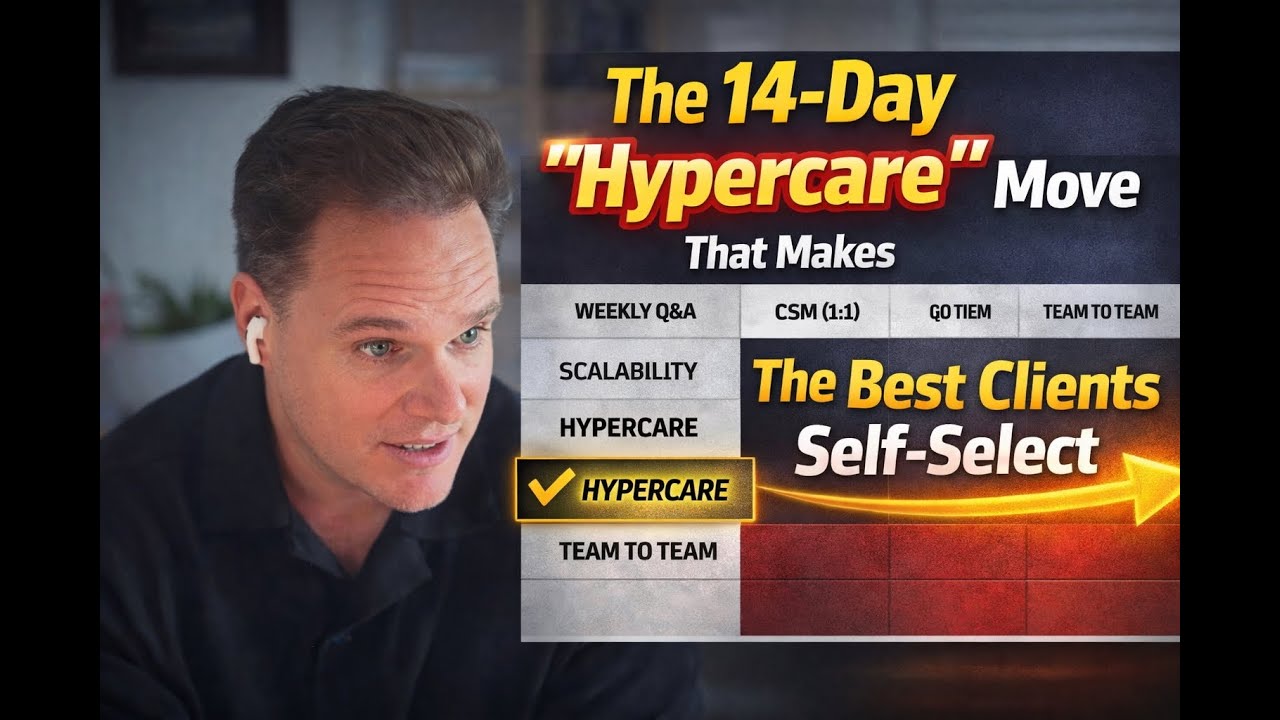
Jeff Miller breaks down four fulfillment models for service businesses, from DIY to team-to-team engagements that command $100k+ per week. He introduces hypercare, a 7-14 day intensive onboarding sprint sold as an upsell, and maps each model to pricing tiers, retention rates, and client types.
Chapters
Oh nice, it's working. All right, cool. What's going on everybody? Let me finish my click-ins and then we'll rock and roll. Oh wait, let me fix that public. Okay, here we go. Share group. Yeah, I think we're good now. What's going on everybody? How y'all doing today? Paul Corral. Says, what's up, G? How you doing, sir? Pavlo says, Jeff, you legend. Appreciate the compliment. Jared says, I'm ready for my mind to be blown. I like the energy, my man. Appreciate it. Yeah, today should be interesting. Um, we're going to talk about, uh, fulfillment models, and we're going to go beyond the done with you, do it yourself, done for you kind of jam. Right. My goal is really to get you thinking differently about what you do, how you do it, who you do it for, the methodology that you do it with. And I've really boiled it down into this little chart that should give you an understanding of the kinds of fulfillment and how they match the client status. The kinds of fulfillment and the retention rates, the kinds of fulfillment and the time to win, the kinds of fulfillment and the risk profile. Like all the things that go above and beyond simply talking about done for you, do-it-yourself, DIY, that kind of thing. And we'll hint at the model that My client is currently doing and using, uh, to go from, I guess you could say, $8K or $10K a month a year ago to now $500K a month the past month, cash collected. Wild, right? Um, so we'll talk about that and a few other things. So yeah, dude, um, your brain should be blown, and I think you, uh, I think you're gonna like it. What's up, Aaron? How you doing, sir? I don't mean to ignore you. That's not my intention. Um, I will give you an answer. It's that I haven't slept in like forever, so it's just rough, dude. So I, I ask for and I appreciate the, the rope and the length, um, and forgiveness for me accidentally ignoring you, which is not my intention. It's just like life stuff, you know what I mean? Right? And something about like the last month has just been like, you know what I mean? That kind of stuff. What's up, Justin? How you doing? What's going on? Uh, I can't pronounce that name. Oh, Julio, I got you. Marcus, what's going on? Nigel, Gil, Mr. McSpeedy, Jay Lewis. This feels like a fucking Discord chat, man. Like Digital Andrew. Uh, J-Sec Ham, Ray White's Tattoo. It's a fucking Discord chat, dude. This is why Facebook is like, give us your real name, okay? Like, on Instagram it's all fucking made up and nothing really matters. That's so funny. Let me check the other stuff as well. Uh, let me see if we're live on YouTube as intended. I think I always choose the wrong YouTube channel. I split the sucker and I haven't changed it since. Did I do it wrong? View your channel. Yeah, I did it wrong. Of course I fucking did it wrong. At least I did it right. All right, let's, uh, let's get this party started in a couple more minutes. What's up, Oliver? How you doing, my man? Been a long time. Uh, Jared with the fires. Andrew with the babies are fun. Yeah, dude, it's worth it. But my God, like, Andrew Kosovich, how you doing? Hamza says, what are you teaching us, bro, today? Yeah, we're gonna do some fun stuff, uh, understanding and thinking a little bit differently about fulfillment. Um, let's just fucking boogie, right? Let's just get this party started. I don't see if there's any reason to wait. I think I'm waiting for like one particular person for some reason. I'm not. Fuck it, let's just boogie, right? Let's share the screen and then we'll get rocking and rolling. Let's do it. I think this is better. Yeah, here we go. I really want it the other way around. Can I do that? No, I can't. No, not gonna happen. Okay, whatever. All right, Aaron says let's fucking boogie. Uh, Jeff25, put on a t-shirt. Yeah, dude, I used to have this whole habit of putting stuff on t-shirts. I fucking love that habit. It was so much fun. Just everything would go on a t-shirt. It was great. Okay, so we're gonna boogie, right? We're gonna talk about styles of fulfillment, and it's my goal to have you develop an understanding of fulfillment and more importantly, thinking really beyond the normal everyday done for you, done with you, do it yourself. And I'm going to do a sense check real fast. Oops, I didn't mean to click that. I want you to tell me which model you believe is your favorite model: done for you, done with you, do it yourself. Which model is your favorite model: done for you, done with you, or do it yourself? So it's DFY, DWY, DIY. And depending upon how you think about it, that could be called an agency service, that could be called a coaching program, that could be called a course, whatever you wanna call it. Tell me your favorite model: done for you, done with you, or do it yourself. Let me put that on the banner right quick. Tell me your favorite model: done for you, done with you. Or DIY. Is that gonna work? Yeah, here we go. Tell me your favorite model in terms of client fulfillment, your favorite model in terms of reception of services. Tell me in the chat, whether it's Instagram or YouTube or Facebook, what is your favorite model? Aaron says, uh, I've seen the most success with some done for you and done with you, little hybrid, right? For the sake of the quality, done with you. Okay, very cool. I agree completely. I've seen that. Uh, Swap has been saying— what's up? Oh shit, what's going on, my man? He's been saying done with you, which is cool. So in this case, a done with you would be like an 8-week coaching program where every week we do one thing, we got on a common call, and everybody does it together. that type of thing. We've got done for you, and Oliver's in the Google Ads game or the Google My Business game, and it's probably easier to just do it for your service provider as a service provider to somebody who has no technical expertise. Done for you, which is totally fine. Has a done for you, and I believe a done with you, right? Is— does anybody here have a preference for a DIY, a do-it-yourself? AKA a course. Anybody here have a preference for a DIY, AKA a course? So you pay $97, $297, $497, some of the kind— sometimes called an info product or a book, right? Um, who here has a preference for that info product low-ticket DIY fulfillment model? Who has a preference for that? I prefer it only on low ticket. Okay, so do-it-yourself on like that info product front end. So like brain-breaking, maybe like a $7, sub-$30 type of thing. Yeah, um, it could be a, a DIY hybrid. I've seen those where it's like you have to do it yourself, but there's a community aspect. So it's a hybrid between DIY and, and DWY, maybe, right? I've seen those as well. Um, and the reason why I bring it up is not just to like level set, but more importantly talk about what I believe are the stickiest the least risky and the highest client status type of fulfillment models. So when I think of a do-it-yourself, it's pretty rare for a very, very high-end, very, very high-status, very, very time-constrained, money-rich person to say, fuck it, I'll just do it myself. It's almost never the case. And it's very, very rare for that same client to say, fuck it, I'm gonna jump on a group coaching call, right? The point I'm trying to communicate is that very often how we deliver services has a connection to the type of clients that we receive. More importantly, clients that are successful. And the mismatch between A highly successful, high social status client and a fulfillment as an info product that can very often keep, kill, make, or break an entire business, right? So let's just get this party started, right? It's just as a summary, you know, a weekly Q&A. Think like a Done With You type of thing. That's just a big group Zoom call with faces and interaction, just like this, right? Sometimes you'll have like 30 people on here. You do a Q&A. Sometimes it's a one-way only type of thing, but this is normal. Every day we get a weekly Q&A. Totally fine. Not the big of a deal. Another kind of fulfillment you have would be CSM-driven fulfillment. So client success manager. Sometimes it's called an ads manager. Sometimes it's you, the service provider. Sometimes it's a member of your team, right? But somebody leading the charge, and that somebody is usually on your team, and they are assigned X number of clients, right? So whether you've got a Drew or a John or a Scott or whoever it is, CSM-driven fulfillment. If you're doing in-person, if you're in the doctor arena, if you're a psychologist, if you're a chiropractor, if you're a gym session, you have CSMs. You just have different names for this. You could have, um, a rotation if you want, but as you sign up, you are assigned, you know, 10 patients, right? If you are doing a group fitness class If you're assigned 10, if you're doing one-on-one, you're assigned one. It's the same kind of idea, right? And then all the way over here is the most fun of them all, which is your team and their team. So this is team to team. We've heard of person to person, consumer to business. We've heard business to consumer. We have been sleeping on this idea. Of team to team. That's when the teams are connected and they are training. So here's a quick Q&A for everybody. Of these 3 things, which do you think is the highest dollar in terms of scale? Scale. In terms of dollars per hour, in terms of growth, whatever your metric happens to be, which one of these 3, and this is given your experience, do you believe is the best bang for the buck? Again, by whatever metric and measurement instinct, gut experience you've had up until this point, which one of these 3? makes you go, that's the one right there? Which one of these 3 makes you say, hot damn, that's the one right there? We've got Dina throwing in the team-to-team. Yeah, we've got Justice saying my algorithm is fixed, I'm seeing Jeff on my feed again. I appreciate that. Yeah, let me remove the banner. Which one of these 3? We got Jared on Instagram saying team to team. Yeah, so in my experience, the most dollars exchanged and the happiest clients with the fastest results were team to team, not weekly Q&A. Not CSM, but team to team. There's reasons for it that we're going to go into, reasons for it we're not going to go into, but just as a concept, 3 different kinds of fulfillment. One is attractive to people who want to be in a Zoom call, one's attractive who want to work with one-on-one, and one is attractive to somebody who has a team. Obviously one is gonna be more dollar-driven than the other, right? Let's talk about the next metric, which is scalability. Who here has been on a Zoom call where you're like, damn, this is good, I like this, I'm feeling it, the tribe is cool, the instructor is cool, You're really like, hmm, this is good stuff. And then 2 weeks later, that same Zoom call sucks ass. Who's been on one of those where just your happiness on that Zoom call swings wildly? One session, amazing, oh my God, beautiful. Next week, the same session is just absolute trash. Who's experienced that on Zoom calls? Where one session is good, 2 weeks later that same session is sideways. Uh, Ty is saying yep. Super Doby is saying yep. These names are just wild to me. Um, Jared is raising his hand, right? Oliver's saying I've been there, right? And that's because weekly Zoom calls just tend to cap out at 30 to 40 per call. They just— that's it. Less feels best, but 30 to 40, just kind of like, that's really on the high end of like customization, applicability, being acknowledged while you're there, you know what I mean? And it— that size is the same size as a classroom, and 30 to 40 kids per classroom, like all of a sudden, like, that classroom sucks ass. You could have 15 people in there, it's a great fucking time. It's because of the instructor, whether or not that instructor can handle 30 to 40. And then somebody who's had to handle up to 100, it's like, oh my God, like Jesus Christ, because one thing specific to them is not specific to everybody. It's like a whole kit and caboodle really fucking fast, right? So weekly Zooms have a certain type and feeling and price point, right? CSMs, that's when it's you or your assigned person or your CSM. If you want to grow that CSM fulfillment model, you have to hire new CSMs, right? That'll cap out at maybe like 8 to 10 clients, right? And then you've got team to team, and your ability to expand that team is based upon new hires and your ability to train them. There's pros and cons on each. Weekly Q&As cap out 30, 40, which means once you hit 30, 40, you have to do a new weekly Zoom. You're gonna cap out here, every 8 to 10, gotta hire a new one. You wanna expand your team, gotta hire a new team. This is not something that marketers particularly enjoy doing and discussing, but you need to have an interaction and understanding of this. If you— put all your emphasis on Zoom calls and your Zoom call starts to creep up in the 20s and 30s, you're on the high end of that Zoom call, you need to do another Zoom and you need to assign people to Zooms. That way you're not having 100 on one and zero on the other. If you start hiring team members, you need to assign them to a client and say you're going to get a percentage of sales That this client pays, and you're gonna be assigned to 8 clients. Make sure that they love you and make sure that they renew. And with team to team, you've got to learn how to hire a team, which is the most difficult part out of all of this sometimes. Let's talk about hypercare. Hypercare is an easy upgrade. No questions about it, but I'll bet you're wondering what the hell is hypercare. So I want you to tell me in the comments what you think hypercare means. What do you think I'm trying to communicate when I say hypercare? Hypercare to a weekly Q&A, AKA group coaching? Hypercare to a one-on-one, AKA a CSM? Or hypercare to a team-to-team environment? What do you think I mean when I say hypercare? Give me a quick 30, 40 seconds. 30, 40 seconds. Give me a quick 3 to 5 sentences or 3 to 5 words. When I say hypercare, what do you hear? Again, when I say hypercare, What do I mean? Dina says extra handholding or done for you, right? Um, Aaron hinted at this— done for you, done with you hybrid for the sake of quality control, right? So hypercare is a 7 to 10 to 14 day time frame where you're doing a lot of work You're doing all the pushing, removing all the boulders, launching stuff, getting it live, figuring it out, doing all the meetings that you can to get this client results ASAP. In other worlds, it's been called the kickstart or the fast cash or the, you know, orientation or onboarding. But in the online space, it's often called hypercare. We're gonna meet once a day every day for the next 14 days and getting all of this live. We're gonna be meeting once a day every other day between me and my ads manager, and we're gonna exercise this roadmap and we're gonna get it live. The first 14 days of this email campaign that we're implementing together going to be fixing and analyzing and pulling data And that requires us going into your stuff for 2 hours every other day for the next 14 days. Hypercare as a concept is very easy to agree to, very easy to sell to, and very easy to buy from. It feels like a lot of work. It is a lot of work. But it's work you have had to have done anyway. We're going to build the VSL. You're going to be shooting these videos. I'm blocking it off on your calendar. This ends up being a higher dollar amount that somebody's willing to pay. I've done hypercares where somebody spends $10,000 over 3 months, and I say, as part of hypercare, you have to block off 2 hours of your Monday, Tuesday, and Wednesday, and I'm going to have my admin sit on the Zoom and watch you get these scripts done. And they go, goddamn, that's what I fucking paid for. I've done hypercare where I have to manually sit there with their team and give and grant access to the Facebook ads account. You've never called it hypercare. You just called it onboarding. Words matter, right? And when you're doing hypercare and your fulfillment is a weekly Q&A, it seems natural and works really, really well. Hey, we just built out all this stuff for maintenance and questions. Come on the Monday, Tuesday, and Wednesday calls. They go, you got it. Hey, we built out all this hypercare. For Q&A and questions, ask your CSM. That works for hypercare. Doesn't work with team to team. It's already included. It's part of the game. You're telling me I have to pay extra for a data analyst? Just— that's part of the team. Tell me you have to pay extra for blank. No, man, that's part of the team. So companies like McKinsey don't have hypercare, they just have high prices. $25,000 a week, $100,000 a week, $250,000 a week. They just roll that in as part of the game plan because they are doing it. It's very easy to get all that done. But if you're doing weekly Q&As, a very easy way of getting an extra 3, 4, 5 upfront is by saying we're doing hypercare for 2 weeks, getting everything live, and then for maintenance questions, come in the weekly Q&A. Easy, top tier, has a great time. Now here's my question for everybody. So I wanna get— I wanna get your keywords, right? Get ready for typing. Do you think hypercare is more attractive to great clients Or is hypercare more attractive to bad clients? Do you think hypercare is more attractive to good clients or bad clients? Tell me in the comments. Is hypercare good for good clients or bad for bad clients? Hypercare as a selling point is wildly attractive to very, very, very good clients, and is a signal from bad clients. The common effort is that bad clients are often unwilling to do things, only have curiosity and no implementation. And when you say we will do this together, they say, oh no, no, no, I'm not ready. And then they freak out. When you say this to good clients who are ready for implementation and execution, they go, hell fucking yeah. So hypercare as a communication and an idea enables clients to sort themselves, and it's one of the reasons why good clients get great results. Let's talk about pricing. When you pitch your price and you have a weekly Q&A, that is stereotypically very easy to agree to. There's no effort. They have to do nothing. They can just sit in their chair, be dumb all day long, check the box and say they attended. It's like a stupider version of school. It is very, very easy for people to agree and ultimately pay you to join a weekly Q&A. They have to do nothing. If you have a CSM or a one-on-one, pretty quickly that same client realizes they will have to spend more money. They will be unable to hide in the back, do nothing. Somebody will be talking to them and they're gonna have to get shit finished and done and launched, which means the clients who find it easy to agree to pay that money tend to be like middle to higher pricing and middle to high tier. And when you price your CSMs, you should be middle to high tier. What's interesting is for most people on this call, $2,000 to $5,000 a month is still low tier. It's still a $60,000 person, not particularly high. I have seen contracts for $100,000 a month That have 2 CSMs. So $50,000 a month for one CSM, that is middle to high pricing. $5,000 a month, that's entry level for any job with any skill. And as far as pricing for team to team, as soon as you start talking about how my team will train their team and my team will integrate into their team and my team will do stuff with their team so their team is just knowledgeable as my team, the price point is naturally much higher. Super high price points, incredibly high price points. I'm talking McKinsey-level price points. I'm talking $25,000 a week, $50,000 a week, $100,000 a week. It's a big deal. Super high business-to-business, government, and industry. When you start talking about team-to-team, your pricing starts to move up, and the ability of your clients and desire of the clients to spend more money will move up. I've seen plenty of conversations Plenty of calls in person and online where somebody will pitch a weekly Q&A to a super high-end client who wants their team to learn how to do blank, and it's a no-go at $7 a week. And I have seen that same person get on another call And say yes to a $15,000 a week contract so their team can learn the good stuff. When you start talking about team to team, your prices move up and the desire of that person to pay increases as well. Let's talk about cost to you. Doing a weekly Q&A. It's like 1 to 3 hours a week. Some people like me got to recover from a Zoom. Some people got to think about the Zoom beforehand. Some people just go live. There's some admin, all that stuff. 1 to 3 hours a week. I currently teach one of my clients' programs, the one that's doing half a million a week— half a million a month. Almost said half a million a week. Half a million a month. It's a 1-hour Zoom call. It takes me 1.5 hours. That's just how it is. So it's not just a 45-minute Zoom, not just a 1-hour Zoom. There's a 1 to 3x time frame. That's the cost. Running an hour-long Zoom call could cost up to 3 hours a week, which changes your numbers pretty quickly. If you have a CSM, you're going to give them a percentage of the deal They have to do work and do reports. So you're giving up between 10 and 30% of your contract in exchange to have somebody do it and report back to you. Team to team is billable hours on top of strong management. So that means, and I've seen these deals, it's $100 grand a year management, and then $500 an hour. Excuse me, $100 grand a year and then $500 an hour? Crazy. For team to team, I've seen those. There are people that you know that charge that amount, and people are willing to pay that not just to have strong management and talk to the manager But more importantly, to make sure that their team learns the stuff. And if you want a different word for it, it's like they're paying for coaching to their team. It's much easier for me to buy coaching for my team than it is for me to buy coaching for myself. Let's talk about stickiness. This is the biggest problem with weekly Q&As. As your weekly Q&A gets more popular, people leave faster. I'll say it again. As your Q&A gets more popular, people leave faster. Information's not always relevant. There's a stupid question. You got to go through everybody under the sun. It's like a whole thing. As you cry, as you cry, as you creep up to the 30 to 40 mark, people just start to leave you and come back down to 10 to 20. It'll get better up to 30 and 40, come back down to 10 and 20. So as your program gets better, it does this all the way up and down. Doesn't feel great, but that's how weekly Q&As work. If you run a CSM-driven model, the stickiness of your business is based upon the stickiness of that CSM. It's based upon their ability to have individual retention and their ability to generate real results. If they cannot, your client has gone fast. If they do, their client is jumping up and down. This is a function of your channel, Google Ads versus Meta Ads. This is a function of your industry, dentists versus personal injury attorneys. This is a function of the size of the business, a solo tax professional versus a group of 30 tax professionals. But the stickiness of your business is based upon the stickiness of your CSM. The cool part about team-to-team is the stickiness is based upon long contracts and paperwork. I'm talking like 2 to 3 year, 12 to 36 month contracts that are large, that are massive. Managed service providers are a great example. They'll sign 3-year deals. For five to eight thousand dollars a month. Crazy, right? It's a hundred fifty k deal done just to be a managed service provider. They ain't going nowhere. Elevator companies will sign ten-year elevator maintenance contracts for eighty k a year. What the fuck? Team to team, not weekly Q&As, not CSMs, but team to team. Social status of a client. Weekly Q&As are really attractive to people who are like low on the social status totem pole. They got nowhere else to go, nowhere else to be. Why the fuck not? It's 4 in the morning. Just like people are jumping in and out of this IG all day long. Jumping in and out of this Facebook all day long and YouTube all day long. There is no common denominator. And stereotypically, it's people that aren't running a $5 to $10 million a year business. It's just people low on the social status pole. It's easy to join. For CSMs, it's pretty fair to consistent But it's never CEOs or hard-to-get clients. Like, it'll be okay. Not great, not bad, but okay. Like, you know what you're doing, kind of. And that's just how CSMs work. But team to team is working with the best in the biz, the best in the industry, and the connections are top effing tier. I've seen people running pay-per-lead models that do a weekly Q&A and it will only be their worst clients. And I go into their Slack channel and I'll see like 10 Slacks and it's team to team with the client name. And those guys are doing $100,000 a week. These guys are not in the weekly Zoom. They don't want it. That's not how they like to digest their food. They're not a fan of it. They would much rather just work intimately with top-tier people. Risk profile: if you fuck up on a Zoom, everybody will forget what you said in 15 minutes or less. It's gone and nobody cares. You close it out, you delete it. When shit happens, it's gone. It's no big deal. And short of doing something wild and insane, it's not going to get clipped. It just simply doesn't matter. And if they implement the advice, it doesn't fucking work. It's on them, not you. With the CSM and shit goes south, Switch out the CSM for another one quickly. All good. But if you fuck up on team to team, oh my God, that's a big fucking problem. Real quick, not too long ago there was a security breach of a massive company, and this massive company said it's not on us, we outsource everything to an IT service provider. Their agents are the one that leaked everything. Sue them. Interesting, right? When the government project doesn't get done, they call up Deloitte and say, I'm yanking this $200,000 a month contract. It's higher risk, it's higher reward, and when shit goes south, there's lawsuits and press. What's interesting For some reason, everybody forgets just as equally as they did with this one. So just wait 1 or 2 weeks and everybody will forget. Wait 15 seconds, everybody forget. Wait a month and everybody will forget. The point I'm trying to communicate is that the risk profile of weekly Q&A is very low, which is why you are possibly Sticking with weekly Q&As. And the risk profile of team-to-team is very, very high, which is why you possibly have not thought about integrating team-to-team fulfillment and delivery into your business model. Time to win. If I get on another Zoom call With a client that said I forgot or I didn't have time, I will reach through their computer, choke them to death, and body slam their corpse through the computer. It is insane how many excuses I get about why stuff isn't getting done. My fulfillment and my service delivery goes down. When these guys take way too damn long, but that's how weekly Q&As work. CSMs, we're live in 24 to 48 hours. Cool. Team to team is based on a 12-month rollout schedule where every month is divided into weeks and every week is divided into days. And every day you have 1 or 2 initiatives that you launch, train, and do with your client. I have seen these 12-month calendars divide into 12 sections, and each month has a particular theme, each week has a supporting pillar, and each day has a kind of notepad of this is what we're doing. They meet, they train, they execute, they implement, and they go to the next thing. And the next thing, and the next thing, and the next thing. And it's based on slow, extensive, consistent rollouts—ones that keep clients and ones that force progress. And more importantly, the pain of leaving. When you exit a program and you no longer have to get on Zoom calls, are you like, damn, I really miss doing those weekly Zoom calls? Or like, damn, I just gained an hour and a half. I get to do whatever the fuck I want. Do you feel pain when you leave a program that has weekly Zooms, or do you feel pleasure? When you leave the weekly Zooms. That's the challenge with a weekly Zoom delivery. Not only are you actually giving pleasure to somebody when they leave, but it's very, very easy to cap out your program. So at the most, on a weekly Zoom with some interaction, you're gonna hit 30, 40 clients. The program will get worse. They'll quickly leave, quickly. They'll come down and get better, and then they'll quickly leave and come down and get better. If you have a CSM-driven approach, they will lose a trusted advisor or employee, AKA their CSM, those getting stuff done, but it's a slight loss. It's not like a big deal. They're not going, oh my God. I lost Jeff. Holy shit, what am I gonna do? They're not thinking that. But in team-to-team, it is a significant disruption, like top-tier at its core disruption. They're going, holy shit, the people that knew the system the best are no longer here. How am I supposed to fix this? What am I supposed to do? What's the game plan for the next 6 to 12 months? What about this update? What about all this? The guys that were leading the charge are gone. What am I doing? What am I thinking? I have no idea what's happening. So the team-to-team model experiences significant pain and significant disruption when people leave. The weekly Q&A has pleasure when they leave. So you have to develop this interesting understanding of where you are what you need to fit and how it should be. The reason why I say this is because we're very often expecting our clients to experience significant disruption. We want to have slow and scheduled rollouts. We want to work with the best in the business, have large contracts, But we're doing weekly Zooms, or we'll have CSMs that lead the charge, and then pretty quickly we're going, damn, I really don't like working with CSMs. I wish I was doing weekly Q&As. You have to develop a deep, meaningful understanding of where you are on this box. And what I've learned to do is I'll make these boxes and start bolding where I believe is the best fit for me and where I imagine myself and what I want to do. So if you go here, I like this, I like this. And this and this. I don't believe this is ever going to happen to me, but I like this and I like this. I like that. Maybe willing to accept it. So the characteristics of a team-to-team fulfillment model are very in tune with what I like to do. The problem is that I'm still doing stupid weekly Q&As. Which are wildly unattractive to people who want to do team to team. That's it for today's lesson. I'll bring up the Zoom chat, Zoom chat, the Facebook chat, the IG, and then we'll do Q&A. So let's take a look. I'm opening up the Zoom chat. I keep saying that. The IG chat. Jared says, are they available at any time for any reason? Stereotypically, the narrative between a client and the CSM is the CSM will be checking something at like 9, noon, and 5 PM, and/or phone calls are a 50/50 shot. That's stereotypically like how they think about it. Uh, Jordan says, can you recap what we walked through? No. Watch the replay. But he also continues on and says, so the price walls and the tiers and the separation wars to clients, these commit to most results. Correct, right? So when we think about this setup, right, we just need to develop an understanding of the attributes and the characteristics that we enjoy. My best work is always working intimately And at a very close level with very good people in teams of 3 to 5. I'm bringing in ideas, leading the charge, assigning initiatives, getting stuff done, and we don't have to do a weekly Zoom at all. Me and my team will train you and your team. This is great for me. I enjoy this. I'm not really digging the weekly Zooms. So you just have to have an understanding of the attributes that you enjoy, and then you'll be able to communicate a deliverable that is attractive to those clients. And I have found clients that will say no to weekly Q&As and no to CSMs are saying yes to a team-to-team approach. And paying much higher price points because of it. That kind of stuff. Let's see. I'm dying again. Uh, ask, ask. We'll do last call for any questions, comments, concerns, thoughts, and ideas on this model, and then we'll take it from there. What's the current pricing structure model from free to high ticket pay, highest ticket paid? Um, I have found that the— oops, sorry. Stereotypically, the model on the left has the lowest price points. We're talking like $7 a month, $7 a week, $97 a month, $300, $500, maybe $1,500 a month recurring if you're at super high on the authority and the branding level. But I've seen and interact with people that are doing these massive $100,000 contracts, they're not doing weekly Q&As. They're doing my team will train your team. So there you go. Oftentimes I hear people complaining about the service program being the CSM-led when the company is heavy on personal brand founder, but I guess probably another channel upsell. That is correct. Right, so one of my clients right now that is doing $500K a month, uh, at each tier he's hired a replacement. So when he hit a certain amount of money, certain number of clients, cool, hired the CSM. And if you want to work with them one-on-one, you have to pay one-on-one. Then he introduced a one-on-one program, solidified it, gave it a name, and now he's at the third tier. So the price points will range for his program from like $10K to $30K, and now it's gonna be $50K, right? So at each level, he just does one-on-one, solidifies it, next one-on-one, solidifies, next one-on-one, solidifies, next, right? And so I believe that it's a channel to upsell, but I also found stereotypically that the CSM only needs to be like 80% good. And most people are expecting 100% good. And in the extreme scenarios, like, I have another client right now that was like, Jeff, can you just be my CSM for my clients? Um, that the CSM is like just not responsive, something like that. Yeah. So yes, there are pros and cons. It is everything that you mentioned and more. What is the highest ticket thing that you sell right now? I've got a $30K 4-month program. And what's the current MMR continuity? So the $30K MRR will probably go down to, if they do continuity, $3,800 a month. That's what we have one client on right now. Um, and in that model, we are doing and having conversation about team to team. So not CSM, not weekly Q&A, team to team and hypercare, right? So we're gonna do a bunch of work together in the first 2 weeks. Like we're gonna get exhausted with each other, right? And then they'll be set on a milestone. We'll call each other every now and then, or the team will ask questions, make adjustments, things like that. And then at the end of that 3-month or sorry, that 4-month contract, they can either renew team-to-team or move into maintenance at $3,800 a month. And we have a client doing that right now. And they want to increase. I think they— based upon the conversation I'm having, I think they're going to be like $3,800 to $6,800 a month. Like, they're going to upgrade that way. So we'll see. Yeah, that's the price point that I'm rolling with. I've got 2 more minutes and then I gotta run off. Let's see, one moment. Yep. All right, we're good. I'm gonna open up IG. Singh says, can I ask a question? Now is the time. Uh, what is a CSM? As a client success manager, as a person your team assigned to that client, and they work with that person to do stuff. I wonder why IG comments don't show up in StreamYard. What's going on, Andrew? Been a while. Weirdest niche you've worked on? A guy right now is trying to get me to run ads for his MLM. That one's fucking weird. I don't want to do that. Um, I've had a guy do Ozempic. try to sell Ozempic, but it was off-brand. I was like, this is funky. What's in my list right now? I got some vanilla ones like GMB, martial arts, salesperson recruiting. I guess weird is not like— I guess I'm not like particularly weird, but yeah. Jared says, what's the roadmap for starting team-to-team? Can you briefly touch on it, or do you just do it? So when you're having a conversation with your client about team-to-team and your ballparking ideas and all that, you're usually presenting like a 4 to 6 month agreement. And then over those course of 4 to 6 months, you've already created or predetermined a plan. Or you'll say, look, if we're just— if we're not against it, we're going to get on the horn and outline a 4 to 6 month timeframe and everything we're gonna do together over the course of those 4 to 6 months. And then that becomes the roadmap, right? So it does not have to be prescription, it can be customized. And sometimes it's 2 people working together on that specific roadmap and then they go, fuck yeah, let's do it. So in this case, the contract that I'm looking at is, hey, we're gonna get on a Once we agree on the preliminaries and sign an LOI and get on the horn, figure out the next 4 to 6 months, where you are, where you want to be, 4 to 6 month buckets, 4 to 6 1-month buckets, the objectives for each week, and then the sub-objectives. And then my team will train your team on these things. So that kind of idea. Says, what do you think after AI Advantage Plus affecting the whole Yeah, dude, uh, you're no longer gonna have targeting pretty fucking soon. You're just gonna be able to pick the geography and then Meta will do the difference really fast. Like, really fast. Like, I'm surprised that targeting now is doing any work at all. Um, I think in the next 3 to 6 months, advertising on Instagram is going to be exclusively based upon your ability to be creative and do good ads, and it will push a lot of, uh, hiding behind the scene people out of the market very, very fast. Like, you need to be out in front yelling, kicking, screaming, doing good images, doing good video, doing good ads, that type of stuff. And if it's not within that skill set, then peace. Like, that's it, right? Um, ultimately Meta is moving away from targeting. Meta will read your ad, read your captions, read your, uh, imagery— background, foreground, all that stuff. It'll, it'll read your customers, it'll read your followers, and then place the ad accordingly. So yeah, you can see Zion says, should we opt for it blindly? Sometimes it goes off track for 15 days. Yes, that is correct. It will always go off track. The reason for that is because Facebook will find a batch of customers Just like you go digging for oil. We found a bunch of oil. Okay, fuck yeah, let's go. Found all the oil and that's the end of the customers. And that has to go find new oil, new batch customers. So it has to go somewhere else and it'll go all the way over here. And while it's finding the new batch, that's when you're experiencing it's going shitty or off the rails or it's no good, it's bad leads, there's no customers, there's no purchases, my CPA, ROI, whatever it is. That's them finding a new thing. as the creative and the advertising agency owner and somebody who knows what the fuck to do, right, you are going to be soon put in a position where you have to make consistently new creatives and consistently new advertising, new hooks, new angles, new videos so that Facebook can get there faster or maybe even have less space to go. So if you have a video that only talks about You have back pain, they'll find back pain people, and then you run outta back pain people. You go, fuck me, what am I supposed to do? And then it's like, I don't know, go find more back pain people. So it takes the ad and tries to find more back pain people, right? Or you could do back pain, you could do neck pain, you could do joints, you could do all this stuff about chiropractic. You have 10, 15 different types of ads and they all stay here and they'll do all the back pain people. And send the back pain out over there, but there's still people here, so it gets to your other ad and it goes, oh, okay, well, back pain people are— they're all taken care of, but what about hip pain people? Okay, we can still fucking do it here. And then the hip pain will go find more, etc., etc., etc. So you need more creatives. That's what I'm trying to communicate. Do you see traditional retainer model work for agencies that help local service providers? That's the problem with local service providers. They just fucking suck ass. Like, there's a reason they are local. It's not because they're good, it's because they're not. Like, there's something inherent about their business to where they are only good enough for their tiny little location. And in a global world, if you're only selling to people within 5 miles, what are you gonna do, right? So that's inherent challenge. Your question continues on and says, should I charge them $2K a month for lead gen, booking, and all that? What's the best value or levers? You all right? Okay. Um, what's the best value or leverage you should be providing with the scope? That's the problem with local lead gen, dude. Like, there is simply not enough volume to be like jumping up and down and charging a boatload, right? If you're saying, how do I keep and maintain a $2K a month retainer, the easiest thing to do is to start getting prepayments. That will be worth it very quickly. If you do that, your share will be high, your clients will be happy no matter what, that kind of thing. Um, but local clients are just rough. Right, uh, Vimal says, I work exclusively with medical doctors, um, what would you do instead of— so there are national medical doctors, there are regional medical doctors, there are medical doctors with multiple locations. So you don't have to change your industry, you just have to change the size of the business that you work with. That's how you could expand the TAM. What's going on, my man? Been a while, we should catch up. Avery says, there are certain verticals but most suck. $2K retainer buyers are going to weigh you down unless you have a wizard appointment team. Correct, right? You're gonna have to put a lot of effort to keep that $2K a month retainer. You will not have 75% margins like you need, and they will be unwilling to refer you out because they compete. It's just rough, man. It's absolutely rough. Are these also in the coaching program? Shannon, you have an invoice in front of you and a payment link. All right, you, you take care of that now. You sign the paperwork, okay? Now's the time. Hold on, fellas. Okay, Steve says, did you just say local targeting is going to be difficult? Yeah, dude, it's been that way for a while now. Local targeting is fucking rough. Not a fan of it at all. My best clients are national clients that have a national customer base every single time. Yeah, and if they're if they're local, they need to be a gem—an absolute fucking gem. Katie says, "How's the baby?" Baby is good. We're coming up on seven or eight weeks now. She is now sleeping more than three hours, which is a big plus. The other night she slept four, which was a godsend. Absolute godsend. Other than that, we're rocking and rolling. We're assuming she's getting into Harvard in like two or three weeks. If not, she's going to start her singing career. We have a backup. We have a backup of like you know if she just becomes like a. a go-kart rally racer like NASCAR, that type of thing. You know, we're doing Career Day tomorrow, so we'll see. Alvin says national and state are always the best. That is correct. So what would you recommend for local to find gem? Uh, if you are still looking for local, Google Ads or Google My Business is probably the only saving grace that that a local business will have. Um, outside of that, they need a very strong online business card, which is their TikTok or their Instagram. Have personality, have a story, have a communication, very like Russell Brunson Expert Secrets type of thing. Um, other than that, like, it is going to be damn near impossible for a local business to be doing what we want them to do very quickly. Do you feel approaching these regional national clients takes more or less than a little— takes more, or is it just limiting? That's it. I had a 25-location dentist company. It's not that big of a deal. I imagine getting them to commit makes you look a lot different than these shitty business owners that just give you their credit card Save their operations. Oh, he's talking like Jeff now. That is correct, Jamal. It's not that big of a deal. It's not hard, not challenging. They just talk different. That's it. And you just got to learn how they talk. And you can use advertising no different than anything else. You just got to realize that— I'm gonna serve some fucking shit right quick. They don't like Alex Hormozi books. Because all y'all tried to Alex Hormozi them, or Dan Kennedy them, or Russell Brunson them, and they got it, and they don't like that shit. So if you want to talk to a local business that knows what the fuck they're doing, they're going to be regional, they're going to be national, they're going to be state-driven, and they're going to talk a whole lot different than how we expect. Justice says, I like my local businesses, plenty of small things to fix, and they're valuable, easy to provide results for growth and demand. When there's a little start from okay cool, I'm happy that you like them. I'm just experience communicating from my own experience, and it looks like our journeys veered off a bit differently in the past two years or so. So yeah dude, I'm happy you're happy. How do you find national clients? You know exactly how to do it dude. There is not a secret at all. Alvin says here's my local business. It's my last $500. Please, Maze, save my ship. Thank you. I'll just do a chargeback. Yeah. Shannon says check your notification now, it is in the program. Okay. All right, cool, dude. Yeah, schedule your 101. Let's boogie. I'll send you the link. Happy to have you. Is he lying? That would be so fucking funny, Shannon, if you're fucking lying right now. I didn't get a notification. Okay. Yeah. Cool, man. I'll send you the next steps. Peer pressure, dude. I'm happy to have you. We're gonna have a good time. Abdullah says, I would assume that the future is with the marketer who perfectly knows customer psychology and has the best designers. I agree with that completely. Like marketing, I'm talking not the future, but in like 3 months, 6 months, you will now have to compete with kids that grew up in marketing. Right? Like they know how to go viral. They know exactly what to do. You got to do the same. Let me check IG right quick. Justice, you got a question right there, dude. Let me see. Xander says, do you take your own sales calls? Sometimes I do, sometimes I don't. Uh, Rando Slog says, what's important for a street food business, online or website? Neither. Do Instagram. Just do Instagram. Have a fucking personality. Follow, uh, crazy TikTok accounts that are just wild with personality, that kind of stuff. Are you saying a local service lead gen is harder than national B2C or B2B? Correct, Xander. If you can do local lead gen for a local business, it's much easier to do national lead gen for a national business. Much easier. Much easier. Says good vibes, have a great week, um, and what you're wearing, dad life. Yeah, dude, I appreciate the love. And Justice says, here's his tech stack. The DBR is probably working the best right there. And Danny jokingly says, so marketers have to get good marketing. That's correct, right? Um, yeah, right. And then Steve says, what's the best way to get IG followers? Okay, great question. And then I'm gonna bring it to the end. By the way, um, if you've been having a great time, I'm gonna give you the bonus or the bribe for coming up live. Comment Jeff my face. I'll pick 3 people. We'll do a group Zoom call and we can jam out, vibe out, ask whatever you want, do a screen share, audit your stuff, whatever you think is best to ultimately move the needle in your business. So comment Jeff, my face. I'll pick 3 people. We'll find a time together. And then that will be my thank you for tuning in live and asking great questions and me following through with what I mentioned before, which is you will have you know, a special reason to like come up today, right? What's the best way to get Instagram followers? So I'm gonna change that question to what's the best way to get Instagram followers who are deeply interested in my services, right? I found stereotypically that doing a podcast, getting a clip of it, and then posting it and then boosting it on IG Desktop is the easiest way. When I've done my way of working Following that, I'm getting like 30-cent followers and they're watching the lives, you know what I mean? So yeah, that's how I recommend it. Chris, Andrew, Oliver, Peter, much love and appreciation. Face my ass, ask my face. All right, cool. I'm gonna pick, uh, some people right now. If I say your name, please message me on Facebook. And if I say it and you're watching on YouTube or Instagram, find me on Facebook, right? And please do it as soon as possible. Life gets in the way and I want to do this quickly, right? Uh, let's do— okay, this is refreshing too fast. Sorry guys, hold on. Um, wait, uh, Chris, you were the first one, so please send me a DM and we'll do a— we'll do a big group and we'll find the time to get together. Uh, let's talk to Malachi. I've not talked to him in, I think, like 7 years or something like that. Um, and let's get Steve Fisher in on here because I haven't talked to him in a while too. So the 3 of y'all, if you could just DM me on Facebook, we'll set up a group chat, we'll find a time, and then we'll be off to the races. Uh, Xandax says, I DM'd someone from your live 4 months ago. We did a new vertical and with 6K in ads to make— Xander, you're leaving me on read. To make how much, Xander? How much did you make? I DM'd someone from your live 4 months ago. We created a new vertical, spent 6K on ads to make— who the fuck knows? All right, so with that said, I gotta boogie off. It's always a pleasure. I hope today's lesson was particularly useful. And again, kind of in summary, I'm looking to change how you think about your fulfillment and ultimately maybe understanding that you can match your wants from a client interaction with their wants from their fulfillment models, right? And so that means if you like weekly Q&As and you like capping out 40 per call and you like having people stereotypically on the low status pole, social status pole, that's cool, man. Do weekly Q&As. If you like having CSMs that get a percentage of the deal and you get to switch out CSMs and the time to win is based upon their actions or yours, that's cool too, right? If you like having team to team, if you like hiring people, if you like super high billable hours, Right, working on complicated projects, team to team is probably the best fit too. So I gotta run. Peace out, everybody. Bye.








