
Jeff Miller covers performance marketing tactics: why $39 chiropractor offers fail but $200-plus cash-pay models work, how $11k ad spend generated $117k revenue, and the five-stage funnel from unaware to most-aware. He breaks down Meta CAPI integration, advertorials, and why only tier-2/3 clients are worth pursuing.
Chapters
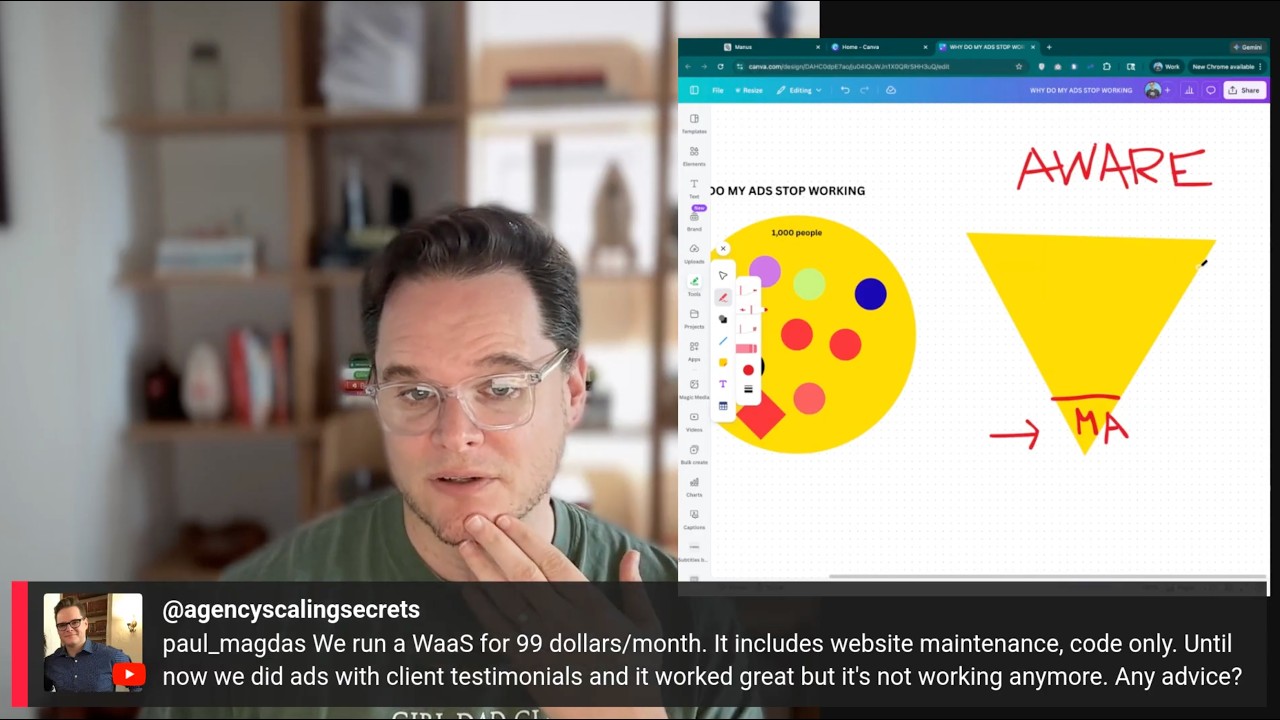
Come on, is it gonna work? There we go, we're working. I'm gonna get water. I'll be right back. All right, now we're rocking. Let's double-check some stuff. All right, what's up, Alvin? How you doing? All right, ladies and gents, it's time for questions and answers, Q&As, all sorts of fun stuff. Um, I will tell you, I'm having a rocking awesome time with Manus. It has solved a lot of bottlenecks, a lot, right? Um, with CAPI tracking, integrations, communications, just the look and feel is fucking awesome. Um, we brought on— we lost 2 clients last week, we brought on 3. We're probably gonna lose another one this week. Uh, there's just a lot of communication, really, really like a lot when there shouldn't be any. Um, but that's just how it works sometimes with clients. Um, the pod is rocking and rolling. We had somebody turn $11,000 of ad spend into $117,000 of revenue, which is cool. And they collect 50% up front, so that ain't too fucking bad, you know what I mean? Um, and then Thursday, Friday, and Saturday I'm presenting at Will Nelson's conference. So it should be good. But if you got any questions, comments, concerns, thoughts, ideas, if you want to prompt me on a rant session or anything like that, ask away. Alan says, what are your thoughts on a $39 chiropractor offer which brings them 30 leads a day versus cash pay-ins patients paying $10K? So I have a physical therapist client, and he does coaching for physical therapists. And his entire narrative and messaging communication is to drop insurance-based packaging and planning and market exclusively towards super high-end cash-paying patients and make them pay— I think it's, it's up to $200 for for each visit. And the reason why he pushes his clients to get $200 a visit is because that removes 50 to 70% of the false positives. And so by a false positive, I mean we'll have 10 people on the books for a $40 offer. Out of the 10, 5 show up. Out of the 5 that do show up, 2 or 3 are somewhat qualified, and then you and the client are very, uh, gritty and grindy on whether or not they could have turned one of those 3 into a, you know, $3K, $5K, $10K care package. More so, the, the relationship you end up having with this client is out of the 10 slots that were available One was good enough to be sold or upgraded. And that narrative like fucking hurts, like really, really quickly. So it's much better to have a narrative where you're saying, look, you should charge $200 and 1 or 2 people a day are gonna come in that are brand new. They have no idea anything about you, but they're gonna be interested in paying $200. Here's a sales script. Here's how you do your sales pitch. Get to it. And now all of a sudden you're not talking 1 out of 10, but instead 1 out of 2 or 1 out of 3, which that just feels better. And the quality of the conversation that you and the client have about you and the end customer is much higher and better. The mistake most people make is believing that a $39 Cairo offer is workable Because it's not. A $39 chiro offer is effectively what, a $5 or a $10 offer if we're talking 2003 prices, right? So back when we were in college, you know, $5 at a chiropractor, you're like, well, that appeals only to college kids, right? Um, in the modern day and age, uh, $200 offer to go see the chiropractor is much more self-selecting, feels a lot better, and ultimately optimizes for much higher-end clients, better client lifetime value, higher client lifetime value, things like that. So my overall narrative is that it's better in the medium and long term to build a business around— I'm pointing to the screen like mobile can see it— around selling $5K and $10K packages than it is trying to flood a practice with $40 appointments. Just feels a whole lot better for everybody involved. So yeah, I, for the most part, believe that it's better to aim for a $200 fee to see the chiropractor if they have the branding correctly, the positioning correctly, the marketing messaging correctly, if they have the sales script correctly, if they have sales process correctly, then all the stuff works. Very often, however, running some like irresistible offer Alex Hormozi, Russell Brunson, Grant Cardone, Dan Kennedy stuff, where like we make massive promises and those massive promises only appeal to very shitty clients. So it's, it's likely a scenario where if you're one bucket, the other bucket doesn't even exist and you can't even think about it. So that's a really long-winded answer, but effectively what happens is if you accidentally find yourself in a $39 chiropractor bucket You're just losing, just absolutely effing losing. So yeah, that, that's ultimately the challenge. Um, so I am very much in the, uh, $10K bucket. Hold on, let me fix that. Can you use this logo? Hold on, let me fix my mana stuff. So yeah, that's my thoughts on that stuff. Uh, Real Shivs is shooting a shot. Thank you. Do you have any openings? I have a strong track record in performance marketing for 6 years now. Um, I don't think so. No, not unless you have like real explicit obvious experience. Um, the only clients that I have open for, um, a CSM placement would be— I've got a health coach. It would probably be a health coach. Um, but I don't know if they're even open to it, so I, I think I'm gonna have to pass. But yeah, I do not have any openings right now. Uh, how do you stand out in a hyper-saturated market like selling e-commerce email marketing? Um, yeah dude, e-commerce email marketing is going to be fucking rough. Yeah, let me copy and paste this. So this is what Simon says. No, no, here we go. So Simon says, how do you stand out in a hyper-saturated market like selling e-commerce email marketing? Um, so the current situation is that email marketing, text message marketing, anything that has to do with the generation of the written word, the competition is now credits or tokens, right? And it's very, very difficult for a person to charge $2,500 a month, $5K a month, $10K a month when the alternate is $30 a month, right? Very, very, very difficult. Your best bet is to, uh, teach or communicate or provide structure or strategy to your ideal clients who want to know how and when and what and why they should deploy that skill set. So for example, if you had a 3-day paid event that was $47 and you were showing e-commerce companies that were doing $100,000 a month who are already using Uh, fuck, what is it called? Klaviyo, right? If you're showing them the AI prompts you use and the processes you use to create email sequences that increase, uh, customer lifetime value by $500 to $700 a year so they can go ahead and sell their e-commerce business That's much more interesting and much more valuable than just saying e-commerce marketing, right? Now all of a sudden we're applying thought processes and, and higher-end thinking and strategy and what and when and how, right? And the cost of attendance and the cost of attention is $47, but what you're receiving in return is a much higher value conversation, right? So there's 2 things, or maybe 3 things, that are running around my head. The first is that e-commerce email marketing, it's a very wide mark, and when you shoot wide Um, you will get very few dollars and you not go very deep. But if you shoot very narrow and you say my ideal client is again an e-commerce company doing a million a month that runs 80 flows on Klaviyo and wants to deploy an AI agent that can increase their open rates, their click-throughs, and their blanks, and do it in the background automatically, and the reporting to the organization is one report every 3 weeks Um, and it's a 30-45 minute meeting. That's very, very valuable very, very quickly. Um, and then the conversation is how do you get attention to it, right? So you could have a paid event where you show them how to do it, and at the end you can say, if you want my admin to administer this process for you, cool, right? Uh, how do you get attention on it? Volume number 2 is doing a lot of YouTube walkthroughs, and you can let your audience self-select into 3 tiers. One of them is I want to buy the recording of how it works. 2 is I want to buy the AI agent itself. And 3 is I want to buy your time so that you manage it, right? That's the easiest way of standing out in the hyper-saturated market space like e-commerce email marketing, which is again, get incredibly wildly specific. Instead of just saying you do email marketing, you need to say I help a specific kind of person And that target client is going, damn, I have a whole lot of upside in exchange for $1,000, $2,000, $3,000 a month. So that is effectively what you need to be doing, um, very, very quickly. So that's ultimately how you would stand out. Uh, let's see what else. Uh, Paul continues on and says e-commerce marketing was a big deal, now it's dying. Yeah, I agree. Uh, let's look at, uh, oh, this one is going to be interesting. All right, let me show you this one. This is a comment by Paul, and you know, Paul, I think somebody that I spoke with a month ago had a very similar offer. Hold on. All right, so Paul says, I run website as a service for $100 a month. Please, website maintenance code only. Until now, we only did ads with client testimonials. Work great, not working anymore. Correct. So I'll tell you why your ads stop working. Let me bring up my screen. All right, ladies and gents. Let's have a good time. Let's go here. Share screen. Boop boop be doop boop. All right. Let me blow this up. Here we go. Why do my ads stop working? This is the question that you are having. And a couple things. The first is. The symptom, or how do I know if my ads are actually working? So this right here is the symptom, or the experience symptom. Is that right? Yeah. Okay. So this is what you're going to be experiencing when your ads stop working. It's going to be cost per lead shoots up. Number of leads is down, um, quality is up or down, budget goes further— or budget goes nowhere, goes less far. And you'll get the following thing, and this is probably the killer of them all: how are you different? This is what you will be experiencing when your ads begin to stop working. Um, again, your cost per lead goes up, your number of leads go down, your quality is sideways, your budget goes as far, and how are you different? What is actually happening is that every single person in the world with their market, with their offer, with their whatever, has— just call it a universe. A universe of advertisements, a universe of audiences, a universe of reach, something like that. And this reach goes up or down depending upon how big you happen to be at that moment, right? So let's just say that you are, uh, a 13-year-old kid starting a YouTube channel and you've got an audience of like zero people, right? And one day you get like 50 people, you're like, oh, this is amazing. Well, then all of a sudden your audience from left to right, the entirety of this circle and everybody in it is going to be effectively 50 people. And then you and your 13-year-old YouTube channel, Roblox stuff, you're like, holy shit, I got 50 subscribers, this is amazing. I'm gonna be rich. I'm gonna keep doing this until I have 1,000 subscribers or 1,000 people in my universe, and then I'm gonna make an offer and we're gonna be good. And then we're gonna add more people later on, but it's fine. I'm gonna put an offer right now, but you got 1,000 people. And all of these people really, really like your stuff. And you run an offer, and this is your offer. Let's just say it's like this sucker right here. And you run your offer. You run it to the 1,000 people. So it's like a bullseye. You're like, this is fucking great. I'm gonna run my ad, and the first week you get 10 people like, this is great. And then you run another ad and it's slightly different, right? So you run a different ad and then you have a different ad over here. And these are all like different hooks or communications or something like that, right? They're all like different variations. And then you do this one here and you do this one here. And then you're like, oh, this is not working anymore, but it kinda works, so sure, fine. And then you do this one here. And you're doing all different ads effectively to, again, your audience of only 1,000 people. Not everybody's gonna buy. Typically only like 8 out of 100 are interested in buying at any one time. So once you hit 8 people, that's like, that's really the end of it. And really quick, you realize we're up to 6. So you go, okay, you know, let me just go back to the original ad 'cause like it's going sideways. I'm not really sure. And then one day you're like, oh, I'm gonna watch some stuff and I'm gonna realize I need to do a different ad, just wildly different. It's gonna be fucking crazy. I'm gonna do something off-the-wall nuts. I'm gonna do this ad, which is different, right? And you're like, oh, I'm freaking out 'cause there are fewer buyers. I'm gonna go ahead and do this ad. And this ad is the same kind of ad as I ran in the beginning, but it's a little bit different, you know what I mean? And then that goes here. And effectively, what you've done is you've shotgunned the 80 people of your 1,000 who are interested in buying, and guess what? They all bought. Now what? This is what you're referring to, Paul, which is the ads stopped working because you ran out of people to send the ad to. You did all the different variations. All the different looks, all the different hooks, all the stuff. And usually you don't, but you know what I'm trying to say here, which is you did it and now your ads stopped working. So you run another ad, another ad, another ad, another ad, and you run out of people to send an ad to. And the reason you're doing this is because you're probably— and I don't know, I haven't deep dived into your ad account— but usually You're only running one type of ad. Usually— I don't want to do that at all. Usually you're only running an ad to your future buyers. You're usually only running These right here, which are your buyers. These are the people that are most aware of what you do and how you do it. They're interested, they're fans, they're like, fuck yeah, whatever you sell me, I'm gonna buy, right? You think you're running it to 1,000 people, you're not. You're only running it to your smallest market here. What you need to do is run marketing messages for each stage of awareness. And this is a very different style of thinking, and it's very difficult to migrate from one to the other, but if you do it, all of a sudden, fucking works. So you actually have like 5 stages. You have people who are just totally unaware that you exist, and that's why you'll see people that are like brand new or like, I got nothing to lose, they're on their wildest, craziest shit. 'Cause you're just unaware and like, oh, I got all these people that are interested, this is amazing, I got all these views and this traction, that's unaware traffic, right? And then you got people who are, let's just say problem aware. Let's do this. Then you got people who are solution aware. And then you got people that are product aware. And then you got people who are most aware. Most times, Paul, you accidentally only talk to these people. You're only saying, buy my website, buy my website, buy my website. I've got $100 a month software as a service. It's fucking great. You're gonna love it. Buy, buy, buy. And guess what? You used up all the buyers. Now what? What you need to do is have this constant communication to people who are completely unaware that they need a website, who now know that they need a website. The problem creating websites is that it takes so much time, you don't know what to put, changes are impossible, blah blah blah. And you know what, I have a solution and it's called Jeff Miller, uh, WASS, right? Um, and here's what everything does. And by the way, you can buy it now for $99, right? So you need to migrate your line of thinking to away from this style, which is what you're referring to, towards this style. And once you realize that, you go, okay, I've only been targeting the people who are most aware. That bucket is now empty. I need to go back to unaware, problem or solution, product. And then all of a sudden you have to start working again very, very quickly. And that's how we took a client and we spent $11,000 on advertising Here we go. And then he ended up making, um, $11,000— $11,000— $117,000. That's how. So it's totally different line of thinking, right? There are challenges Right? Um, to this line of thinking, there's frustrations, there's difficulty. 6 months ago, doing something like this would have taken— 6 months ago, uh, 6 years ago, doing something like this, like properly creating this whole setup, was probably 6 months and $60 grand. The client interviews, the long form, the communication, the creatives. Now it's like 15, 20 minutes, maybe an hour if we're slow, right? Um, and this is the bedrock of my offer, by the way. Migrating people off of this whatever line of thinking, the big circle with the stupid dots, into this triangle of multiple stages of content and doing it on a weekly stage. So that is effectively why it's happening. It doesn't give you a great answer as a solution, but this is why it's happening. And the advice here is you have to create content for each of these. each of these stages, and then all of a sudden ads will pick up again, and the change is like very, very quick. So there you go, right? Elizabeth has a question. Elizabeth says— is this Elizabeth from the program? How can I tell? I can't. Okay, Elizabeth says How do I educate myself on all the backend stuff Meta works? It feels so confusing. I love to educate, not sure how to do that. The question that you mean to ask is, how do I make sure that I'm properly tracking, communicating to Facebook and Instagram and Meta what my clients look like, sound like, and what's qualified? And the answer is obviously something called CAPI. And effectively, the way it works is you have your ads manager and you have your landing page and they gotta talk, right? And 3 years ago, the way they talked was with something called pixel, and now they talk with something called capping. And that means you got to do more work, right? Again, you got to do more work. So inside of your landing page, you have qualification, and you can say, hey landing page, uh, if somebody passes my qualification, take their name, number, email, demographics, psychographics, where they came from, how they came from their age, gender, address, all the information, send that back to Facebook. It's called CAPI, right? Conversion API. It sounds complicated, right? But if you're using something called Manus, which is Facebook's AI, shit works tight, like really, really quick, and there's not a lot of confusion around it. Um, so yeah, if you just go on like a 3 or 4 hour journey on, on CAPI You will find the answers and figure out the questions that you didn't know to be asking. Yeah, let's see what else. Paul says, I understand it's similar to tofu, mofu, bofu. Yes, however, it's important to migrate off that line of thinking. You need to create marketing messages for each of these, and top of funnel is not descriptive enough. Middle funnel is not descriptive enough. Bottom of funnel is not descriptive enough, and Facebook has a very strong preference for the awareness stage marketing style. They made an announcement about it. It's in their documents. You know what I mean? And you need to create market messages for each of these, and then you're gonna get where you want to go. All right, let's go to Facebook. Tony nailed it. You ran outta people to send the ad to. That is correct, Tony. Well done. Yeah. I open up Instagram, it's on Jeff Reels. Facebook, it's just live. Algorithm. Fuck yeah. And John, what's going on? How you doing, my man? Tony asked a very good question that says, how will the publication business survive? Like, to me, newspaper stuff, I'm just curious about your thoughts. Great question, right? So let's talk about the written word. As a concept, right? There used to be a lot of value on this sucker, um, in terms of what was said, how it was said, more importantly who said it, right? And you can see that effectively in the finance industry. And there used to be companies that would get together and say, hey, I have a very good financial analyst and he's very good at looking at stocks, right? And he writes these reports. I'm gonna sell you this report for like $200,000 a year and you can do whatever you want with it. You can buy the stock, sell the stock. It's all fucking great, right? And you see that a lot also as well with consulting. And this was McKinsey. And then say, look, take my team, pay 'em $250 grand a week. We'll send 'em to your site. They'll take all your data. turn into something useful, and they will communicate your ideas to your staff, and you'll make a boatload of money or something like that. And you also saw this with media. So this was back when, you know, uh, the Washington Post would do like an exposé on, uh, a Republican president paying a bunch of criminals to go raid a political party's offices during a presidential election year, and then they like broke the news and like it took down a presidency, that kind of stuff, right? These 3 industries, as an example, are dependent upon the words and more importantly, the who says it, the why they're saying it, the way that they're saying it. The how, you know, all those types of stuff. The who, what, when, where, how, right? Again, these 3 industries: finance, consulting, and media. What I have discovered is that media is translating into proximity. So it's who can you meet? AKA in-person events, right? Business club meetings, associations, things like that. And media is simply the way that the association, the business club, the blank builds interest, right? So media's job is no longer just media. Media's job is to be the front end for a proximity offer, right? Consulting is now fucked, right? However, the consulting companies that are doing and having a lot of success are using their consulting as a front end for the implementation. So now a consulting company will say, look, you're going to deploy our AI agent That AI agent will analyze, understand, make recommendations, and when you're ready to kick some butt and take some names, you call us. We'll implement it in 90 days, 6 months, 2 years, that kind of thing, right? And then finance is turning into single-player Substacks. Substack. And these are email newsletters that you can pay up to $10,000 a year. And it's a guy, right, who used to work in a finance company, like, I'm doing this shit on my own, get $5 million a year free cash flow and do whatever the fuck I want. And you see versions of this, by the way, in our industry for like, uh, crypto people or trading people or Discord groups or WhatsApp groups, something like that, right? So effectively what happens is The finance part is really just becoming the front end to their Substack. Consulting is becoming the front end to implementation, and media is becoming the front end to proximity, right? What's really, really interesting is— I don't think Substack's the right word. It's probably like alerts or something like that, or timely actions. I'm not really sure. What's interesting about all these industries Is that they are becoming more profitable and more successful when they move into this. So for example, a solo— how do I say this? A subject matter expert at Goldman Sachs gets paid $2 million a year. He's gotta work 18 hours a day. But the second he goes, I'm doing this on my own, Substack, he starts making $3 million a year working 2 or 3 hours a day, gets to think a lot, right? The consulting company That only does consulting can now deploy an AI agent, and that AI agent can effectively build an implementation plan, tell the client about the implementation plan, make a phone call. That consulting company already knows what's up, and they can deploy 2 or 3 people. Their margins are better, faster, and stronger than ever. And what's also interesting in media— so this is your question to me, Tony— is that the transition from media to proximity. So I'm seeing more people in my parents' company, community newspapers, have more fun with proximity, with events, with podcasts. And then the paid newspaper, right, is just the front end as such, right? So we'll have deals come through, and I can't say the dollars or who it's with, but the question is like, so how did you hear about the deal? Like, oh, we heard about it through your media branch. And I go, there we go, right? So again, in the agency space which is effectively always 6 years ahead of the curve, you would run ads to your offer, right? Now these are going through the same transitions, which is the core of your business became awareness for the next tier of your business. And for what I'm seeing with me, a lot of people say, Jeff is in the ads game, right? My offers are, $2K set at $2K a month, and that's done for you. We have a $1K set, $1K a month done with you. And if somebody wants one-on-one, it's $5K, right? And these are all monthly charges. Um, if they want ads, here it is, right? But also, as it turns out, the ad by itself has less and less value. What they really want is implementation, and they also want proximity, right? So that's just how I think about all this stuff with changes, with AI, with the movement of markets and things like that. And that's my thoughts. So there you go. Uh, single-player substacks. Yeah, that is correct. Yeah, those are wildly profitable. Yeah. See what else. Okay, there you go. Yeah. Oh, here we go. Sorry, I missed this one. There's a bunch here. Sorry, dude. Um, Tony says, hey Jeff, what's a high-level overview for client acquisition that's working right now, given your experience? Yes. So, um, here's how buyers are buying. And when I say buyers, I mean good buyers. I don't mean like bottom-tier clients that are easily swayed with irresistible offers and a slick salesperson. I mean good buyers, right? The people that are like, I have real budgets, real conversations, real businesses, that kind of stuff, right? The way buyers are buying in 2026 and probably for the next 4 or 5 years is ultimately the following. They will see your ad, but your ad is not really your ad anymore. Your ad is your marketing message, what you're trying to say. So if I'm trying to say, look, the biggest thing since sliced bread is Manus and using Manus to craft avatars that are specific Measurable, useful, and spinning that up on a weekly basis. I have a lot of different ways of saying that. I could say the testimonial. I could say that with a screenshot. I could say that with a text thing. But the basic structure is that my marketing message, and then my ad is like different ways of saying that, right? So again, if we're going back to the dating scene or the gym scene, something like that, like if I like blondes. I have lots of ways of saying that. If I wanna do bench press at the gym, there's a lot of ways of saying that, but effectively it's still bench press. So you have your ad, but really it's your marketing messaging. So I will communicate my marketing messaging by either putting time into organic or long form like this, or with an advertisement and putting money behind it, something like that. But effectively a good buyer is saying, all right, what's your marketing message and is that appealing to me? For the vast majority of people, there are tiers of clients and most people will accidentally target the worst tier because they use KPIs as a measurement. And if they don't hit KPI, they freak the fuck out, right? They're like, oh my God, we didn't get enough leads today. I need to do more outbound or something like that, right? But there are tiers, right? So you got tier 0, which is like the solopreneur, really responsive to Scarcity, urgency. They got nothing to lose. They got nothing to gain. They got no skill set. They're one month away. You know, you'll see Russell Brunson talking about like back maybe like one funnel away, that kind of stuff, right? Those are tier zero people. Tier one people is like, look, I got a business. I just need a little bit more. Shit's working. I just need to like figure it out and get organized. Then the next tier is like, I need a team, dashboard, an organization, and understanding my numbers. And then, you know, the highest tier is like, I'm building this shit to sell it. I wanna talk valuation if my business initiatives lead to better valuations, that kind of stuff. Most people accidentally market message at the bottom when you should be marketing messaging right here. This is where it makes sense to have a client. So I'm saying very clearly and very explicitly, having tier 0 clients, you should not have them. Tier 1 clients, you should not have them. The only time you should have a client is when they start in tier 2. That kind of stuff. Tier 0 and tier 1, horrible, right? So if we're talking good clients, tier 3 and tier 2, they're going to see your marketing message. The first thing they're going to do is say, who the hell are you? And they're going to look you up and they're going to Google you and they're going to go to the 2 largest social media platforms, Instagram or YouTube. There's no argument for LinkedIn or Twitter, but They tend to be minority players. So they're gonna go on YouTube and they gotta see stuff. They're gonna go on Instagram, they gotta see stuff. Your Instagram, by the way, is your landing page. Your YouTube is your sales page. So your buyers will see your stuff. And then creep on you and go, is this guy legitimate or not? And then they go to your longer form stuff and get indoctrinated. This is the cycle. Have a great marketing message, target better clients, make sure IG lines up with that, make sure YouTube lines up with it. You're rocking and rolling, right? If you do that, you will be wildly successful, right? Um, the next conversation is what are you gonna sell? Right? Like an argument for affiliate, like passive, like GHL subscriptions or something like that. People will still do this. In fact, there's a guy who wants to hire me. He spends $100K a month on Google Ads, and I'm pretty sure that's his recurring on GHL, right? Something like that. The biggest problem is that 99% of the people never go past the free trial ever. And I know for a fact what's happening. I know people are actively looking for stuff. They are tier 0 clients. They go to his IG, there's nothing there. They go to a landing page on YouTube, there's nothing there. And when they fall off, they resubscribe to somebody else. So what that guy is doing is he's paying for awareness of said tool, and then those people go look it up and find someone else who has better information here. That's what's happening. But you know, it's up to him to pay me money to fix this for him. But you know, what are you gonna do, right? If you have a done-for-you service, this applies as well because this is effectively, uh, how you get buyers, not just how you build, you know, affiliate or something like that. So that's ultimately how you would think about it. Uh, Joel says, when doing marketing for services like attorneys, chiropractors, Are doing a survey first or opt-in then qualify? Um, right now I'm doing a survey and then they do an application. Hold on, you know, survey and application are the same. Hold on. Let me see. Yep. So the way it works right now, and I'm not going to show you this, tough, is we have an ad that goes to a landing page, and that landing page is a survey. After they do the survey, they can then book a, uh, oh, survey and then name, number, and email. After that, they can then book an application. Or no, I'm trying to say this without saying it. Add to the landing page, inside the landing page is a questionnaire, at the end of the questionnaire, we ask for their name, number, and email. That questionnaire says, you are good to go, you will pass this qualification. After that, we send them to a thank you page, the thank you page says, we just sent you a text message, use that to book. That's what we're doing now. Cool. Uh, you're welcome, Tony. Always happy to help you. Alvin says, I'm doing a lot of B2B display, uh, outside of Facebook, Google Ads targeting C-suites, company revenue. Advertorials are the fucking jam, dude. They're fucking amazing. You need to do them immediately. It is an awesome game. Buyers will be reading for— buyers will read your stuff either with the blog or your email or whatever it is, your post, something like that. And even an ad, right? So your ad can be that advertorial. That's where I put a lot of my ads. We're migrating forward into the landing page to create advertorials for our clients, that kind of stuff. But yeah, dude, advertorials are fucking awesome. You 1000% should be doing that. No other ifs, ands, or buts. Paul says, when you say Substack, do you mean paid newsletter? Yeah, Substack is really nailing the paid newsletter wording. They have like removed the term paid newsletter and now it's a Substack. But that is correct. They are kind of like interchangeable in the modern day and age. We got this one right here. Subhan says, what are your thoughts about views on podcast long ads? Um, I have not uploaded an hour-long podcast as an ad, but I have used podcast clips as ways to generate awareness and interest in the paid services. And, uh, that works really, really well. Not necessarily for converting because you're not converting with that. What you're doing is you are optimizing for These kind of stages, right? Unaware, maybe problem solution, that kind of stuff. So yes, most people use them incorrectly, but directionally, like, yes, we're doing that. Yeah. Subhan says, oh, I did not see your question, Subhan. Let's see if I can scroll up. Oh, here we go. Supan says, Jeff, I need your guidance. My only creative performing is problem aware. Is it normal? Others are not giving leads. That is correct. They will not give you leads. They are feeding the stage that is working. So I'll give you an example. Richard Branson is the CEO of Virgin Enterprises. It's like Virgin Mobile, Virgin Flights, Virgin whatever the fuck. And he will do the wildest marketing stunts. Like back in the day when they were selling cell phones, he would get on like the tallest building and he'd have like a superhero cell phone crotch type thing and just like run around town being all sorts of fucking wild. Zero ROI. None. Right? Elon Musk, when he bought Twitter, zero ROI, none. And now he tweets all fucking day long like a goddamn idiot, maxing out his autism so that his other things can do better. That's how that shit works, right? Logan Paul shot a million fucking YouTube videos with zero ROI because they were nailing the different stages. Every single one of those examples. And every single one of those stages fed the stage that was working, as such as this, right? So the other stages will not generate you an ROI. Instead, they will feed the one that is generating ROI so that there's always an ad and a person to go to. Otherwise, you're just like this idiot child trying to put squares into circles. You know that game, like trying to match it up and you're like, ah, the square doesn't go in the circle. Fuck, that's what you're gonna fucking do. You need to have something like this. So yes, your only creative that is generating and performing will be problem aware. It is being fed by other stuff. This is a problem with crypto a lot. Let me put crypto. I will run crypto offers, and the first thing they'll say is like crypto's down across the board, is not working. And I go, oh, why? And they're like, well, it's just it's a down market. That's what happens. when it's a down market. And I go, okay, but half the time there's a down market. Well, this is a lot of down, so nobody wants to invest in crypto. I go, you're right, but when there's an up market, what's happening is there's a fuck ton of news feeding the unaware stage. A lot of people are seeing it in all the headlines. Oh my God, what's going on, right? And then all of a sudden there's a lot of people ready for the problem-aware stuff, and there's a lot of people for the solution-aware stuff. Right, all the way down. So crypto as a coaching offer, as a done-for-you service, etc., is being fed by something else such as headlines in the ads, in the, in the news game, right? Whatever is trending on Twitter or trending on Facebook or trending on Google News. And if you run a crypto offer, you need to create the assets for the unaware stage of problem or solution, the product the most, and all of a sudden your stuff will work. Here's what's interesting, by the way, especially for crypto offers, is that when you fly by the seat of the news and you are, I guess you could say, subject to the news's headlines, you'll have these like big swings and ups and downs, like, we're massively profitable, everything is cheap, oh my God, you know, everything is bad. It's gonna be like this. This is your business. When it's in the news, there's a lot of people interested, a lot of people buy stuff. It's not in the news, ah, I'm not doing crypto right now. Blah blah blah blah blah. So what ends up happening crypto people is they'll call them market stages where stuff is cheap and stuff is expensive, etc., etc., etc. And when they come to me and they're like, "I want to break out of the cycle," I say, "Okay, we have to create these assets." And then we create these assets. Guess what happens? It is more expensive because they're not getting a million views a day. On Ethereum, on Bitcoin, on what, Ajax or AVAX or something like that. They're not getting that. They're down here and we start building this stuff up and they're like, oh, this isn't working. I wanna cancel. This is like the worst thing in the world. And I go, it's not. You're in the bottom. Remember how you said that to me? But more importantly, the bottom that you have now is not the bottom that you had last time. So if you look at the cost per, let's just say, booked appointment of a crypto offer, that is dependent upon headlines and news, it looks like this. It'll range from like $700 cost per booked appointment, 'cause it's not in the news anymore, and when it is, it's $80 per booked appointment, we'll do this, right? Ah, it's fucking horrible, it's great, it's fucking horrible, it's great. When we introduce these assets, all of a sudden it's $80, it's not $700 anymore, it's $80 and then it's $500, it came up, $80 and then $500, and then all of a sudden it's not $80 anymore, it's $70, and then it's $7,400. And then it's 460, and then it starts to do this because you're generating your own interest, feeding your other stages. When a crypto offer is unaware of this, when they think it's all based upon Google News headlines or it's trending in the marketplace, they're— the success of their business is up to the whims of the internet. But if they start building out these structural assets like long-form avatars, blog, YouTube, all of a sudden their business becomes a lot more steady. However, it does not happen overnight. As such is the problem with a lot of my clients who expect something to happen in 36 hours or less. That's just how the game works. Now, Supan says, how much do you spend on testing one creative? Um, I'll spend $100, and if it's good, I keep it. If not, we just continue on the rotation. Paul says— hold on, let me close this out. Paul says email marketing was a big market a few years ago. Oh, sorry, I skipped it. My bad. Uh, let me scroll back down. So this means I'm doing something right directionally? Yeah. Um, ultimately the challenge with marketing is that you're never 100% right. You range between like close and a no cigar. You're never like on target, you know what I mean? But yeah, you are correct. Yeah. But I think that's everything. I think that's all the questions. Let me just double check. Sayed says, how can I learn stuff from you? Do you have any recorded lectures? Yeah, go on my YouTube channel and when you're ready to sign up for the pod, you can message us and we have a paid program and it's a good time as well. That's it, ladies and gents. Ah, I did see this. Right, this was my rant in the beginning when we talked about the challenges of $39 chiropractor offers. But yeah, I went over it in the beginning. As soon as I end the stream, it'll re-record, re-upload, and you can just scroll to the first like 5, 10 minutes. But that said, I gotta boogie out, everybody. Peace out, bye.








