Brad And Jeff Re cognizing Existential Crisis Cause And Solution
Brad and Jeff argue that modern materialism has severed spiritual from material values, creating existential powerlessness. They propose building a coalition of 10% of the global population to adopt an integrative framework that reunites these values and enables planetary transformation.
Chapters
I mean, I would also say the root of our suffering is that we're living in an egoic world now that's unmitigated by any constraint of transcendence.
Yes.
Spiritual transcendence. Because the church has been devalued, and I'm not a big fan of the church. Yeah, yeah, per se.
Yeah, yeah, in a way that's what I'm saying here. So, so what is the most limiting existential constraint? Is that the evolutionary progression of human civilization is being constrained by our ignorance about the interconnection between the spiritual and the material aspects of our existence. Okay, good. So what needs to change for us to become able to realize the immense value of our spiritually emergent goodness potential.
Okay, good, good. That's, uh, that just says what I just said, right?
So what is our most crucial need to change? We need to evolve the ways we are collectively realizing the value of our existence as a whole.
Okay, okay, I can't argue with that.
All right, so now the ideal approach would be for people of goodwill to come together in an effort to recognize correlates the value of our goodness inherent to our humanity. But from the start, we face a seemingly insurmountable problem. Under our current worldview, one of rational scientific materialism, this idea is just that, an idea with no potential for becoming real.
Okay, can't argue with that.
Good. And then, so, but why? Is this a perfectly good idea? Yeah, it is perfectly good, actually too good for the current sociocultural reality in which we're living. In other words, it is too good for it to be treated as anything more than an ideal with no potential for being realized. And the limitation is not in the idea itself, but in the current state of crisis of our sociocultural reality. All right, so here, here I have an insight, and then I have the, the problem in a nutshell. The insight that I have is that it is by making meaning that we realize the value of our existence. I have a theory of value and meaning that explains that. We're not going into that right now. Let's just get— take this insight. So because meaning is context dependent, right, today we lack a reality context that formally represents our existence as a whole, as we think the current view of reality bound by time-space continuum we have not and cannot realize the value of our wholeness. Here we go with wholeness, it's the key. So currently we are correlating our values in two disconnected existential contexts. On one side we have external objectivity, realizing the quantitative value within a shared secular scientific materialism. On the other side, internal subjectivity of qualitative values within dissociated context, a religious context, family morals, upbringing, academic and political fundamentalism. In a way, what terrorist narrative is, is a way of creating a context that is sort of like a modern mysticism to bring back the idea of practicing spirituality in a commune, as a collective. That's what I see.
Well, yes, I would say that's true, uh, as far as it goes. Uh, what I think he's trying to bring people back to though is to recognize, uh, there is an eternal truth and reality which we're ignoring.
Yes.
And I, when I say eternal, I mean eternal. I don't mean—
yes, yes, yes.
Change it.
That's where I'm going. I'm glad you said that because that's exactly where I'm going.
Okay, good. All right, I will just—
All right, so here's how I have distinguished the different elements of what I call an existential cycle of ignorance. So the spiritual and the material—
Thank you. Thank you for making it bigger.
Yes, yes, yes. Spiritual and material are disconnected. Since we can't explain the wholeness of our existence, we are not being and cannot be as good, kind, and humane as we could, because we cannot see how the material objective and the spiritual subjective aspects of our humanity are interconnected as a whole. So we lack an integral self-awareness. That's one. At another level, the cultural and natural dissociation. Since we lost the authoritative qualitative directionality given by our absolute creational source, we are now living in an absolute sense of life, purpose, and meaning. This is what you're saying, the transcendental, the connection. Because we have connected the creation with the natural levels of existence. And so I call this a lack of creational value theory, for which I have a theory. So this is basically to say that Uh, the spiritual is inherent to nature, it's pre-natural, it's inside of nature, but we have grown to dissociate these two understandings.
Uh, yeah, and I would, in my words, I would just say we're, we're dissociated or disconnected from our true, true selves.
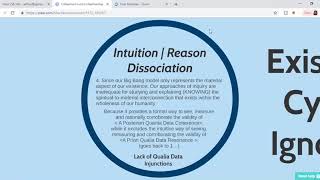
Correct, correct, correct. Yeah, that was before. So, okay, I guess that this comes with this, uh, here. So we have this stated, the potential of us exists, and so Since we do not see a way to capitalize our subjective value dimensions, we're wasting the immense value of our goodness potentials because the view of our emerging goodness potential is excluded from our chronological Big Bang model of existence. Again, lack of existential wholeness. This is where it's very important to bring in the new scientific discoveries to be integrated with the new understandings of consciousness and spirituality. So, and this is the other part: intuition and reasons are dissociated. Since our Big Bang model only represents the material aspect of our existence, our approaches of inquiry are inadequate for studying and explaining or knowing the spiritual to material interconnection that exists within the wholeness of our humanity. This is to say that because it provides a formal way of sense to measure the rationality corroborated by the validity. So what I'm saying here is that science only measures quanta, the quantitative aspect of our existence, and, and we do not have a way to do the same with the qualitative. Okay, and, and so we lack a, we sort of like, we lack a scientific method to validate the information from our spirituality.
Yeah, yeah. I mean, that's— any integral person understands this, that there's no way to measure exactly what you can't see, or there's a different way to measure it.
Yeah, exactly. There's a different way, right? Right, exactly.
Wilbur's point has always been there's other ways of knowing besides Exactly, exactly, exactly.
So, so, so, so, yeah, so then after this exact cycle of ignorance, and so what, how is this crisis an existential condition affecting us all?
Okay.
So we don't believe that changing the world is possible. Even worse, we feel we know it is not possible. So to make this change, we need to overcome some big obstacles. The biggest obstacle to making this urgent change is that, even though there might be a large majority of us aware we need to change, and also that if we were to unify globally at a large scale we could change, within our current world reality we do not see how such large change, global unification, is possible. And therefore, we do not believe in anyone's proposition for pursuing this externally urgent global change. So, although—
well, I would even add to this that because the problems are so overwhelming, yes, and so large and pervasive, yes, that any one person feels powerless or disempowered to make a change even if they want to.
Exactly.
It's overwhelming, it's discouraging, it's disempowering.
Yes, yes, yes. So it's sort of like— okay, I'll go to that because it's also less reflected here. So although there might be many of us aware this problem is threatening our existence, our existence, we do not see or trust any way to resolve them. Therefore, we take this problem as if this is the way it is and there's nothing we can do about it.
Yep.
And again, this is why in regards to the threat of self-extinction for climate change, we remain as a frog in a pot.
Yep, got it.
So here's like the most detrimental effects of our existential conundrum, what I call an existential value dissociation. Externally, we are capitalizing the material value within the shared integrated existential context. Secular scientific materialism, while internally we're not truly correlating the wholeness of our spiritual, moral, emotional, mental, cultural, and ethical values because our predominant worldview of reality, Big Bang model, only represents again this dissociated context— religion, family, morals are breaking, as well as just brings a competition into every aspect of our culture. Okay. So what— why we are not coming together for the sake of our own self-preservation? That goes to what you were saying right now. Again, under our current worldview, we cannot see the wholeness of our existence, and therefore we cannot see how to harness the unified self-identity necessary for exerting the communal agreement required to come together globally. and this is because we do not yet have the existential context for properly studying, testing, and explaining the way our consciousness works. Okay? And I'm going with this, that there is a new paradigm that is now finally— many scientists are already agreeing that The problem of how consciousness emerges from matter cannot be solved because it doesn't— because the existence is not like that. It is matter that emerges from consciousness. And Deepak Chopra has an institute with many scientists already working on that. Okay, so here's what I look at as the, you know, what would it take to break through our existential existential crisis, you know. And this is basically what we're talking about, Brad, what I have outlined, that what it would take, right?
Okay, so now we've described the problem, right? And this is getting more towards the solution, right?
So in other words, this metasanga of luminaries need to deliver these 3 steps. Right? So this is the outcome of all the people that are going to collaborate with Terry and me and everybody. We need to, we need to be able to deliver these 3 steps. So we're saying we need to elicit the social will necessary to change globally. Then that requires one, enough of us becoming aware of why we ought to change, agreeing on what it will take to know the global change is possible. That's the key. And then when we will collectively engage in becoming a critical mass population that commits to learning to change our behavior. Yeah.
Now, we're probably not going to— we're not— what we're really talking about is enough critical mass to take— to lead global transformation. You know, Wilbur himself has talked about it probably would only take about 10% of people that all agree.
Yes.
To actually transform.
Yes.
Or lead to a transformation of the planet.
Right. We're still talking about, you know, a good few hundred million people.
Oh, 10%, of course, is—
Yeah. And there's no movement right now out there that is bringing in, I mean, of this nature of consciousness or spirituality or anything that is bringing in more than, you know, 100,000, 200,000 people. But I do think that everything is lined up to begin to bring into this coalition all the different movements, and I do believe that we can see the context. And this is precisely what I'm talking about, okay? And, and because if we— that— because ultimately it's about solving the core cause of our existential crisis, all right? Because so ultimately what I'm saying, we need this theory because only within the context of such shared understanding we're going to be able to engage in communal awareness sense-making. This is what I call co-realizing the truth that is going to move us forward. Okay, totally agree.
Great.
So then let's understand that the idea we must slowly change is already a mainstream notion. Everybody knows that we're going to change, all right? And so, so, so there is a critical mass ready to collectively engage in learning, to participate and contribute to such global change, in particular since the millennial generation forward. They were born with the— with 9/11. They know that the world has to change, right? So all we need is an agreement on the way we can all know the global change is possible. This is the key, Brad, that we're talking about. This is the key issue that we need to solve, right? So what will it take to know the global change is possible? What would it take to enable anybody, right? You know, so here's the root causes as I see it. The root cause of our existential crisis, the core of our crisis, is that within our current shared view of reality, we cannot corroborate the truth of how essentially we are all spiritual beings.
There you go.
So while we believe we are spiritual, we cannot collectively realize the immense value of our spirituality because we do not yet have a formal shared view of our existence that distinguishes, correlates, and integrates the value dimension— all the value dimensions of our humanity.
Yeah, so true.
Okay, so true, right?
Now, now to me, now you're getting down to it here.
Yes, yes, yes, yes. Thank you, thank you, Brad. Thank you, brother. Because, because this is, this is the insight that why I postponed, uh, the, the presentation that I was going to give you to, to bring this, because, because, you know, this is the key. This is the essence.
Well, this is the, the core of it here. Yes, yes, core, the root.
Yes, yes, absolutely. Thank you, thank you.
Got this, got this part right.
So, so ultimately we all, we're going to— the collision, the purpose of the collision is to answer this question: how are we all spiritual beings? What will it take to make it possible for everyone to corroborate the truth of how we are all spiritual, to corroborate by themselves?
So let's pause here for a second. So my understanding is the members of the original coalition, we can call it, itself will not have to go through this kind of questioning because in a sense they're already there. I mean, they wouldn't come together on this basis without already understanding most of this, right?
Correct, correct, correct, correct. Yeah, yeah.
The question— so really this is a question for the coalition itself Yes, yes, yes, to ask itself, yeah, are we going to let everyone else understand what we are? Yes, we already know and understand, right, right, right, right, right.
So, so beautiful, wonderful. I'm, I'm getting excited, I'm getting goosebumps here because, because now that's, that's it. In other words, in other words, we all, we all already intuitively know that this is the core issue. And we're trying to come up with all kinds of ways to solve it, right? And that's what I'm saying.
The coalition itself already knows this. It's outside the coalition most people don't understand.
Right, right. But there is a reason— there is a reason why all the potential members of the coalition have not been able to create a critical mass following. And it has to do with the idea that we do not have a formal way of explaining this.
Okay, okay, keep going.
This is good.
I just wanted to pause there.
Yes, yes, yes, yes. So, so now here, here's the test when we will have it. So we will know we have such new view of the— for the wholeness of our existence when we can make it possible for everybody— everyone to know how is each of us humans directly connected with the Absolute Original Source of Universal Qualitative Directionality that orients our intersubjective spirituality, subjective morality, intersubjective rationality, and transsubjective intentionality.