Brad & Jeff Intro To New Model
Brad and Jeff argue that current economics pit creators against extractors at every level, from authors to employees, creating inequality. They propose the Creational Value Proposition, a model that merges material value with ethics, identifies eight types of human capital, and flips how value flows through society to benefit creators and communities instead of concentrating wealth.
Chapters
because so difficult for us to fulfill our potential. Okay. Okay. So let's think about it.
Oh, there you are. Yeah, you're back. You got froze, the video and audio froze there.
Okay. Alright, so I was talking about the people with good ideas that they go to work that way.
Jeff, can I interrupt for a second? Now, so this part of the presentation, what's the overall theme so I have a general idea?
Right, so here I'm going to show how this system that we have has produced the income inequality because precisely it is assigned with what I call opposite value gain intentionality. Opposite value gain, basically the system is not suitable for us to fulfill our potential. And there are many barriers to it. Okay, and these barriers are the ones that we're going to break through and solve. So beginning with people with great, with good ideas, millions of people who go to their deathbed with great ideas unrealized. It's the reality that we're in.
Yeah, I think anybody would recognize that.
And people with good ideas and skills, even having, even when you have skills to produce the a good proposal, communication, and leadership. You have to have the salesmanship to be able to sell this, to persuade and convince a team. Absolutely. Even with a good idea, skills, a team, and a plan, then you still have to go and get access to funding to be able to bring this opportunity and capitalize your creative potential, right? This is how difficult— this is like the—
Yeah, well, this is like what Terry is trying to do.
Exactly, exactly. And then we are all— we all suffer through that.
Everybody, yeah.
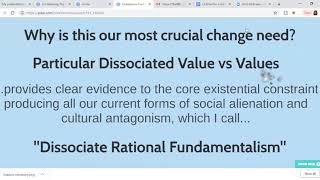
Right. So then, and then on the reverse is that once you enter, so at every level, the relationship are opposing value gains. The author that has some kind of idea that wants to publish their idea, in a way, it has to be— is that he would like the author to have validation from the audience. But if the author shares the idea with the audience, basically, why do the audience need the author anymore? So basically, I'm saying at the stage of an idea, there is an opposing value gain relationship between the author's insights that he needs to protect and the audience inside validation to the idea. So these two things are in opposition. So the author cannot get validation until he shares the idea, but if he shares the idea, then the audience doesn't need the author anymore. Okay? So then at the entrepreneur-investor level, the relationship is to capitalize an idea, an entrepreneur needs to get funds And the investor is going to get funds in exchange of equity. But the investor might be saying something, okay, if I have your idea, why do I need you? Or, you know, you need to prove to me that this idea works and by having made sales. It doesn't matter what is your potential. What matters is how much have you sold. So again, a tremendous barrier, okay? And it's money-centered. Money dominates. Money trumps here the potential entrepreneur. And again, so this is at the startup level, the opposing value gains relationship between entrepreneur idea potential versus actual seed from the investor. These are opposing. Then when the entrepreneur gains the seed capital, becomes an employer, and is able to offer labor to the employee in exchange for salary, But these two things are also opposing. The employer wants to pay a salary and, and for the labor that the employee is producing. Again, this at this level, the relationship at operations are opposing value gain. Employer labor cost versus employee job salary. Yep. And they're in opposition. And then at the producer-consumer level, to succeed, the producer wants to profit from winning competition and and supply the competition. And the consumer wants to simply satisfy the quality at a proper price. And again, the— this— this too, uh, the producer wants to produce as— as pay as little for the production, and the consumer wants the highest quality. And again, these are again opposing value gains. So at every level there is opposing value gains. in the system that we have. And that's why we have the idea that those who own the system are really wealthy, those who work for the system are being squeezed. Okay? Yeah? So this is the system that we have, and this is why, you know, we— you already saw this. So the root of the suffering that we are experiencing— we're experiencing a crisis, and there's suffering by this pressure to work around it. Highly good while wasting the best value of our goodness potential. Because the reality that we have cannot measure this value, so our goodness potential stays unrealized, as if non-existent. This is something we saw the other day, but basically so far I've shown you how that is the condition. So, and this is because we don't have an understanding of the imperfection of the material and the spiritual. So what needs to change? We need to change the way we're realizing the value of our existence. This is something that you saw before, but more specifically, change the value of how we realize the value of our money from what to what. And what I'm saying is a particular dissociated value versus values. Here it's talking about the idea that Today, when we use the word value, everybody knows that we're referring to the material sense of value. But when we use the word values, well, there are many different ways of addressing that, and we're not in agreement about what are we talking about when we say values. So we need to change that. So that's, that's where we are right now. So, uh, but why would— do we need to change that? Again, because this dissociation of value and value is what points to the evidence of what is causing what we talk about, the dissociated rational fundamentalism that we talk about right now. And it's basically reflected in this idea. So, religious— different types of rational fundamentalism. Religious absolutism: only my religion is true. Cultural antagonism: only my values are valid. Scientific physicalism, only the physical is real. Economic materialism, only the material has value. These are the effects of our rational fundamentalism, because we don't have a reality that integrates value within value, which is the solution that we're going to provide.
Yeah, Adi Da calls the aggregate of those four, those four things you just mentioned, philosophical orientation of scientific materialism.
Exactly, exactly.
That's really the aggregate of those 4 points right there.
Right, right. And what we were talking about, the philosophy of scientific materialism. Exactly.
Thinking that you've taken the scientific method and made it a philosophy.
Correct. Disconnecting your intellectual right versus wrong rationality from the true essence of intelligence, which is a connection to the Divine. Yeah. All right. So, this is basically how it looks, particularly, social value versus values. We have exterior objective sense of material value, and the internal values, cultural, social, ethical, mental, emotional, moral, and spiritual. So, for what we want, okay, we want an integrated, a holistic integrated value within values. Which is the framework that I have constructed based on—
Is it the hierarchy of needs? Is this the Maslow pyramid here?
Correct. Yeah, yeah. On the left? Yeah. And so, so, so this spiral is basically the representation of the B-values for self-actualization. So, so it's, it's —continuation of that. So, right, so, okay, so, so basically the way this, this works is, let's look at it again. We have all the different perspectives, extended more perspectives. In, in awkward, you have 4 perspectives. Here I have extended to 8 perspectives because I have distinguished the 4 perspectives of agency inside the first 4 intervals and the 4 perspectives of communion in the outer 4 intervals. So that— Okay. —basically, we begin at interval A1, and that's where we get— that's where the spiritual or the intuitions emerge from, intra-subjective, prior to subjective. So that's the ground, the ground— what grounds all of us. From there, we go into moral goodness instincts, The moral goodness instincts then emerge into emotional love feelings. From there, it grows, it keeps evolving, keeps emerging into moral freedom actions. And that, those are the 4 intervals of the particular human perspective, the agency. And then we go into the other interval, 3, 1, which is the intra-subjective, and for there the value is more reason, more at peace, I mean mental peace, that manifests through reasons. Then we go, we merge into ethical beauty intentions, transcendental, and then we go for social justice interactions, and then we come down into cultural transactions, And these 4 intervals are within the Holonic sense of Humanity. So, a Human is a particular perspective, and Humanity is the Holonic perspective. So, this is to say, you know, what Ken Wilber says, you know, a Holon is a whole that is a whole of a whole part of another Holon. Well, basically what I'm saying, every Human being is a whole part of Humanity as a whole. Yep. And so, but then the question that we all want to resolve by synthesizing: are these, for us humanity, our highest values? This is what I claim. And if they are not, then we have an opportunity to corroborate more insights that then will help make this more accurate. But these are the basics.
By the way, I think us humanity, you should always be— have a hyphen there. That's humanity. That's one word.
Yes, yes, I agree with that.
And you've done— I've seen you do it. Yes. Now, in this spiral here, what happened to the B level? You went from A level to C level.
Um, I went from A. The first, the first 4 intervals are A for agency and C is for communion. Okay, all right. And all the values are being values. Yeah, okay.
See, I wanted— it didn't make sense to me until you just explained that.
Okay. Okay. All right. Okay. All right. So, again, this is just, you know, something similar to, or basically what is reflected in the spiral. Are just the part of our self-actualization. All right?
The self-actualization?
Yeah. So, the project that we are launching is the Consciousness Alliance, is for conscious people to correlate the communal consciousness capacity necessary and sufficient for regenerating our communal wellness, one community at a time. And these are the three capacities The first one is recognizing our communal unity. The second is activating our communal sense-making, which by the way, this tool is what is going to enable us to begin to create this communal sense-making. To be able to, to be able to begin to see how we are all connected to the divine, and we all are oriented by chaos to harmony, and we all can begin to construct construct a new understanding of our agency and community, to begin to realize the value of our existence as a whole. And then ultimately so that we can begin to really realize our emerging goodness potentiality and create that world that I talked to you about where everybody is provided from royalties of their creativity. Okay, so for that we are providing Okay, internet connections. Are you there? Let me know when you're there.
No, no, I can hear you now. Okay. Okay.
So we're providing a new model for realizing our emerging creation of value at This is what I'm calling Purpose-ness for Realization. And what the functionality is, a distributed shared purpose role for everyone to co-realize their unique goodness potentials. And we're basically identifying 8 types of capitals that we're going to be able to to capitalize into the system. There are, this way, these are again the same attributes, but now it's specifying the, I said before spiritual insights, the channel of the spiritual insights is intelligence. Moral virtues, the channel of moral virtues is character, one's character. Emotional intelligence is health, material skills, the channel for material skills is competence. The channel for mental ideas is the intellect. The channel for ethical decisions is creativity. The channel for social capabilities are relationships. And the channel for cultural roles is systems. So this again, it begins to—
So what's in the title there? You say current-dash Cs. What's that?
Yeah, this is relating to a new way of addressing this type of capital that is also something that Arthur Brock, which is the founder of Holochain— Holochain is going to be one of our partners, yes— and is a technology that is coming after the blockchain. And he has identified a new way of creating systems that mimic nature. And what he— the reason why I put it like this, because what I'm referring to, why I'm referencing, these are the currencies of human value. But in essence, the idea of currencies is about seeing The current of value as it emerges. So, these are currencies, but they emerge as a current. The first one, it orients the second one, which orients the third one.
I see, so it's a play on the word currencies. Correct. Okay, all right. That's not clear from this, and if you don't have any—
Yeah, yeah, yeah. Or whatever. Yeah, I did it, I did it for somebody else and they, they got it and they liked it. Somebody who understands. Yeah, okay, yeah, all right. So again, this is, this is the framework, right, that has different aspects of our behavior. And this here, the Holonic Self Embodiment— Spirit, Consciousness, Soul, Organism, Mind— Awareness, Willingness, Consciousness. This is basically the way that I'm plugging in here the Great Chain of Being that is so important. Okay? And these are the perspectives: Individual, Singular, Internal, Particular. And look how Individual Agency is correlated with Collective Communion, Singular Agency, Plural Communion, Internal Agency, External Communion, in particular agency, with Holonic Community. Okay? Okay? Just to— so you can begin to see that this— and these are the attributes that I'm claiming. These are the meta-values, meta-principles, and therefore meta-purposes for us humanity as a whole. And— spiritual order, moral goodness, emotional love, material freedom, mental peace, ethical beauty, social justice, cultural joy. And a way of organizing— this gives us a way of organizing. Let me show you how we're going to implement that into a system. Okay, so here's where we begin to see the model, which I call the Creation Innovation Core Realization. It's a new value core realization model and method for enabling a more purposeful existence. Synergistic, and systematic capitalization of the value of our emerging goodness potential. All right? Yeah. Let's think about the way these attributes emerge from the, from the agency perspective. Again, think about agency as the perspective of being a player and community as the perspective of being a team, right? So as agents, we organize the fulfillment of these attributes in the following way: intelligence insights are for fulfilling spiritual missions, character virtues are for fulfilling moral purposes, health balance are for fulfilling emotional needs, and competence skills are for fulfilling material tasks. Okay. Right, this is as an agency, as player. And then in communion, as a team, organizing the fulfillment is that intellect ideas are for fulfilling mental objectives, creative decisions for fulfilling ethical visions, relationship capabilities are for fulfilling social milestones, and system roles are fulfilling cultural roles. So now, this is the breakthrough in terms of a whole new model when we combine these two and synergize all this new understanding. This, in essence, are the four services that the ecosystem is going to provide. In other words, the technology is going to provide a way to create networks, to develop these communal capacities through these services that implement these functions that I'm going to begin to show. Okay, okay. First one is, is about synthesizing collective intelligence. So synthesizing intelligence insights within intellect ideas. This is to say that there are many insights in the former expression of everyone, but what we're going to do is we're going to synthesize all the different types of insights into new intellectual forms that are going to basically transcend the limitation of the original presentation but include their insights. So therefore make it more valid.
Okay, so for example, when you talk about coming together in this umbrella coalition, uh, this meta-sanga, to get this group of, of advanced thinkers together in a room, right? And you say, okay, let's, let's get together with all our best ideas and see if we can combine them into a a format or a way that transcends—
Bring them into coherence, you know.
Yeah, with each other, with one another. Yes. So it creates another thing that transcends all the individual.
Exactly. Okay, got it. All right. Right. And these are designed for fulfilling our spiritual missions from pursuing mental objectives.
So this, in effect, would be one of the first things that a coalition would do.
Yeah, this is actually the first thing that we're going to do.
The first, yeah, no, it makes perfect sense. You're, you're, you're, there's a good logic to all this. I'm agreeing.
Right, exactly. So, okay. We'll be bringing the top thought leaders relevant to helping humanity evolve into the next level of civilization with a new paradigm, and we're going to synthesize their collective intelligence, and this is what it means. Okay, so we're going to implement that through a website, through an initiative. Sure. So the next functionality that the ecosystem is going to provide is correlating creativity visions. Correlating creativity visions is correlating character virtues within creativity visions. So this is designed for fulfilling moral purposes, for making ethical decisions. Right? And by the way, we're going to be making ethical decisions based on this new set of values that works for everybody. All right? So I'm going to keep on going. The third one, the third level, the third type of functionality is synergizing relationship capabilities. So we synergize fitness talents within relationship capabilities, but this is designed to fulfill emotional needs from reaching social milestones. Here, let me give you an example. Imagine that we begin to organize everything we do in terms of what is an ideal life. An ideal life, let's say, it says that at every stage of life You have particular goals that you should have accomplished if you're going to live the most ideal life. So we make that like a standard. So this goes in between the stages of your life become the social milestones. So we're going to organize everything that we do in the sense of beginning to help everyone achieve what we have collectively constructed as the most ideal life possible. And we are going to synergize our capabilities in the relationship so that we're going to form teams. Basically, we're not just going to form teams with anybody. We're going to form teams in which our capacities are synergistic so that What one person can do with another is going to be better than doing it by themselves. Yeah, it's a big principle here. And then capitalizing system roles. Now we're going to create systems and, and, and we're going to enable the capitalization of the role instead of the jobs. So this is how we're going to capitalize competence skills with system roles. It's a science for fulfilling cultural goals by performing material tasks. Okay, so let me show you what it— how is the flow of these attributes right now in the current systems. Right now we have that we begin with an idea. Entrepreneur begins with an idea. And gives it to the investor, and the investor gives the seed money, okay? And then from that seed money, the entrepreneur becomes an employer that produces a job and finds an employee, and the employee gives back the labor to the employer entrepreneur, and then they become the producer that way. And the producer provides the supply to the customer, and the customer, you know, pays for the demand. Right. Yeah. Are you there? Yeah, yeah, sorry. Right. And then, but then, but then what is not happening is that we do not have a way for authoring ideas and provide this insight of these ideas to an audience for validation, for value and validation of our ideas. And because we don't have that in the system, that's why— that's why we have opposing value relationships at every level. So entrepreneur versus employer, employee versus producer, and this is what I call a dissociated rivalrous supply chain competition, which is again based on outside-in survival, money-centered, productivity-based. So what I'm saying is that we are lacking that, that process in our economic system, and because we're not seeing the value comes from inside, right? Yeah, let me show you how. So this is basically our current broken reality constructed through business jobs, business, business jobs. So I was trying to fix this, but, but I didn't, I didn't finish on time. But let me explain to you anyway. So the new model, Creational Value Proposition, is about aligning the intentionality of value gains. So we begin by synthesizing collective intelligence, like we just saw, and in which an author provides insights to an audience for valuing. And that then, uh, the audience also becomes investors that give seed to an entrepreneur, which is the same author, and for the idea And at the second level, correlating creativity visions. So we are now, we are now basically implementing these two levels, these two steps. And what I want you to observe here is that now we are beginning to contribute insights and contribute seed money to, in an order that's completely different than before. And because we are beginning at the core where, by synthesizing our collective intelligence rather than competing on everything. So now that enables the, an employee, which is not an employee, it's somebody, the co-reallizer is gonna contribute the labor as well. And that's how, by contributing the labor, we make the entrepreneur an employer. And now we close that loop, and the employer then provides them with a job. But we provided— basically, by investing our labor, we get the job once things are working out better. So this is how we're going to— at this level, we're going to synergize. Relationship capabilities. And then also the flow of demand comes first because we have already validated that we want these products and services. So it's like instead of spending for consuming things, we're going to, we're going to begin to budget what we want and then Once we have budget what we want, then we're going to go and produce it. And it's totally flipping the flow of these attributes. So we provide demand, and then that's how we produce, how the employees become producers, and by capitalizing system roles. Okay, I need to make all this more clear, but basically what the system does, the system creates co-relationship roles, and people take those roles and then begin to contribute their labor and begin to contribute a little seed for producing this, what needs to be produced. And this is how we shift from from jobs that are produced after having invested to roles that are produced through contribution of our goodness attributes.
Yeah, okay, I got it.
So then this becomes an integrated synergistic demand-driven corealization, which is inside-out fulfillment of people-centered Creativity-based, which is for the next emergent reality constructed through purposeless roles. So basically, the, the shift here between business jobs and purposeless roles is what is shown here, and this is what we're going to implement. We're going to facilitate a global value co-realization paradigm shift By evolving our entrepreneurship. We're going to evolve entrepreneurship from rivalrous opposing value gains to synergistic aligned value gains. We're going to move from venture capital funding to creation of capital co-funding. Of centralized corporations, distributed cooperatives. Optimized for money-centered competition Optimized for people-centered core realization. Sweet. Nice. Yes, that's a nice slide. So here is what we are going after: becoming a world in which everyone fulfills one's unique potential towards improving life order for all. Yeah, I like that phrase. It's great. So what we're going to build an ecosystem, which I call Communal Wellness Regeneration Ecosystem. So we're going to build a system of user-owned platforms based on cloud services for developing and managing discovery and creation, communal life improvement cooperative roles, designed around 3 creation, innovation, or realization principles. This is going to give more clarity to what I was mentioning. So people participate to generate wholesome livelihood from their contributions. Again, this is the idea of generating livelihoods from royalties of their creative insights. Okay. Participate, contribute, result from fulfilling their unique