Brad & Jeff Recognizing Our Goodness Potentiality
Brad and Jeff argue that everyone shares one purpose: expressing their "goodness potential" to improve life's order. Most jobs reduce this to money. They offer four questions to clarify your goodness and a framework mapping it across spiritual insights, moral virtues, skills, and social roles.
Chapters
That way we give us Are you there?
Yeah.
Okay.
You're seeing my screen, right?
I am. What is life's purpose?
Okay.
So, this is a core insight of the research. I'm saying everyone's life purpose is the same, and I'm gonna demonstrate why I mean that.
That'll be controversial, but I like it.
But yeah, we'll show you why. So let's say, to fulfill one's potential towards improving life order. But here's now why this makes sense. Everyone's potential is unique.
I like that.
Everyone's potential for improving life's order is unique, right? Okay, so, so here, here's now the thing. The thing is, the problem is that for the majority of us, the way we earn our life, our living through daily work, is not conducive to such fulfillment.
Well, you will get no argument from anybody on that one, right? How about you?
That's, that's right. How much of your potential are you currently realizing through your daily work? So by the way, this is, this is kind of orienting the person to begin to— that's hardly any, right? To begin to, to have the sense of the experience of what we're referring to here. All right, so right, making it very personal. Yeah, why, why do you do what you do? The work you're doing is part of creating products and services. Products and services deliver benefits to customers. Customers pay for these benefits, and you get paid for what customers pay. But then, is that all what your goodness is for? Is that all what your potential is for? So, how about the value of your goodness potential? It's been reduced to getting paid for what you're doing. So, how about the value of being conscious, purposeful, and creative? How is that compensated for? How are you compensated for the value of investing your best— We don't have any campus.
Okay, all right.
Make sure it's stable. Are you there?
The answer to that for most people would be nothing.
Nothing. Yes, nothing. Exactly. And there is a reason for it. So, so what are the different value attributes that emerge through your knowing, being, doing, and having, which happens concurrently? Well, let's expand our awareness.
Okay, good.
So let's expand our awareness. So we're going to go through the orientation so people can can see in their own awareness about this, this, this, uh, understanding our emerging goodness potentiality. So these are 4 questions for expanding our awareness of how and why our goodness emerges from within us.
Okay? Let's get it back to Max.
So first question is, to whom does your goodness belong? So ask, so observe how, what you feel when I ask you, to whom does your goodness belong? Let's continue. The second question is, where is your goodness coming from or to? What does your goodness consist of? And what is your goodness for? The majority of us are, are not quite clear about any of this.
I don't think anybody's clear about any of that.
All right, so okay, let's look at it. These are 4 Awareness Expansion steps towards co-realizing our Emergent Goodness potential, making it real for all of us in the same way.
All right, so to whom does your goodness belong?
Possible answers: A) Absolute Original Source, B) you and me, or others? I will say others. Well, let's say—
wait, is this a multiple choice?
Yes, this question. Yes, yes. But, but let's still see how they come together. So where is your goodness flowing from onto? Again, so if we go back here, it's— there's 3 choices: absolute source, you or me, or others. So in this one is where is the goodness flowing from and to? Or again, original source to you and me, or from you and me towards others, or from others towards you and me. And this is actually how it happens. From original source into you and me towards the benefit of others, emergent. From Source into you and me, towards all. And this is the great new understanding and the principle. The emergent flow of our goodness includes and transcends you and me. It's emergent, it's emergent from within each and every one of us, from the Source, and it is to be fulfilled towards the benefit of others.
[NOISE] Okay?
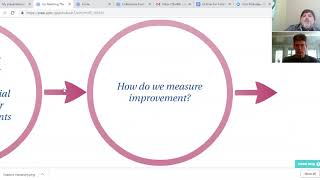
Right. Now, so what does your goodness consist of? Here's where the new tool, the new cognitive tool that I have constructed based on Ken Wilber's POCO has informed me of this attribute. These are not invented by me, these are actually derived from applying this new framework, this new theory. There's two types of attributes: individual agency attributes and collective communion attributes. Remember, think of individual agency as playing a game as a team, as a player, and collective communion playing the same game as a team, right? So those are the different attributes. So the core, the most— the first one is spiritual insights. —and then the collective correlates to mental ideas. The difference between insights and ideas is that an insight is an intuition, and the idea is a form already in language. Moral virtues, ethical decisions. Emotional talents, social capabilities. Material skills, cultural roles. So if you think about it, This is the way our goodness potentiality manifests into the world, through these attributes. And they manifest— material skills manifest through our actions, emotional talents through our emotions or feelings, moral virtues through our instincts, and spiritual insights through our intuitions, our mental ideas through our reasons, our ethical decisions through our intentions, our social capabilities through our interactions, and through our cultural roles we do transactions. Okay. So this is a whole new way of understanding the 4 attributes of our goodness potential for agency and how they correlate with the 4 attributes of our goodness potential in community and how they manifest into the world. Right? So, and then what is our goodness for? Our goodness is for doing good, or is to cause more goodness. Our goodness is for affecting more goodness. Our goodness is means that already exists as our potential for causing goodness. So this is a view that Fulfilling our life potential is fulfilling our potential for doing good. That's what it is. All right, so again, what are the different value attributes that emerge through your being, knowing, doing, and having? Now this begins to look familiar as the four quadrants, and, uh, but in a different way because it's about correlated to individual agency and communion. So emerging goodness attributes in living, the four streams of living. So intuitive and instinctive is the relationship between insights and virtues. So intuitive insights trigger our instinctive virtues, which then trigger our emotional talents, which then trigger our active or actual skills, activity, which then after that, then we bring in the rational ideas and observe how insights and ideas are about knowing, just the same as then virtues and decisions are about being, and emotions and interactions are about doing. Balance and Capabilities. The roles and the skills are about having. This is the way that those attributes emerge in the spiral, right? And the different types of ways they manifest concurrently through being, knowing, doing, and having. So how do we measure the emergence of goodness through living? So how do we measure again the emergence of this? There is a qualitative directionality scale. So these scales are for knowing right versus wrong. So there's no question that the idea that inequality goes in the direction of wrong towards right, not the other way around. And in being is backwards was good. Again, qualitative directionality from bad to good and not the other way around. And doing, failure and success, and having. These are the scales, but then I'm going to correlate how these scales work in a different way. Okay. Are you there? Okay. Yeah. Okay, so what is our goodness for? Again, our goodness is about our potential for affecting more goodness. Already exists, it's a being potential. Our goodness already exists, it has the potential for affecting more goodness. Our goodness potentiality is our combined emerging goodness potential. Affecting our life improvements. But how do we measure improvement? That's the other part, which is, you know, how do we measure improvement? We recognize improvement as the realization of a positive change in order. But what is a positive shift in order? A positive shift in order goes in the direction of chaos towards harmony. An improvement is a shift in order in the direction of chaos to harmony. So now let's look at how that, at the spiritual level, is what enables us to make meaning and realize Truth. So chaos to harmony, that's Qualitative directionality is the scale that orients our intuitive knowing. This is what grounds us to the Divine, our intuitive knowing, which is what actually— this is why we have this thing that we call common sense. It's operating at the intuitive knowing level and it's oriented by the direction of chaos to harmony. Because that is what orients our bad to good instincts for being, through the channel of being. And that is what orients our pain and pleasure directionality for our emotions, that emerge through doing, which is what orients our loss to gain actions that we have in having or in exchange. We then go all the way back to orienting the right versus wrong, rational, knowing. What I'm saying here is that this thing that we call rational knowing is not possible. Without the intuitive knowledge that grounds everything. There is no possibility of rationality, right versus wrong, if it's not because it is emerging from loss to gain, bad to good, pain to pleasure, and ultimately all the way down to chaos. So it's like Wilbur's, the combination of eye of mind with eye of spirit. Exactly, exactly, that level. That's what grounds us, that's what anchors. We're not the people who are intelligent to have our own way of deciding what is right and what is wrong. There is a right and there is a wrong because everything is grounded in chaos and harmony at the intuitive knowing level.
Well, in fact, remember when I brought up— the last time we talked, I brought up integral world? Those guys are only high of mind.
Yes. Without high of spirit. Exactly.
Exactly. And it makes all the difference. They're justifying scientific materialism and we can't— everything else is a mystery kind of thing.
Right, right. And this is where we are right now. We are all suffering from rational fundamentalism. Believing that— Rational fundamentalism, I like it. Believing that we have the capacity to know what's right or wrong, therefore we are the ones who are intelligent, and if we are more intelligent, we are more right than you. And, you know, we have gone from Descartes' idea, "Cogito ergo sum," "I think, therefore I am," to "I think, therefore I'm right." That's good.
Yeah, no, it's exactly, that's exactly how it is.
Right, and this is where we're stuck. So, so we need to recognize that it needs to be grounded. Yeah. And this is basically what we're showing here. So, so we recognize order improvement because we experience, experience is the interior experience of the harmonious sense of resonance. And this is what I'm referring to, Brad, is that Everything I just said that you liked is because you're experiencing the resonance in what I'm saying. What I said resonates with you. That sense of resonance, that is the phenomena of qualia, orienting that what I am saying helps you move from chaos to harmony, helps us make better sense of more of everything. So this is basically the discovery here. Qualia is the phenomenon that provides the quality, the universal qualitative directionality that is in alignment with the will of the divine. Let's say it that way. And we simply recognize it with this, the qualitative sense of resonance, of knowing things that are moving from harmony to get more Truth. Okay? Okay. All right, so what are goodness attributes? Goodness attributes are any attribute conducive to the improvement of life order. How can we consciously construct a more ideal reality possible? By collectively realizing the vast value of our emerging goodness attributes towards improving life for all, which is the purpose that originally I started with, right? Yep. So it's time to shift from getting jobs to get paid from doing meaningless work to being purposeful at playing roles in co-realizing life improvements that benefit us all. So that's a shift. Exactly. And that's what the new ecosystem is going to provide—ways to shift from jobs to roles. And basically, that's—
let me stop here for a for a second, so that—