In this live Q&A, Jeff Quintero asks Nassim Haramein how the conventional three‑state conception of time (past, present, future) can be replaced. Haramein argues that time does not exist fundamentally; instead, memory embedded in the superfluid, superconducting fabric of space‑time serves as the primary structure. He describes the universe as a fluid where moving objects leave spiraling information trails, analogous to vortices, and where past information persists as entangled patterns in the space‑time medium. This leads to a view of the arrow of time as a manifestation of fluid‑dynamic vorticity and deterministic evolution of Planck‑scale oscillators. Haramein further explains that protons (and all matter) are holographically entangled with the entire universe, forming a fractal information network that feeds back and forward across scales, potentially giving rise to self‑awareness. Jeff connects these ideas to his own philosophical work, proposing an integration of Ken Wilber’s integral theory of consciousness with Haramein’s unified physics and Roger Penrose’s quantum consciousness, suggesting that the collapse of the wavefunction marks the onset of the present, while potentials constitute the future. Haramein acknowledges similarities but notes differences from standard Copenhagen interpretation, emphasizing entanglement and complexity growth rather than collapse. The conversation also introduces the “omni‑central” concept, claiming each Planck element within an individual is a center of the universe, reflecting a fractal, holographic cosmos. The dialogue ends with plans to further collaborate and bring together Haramein’s research with Wilber’s work.
Chapters
hardly anybody's left today, is at the very end of this call, Nassim's going to do a little visualization for us, which is really his opportunity to kind of share how he does what he just said, right? Like tapping in for a moment. So stay on, and that'll be towards the end of our call. All right, William Brown, we still have a little bit more time. We have like a half an hour, maybe 20 minutes, because we need to have our ending, but Got time for a few more questions.
Well, there's no shortage of good ones. So let's try to get as many in as we can, I guess. This one is from Jeff Quintero. And Jeff asks, as there is no time, what replaces the three states of existence— past, present, future— within what is known as the arrow of time?
Ask that again. So there's no time, uh, there's only memory, only memory in the structure of space, right?
That's probably the answer right there. But, but, uh, what replaces the three states of existence? So like, uh, you know, we like to think that there's a a past out there, in the present, and there's a future ahead out there. What replaces that conception of an arrow of time if there is no time?
Right, well, that's the thing. It's not replaced, it's abandoned, meaning there isn't the arrow of time that we experience, like the evolutionary structure that we experience is really related to the position of things in the space, right? The position of memory in the space, the imprint of memory in the space, and the memory, because it's in a superfluid and superconductor, the memory, while it's— you're able to remember because it's linked to you, it's still, you know, entangled with you, those bits of information on the structure of space. And so you're really kind of like— and so you're really kind of saying that the past, the past in that case is more like just information that's still present. yeah, on the structure of space in those coordinates in space-time. So like to give you a— so now all of a sudden the arrow of time is linked to the mechanical functions of the universe. That is, you know, think of you going around the world, you know, as the Earth is spinning, and then as the Earth is going around the Sun, it's making a spiral through space, right? Because the Sun is moving Imagine that you're, you're leaving a trail of information along that whole spiral, and it's connected to you because it's entangled with you. All these bits of information are connected to your frequency experience at this moment, right, in which you're placing the information in space-time. You could think of it as like making a disturbance disturbance in the fluid, like as you move your finger in a fluid, you know how the particles all spiral behind your finger, right? You can think of that being the information you're leaving entangling with you as you're moving through the fluid structure of space-time, right? And, and that— so that means that the reason why you can remember is because you're actually accessing information on the structure of space. And your present is actually the information, you know, that you're leaving in that moment, but it's influenced by the past because there's these eddies that are, you know, still producing, you know, their effect on the present. And then you can imagine that you can make some predictions about what the eddies are gonna do in the future, right? You can— you could run the mechanics of what's happening forward and see a very specific evolution Right, that would— so it has some deterministic function where it's going, this whole vortex thing that you are, right, of all these billions of Planck oscillators that are like doing their thing. And even physically you're leaving some of these vortices behind, right, because You know, you're shedding, you know, trillions of atoms every second because cells are dividing at the rate of like a million cells a second. And, you know, each cell is made of 100 trillion atoms. So, you know, you're leaving stuff behind even on the physical plane. And so basically, this arrow of time and this evolutionary arrow is really the description of the vorticity or the fluid dynamics of space-time, you know, learning about itself, information transfer across this whole thing, right? Whether it's for a planet, for a star, for a universe, or for an individual on a planet. Does that answer your question, Jeff?
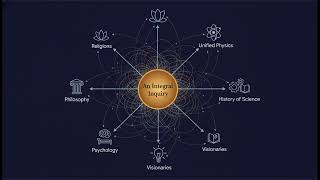
Yes, thank you. It answers to me how you view it. I'm a philosopher and I actually am working with a new theory that I have conceived, a new theory of value, and I have expanded Ken Wilber's integral approach. All right. And I am actually, I am Putting a proposal together for you to be able to integrate Ken Wilber's work on consciousness with your work and Roger Penrose's quantum consciousness. And thinking that the idea that the present, what we call present being actuality, begins at the collapse of the wave, from wave to particles, and then from there you have— I think that you call that singularity. at the quantum level. That's— let's say that begins the present time. Before that, we can say that's the future, which are the probabilities, which are the possible and the potential emerging into the singularity, which is the collapse of the wave. And then what we are experiencing as this passing of the time is— is the potential energy emerging into actual And this actual, that experience of potential to actual is what we then interpret as this arrow of time, and which we of course experience as, in memory, as this time, because this is the experiences that we're having. So, I look at it from that philosophical point of view. And I think it complements very well, it complements very well what you're doing, and I wanted to understand how you saw it. which is very difficult for me to— very difficult for me because I do not quite understand the Unified Physics from me being part of the whole Universe, as the Universe is rotating and spinning, I am with it as well. Because all of this information is also emerging through me, and then information becomes light and it becomes energy and it becomes matter. So my experience, right, is basically, my experience is just simply part of being a whole part of whole humanity, which is all part of the whole Universe. So, I look at the world as a holistic structure. So I wanted to understand how you saw that and I look at your answers on the idea of time and And I think what you're doing with this understanding that we need to replace time with memory is one of the most breakthrough understandings so we can integrate consciousness, spirituality, and the physicality of our universe. So, huge reminder.
Yeah, you know, the important part to remember is as You know, is that it's not a linear function. That is, nonlinear functions are involved because when you look at the protons that you're made of, right, your current experience of matter, you find that it's entangled with all the other protons in the universe. That is, the mass of the universe is present in terms of Planck energy, in terms of information, in each proton. So it's holographic, right? So, so your evolutionary path through space, your, you know, arrow of time through space, is really an information network that you're feeding to the whole, which is feeding you back your experience, which you're feeding back to the whole, you know. And that feedback feed-forward structure, right, is what's driving all this evolution at all the scales. And that's why eventually the system can get— the little vortices can get so complex and they'd be able to like have so much information crunching capability that it becomes self-aware because feedback is already in the mechanisms of the structure of space-time. And the only difference between what I'm saying and what Ken's saying and others is that the mechanics are not the standard, you know, Copenhagen interpretation of the collapse of the waveform. It's a little different than that, and, you know, but it's similar. It's just that the way it's imprinting on the structure of space is not under the collapse function. As, you know, as was pointed out by Susskind, it's not, you know, there's nothing in the equation, even in the standard interpretation, that says that it's collapsing. It's basically saying that it's entangling, it gets more complex, it's entangling with more and more as it moves forward, it gets more complex.
Great.
Kind of a follow-up.
All the information that is emerging from within me, meaning from within my organism, my cells, my molecules, my subatomic particles, all the way to the Planck's. Basically, I am connected to the source of the infinite at the Planck level, when mass begins, which prior to that is the source of all the information. So at that level, information begins to emerge at the Planck level, and that's the first boundary to— location that I have, but then all that information merges through, through everything that is part of me, and then also have a boundary, a local boundary that is me as an organism.
That's right.
Correct.
Is that view correct?
Yeah, exactly. It's the collective behavior of all that information. 100 trillion cells plus, multiplied by 100 trillion atoms that makes each cell, multiplied by all the protons and electrons that makes each atom, multiplied by all the Planck's that makes each of these particles. And, you know, and that's all the information network, right? That's, that's Transferring at each level of the scale, and as it transfers, right, it produces different physical phenomenon, right? Atoms that gets together that makes molecules, that gets together that makes cells, that gets together that makes organs, that makes, you know, you as a collective behavior of all the cells, right? They all organize, they all function together. It's not just like a big mess of cells. Cell, right? You know, that whole— that is all structured by the information network that's emerging from the vacuum that eventually you call you.
And then if we continue with that, then me as a whole part of humanity as a whole, right? I am basically a whole on, whole part of Humanity as a whole, and then this reality that we have constructed, which we have organized in the past, present, and future, is simply because we're interpreting this information. But—
That's why I was mentioning the mechanics of, you know, you in the world, in the solar system, the solar system is part of the galaxy, the galaxy part of the superclusters, and so on. And so on. So it's like a fractal information network that you're embedded in.
And then this also corresponds with the idea of that being all spiritual and that the source of spirit is everywhere, is because we are connected, we contain all the information already. and that this, at the level of the Source, at Planck level, there we are entangled. So everything is entangled because— so the concept, I come up with the concept of omni-central. So I am the center of the Universe.
Right, that's right.
As every Planck that is within me is at the center of the Universe.
Yeah, every scale You know, it's a fractal center of universe. So, basically, that's very good. And, you know, it— when you look at it this way, as well, then you can understand why, you know, so many masters talk, you know, when they talked about spirituality, they talked about going inwards, you know, and going to the source. and literally the source of information is what actually produces your physical world and your physical existence. So, you know, it's nothing different than what was said by all these people. It's just that nobody— I mean, in general, people didn't write the math for it. When you— and/or write physics on it. When you write physics on it, it actually works. It does the right thing. It says the right thing. It comes up with the right answers. So it's remarkable, and it modifies the standard view of physics dramatically.
Thank you so much. Thank you, Jeff. Thank you so much. Look forward to hearing more about your work and Nassim, you know, this is not the first time that we've heard about somebody applying your research work and Ken Wilber together. I know we were contacted by Wisdom University hoping to bring the two of you together in a discussion with their community. Seems like maybe there's something there before we lose Ken from this world. I know his work will continue on, but I think that might be something for us to look into. It keeps popping up.
I would love that. That would be great. Yeah, we got to make that happen.
Yeah, I'll follow up with them. I think that's an important— it's kind of like one of those legacy pieces, I think, that we need to bring in together.
Absolutely. Another question, William? Do we have time?