#69: The Ultimate Guide to Trusting Your Intuition (Nurse Edition)
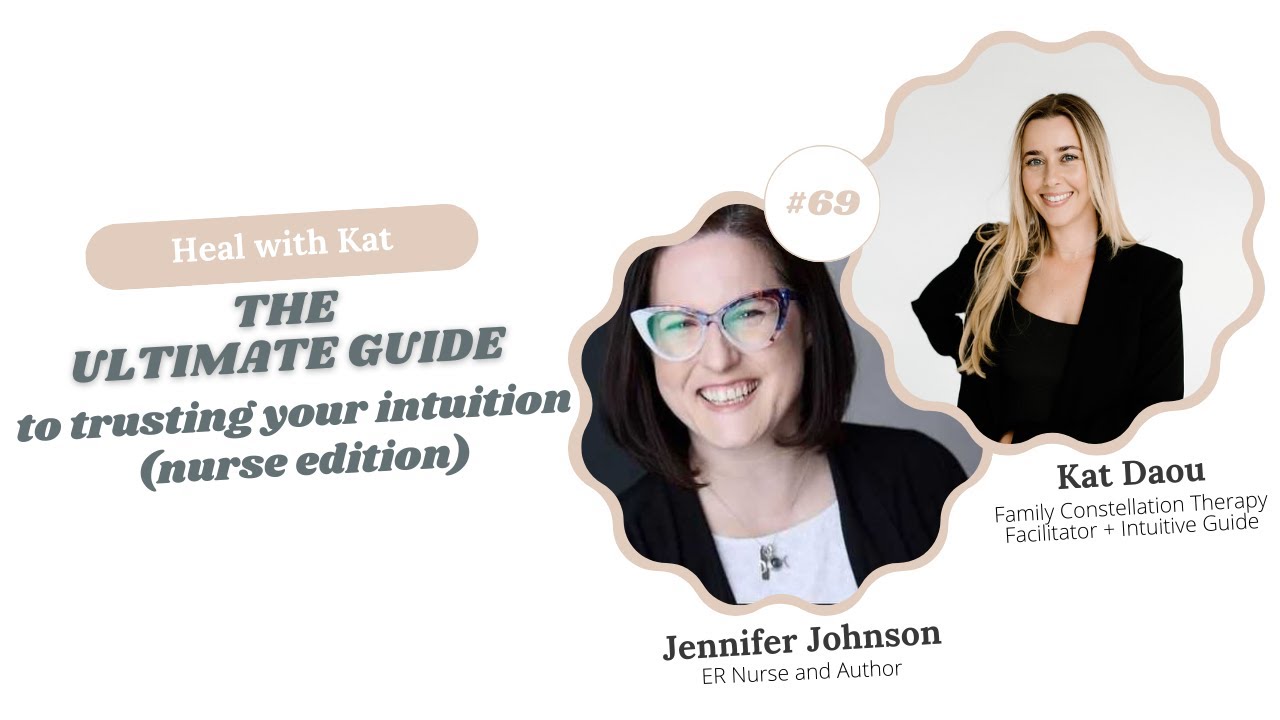
ER nurse Jennifer Johnson describes the physical sensations of clinical intuition: a bowling-ball feeling in the gut, sudden visual cues, spontaneous questions. After 16 years in nursing, she wrote Nursing Intuition to help clinicians trust and voice their gut instincts about patient deterioration.
Chapters
Jen, welcome to the Heal with Kat Podcast. I'm so excited you're here. We were just having like funny conversation before this, you guys. I mean, this is the second time we've had to record the episode, which I'm actually super happy that we got to do it a second time because there were some things that we talked about in the end of the last episode that I was like, wait a second. We are your people. You can talk about this.
Wait, wait, you can open up. I swear to God, you can open up. We're not going to judge too harshly.
Oh, not at all.
I've—
you should go back and look at the episodes I've posted about stuff I'm into. It's— you're, you're right on par here. Um, welcome to the Heal with Kat podcast. I'm so excited to have you back. I'm so excited to read your book, Nursing Intuition. I cannot wait for the community to hear about your story. So I really just want to Jump right into that. Tell us about your story, who you are, and how you got to writing this book.
Yeah. So, I'm Jen Johnson. I'm your token ER nurse from Canada. I've been in the ER for a little over 16 years now. I have worked all over Northern Ontario, Southern Ontario, ERs as big as just me or ERs as small as just me, and then a couple RNs on the floor. And to stroke centers, trauma centers, pediatric emergencies, you know, chaos, booming, bustling. It's, it's been an interesting little journey from the beginning to now. But yeah, just kind of finding myself along the way and dealing with some bullies and figuring out how intuition in nursing really does Like it's there, it's, it's ready to rock and roll and we just don't talk about it. It's one of those things where it's a 3:00 AM conversation along with ghost stories that we don't, you know, we'll talk in and amongst ourselves, but it's one of those concepts where we don't very openly talk about our intuition and using it and how it can help with patient outcomes and patient care.
It reminds me of that woman on TikTok, that Hadley lady who does the end of life care, how she wrote that book.
Hadley Veloz. Oh my God. So I bought that book. So she's a hospice nurse out of the States. She is phenomenal. She's written this book and it's a bunch of her stories about the life lessons that the dying are giving us, like as last life lessons. And I bought the audiobook and it's her doing the audiobook and I can't get through more than one chapter at a time without bawling my face off because they are just, it is so well written and it is her and you can hear her emotion in her voice as she's, as she's reading it again and obviously reliving it again. And there's something about that that is just so powerful. And so when I'm thinking about then having to do my own audiobook and going through some of these stories all over again, I'm a little nervous. But the stories need to be told and having them in my voice I think makes them that much more powerful.
So what I'm hearing you talk about when you say, you know, kind of tell us how you've gotten to this place of being an emergency room nurse and all these stories that you've collected. What I'm hearing you say is being intuitive or maybe having a spiritual experience in nursing was not talked about, was not welcome. So why emergency nursing? Were you always like this? Were you always intuitively led? Like, tell us about that.
So I never once wanted to be a nurse ever. It never was on my radar. I fell into nursing face first. Um, I started out my, my university degree in biology. Uh, it was something I thought I was gonna, you know, do genetics and, and this kind of thing. So I was like, oh, that'll be so cool. And then I got a year and a half in and failed second year, uh, the, the organic chemistry course, the first half. It was a year-long course. And I'm thinking like, Uh, I've just failed this first half. I'm, I'm now a year behind. This really isn't what I'm into anyways. It's Lakehead University, so it's very, very plant-based because they've got a huge forestry school. And I'm like, this sucks. Like, I am not, I'm not a green thumb. I suck with plants. I don't, I have no interest. Uh, that's not what I thought biology would be. I thought it would be human biology. And so a lot of, uh, there was a girl in my first year who was in nursing. And so we would like pore over her textbooks and stuff and I'd be like, oh, this is cool. Like, look at all these like, Fully very graphic, you know, full color photos of all these like ridiculous diseases and, and, you know, surgeries and all these things. And I'm like, okay, this is cool. This is what I think I want to do. And was able to thankfully very easily swap into the nursing program. And Lakehead had a 3-year compressed program versus a 4-year. So I was able to use my previous credits forward and help kind of really make the transition much, much easier. And then the ER again was the universe kind of, you know, pushing me into it. I had met my husband, my now husband, when I was in my third year. So finishing up my courses and doing clinical programs, you know, I was like, oh, they'll take me at the hospital where he's working and, or in the town that he's working in. And oh, then I can live with him and we can play house and we can do all these things. And oh my God, this is so cool. And So when I graduated, the town, which was like less than 5,000 people, you know, they were deemed underserviced by the Canadian government. And so for every year that I worked full-time hours, I got one year's tuition back. And so I was like, oh, well, what a win-win. This is fantastic. Not realizing that there was a very good reason why that town was underserviced and it was pretty much just surrounded around one person and their behavior and personality. and then pushing a lot of people out of the hospital. So didn't realize that at the time, but, you know, hindsight's 20/20 now. And, you know, there was only 2 options. The hospital had the ER, which was just the one nurse working the ER. And then they had the floor with about 14 beds with one registered nurse and 2 registered practical nurses or LVNs on that side. So you would just flip-flop. So one day, your first day, you'd usually be in the ER. The second day you'd usually be on the floor. And you just kind of flip-flop with your partner. And it was just one of those things where, oh, I guess I'm working in the Emerge. That's kind of cool. Like, who saw that coming? Not me. Um, but in working it and having it been 16 years already, it's very much a passion and a love, and it fits with my undiagnosed ADHD very, very well.
So.
It's, I, oh, so many things going on, right? Like, oh, you know, all these things up in the air and then all of a sudden trauma and you're like, oh, and you just run and, and go and, and that's the next thing. So it's been, it's been, you know, a love, a love relationship with the ER, a, a hate relationship with some of the staff. But, um, through the years it's just been, you know, trying to watching myself grow a little bit, get more confident, and then finally be supported after about 5 years when we moved down south. And it was like, oh, this is, this is what working in a supportive environment actually feels like. Oh, this is fantastic. You know, and all of a sudden we're seeing so many people and going from seeing 2 to 6 people in a day to, to like 70 to 80 in a day. And just that all of a sudden getting smacked in the face with all these people and all these admit no beds and, you know, just. The chaos of the ER personified because we were in a tourist spot. It was just crazy, but like in such the best way because the staff were phenomenal. The management was phenomenal. It was busy and it was fun and we laughed and we had, you know, all the bringing food into the nursing station when we weren't supposed to and having big potlucks on holidays or birthdays or retirement parties or whatever. So it was always— There's always something going on. And it was just, you know, that was finally feeling supported and going like, oh, I actually really love this.
That's amazing. I love that you were able to find a place that really embraced you and also embraced community, because I think that's so important and probably hard to have community in such a small place with not a lot of like that, you know, busyness going on. I feel like sometimes when there's not enough productivity, then people just start talking. Was part of that bullying— oh, go ahead.
Oh no, it's just they, you make up problems. Like the, the problems all of a sudden are, um, you know, you'd get hauled into the office if you didn't put extra paper in the charts on night shift, even though the, the paper was right there on day shift. Like, it's not like it was hard to find. It's not like it took you 2 extra seconds, but they were like, oh, I can't believe that you didn't fill the charts with extra paper on night shift. You're like, there's like 4 patients on the floor.
Like.
What do you want? Like, why are you in such a tizzy over this? Over nothing. So little problems became very, very large problems, which was not fun.
Was part of that also too, when you started realizing that you had a bit of an intuition with nursing, or when did that start to pick up?
That started pretty early. Um, probably the earliest time that I can remember that happening. Um, was, I think I just graduated. I just started on the floor. I may have been in it a couple of months, if that, and had a patient with pancreatitis and never had a patient with pancreatitis before. And, um, you know, he was chronically in and out and not a big deal. And, and everybody kind of like sloughed him off kind of thing. Oh, he's an alcoholic. It's, yeah, whatever. And so I'm going in to assess and all of a sudden, you know, taking the vitals and everything's fine. And then he just doubles over in pain and he's like, oh, and he just doubles over.
I'm like, What?
What the hell is going on? So redo the vitals. They're they're a little bit changed, but not much. I I call the doc because it's all of seven thirty eight in the morning, and telling the doc to be like, "Hey, this has just happened," and and I don't know what to do, and I'm new, and and you know I I just need you to be aware kind of thing. And they're like, "Oh, whatever." Just you know, and they sloughed it off, which of course, like in the beginning, it's not a big deal. So they slough it off, and I just kept going back and and redoing vitals, and and he his color kept changing. He kept getting paler, and then. Kind of green, then kind of gray. His vitals went in all the wrong directions. All of a sudden, now he's spiking a fever. His heart rate's up. His blood pressure's dropping, which now I know is like sepsis criteria. So you know you're getting a blood infection kind of thing. And but I kept calling the doctor, like probably every 45 minutes, every hour. I was calling the doctor to be like, "Hey, these are his vitals. Like I need you here. I need you to see him." Da da da. And kept getting pushed off, pushed off, pushed off, pushed off. And I'm going, well, you know, maybe it's just me. I'm new. I'm, I'm, I must be, you know, there's just too much going on. I just don't know what I'm doing. I'm, I'm too new was what I kept coming back to. And having the doc continually put me off really kind of cemented that in my mind. It was like, oh, I'm not, I'm not right. So by the time she finally came in at like 11, 11:30, um, patient was really getting quite sick and we had to move him to the one cardiac bed that we had on the floor. Very quickly, we're putting him on really high-alert medications to bring up his blood pressure. We're trying to give fluid boluses. We're trying to control his fever. We're trying to bring down his heart rate and nothing's working. And within an hour or 2 of that, his heart stops and we're doing compressions. We're trying to get him back and can't get him back. And so, he dies. So, from the time I come on shift to the time he's dying is maybe 6 hours. And all I can think is like, what did I do wrong? You know, what, what was going on? You know, what did I miss? Did I not act fast enough? Did I not push hard enough? Like, I don't understand. And nobody really backed me up. Everybody was like, oh, you know, he's just an alcoholic, you know, whatever. And they just, again, sloughed it off. And I was like, oh, okay. And nobody was coming to me and saying like, oh, I can't believe you didn't do that or anything like that. It's not like there was a debrief where we kind of talked about things afterwards. But it just left me with this feeling like I felt like I let him down because really, what else would I miss? You know, it kept coming back to me. What did I do? What did I miss? What didn't I do fast enough? What did I not push hard enough kind of thing? And so it wasn't until I was leaving and finally quitting that job after about 5 years when that doc came back up to me and she's like, oh, I heard that you were, you're leaving. I said, oh yeah, no, we're moving down south and we're doing all these things.
Mm-hmm.
And she goes, don't you let them tell you that you don't know what you're doing. And she walked away and I'm like, you have got to be kidding me right now. You waited 5 years to tell me that I was right on that call. And only when I'm leaving, do you say anything? And had I not ever left, would you have ever said anything? And so I was pissed in the moment because I was like, I can't believe You let me flounder in my own guilt for years, second-guess myself for years, worry about my practice for years, and not said anything when in reality I was right. I was on the right path. Something was wrong and my gut was saying that something was wrong. And it was you that didn't listen. It wasn't me. And so it was, you know, you kind of take that with a grain of salt. You're like, like, I really wished I would've heard that. 5 years ago, but at least I heard it. So I'm like, okay, all right, whatever. I'm gonna, I'm gonna take this. I'm gonna put it in my back pocket. I'm going to start trusting myself and really letting myself lean into this because clearly that I was right. Something was wrong and, you know, I was on the right track with it. So that was the first time that I had ever felt like anything was off and had pushed for it and nothing happened. But it was the start of me finally starting to like lean into it and listen to my gut.
I love that you, we talked about this when we recorded the first time, it's like, you know, you listen to your gut, like your gut feeling, that's like similar to intuition. And so how do you know when you're listening to your gut for you in life as a nurse, like for any occasion that you're in, what does that feel like? What is that experience?
Yeah, so usually it's just like a feeling in your gut that all of a sudden, like, for me it's a bowling ball. Like, it just all of a sudden a bowling ball hits the bottom of my stomach. I'm like, ugh, like, what, what is going on in this scenario? I don't understand. And it's the same, it's the same thing with, you know, the creep factor. You know, you're walking around, it's nighttime, you're kind of on high alert as a female, and somebody kind of comes into your purview and you're like, Nope. And you cross the street or you do what you need to do and you go. And it's that kind of same sensation where your body's screaming at you. And, you know, half the problem is that we're not listening to it. We're gonna listen to it when our own lives are theoretically in danger. Sure, we'll listen to it then. But when it comes to patients and it's kind of, you know, it's not necessarily our own survival, we tend to just, oh, it's nothing. We slough it off and you, you know, you don't listen to it or you just talk yourself out of it. And, you know, it's one of these things where you get enough experience, you finally start leaning into it and then you go, oh no, like there's more to this than I realized, you know? So sometimes it is that very heavy pit in my gut feeling. Sometimes it'll just be a thought that pops into my head where it's like, Um, so the patient will be telling me their story and all of a sudden it's like, oh, rhabdomyolysis. And I'm like, why is that popping into my head right now? Like, I don't understand why that's kind of coming in there. And you're like, oh, okay. Like, I'll kind of keep that in the back of my mind. But, you know, me saying that to the patient means nothing. Uh, and I'm probably gonna have to answer more questions than not. So you're just kind of like, okay, I'll keep that in the back of my head. Other times, um, my feet will stop. So if I'm like walking up the hall and there's a patient in the hallway, um, that looks awful. And so you're just like, boop, and just stop. And you're like, what is going on here? Like, who is taking care of this patient? What is the story? What is happening? What, what are we doing? Because this person looks like they're gonna code in like the next 20 to 45 minutes. Like, what are we doing here, people? Are they a full code? Are we gonna do everything to save their life? Or are they palliative or no code where we're going to provide them with comfort and care, um, but let, you know, natural death occur kind of thing. You know, there's a very big difference in what is required of the whole department if the patient's a full code and we're gonna have to do, you know, the full stop, full resuscitation versus like, oh, they're palliative and we're gonna give them some morphine and we're gonna give them some other medications for like, um, sedation and comfort and pain and, um, What are the other ones? It's— they're benzos. So it's like just relaxation kind of thing where you're just, you know, you're taking all the edge off of everything so that they're not in pain, they're not stressed out, they're not scared. And then they can just die naturally if that's what's gonna happen. And so it's just, it's one of those things where it's, I need to know what we're doing right now and then go from there. And other times, I'll be talking to somebody and things will come, like questions usually will come outta my mouth before I realize what I'm saying. So I had a patient who, um, was, had pancreatic cancer. He'd come in, it's like 6 o'clock in the morning, super early. You know, I'm, I'm done in an hour. It's night shift. I'm, I'm kind of over it, but I'm triage. And so he comes in and he says, I've got pancreatic cancer. He's a young guy, um, 30s. He goes, I've got pancreatic cancer. Um, we're just kind of starting treatment, but I'm, I'm starting to have pain and I just, I don't know what to do. So we, you know, right, get him registered and he's having a little bit of pain, but nothing too crazy and finish up the registration. And it's before he kind of gets up and walks away that I'm out of my mouth. I'm like, so how are you coping? And it's not something that I would ask at triage ever. Um, and it's definitely not something that I ask even in my normal assessments usually. Um, but it's, it was outta my mouth before I even knew what was going on. And so he, he and I kind of started talking and he goes, well, you know, I, you know, we're doing, we've got these plans and we're looking at treatment, but I know that prognosis isn't great. And again, outta my mouth before I realize what I've said is like, well, have you planned your funeral yet? And for somebody, For me, for that to come out of my mouth, that's fine. That would probably be something that would come out of my mouth, but usually to like an 80-year-old who, you know, has probably had this conversation multiple times and, and I've already gotten the hint that they want to talk about it or they're starting to make plans or something like that. Like I've already gotten kind of the inkling that they're okay with that and, and that's the direction we're going. I had gotten no inclination from this guy that that was where his head was at. Especially being so young. And he goes, actually, yeah. And so we start talking about his plans and like what he wanted done. And, you know, oh, I wanna be cremated and I wanna go here and, um, have this done and have a celebration of life and, and, and all these things. And so I'm like, this is all great. I said, um, and so I see the wedding ring, so I'm like, how's your spouse with this? And he goes, she's not good. She's still in the, we're gonna fight, we're gonna cure, we're gonna win. Kind of thing. He goes, she's very much in denial about the actual prognosis of this. And knowing pancreatic cancer as I do, like usually you've got 3 to 6 months if that, and you're gone. So super, super, super quick. And I said, okay. I said, well, there are such things as death cafes. And so usually the death cafes are, you know, they're held all around the world and it's usually professionals who deal with death that kind of come together. We're talking about it. Death's not taboo. It's just part of the job. So, um, nurses, funeral home directors, um, police, fire, EMS, you know, all those kind of people who deal with it on the daily. And we just wanna talk about it. We just wanna kind of let a load off and, and vent a little bit and, and not be super judged because of the topic of everything. And so I said, you know what, there's lots of death cafes and like you can do online ones, you can do in-person ones. Whatever you want to do. I said, you know, just Google it. You can find them, no problem. And, uh, and yeah, we just kind of talked about it for a little bit. And he was about to like get up and go and he's like, oh, you know, thank you so much. And, and I'm just, you know, I'm just excited. We're gonna go on a river cruise to Europe, like in a, in a, I think he said like April. And I can't remember if this was like January. So like 4 months. I was like, Oh my God. Ooh, um, you might want to bump that up. Oh, do you not think I'll be here for it? Uh, not necessarily, but I said, don't you— wouldn't you rather be well and enjoy it versus like maybe a little bit too sick, a little bit in pain, and like not actually be enjoying it versus, you know, not really have those concerns and, and really enjoy that with your family and enjoy that? He goes, oh, I didn't think about it like that. Yeah, yeah, we'll have to bump it up. I'm like, Good.
You just knew.
But I just, for me, I'm always on the prevention end of things. Like always do it when you can. It's a very ER way of thinking, you know, do the things when you can because you never know what's going to walk through the door and kind of like throw your day into a tizzy. So I was just like, okay, you know, do all this. And so I turn around and here's like the whole rest of the department. There's like, you know, 6 or 7 girls and, and the doc sitting all there, and they're all like misty-eyed. I'm like, what? They're like, why were you talking about that? What happened? Like, why would you start that? I'm like, whoa. I'm like, um, I don't know. Like, sorry. They're like, they're like, oh. So now it's a running joke. They call it having a caring intuitive moment when Jen goes off script and is all of a sudden asking really random seeming questions that then very quickly open up into bigger topics that we don't typically talk about. And so my, my buddy and I were carpooling that day and she was there. And so we were driving home. I said, I'm going to ask you a really odd question, and I would love it if you could be semi-honest with me. I said, it was my normal voice, right? Like, it wasn't like a weird voice or like something. There wasn't a twang to it or any— like, I don't know, like it was my voice, right? She's like, yeah, it was your voice. I'm like, okay, just checking. I'm like, I don't know, I kind of spaced out a little bit. And again, like, the, the questions were just out before I even realized what I was doing.
But, you know, you say something so profound in the sense of intuition itself. And I think as somebody who also works as an intuitive, it's like learning to trust what you receive because that information is a receiving. It's not like you're consciously thinking about it. And, and I've really battled my ego a lot in intuition for myself when I'm trying to read for myself. And this one that I, I see, I see a couple people, but this one woman in particular, her name is Mickey Jacobs, she's amazing. And she's like, Kat, she was like, you think too much, you think too much, you have to get out of your head. And she was like, you can't do readings for yourself. You like, you can— Yeah, and so how I know that I'm receiving something for myself is when I'm not actually It just comes to me. I just— it feels like it comes out of somewhere I don't understand. So this bigger conversation I think you're alluding to is, and something we talked about, is everybody's intuitive. And there's so many benefits to being intuitive and to owning that part of yourself.
You just have—
it's like a muscle. You have to practice it. And you can use it in any part of your life, with your kids, with your family, with relationships, with your work.
Absolutely. Whatever it is, you have to watch out when strangers come into the mix. Like, I mean, as, as a, as a job, right? Like I can, and especially as an ER nurse, like you could ask any question and 9 times outta 10 people are gonna answer it. You may not get a straight answer, but people are gonna answer it. So you get very comfortable just asking questions and, and just kind of shooting off the hip versus like if I was to be just walking around and like something pops in and you're just like, oh, I don't like the look of that person.
Yeah.
Like, I don't think they're too well. It's not up to me to go up to that person and be like, hey, how's your health? Like that? No, that is not, that's rule one. Like you're not just going up to people randomly and like inserting yourself into their life. You don't know where they're at mentally. You don't know where they're at spiritually, if they're open to it, if they're not, you just, it's not, it's not common practice or it shouldn't be common practice. Um, and it's very hard to stop yourself when you want, like you're, I just gotta say it. And you're like, no, I don't. It's taken years to get there.
Well, I've I've come to the point now where when my intuition first started really coming online, I would pick up everyone around me. Plus I'm an empath and super hypervigilant from my childhood. So like that, like on high. But I've— it's funny because like now when I— when that happens out in public or with somebody that I don't have like a close relationship with, I'll just say, if you really want to talk to them, have them somehow book a session with me. Like figure out a way to come find me in a professional setting. But yesterday I went to this place called Archipelago in Denver. It's this communal place. It's a house that has a yoga studio and a sauna. And so a friend invited me, so I went to the sauna and we're sitting in the sauna and this guy walks in and he's talking to us about microdosing and he says his name and I'm like, oh God, your grandpa's here. I was like, oh my God.
And I was in the sauna.
I'm like, can you Can you just give me a freaking break? I'm in the sauna right now. And the grandpa was telling me, oh, I'm a surfer. Tell him I'm a surfer. That's how you'll know that it's me. And I just, I sat there and I just politely told this to grandpa. I was like, if he really needs me, come find me in a session. Like, I just can't be that person. Because like you said, you don't know where people are on their journey with it. And it's not always appropriate.
No, it's, it's just, and it's so random too, right? Like, you don't know if people are open to it, if they're not.
Hey guys, it's Kat popping in during the episode today to tell you about my free Cycle Breaker quiz. Do you ever feel stuck in the same family patterns or even feel like the black sheep of your family and not in a good way? I felt like that my entire life. What if I told you that you could transform that role into something way more powerful, more meaningful, and more magical? With my Cycle Breaker quiz, I created this to help you understand the childhood coping tools that you are still replaying in your adult life, they're still showing up. And by understanding how you show up with your family and the role that you play, this can be the portal into understanding the patterns of your entire lineage just by looking at you. Whether you're the parentified child, the comedian, the rebel, the hyper-independent, or like me, the caregiver, this quiz will give you the insights that you need to reframe any resentment about how your childhood has shaped you. Once you take the quiz, You'll get a short and personalized podcast episode in your email inbox that dives into your archetype, helping you see the strengths that you've gained from growing up in this complex family. I'll even share with you the potential challenges that you may be facing as this archetype, and I'll even share with you a spirit animal to work with along the way, because who doesn't love a good spirit animal? The shift from black sheep to cycle breaker is a powerful one, and I want to support you along the way. Ready to embrace your role? All you have to do is go to katdow.com/cyclebreaker to take the quiz. Again, that's katdaou.com/cyclebreaker to take the quiz. Your transformation from black sheep to cycle breaker starts right now.
For years, I watched the New York medium, Theresa Caputo. And her style is very in your face. But granted, that's kind of like New York. And her kind of setting, right? So I'm like, eh, okay, I get it. But at the same time, I'm like, it's not me. And, you know, you can just kind of psych yourself out to be like, look, it's not gonna happen. I don't— and I mean, I don't hear per se, like I don't hear people, I don't see people. I get kind of pings about— usually it's questions, right? Like it's just questions are coming out of my mouth that then open the conversation for other things. And that seems to be my best way of you know, accessing whatever intuition, mediumship, empathy, that kind of thing. That's kind of how I'm doing it. And again, like, everybody's so different, everybody's getting it in different ways. Things like smell. So like, I've smelled death before without realizing. I used to work at a nursing home while I was going to school for nursing. And so in the summers, because you've had like 1 year's university education of being an RN, You could work at a, as a healthcare aide during the summer, which it was a little bit better money than just minimum wage. So you're like, yeah, absolutely. And, and it's kind of getting you ready for, you know, what nursing actually is. So you're like, okay. And so the one day I walk into my job and it's just like, what is that smell? It's like damp moss, old. And it's not the, the normal smell of that place. You know, the normal smell, you know, it's older, it's an old home, whatever. But I'm just like, hmm. Like, what is that smell? And popped in my head, I'm like, who died? And I was like, oh, that, that's really random. Okay, whatever. And it wasn't until I got taking report from people and it's like, oh, you know, 3rd floor just needs help because they've just had a death up there. I'm like, oh, okay. I'm like, I'll go up to 3rd floor.
Oh.
Like, and, and help because they needed help rolling and moving and, and all this kind of stuff. So it was like, oh. That's what that was. Yeah.
Well, it sounds like everything for you, you know, with these gut feelings and all your experiences in nursing for so long, like, it feels like with your book, it came to a head in 2020. And like, something changed for you during the pandemic that allowed you to kind of open yourself up more to this or share it with others. Like, tell us about what happened in 2020.
2020.
Well, what didn't happen in 2020?
First of all, what didn't happen in 2020? So 2020, obviously pandemic hit, uh, middle of March. My birthday is like middle of March also. So it was like within days of my birthday that everything shut down and, um, everything got canceled very, very quickly, obviously. And so I was like, oh, okay, interesting, whatever. And, but the problem was we were, A, we had just changed to a continental schedule. So it's like 2 weeks of days, 2 weeks of nights. But with no daycare, cuz the daycares had shut down. I had a 4 and 5-year-old at the time and my husband was also essential. So he did Monday to Friday to 4. I'm like, uh, I can't do day shift cuz we don't have daycare anymore. So just went to straight nights. But the problem was you'd do like 3 days of nights, but you'd also then have to stay up all day during the day to watch the kids cuz the kids were young enough that they couldn't be on their own or, or, you know, meander the house kind of thing. You had to be kind of up. So I'd be up all day with them. Maybe I'd get a nap before, um, Trev came home, or when Trev came home, I'd get a quick nap, go into work, maybe would get a quick nap at work, come home, be up all day, have, maybe have a quick nap here or there and everywhere. And so it would be like 3 days on, 2 off, 2 on, 3 off. It was just, and weeks of this. So just weeks of nights where it really felt like you, there was no point in trying to be a day person because you were going back into nights. Yeah. In a couple of days. So it so messed with my schedule and my sleep habits. And I was completely out of my mind, plus the anxiety and fear and depression with COVID and all this kind of stuff. So it kind of pushed me to a cliff and swiftly kicked me right off. So I got to a point where, you know, in the beginning, we had attorneys come forward who said that, you know, oh, for any frontline workers, we'll do your wills for free. And I'm like, Oh great, that's really lovely of you guys. So the the thing that I'm getting is that we're not expected to survive. Great, awesome. So so you know you've got that kind of tacked on top. You know like oh my god what is happening? And so reached a point where you know I was just you know what do you do if You died. You know, how do you explain to kids growing up that mom chose to go to work? You know, everybody had the out. We all had the out, but, you know, we just all continued to show up and, and do what we needed to do. But in the meantime, I was like, well, if I get sick and have to be put on a vent and potentially die, um, I'm gonna try and write down some of my really good stories for the kids so that they can see, like, this is why mom kept going in. And so I started with the really good stories. There's maybe 3 or 4 of those that came off the top. And then it was just a lot of trauma that I hadn't processed from the last 14 years at that point. So I'm going, oh, this is fun. And so going through the stories and writing them and crying and hitting a brick wall. And, you know, in the meantime, getting some free therapy, thank God for my free therapist. Finally getting on antidepressants, which I'd never been on antidepressants before. And, you know, switching jobs and things were starting to open up by the time I was kind of really turning a corner in like August. But the Canadian government also in August had said like, hey, for anybody working frontline nursing, we're gonna give you a $5,000 bonus. And I'm like, oh, fantastic. This is, this is great. Awesome. Um, cuz everybody else was getting, uh, CERB, so you were getting paid to stay home.
Mm-hmm.
like if you had a job that you couldn't go to because it was closed down kind of thing. And so they're like, oh, we'll give you $5,000. By the time taxes were taken off, it was like $2,200. So we're like, okay, great. That's awesome. Thanks. But, you know, my husband and I were talking and he's like, oh, what do you think you'd, you'd do with that money? And I'm like, I'm going to do the most ridiculous thing I can think of. I'm going to take psychic classes. I had a friend who she she was running the the broom the local broom closet, and so she was having meetings and you know pagans and wiccans and and spiritually inclined and anybody who was curious could come and hang out at her house and we'd just chit chat and hang out, which was so much fun. You know pre COVID, and so she was offering psychic classes. I'm like, you know what? She seems like a pretty cool person. I'm gonna. Sign up with her and go to psychic classes and, and do all this kind of fun weird stuff. And it was with that that, you know, going back and listening to or reading my stories and then listening to Llewellyn, who's a publisher out of the US who does metaphysical books, they were having online book fairs and the one woman was talking about her book and it was like Intuition at Work was the title of her book. And I'm like, Intuition at Work? I'm like, I use my intuition all the time at work. And I'm like, click, like, oh my God, that's it. That's it. So went back, went through all my stories, and sure enough, there was like a fine, thin thread of intuition that went through every single story that stuck around. And so I'm like, okay, well, in the age of misinformation, disinformation, I can't actually risk my license just kind of putting this out without some science behind it.
Mm-hmm.
So went on a deep dive, and not only was there just so much information on intuition, Uh, intuition versus insight and the psychology and the metaphysics and, um, like all that good stuff. But then there was so much information on nursing intuition specifically, and I'm going, okay, well, if there's all this information and all of it's relevant and new and peer-reviewed and meets all the, you know, the Western medical science criteria, let's bring it forward because, you know, nursing is very much, if it's evidence-based, we should be teaching it. So this is evidence-based now, so we need to be teaching it. And that's what kind of started all of it.
That's amazing.
Wow.
And it just felt like it was an inner calling that you had, like an inner knowing of like, it's just something you were into.
Yeah. I, um, I don't actually recall writing the book. It was 6 weeks.
You wrote it in 6 weeks?
I wrote it.
Oh my God.
But again, like most of these But most of these were stories, right, that I'd had that I talked about for years and years and years. Like, it was 16 years or 14 years worth of stories. Um, and so, you know, just— I remember getting up really, really early, like waking up at 3 AM and having to write, and staying up really, really late and having to write, and having everything just pour out of me. And yeah, and then applying to traditional publishers and getting accepted by a traditional publisher, which was a Huge. And then finally moving into editing and all that. And then at the last minute, they're like, oh, by the way, we're gonna go back to physiotherapy books. We're gonna give you your book back. We'll give you your rights back and everything. And I'm like, you're joking. I've waited 2 years, 2 and a half years to publish this thing finally. And you guys are backing out with like 6 months before I thought it was going to come out. I'm like, this This is bullshit. Like, I'm just gonna lose it. So I'm like, well, you know, I moped for 2 days. I grieved, I cried, I ate pints and pints of ice cream at work. I was probably really miserable at work. I feel bad, but I was like, I can't quit now. I gotta show up to work because now it's not gonna be traditionally published. So I gave myself 2 days. I was miserable. And then all of a sudden, I'm like, you know what? Fuck it. I'm just gonna publish it. I'm just gonna self-publish. I will pay for the editing. I will pay for the you know cover design. I will pay for PR and all this other stuff. Like I'll just I'll pay for it. I don't know how I'm gonna pay for it, but I'll pay for it. And I actually had started agency nursing a year prior. Last year, I only started agency nursing. So finally making really good money. But very sporadically, not to a point where I could actually quit my, my regular job. But all that agency money was then funding, paying for the book and moving forward at that point. So I'm like, all right, well, we're going now. So after 2 bumps, it was supposed to come out October 29th, which was the new moon in October. And that was, you know, consulted an astrologer to make sure that, you know, Can you look at my chart? Where do I need to fall? I think I, I do want it out in fall. Fall is my favorite time, you know. Can we do something about that? She's like, okay. And so she's like, new moon, full moon? I'm like, well, you know, I don't know. And she goes, well, new moon is like growth and continuing to grow and breaking patterns, and, and full moon is like letting go. And I'm like, I think I want it to continue to go. So I'm like, okay, new moon. So Bumped it twice now. Now we're on the new moon in December, so December 1st is the new moon, pretty sure. If not, then it might have something to do with releasing on a Tuesday because that's when the new PR sheets come out, or how books are measured on Amazon kind of thing. So I'm like, okay, I guess I'll, I'll give it to Amazon on that one. But yeah, I have had so much positive feedback so far from the few that have gotten to read it. My mom is finally reading it and she's got the unedited, like the lightly edited version, and she wasn't willing to read it. Well, she was willing to read it back in like 2020 when I wrote it, but I said no, it's kind of dark. It's a lot of like the things I haven't talked about with you guys that I've seen and done and this kind of thing. But she's reading it now and she's like, well, I've got my pen and I'm marking it up, because she's the ever avid reader. And so I'm like, I understand, Mom, but you knew that it was like the very rough edit.
Yeah.
But it's— I'm like, I'm so thrilled that she's finally gotten to a place where she can read it and I'm well enough to let her read it because she kind of said like, oh, I didn't want to read it when you're in your really rough spot. So I'm like, that's fair. Thanks, mom. Like, that's, that's really nice of you, but it's, it's going and I'm hoping to, to start to speak and I've applied to a couple conferences to maybe speak, um, you know, Nurse Blake and the whole bit. So we'll see how that goes.
Well, I just, I'm so excited for you because I really do think that what I'm hearing from you and, and to be honest, I would've never, um, well, maybe I would've thought this before, but not as much as after we talked about it. But what I'm hearing is like, there's not this permission for nurses to just be intuitive and also let the science exist at the same time.
No.
And I think that, you know, well, I mean, I guess I could see it, right? Because when my brother-in-law was in the hospital this summer for 2 weeks after his accident, the nurses were very logical, very scientific, very kind, very understanding, very willing to answer any of our questions. But I guess I would have wanted to know if they had intuitive feelings about things, or I would have wanted, you know, like, I don't know, it's just, it's a hard place to be because you don't know who's open to it, like we said. But I'm sure that everything that was said, even if it was intuitive, was communicated. Um, you talk about something in your book called, uh, shifting into the heart for nursing. So how do you—
how do you—
what does that look like for you, and how does that differentiate from living in the gut and being intuitive? Is it all kind of the same thing, or is there a difference for you?
It's more empathy, right? Like, you can be, um, or empathy versus compassion. So being an empath, being empathetic, um, you are opening yourself up to feeling those feelings and, and really actually feeling them. Like, that's— and it's a very hard thing. And, you know, A lot of people don't know how to tell the difference between being empathetic and being compassionate. Like, I can empathize with people's losses. I can understand where they're coming from, but I very purposefully do not, or try not to let them affect me as much as they do. You know, you're kind of putting up your shield. You're kind of saying, you know, I am leaving this at a at arm's length because I can't be fully feeling this because if I was, I'd be a wreck. And not to say that there aren't people, and especially like people and patients that you really vibe with and you're like, oh no, we're definitely on the same page about a lot of things. Or, you know, they remind you of a loved one or a friend and it hits too close to home. And so it's It's hard when those ones come along because it breaks down the barriers a lot faster than we're used to. And it comes at you— well, it comes at you so hard that you're just like, oh, and you're caught up in the feelings and you're like, whoa, I was fine 2 minutes ago when I was coming up the hall. It wasn't until I walked into this room that all of a sudden my emotions were kind of chaotic and all over the place. And I felt myself kind of getting down and, and I felt myself being sad. sucked into the emotions of the family or the patient. So being very aware of setting the boundaries, setting the intention that, you know, A, I like to set the intention that, you know, the people that I'm going to see today need to see me. Um, being hoping that that kind of weans out some of the people who definitely do not need to be in the ER, but you know, it is what it is. Um, and then just kind of being very mindful about like, okay, I am, You know, going to just be, you know, professional and caring, but you can be compassionate, right? Like you can still hug people. You can still cry with people. You just need to be careful that they're not consoling you because that's definitely not the place to be in. And that's not a professional thing to do. Um, but you can cry with families. I can't even tell you how many families I've cried with, or, you know, families who come up and they say like, I don't know how you do this. the very easy answer is it's not my loved one. Like, I can put it out here because it's not my person. If it was my person, I would be just as bad as you, if not worse. Actually, usually nurses are worse for being the family members and overbearing because we know what's supposed to happen. Um, and, you know, we get upset when things don't happen like they're supposed to. Um, even knowing that, you know, everything Happens for a reason. And, and sometimes emergencies happen that things get bumped or whatever else. And, and the bed wait times is a whole other thing. But, um, no, being, being compassionate to family members, um, is something that takes time to bring yourself out of the empathetic into the compassionate. And it wasn't until actually, um, so we put my dog down this summer. She was like 15. It was a whole thing. Oh, I'm sorry. But, you know, it was one of those things where everybody was so compassionate and lovely and they all kind of said the same thing, like, oh my gosh, we're so sorry for your loss. And you're like, I, I understand. But you felt it. It's sad that you did feel that there was a difference because they were doing the exact same thing that I do. I am so sorry for your loss. Like, I am sorry, but I'm not putting that emotion into what I'm saying because I don't wanna feel it.
Yeah.
So you're kind of blocking off a bit. And it wasn't until I heard everybody else say it that I'm like, oh, I really hope I don't sound like that, but I probably do. Um, and I'm, I'm hoping that either other people are just too upset to notice, or, um, maybe I'm a little bit better at hiding it. But it's, it's hard not to give into the emotions because it's so easy to slip into, right? Like, we're very emotional beings. It's just so easy to fall into them. And it feels right to fall into them because, you know, misery loves company kind of thing. So it's just very hard not to, to be overly emotional, but it's, um, again, it's like a skill like any other where it just takes time to kind of realize, A, that that's what's happening, and then B, okay, this is my reaction to it, and trying to catch it before you're, you're full into it and just kind of pull back a bit and say, okay, no, no. Like, I'm here, I'm, I, I am doing my job, I am, I'm being here as best I can, but I can't be there fully emotional because if I was, I'd be, you know, no better use to you than a family member kind of thing.
Can I tell you something? You, when you say that, I'm thinking about putting myself in, in my shoes from this summer. I mean, we lost my brother-in-law to a tragic work-related accident and it was the worst weeks of our lives in the hospital while he was essentially brain dead and laying in that bed, just we were kind of waiting on, when do we— what do we do?
Yes.
And there were moments that I remember, we had a social worker that got assigned to my brother-in-law and to our family and to his family. And there are many times that I said to her, Jenny, her name was Jenny actually. Um, I don't know how you do this. Like, I really— like, how do you navigate this? So, and she's just like busy going everywhere, doing everything. And she's like, you know what, I just like, I know I have to help you and that's my job. And like, and you can see the pain. But here's my thing is that like, I respect the fuck out of nurses because had a nurse been breaking down while our family was breaking down, I would've lost maybe some faith or trust that somebody had it together when I didn't. Someone has to have it together in that situation. And then, so then that makes me think about my follow-up question, which is like, what kind of support do nurses get and what do they not get that they need more of? Like, what do you see? I'm sure you talk about that in Nursing Intuition or maybe have thought about it.
Yeah.
'Cause you guys deserve incredible amounts of support for, I mean, just I mean, now the grief of my brother-in-law has kind of softened. Like, I, I accept where he is. He's come through in a reading for me. I know he's with my sister and my nephew. I trust that he's still a part of their lives in a different way now. What really fucks with my head is those 2 weeks we spent in the hospital. So if I'm feeling like that and nurses are experiencing that every single day, what kind of support—
So first and foremost, PTSD and hospital PTSD is a real thing. It's 100% a real thing. So do not ever doubt that those feelings weren't valid or, um, you're feeling crazy for kind of lingering on those feelings or anything like that. Just if there's anything, you know, slight silver lining is just that, um, you're not alone. It was only two weeks. Like, be very thankful it was only two weeks because even though those two weeks were ridiculously hard, it could have been two years because he was so young. But nursing-wise, so typically if there is something traumatic that happens, we try to do a debrief right after if we can. Sometimes it's really hard because the department's on fire and you're just running around like a chicken with your head cut off and somebody's already at the door being like, "My mother needs a blanket." You're like, "Ma'am, we're just." We just like, you don't even, and you can't say anything. So you can't say like, please get outta my hair right now. Like, I'm trying not to like lose it over the code that we just ran. Like, please. Uh, you have to be professional, be like, okay, ma'am, we'll be there. Right. We're just really busy right now. You know, we just have to, you know, you're trying to be, you're trying to be professional, but you're like, for the love of God, can you just not for 5 minutes? Like, let me just cope for 5 minutes. And then do this kind of thing. So normally we'll try and have debriefs. So what went, what happened, what went right, what went wrong, if anything, and is there any opportunities to learn? And so a lot of the time it's really nice to, if you can reframe it as a way to learn, you're, it's somehow easier to cope with, you know, it's still a loss and it's still hard, but if there's something to learn from that, then I can then pass on to somebody else. without them having to go through that, it makes it kind of worthwhile. Um, and so there's, there's those kind of things. And then you talk about it and you can kind of dispel any guilt that any one of us is feeling about not doing something or not acting fast enough, that kind of thing. Because there's usually a much bigger team versus just, you know, me and the doc kind of thing. You think that you're healed and you're like, I'm so much better. And then all of a sudden you start talking about, you're like, oh, I'm still so bare. It is what it is.
Right.
Moving on. But, you know, it's, we try to kind of in the moment do a debrief cuz it's very, very hard then to get the same crew on, like the same people who were there previously to get them in the room together. Otherwise, you're usually having to do a debrief, um, on your day off. There is lots of support through, um, at least my current organization. There's an employee assistance line that you can call. So it's more for, um, you know, if you're having spousal abuse, if you're having, um, addictions issues, if you're having mental health issues, it's really great for those things. Uh, it's not so great if you're, you know, I've just had a pediatric death and I'm just wanting to know what PTSD looks like and, and how I can make sure to stop it before it starts. They had a really hard time with me asking those questions.
Mm-hmm.
Um, but it wasn't until I finally got paired with kind of a therapist that she goes, Oh, that's what you're looking for. Okay. So her and I had a really good talk, which you could talk to a therapist that moment, which was fantastic. You know, you're at home in bed and you're just like, hey, I just need to talk to somebody about this. They were very, very good on that end with that. Um, you do still have to be mindful that it's still paid for by your employer. So where confidentiality with your own personal mental health starts and stops, I'm not 100% sure, but just something to be mindful of. Um, and, uh, I wish we had a social worker for staff 24/7, 365. That would be amazing. But yeah, like it's, it's hard to say because everybody's so different and everybody copes so differently. A lot of us just go home and whine it out and, and go from there kind of thing. But, you know, a lot of it is you have to realize that you are the one in control of your own healthcare and mental healthcare. So if you need it, you need to realize it and then reach out, which sometimes is not so great because it takes a lot of us. We think we're stronger than that and have been raised to be stronger than that. And so it takes a global pandemic to finally break through and, and go from there.
What is the biggest piece of support that you see that nurses need around intuition and the gut and the heart? What is, what are they looking for that they don't know they're looking for?
Mm-hmm. They need to recognize it and then give it the time that it deserves. Um, because truly half the game is just figuring out that you're getting it. And then the other half of the game is then, are you gonna do anything with it? And so in the resilience burnout game, if you can take your intuition about a patient who's not doing so well, and you can say something and you can intervene and you can turn that patient around, Um, you're potentially avoiding a situation which could cause guilt, burden, um, compassion fatigue, moral fatigue, all these kinds of things, which then lead to burnout. So if you can intervene at the very, very beginning and say, I think something's wrong, do something about it and have the patient turn around, you're potentially saving your own mental health like 10 times over. Because if you're not then having to deal with that Horrific situation where you're feeling guilt about feeling something, thinking something, and not saying anything. Um, that plays into the burnout piece so hard. Um, but being able to trust yourself and give yourself the, the credit that you deserve for feeling it and knowing what's going on is, is key. Sometimes you do have to change the way you're talking to people to To figure out, you know, are you going to be, um, what's an acceptable way for me to say this that you're not just going to write me right off? And again, it depends on your doc. It depends on your coworkers, whoever you're talking to. So a lot of the time, if I'm talking to a doc who I don't really know all that well, and I'm getting a hit to say like, oh man, my gut's telling me that this is not good. They need to get in here right now. I'll come over and be like, hey, Dr. So-and-so, like, my name's Jen. I'm I'm just the charge nurse, da da da. Um, you know, there's just something going on with Mrs. Smith and 6. Like, if there's any way, maybe— do you have a minute? Like, if you could just really— I think they're sick enough that they probably should be seen next. If you could just go in there and take a peek and tell me what you think, you know, I'm just not sure. Those words can get you a lot of places and very far because it's human nature to want to solve problems. It's human nature to want to be the one with the answers. So, giving people the opportunity to fall into those roles, you know, empowers them, empowers you. And sometimes it just takes, you know, taking your ego check back just a little bit to say like, I just don't know, and being okay with saying that. And so, the statistics and the paperwork or the papers even say that. So, if you're new and you're developing this, And you think that something's wrong with your patient, or you think something's up and you're having this feeling, you're like, ugh, I don't know. You go talk to your doc, the doc comes and sees this patient and, you know, hooray, they're not actually as sick as you were thinking. Um, yes, you are wrong and that's okay. We're all wrong all the time. Don't even stress about it. There's no being perfect. There's no being right all the time. It's not happening. Um, but just the doctor having another touchpoint on that patient. Still improves patient outcomes. So no matter what, you can call it advocating for your patient, you can call it being extra careful, you can call it trusting your gut, you can call it trusting your intuition, um, but you're still looking out for your patient and their best interests and their wellbeing. So no matter what, um, even if you're wrong, the patient's still going to improve if you are realizing it and saying something and having the doc come and see them.
Mm-hmm.
So don't stress about being wrong. You're gonna be wrong.
No, I think, I think that's phenomenal advice, honestly. And I think, um, that could be— again, like, so many of the things that you're saying apply to so many different types of jobs and things in life. Like corporate America, if somebody's listening and they work in the corporate world, like, just say like, hey, I've got this feeling that maybe something might be up. I could be wrong, but would you just take another pair of eyes on it and see, you know, what you think about it? I think it's always Better for connection and also better for trusting yourself. My boyfriend had told me this quote a while back and I really have been thinking on it the last couple of weeks. Confidence comes from trusting your choices. And sometimes you have to trust that you're making certain choices to either speak up, say something, do something, and then you build more confidence around your intuition. I think that that's half the battle with most things in life is learning to just trust that you, you feel something or you sense something or you have a thought in your head. It's not there for no reason. There's a reason for it, whether you're right or wrong.
Yeah.
Yeah.
And it might just be that you needed to be wrong and that's okay. Like sometimes the universe is just like, hey, you need a little bit of an attitude check. Here you go.
Ego check.
So trust me. Trust me when you get an attitude check, you go, okay. All right. Note to self. I will Smarten up. You know, it happens to all of us. Um, and me personally, I don't learn anything unless it's my ass is, you know, a swift kick to the ass kind of thing. Like, I really don't take criticism well. So it's, it's usually the universe is like, oh, you think you're gonna get away with this? But like, there you go. And I'm like, oh, oh, all right.
Yeah.
Guess I wasn't supposed to put up with that person or that, uh, bullying or like whatever else. Wasn't supposed to be in that job. Okay.
Every, every rejection in some way is a redirection.
Absolutely, 100%.
Well, this conversation has been so lovely. I just, I love that we got to record a second time because the audio spirit must have been working something because the first one was great, but we didn't get to dive into the intuitive stuff. And I think it's so— no, I think it's so great that you're letting that like come out, especially, um, with, with the field that you're in because it's— I like I cannot wait to read your book. Like I said, I have it on pre-order. I can't wait to read it because I really— I'm always so fascinated by the medical industry. Um, and I think also too, like, being intuitive would be such a hack to be in the medical field. So I just can't wait to read it. Oh my gosh.
It is until it isn't. And then it's like, you know, am I— what am I picking up on? Then you're like, well, who am I picking up on? Like, What is going on? All of a sudden you'd be like having chest pain. You're like, what is happening right now? Like, is this me? Is this not me? Is it somebody else? Like, what is going on? Or your ears start ringing. You're like, okay, what was that thought that I was just having? Or like, what was that conversation just about that like something was, something was up? I have to, have to like pay attention to that a little bit better. Yeah.
Well, where can people pre-order your book? How can they follow your story? How can they connect with you? Um, I just can see see this being shared with like a few people in my personal life already who are in that world. So where can they find you?
Yeah, so you can, um, if you go to Amazon and search Jennifer A. Johnson RN, uh, my book as well as all of my journals will come up on there. You can find me on Instagram and TikTok at ernurse.jenn, J-E-N-N. You can find me on LinkedIn at Jennifer Johnson BScN RN. And rxforgrowth.com is my website. And then you can sign up and I can try and figure out how the heck to get emails working eventually.
You need a Bessie.
I do need a Bessie. I need somebody. I can't. I'm running around like a chicken with my head cut off.
For everyone who's listening, Bessie is my new podcast editor and she is a literal queen. Helped us figure out this recording today because of her issues. We'll link all of that in the show notes. below. Thank you so much for being vulnerable, for being honest with us about your experience, for letting that— that I call it my freak flag— so letting your freak flag fly with us.
Yes.
But it's so beautiful that you have so much experience and so much to share, and I really hope that you're able to get on those public speak— public speaking platforms to give other humans— I'm not even gonna say nurses, just other humans— the permission to let that flag too Absolutely.
Listen, I've been weird since moment one and thankfully have leaned into it forever. So, you know, if you think that you're alone and weird, hit me up because I, I'm not necessarily alone, but I'm so weird.
Yeah. The weird ones are the best ones.
But listen, it's the normies you have to worry about.
I know. Normal, normal's not the goal, guys.
Normal is not the goal. Normal does not exist.
Well, if you like— yeah, well, if you liked today's episode, guys, thank you so much for listening and being a part of the conversation. I hope you loved everything that Jen was sharing. Don't forget, you can rate, subscribe, and review the podcast and screenshot it and send it to me on Instagram. On the last day of every single month, I give away a free ancestral intuitive reading to anyone who rates, subscribes, and reviews. So that sounds interesting to you, all you got to do is screenshot that, send it to me on Instagram, and I'll let you know if you won on Instagram. Thanks guys, and see you next week. Bye.
More from Jennifer
The Holistic Nurse - Transition Shock and the New Graduate Nurse (with Nurse Jennifer Johnson)


Ep.53 The Hidden Truth About Nursing Burnout | Nurse Jenn on COVID, Intuition & Saving the System
Facing Mortality_ The Stories I Must Share On Nursing Intuition w. Jennifer Johnson