The Holistic Nurse - Transition Shock and the New Graduate Nurse (with Nurse Jennifer Johnson)
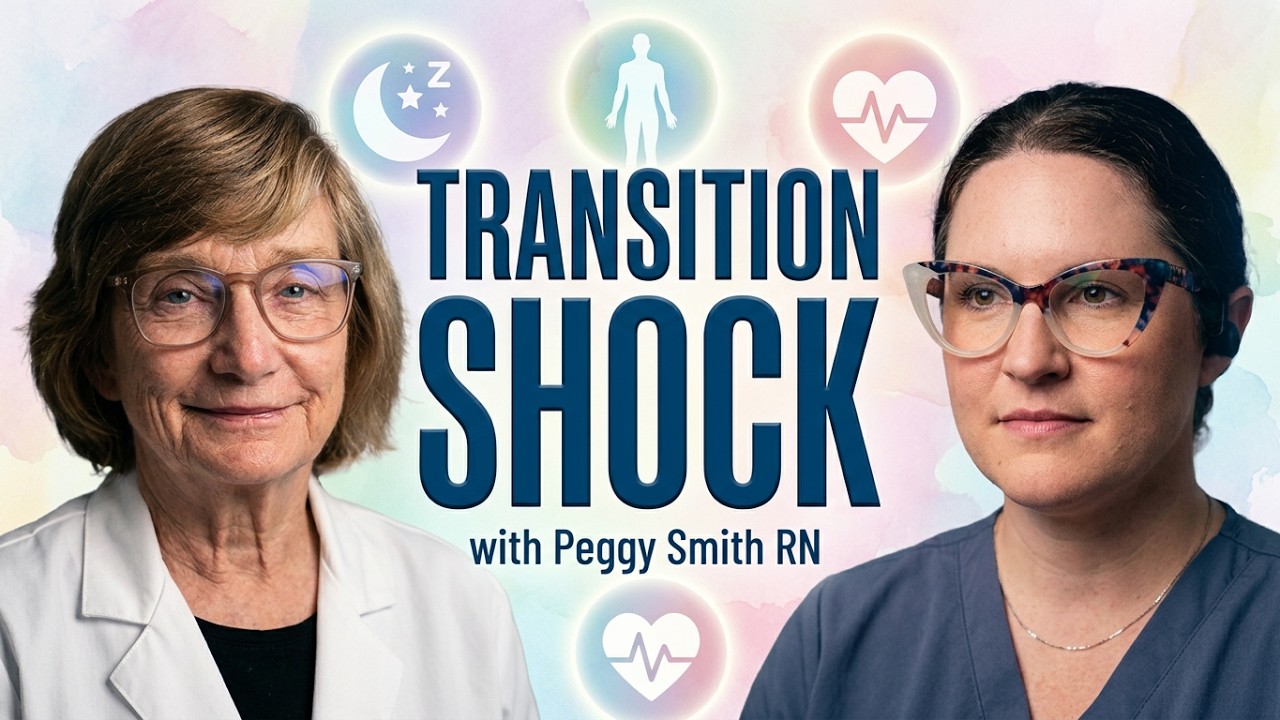
ER nurse Jen Johnson discusses transition shock, the disorienting first years that drive many new nurses out of the profession. She shares concrete strategies: pre-shift naps, blackout curtains, meal-prepping, journaling wins. Johnson also addresses systemic pressures like night-shift physiology and staffing shortages that traditional nursing education ignores.
Chapters
Welcome to The Holistic Nurse with your host, Peggy Smith. Peggy will introduce and educate her viewers about the differences between alternative, holistic, and complementary medical therapies. Her goal is to empower the lay medical consumer to learn how to advocate for themselves. So now, please welcome the host of The Holistic Nurse, Peggy Smith.
Hi, I'm Peggy Smith.
Hi everybody. Welcome to this week's edition of The Holistic Nurse with Peggy Smith. This is a time of year, a lot of people are, younger people are beginning new careers, opening new doors. They just finished school, the graduates. Today's show is gonna be directed towards young graduate nurses. And all of the information we're presenting today, of course, will apply to even the oldest senior nurses that are still working. But I have a special guest today. Her name is, is Jen Johnson from Canada, and she's— her specialty is nurse burnout. She's going to tell us how we can enter this career with all and keep the enthusiasm we got on graduation day. And a lot of the principles are not just for new nurses or new graduates of any kind. They actually apply to most of us in our everyday lives because stress might have different labels or different causes, but the ways of coping are pretty much universal. So I'd like to welcome Jenn.
Hello. How's it going?
Hi.
Great to have you today. You know, I've been a nurse, I guess, over 45 years now. I don't know anything about burnout, right? Uh, but tell us a little bit about yourself and how this became one of your little subspecialties.
So I'm Jen Johnson. I'm out of Hamilton, Ontario. I have been an ER nurse for over 18 years now. Um, fell into nursing after failing an organic chemistry course in university, and thank goodness for it. Um, so got into nursing, um, have traveled around Northern Ontario, Southern Ontario, and hospitals big and small. And it wasn't until burning out hard during, during COVID at the front lines where it became, you know, very much something has to change because I'm not operating at my peak performance. Um, and, you know, what else can I do to make sure that I can continue on in nursing? Because it is, um, a true, true love of mine. Ended up, uh, writing the book on intuition and nursing, and that led to speaking gigs with new graduate nurses and talking to them and, you know, feeling that excitement. Coming from them and they want to be so prepared for nursing, but we're not supporting them as best we can. So that's kind of where I've come into play. I'm going around and teaching courses on, you know, grief and nursing and intuition and nursing and how important sleep is in nursing and trying to really tackle the topics that we all think are kind of soft skills that, you know, nursing school doesn't have the time to teach, and it takes a few years to figure these kind of skills out. But the new graduate nurses are leaving in droves by year 2. And, you know, I'm hoping that by offering these courses first and foremost when they first graduate, that maybe we can help let them know that they are supported and that Nursing is not what it was, you know, 60 years ago. The role has changed, but the, the education hasn't quite caught up just yet.
Okay. Well, you know, if you think about it, 60 years ago was a time when it wasn't unusual for a nurse to maybe have 60 patients in her charge for medications and treatments. Yeah, I've had some of those shifts.
I can't imagine.
And, and the one thing that education, I think between me starting and, you know, perhaps where you came in or even especially the new ones now, is that, um, we weren't warned, but we were just, it was presented to us as this is what the expectation is.
Yeah.
And, and most of us didn't know that there could be a better way. Uh, I've reached several points in my career where I was burned out and First of all, I fell into nursing too. I went to the college to take a guitar class. And it was during the nursing shortage. People were camping out in the hallways of this particular school. And I had never considered being a nurse, but I'm very competitive. And somebody who was in a sleeping bag at 10 o'clock in the morning in the hallway was telling me there were 100 slots and there were 1,000 of them. He just finished counting all 1,000. Tried to get into those 100 slots. I, at that point, had had several other careers, a special ed teacher, research chemist, mom of now 3 kids under 4, and with an aerospace engineer husband who didn't want to pay for daycare with 3 kids at that age, and I was breastfeeding. So when he suggested stay home for a year, why not? I was also an accountant too, and that I'm one of those kids that haven't decided what I'm going to be when I grow up. But I remember doing, uh, and I worked and specialized in whatever area I was working in. I got the certifications. You can't keep them up because I assume they're the same certifications in Canada and they cost like $300 to $500 each time you want to renew them. So you don't get, you don't get a good return for your money for those, but you do get knowledge that is important and gives you confidence. I think that's one of the important things. Uh, but I had actually been a nurse probably 10 years where one day I had a, uh, an epiph— mind-blowing epiphany where it was like, oh my God, I learned this in nursing school. And it felt like that was the first time I was actually doing something I learned in nursing school. It truly is an on-the-job training job.
Um, yeah.
I remember another time, um, doing home care and, and hospice. Hospice is a high burnout area. And I had these 2 sisters. One was dying of breast cancer, 2 little Italian ladies. Her sister Mary would say 1,000 Hail Marys for her every day at her bedside. I got there later than usual that day, and I kind of made a joke. I said, oh, you got a late start. You're still praying. She said, no, I finished Jenny's Hail Mary hours ago. This 1,000 is for you because at the rate you're going, Jenny's going to outlive you. And, you know, it was, it opened my eyes. Oh my God. I was going through a divorce. I still had 4 kids at, you know, grade school. And I realized the patients see us when we're burned out and, and then they don't, there's some that get angry because we're burned out and we're letting it show, which is the human part, I guess. But they also feel almost obligated, especially if they're enablers themselves, to take care of the nurse and don't give her too many more problems to deal with. And, you know, patients should never feel that way. I mean, we know what we got into pretty much when we started. I— my school didn't have any rose-colored glasses to look through. But I remember, well, one of the things I wanted to be when I grew up as a kid, I wanted to be a clown.
I've just—
a lot of people hate clowns. They're scared of them. There was a clown college in Florida back then. They've long since gone out of business because none of the parents would pay for it, I assume. My parents wouldn't consider paying for clown college right outta high school. Um, but years later, maybe I'd been a nurse about 20 years. I was dealing with some oncology, uh, problems myself, and I met the hospital clowns at my local hospital, Bumper T Caring Clowns, the national organization. And that— I was burnt out. I was ready to give up nursing. I didn't think I had anything left. At the same time, though, it made me realize, oh my gosh, as a hospice nurse, I'm selling living wills. And now I've got this diagnosis. And there's no way that I'm going to be, you know, writing my living will. I should— you should do your living will. But no way I was going to plan to check out when I had school-aged kids. And, you know, and realizing that, I became a clown, hospital clown. It really let me enjoy nursing the way nursing was meant to be. We don't have time now for patient interaction. We're so focused on, you know, the doctors getting penalized if they spend more than 10 or 15 minutes with a patient. You know, our facilities don't want to pay us overtime if you have to stay to finish your paperwork. But, you know, the first lesson, first week of school, we learned if you didn't write it down, you didn't do it.
Yep.
So, you know, it hasn't changed. It's become even more demanding, I guess. You know, The Nursing Intuition, the book behind you, I remember calling a resident one day saying, hey, come down to the hospital, you know, this room right now. You know, the man is going to code in about 10 minutes. Well, what's his vital signs? His vital signs were perfect. But You know, I knew he was going to code and he's, what's your name? He was, he's busy writing names, my names, so he could report me. By the time he came down putting his shoes on, because he'd been asleep, it was night shift, uh, the man was in the, we already had the crash cart in the room and we were dealing with it. And, you know, he said, well, how did you know? I said, because it's not all about the vital signs. You know, this, it's about the whole person. And that's really how I got into holistic nursing. I look at the whole person. And yeah, you know, so, um, so you've been doing, you know, sharing your knowledge and helping people. Uh, do you get a good reception or do you scare people out of the profession?
Well, and so the first time that I got invited to speak to new graduate nurses or even just new, uh, new student nurses, it was September of first year and the teacher kind of goes, oh, you know, just talk about your stories. I said, okay. Do you want them to stay in nursing or do you not want them to stay in nursing? She goes, no, no, no, we want them to stay. I said, okay, I've got less of those stories. So, but in talking to them, you know, they were already asking about burnout and how do you grieve a patient? And, you know, what does work-life balance look like and how do you manage night shifts? And they were in moment one of nursing school and I'm thinking, In 18 years, I don't think I've ever asked myself these questions, but you guys are already asking and looking for answers before you're even in nursing school a month. So I'm like, okay, let me try and put something together and, and, you know, bring it forward to try and see what we can do. And so ended up creating a journal that, you know, helped you keep track of the small wins as you went shift to shift and, you know, what went well, what didn't go well, were you full Holy staff, how many steps did you do? Did you sleep well before shift? Um, did you get any meals? And just a way to kind of keep track of your learning opportunities and things that you wanted to like look up later, that once you're at home and you've had a day to recover from your shift from hell, uh, you can go back into those notes and say, okay, that was that medication I was gonna look up. That was that pathophysiology I was gonna look up. And it gives you, you know, that really solid kind of evidence that when you're having that knockdown, drag-out shift, you can go back into your own experiences and go, no, I am learning. I am moving forward. It's just, maybe it's not what I thought, you know, a win would look like, but I am, I am learning. It is, it is happening. So currently I've got a study that's international going on with the journals. I've got about 40, both new graduate nurses as well as student nurses, and just trying to get a handle on what's going on and how can we help and, and, you know, what are we missing that, you know, you guys, it seems like an ob— it might seem like an obvious to you guys, but, you know, we weren't maybe raised the way you were, or we're not in the generation that you guys are in. And, you know, we need to understand better if anybody's going to stick around to nurse longer than a year or two.
Well, that's absolutely true. And yeah, I remember when I first graduated, my 3-year-old came in from playing outside with other 3-year-olds, brought everybody in, and I swear they must have deliberately fallen simultaneously to skin their knees as my Michael comes in saying, my mommy's a nurse, she can make it all better. So everybody created places to put Band-Aids, you know? And, you know, and I think a big key I found over the years, and, you know, being a clown is part of it, um, you've got to keep your sense of humor.
Yeah.
Uh, because that, that is key, I think, for burnout in any, any profession. Um, you know, it's not a script, you know, it's not an engineering thing where you've got math problems, you know, it's going to actually work. Um, And I think having a sense of humor is one of the basic things. I mean, I teach CPR classes mainly for the Boy Scouts. I don't like teaching them, you know, for professionals. We're going to take a break right here. We'll come back.
What if there were a super tiny device that could diagnose the brain and is smaller than a single human hair? What if you could see inside the brain to help an epilepsy patient during surgery or to help the fight against Parkinson's disease? Dr. Patricia Broderick is proud to announce the Broderick Probe, a biomedical and electronic breakthrough. Imagine a probe to help with the understanding and potential cure of brain-related diseases. To learn more, listen live. Live to the Easy Sense radio show with host Dr. Broderick. And to help support the Broderick Foundation, please go to easysense.com and learn how, with your help, we can fight these horrific brain disorders. That's easysense.com to learn more and help support the Broderick Foundation. Author, radio show host, and coach John M. Hawkins reveals strategies to help gain perspective, build confidence, find clarity, achieve goals. John M. Hawkins' new book, Coached to Greatness: Unlock Your Full Potential with Limitless Growth, published by iUniverse. Hawkins reveals strategies to help readers accomplish more. He believes the book can coach them to greatness. Hawkins says that the best athletes get to the top of their sport with the help of coaches, mentors, and others. He shares guidance that helps readers reflect on what motivates them, rediscover and assess their core values, philosophies, and competencies, find settings that allow them to be the most productive, and track their progress towards accomplishing goals.
Hey, welcome back to this week's Holistic Nurse with Peggy Smith and my guest, Nurse Jen Johnson, who spends a large part of her nursing career now trying to keep all the young nurses from quitting so that we can retire. I think that she has an ulterior motive.
I just am wanting to make sure that somebody's gonna look after me cuz I don't know if my 2 kids, uh, are, are headed in nursing.
Well, you know, I took care of my mother-in-law for several years, bedbound in my house. And when she passed away at a younger age, I said to my 7-year-old daughter, you know, when mommy and daddy need help, will you be taking care of us the way we did my mom? She said, are you kidding? I'm gonna have a good enough job to pay for care, so I would never do what you do. And that young lady is now an aerospace engineer. Well, there you go. So my goal, my goal in life is to never depend on my kids. And, you know, we know some of the hacks of how to take care of ourselves, but the, well, the part, the biggest message I think nurses don't get is that there's a lot of do as I say, not as I do, as we're, as we're interacting. Patients, especially because most of my hospital career was night shift. And, you know, I used to kind of say it tongue in cheek, but I'd say to the patient, well, ask your nurse how much sleep they had last week. You know, because typically when a man has a night shift job, he comes home and he goes to sleep. I would come home and my husband would give me the dry cleaning to take, you know, and a list of, you know, what he needs me to do during the day. And then I'd take the kids to school. The year that somebody was in kindergarten, I got a nasty message from the school secretary because my, we had answering machines back then, not digital. And I had Sylvester the cat on my machine, which said, can't anybody, suffering succotash, can't anybody get any sleep around here? So the secretary would call to tell me that I forgot to wake up and pick up my kindergarten kid. And she was always nasty and angry to me. She thought, and she reported me to Children and Youth because as if I was deliberately trying to Honestly. You know, so, and sometimes that best sleep that we get is maybe the hour before we go in for night shift. And, you know, so, yep. But so what, what, what concrete, um, ideas do you have for, for taking care of? Because it's, you know, it sounds nice on a, on a bulletin board or, yeah, you know, but what, what do, what do you tell them to, to do? is stress the importance of taking care of yourself. They don't really believe you when you say that you'll burn out and there won't be anything to take care of you when you're done.
Yep. Uh, I mean, first and foremost is you need to be taking care of yourself as your first patient because we are great at taking care of patients. We are absolutely horrible at taking care of ourselves. So, you know, we need to shift the narrative of you're not a good nurse unless you give everything of yourself to everybody else, which is insane. Because again, we are usually mothers, we are spouses, we are doing a multitude of other things that aren't just nursing. And so to be able to say, you know, you know, the, the airplane says, you know, when the mask comes down, make sure to put on your oxygen mask before putting it on anybody else. And that includes your children. And they mean it because you're no help to anybody else if you're comatose or, or dead on the ground. So this way, you know, it's not just us kind of saying, oh, we're being selfish and putting ourselves first. It's no, no, we really do need to be putting ourselves and our wellness first and foremost in our minds, because you're no good to anybody sleep deprived, hungry. Um, depressed, um, and, and kind of not caring about yourself will equate to kind of not caring about your patients because you can't help but, you know, be tired and your risk of mistakes goes up. And, you know, driving home tired after a night shift, they've said with science, it's like you're drunk and you're driving.
It's actually worse than drunk. I remember waking up once like 6 inches from a parked car and just thanking my angel for Getting me home safely. I can attest. And, you know, I had a therapist in the past who, if she couldn't get through to me, she would say, well, what would you tell your patients? And if you really, really want to piss me off, ask me what would I tell my patients? Because it doesn't apply to me.
Well, and we're awful at it, right? You know, the— so I'm straight night shift right now. Um, after our, our interview, I'm going up to bed to make sure to have my nap before my night shift. Um, and when COVID hit, then, you know, we didn't have— the kids were 4 and 5 at the time. We didn't have any access to daycare. We didn't have any family living close by. So I was up all day with the kids and then up all night at work and then up all day with the kids and then up all night at work. I was a basket case. And, you know, in talking with my therapist, Her main thing was, you need to sleep. And I'm like, oh no, it's fine. I can, I can function. And she's like, you're not functioning. I can promise you, you are not functioning.
So, you know, I wonder if therapists have a special semester just on how to talk to nurses.
They should. We're the worst patients. We're, you know, we think we're, we're superhuman and we can do it all and It's, it's probably the worst narrative we could ever say to each other, um, because we can't do it all. We do need to take breaks. Sleeping for 6 to 8 hours is a basic human necessity. It's not a luxury. So trying to sleep after night shifts— It is a luxury at worst. Oh yeah, exactly. Because we're trying to do, we're trying to do everything and there's always going to be Something on the back end that gets cut out. And it's typically, you know, a really decent meal for ourselves or sleep, or, you know, going to basic appointments like, you know, regular doctor follow-ups, regular dental cleanings. We don't have time for that. We're too busy nursing and taking care of everything else. So we really do need to start putting our needs first and foremost in our minds and getting over the fact that It's not selfish to do that. It's us trying to do and care for ourselves as well as we care for everybody else.
So that sounds good though. Do you have practical rules to live by? You know, like the—
Absolutely. Um, so before a night shift, I always nap. Um, I will try to nap as long as I possibly can, whether it's Um, at least 2 hours up to 4 hours. I'll play a little bit of nap roulette where I won't really set my alarm other than to make sure that I have to get up for work. Um, I try my best to pack my meals ahead of, ahead of schedule. I really do try not to snack as much as I can at work. Although, you know, when the potlucks hit on a Sunday night shift, you know, you can't help but overindulge. Um, you know, trying to really make those who you live with and love, um, aware that I need sleep. I don't want to be woken up. I will yell at you and I will be a bear if you wake me up because, you know, this is just what I need to be able to function. So, you know, really instilling in both the spouse as well as the children early on. That mom always has a nap before the first night shift. If you are in between night shifts, you always sleep as long as you possibly can. If that, if you need to take, you know, prescription medications that have been prescribed to you by a physician to help you sleep that, those periods of time, don't be afraid to because we need sleep. It's really hard to, you know, sleep during the day. Um, sleep hygiene is a big thing. So making sure, you know, you've got curtains that are blackout curtains. I, best $20 I ever spent was an eye mask that has, um, headphones in it.
Nice.
And so I can block out, um, all the sunlight. I can put on a sleep meditation and I can just, you know, sleep because my husband doesn't like to listen to anything other than the fan while, while he sleeps. So, you know, figure out what works best for you and how you can make sure that you incorporate that early and often into your routine so that it's not a surprise when mom goes, okay, I gotta go lay down for my nap. You know, nobody's going, well, what do you mean a nap? Everyone goes, oh yeah, you're going to work tonight. Not a problem. We'll see you later. Um, those kind of things. Um, but even, even having married a paramedic who used to do night shifts, he still forgets that, uh, you know, his 12:00 PM is my 12:00 AM. So if you're gonna try and call me at noon, you better believe when I'm working, I will try to call you at midnight.
I remember, um, well, I mean, science shows that your cardiac output, regardless of what shift you work, is between, it's the lowest between 3:00 AM And, and 5:00 AM. That's why it feels like on night shift, we just hit the wall. That, that last, those 2 hours are hard to get going.
Yeah.
Um, and my second husband, he had worked in the hospital on a 3 to 11 shift, and he would watch the night shift come in with bags of groceries, ice cream, sodas, cake, everything. And, and I didn't know him back then. He, although I was working in that same hospital, but years later, fast forward like 20 years when we met each other, he said, Why do nurses, why do they bring all the groceries in for nighttime? I said, how do you think we stay awake? Do you think we sleep on the job? No, we eat ourselves to death, which makes us more tired because we're high on the carbs.
Yep.
You know, but it's the camaraderie of other fools like us, you know, and I remember, you know, counting narcotics at the beginning of my shift and looking down, I had one sneaker and one bedroom slipper on, you know. So those are clues that your life's not working well.
Uh, thankfully, I think I've only showed up in the wrong set of shoes to work, uh, once or twice. And actually, it wasn't too long ago that I, I showed up in my regular, uh, slip-ons, not my, you know, orthotic sneakers. And so I said to the girls, I'm like, oh my God, I, I'm gonna slip out of these shoes because they, you know, they're just a slip-on and I walk too fast and too sharply for these to stay on. And they said, oh, just go in the back cuz everybody leaves their shoes. And they're like, just go find somebody's shoes that are the similar size.
Well, when I was starting, we had to wear clinic shoes, which I hated. I really, just because I was told what kind of shoes to wear. And, and part of that was teaching us, I guess, that personal discipline that we obviously didn't maintain after nursing school. But, uh, I mean, I was raised with a, uh, a military family, both, both parents, so I could make a bed with square corners when I was 6 years old. Uh, but when I got to college, one of my first, uh, not understanding when you talk about sleep ecology, just to rebel or whatever, and, and only to hurt myself, I refused to make my bed the first few days. And then I found myself right before I would go to bed at night, making my bed because you need a nice crisp, well-made bed to sleep. It's part of your sleep ecology. Yeah. Um, you know, so this, you know, everything, you know, Mother Nature is just something I haven't learned how to hack. And we're going to take another break right now. We'll be right back.
Did you know that your beliefs create your entire reality, but it's the subconscious beliefs that do most of the creating? Belief Shifter Author and life coach Shiraz can help you identify those limiting beliefs and eliminate them, often in a single session.
Like, it was almost instant. Like, I had relief right away.
Creating better health, relationships, careers, and finances. Let Shiraz help you step out of safety and into awareness.
Definitely something's happening. Uh, it's like a flow inside. Yeah, it feels good.
Whether in person or online, Shiraz provides personal coaching, belief shifting. Visit Shiraz at energeticmagic.com or call 416-529-7429. Energetic Magic. Find your greater happiness. Be well. Be aware. Be magical.
Are you struggling to care for elderly parents or a spouse? Do you wonder if being a caregiver is making you sick? Are you worried about taking time off work to care for elderly parents and balance work life and caregiving? Has caregiving become exhausting and emotionally draining? Are you an aging adult who wants to remain independent, but you're not sure how? I'm Pamela D. Wilson. Join me for The Caring Generation radio show for caregivers and aging adults Wednesday evenings, 6 Pacific, 7 Mountain, 8 Central, and 9 Eastern, where I answer these questions and share tips for managing stress, family relationships, health, well-being, and more. Podcasts and transcripts of The Caring Generation are on my website, pameladwilson.com, plus my caregiving library, online caregiver support programs, And programs for corporations interested in supporting working caregivers. Help, hope, and support for caregivers is here on The Caring Generation and PamelaDWilson.com.
Welcome back to this week's Holistic Nurse with Peggy Smith and Nurse Jen Johnson. And we've been talking the fun parts, I guess, of burnout. Let's get a little more practical. What is your— is it fun to be burned out, Jen?
No. And you think, you know, sometimes we talk about it and it feels like it's just a one-time incident. Unfortunately, it is always a roller coaster that you can, you know, you've got your highs and then you've got your lows. So, you need to be very careful to, when you see or feel yourself slipping a little bit or your coworkers kind of say, hey, are you feeling okay? It's time to really kind of take stock of what's going on and how you're doing and, you know, what's going on. Is the home life really impacting the work life, or is the work life really impacting the home life? And trying to get a little bit of a feel for balance as to what's going on.
Well, I know I had a couple experiences in my career. One, I was working in an Alzheimer's unit, psychiatric Alzheimer's unit, geriatric behavioral care. And there was a patient there pacing the unit all the time, cursing everybody, nasty as could be, spitting at people, kicking them. And she was a retired nurse.
Oh no.
And I would hear coworkers say, you're a nurse, you should know better. And I interrupted that conversation. I said, excuse me, she's a nurse and she's getting back at everybody that did that to her in her 40 years of working.
Absolutely.
And then I had another experience in a different unit. This one was just a regular geriatric unit. And my leg was— I was in a splint and elevated. I think I had a spider bite then. But I'm at work. I didn't even take time off to take care of, you know, my health needs. And this lady who was always nonverbal or a gibberishly verbal person, she was gibbering at the nurse's station. She was a retired nurse. And I'm watching her and she sculpted the most beautiful potted plant out of what I thought was clay. And as I got closer, I realized it wasn't clay. It was a ball of feces. But I mean, it was really artistic. I was impressed. And yeah, I actually called my son, uh, same Michael that brought the kids in to get Band-Aids when he was 3, and said, ride your bike and bring me my modeling clay. I gave her the modeling clay. In 5 seconds, it was in her mouth. Couldn't get her dentures out, all messed up. But then she happened to come back to reality for a split second. She saw my leg was elevated in a cast, and she immediately became a nurse. She started checking for pulses. Are you having pain? All the nurse questions. And I'm like looking at the ball of shit— excuse my language— on the counter and the dentures that are now in modeling clay. And she's talking to me like a coworker.
Yep.
So that's, that was a scary eye-opening moment for me. Yeah. This is what we had to look forward to. You're once a nurse, you're always a nurse, even if you try to quit.
We, we joke at work that we're going to start up a retirement home that's only for nurses, firemen, police, and EMS. And, you know, the ongoing joke will be when one of us goes down, there's going to be, you know, 150 of us trying to do CPR from 30 different decades.
Well, not just that, but, um, people that do shift work typically have a shorter lifespan because they're not taking care of themselves. That's well documented in science. So in the remaining part of this section, you know, do you have some specific guidelines? Yeah. You know, we're laughing about it because we'd be crying otherwise, I think is the honest truth, but yep. Um, you know, this is why I became a holistic nurse because doing this, I can be what I dreamed a nurse should be doing. You know, working for the establishment, it's not always the case.
It's hard. And you know, you are, you're kind of a number if you're within a large healthcare system and they'd, they'd post your job before they post your obituary. And so being aware of that, you really do have to put yourself And, you know, if what you realize is night shifts are really not working out for you, figure out what kind of nursing you wanna do that's maybe just during the day. Figure it out. Get into that job. Um, maybe it's the same job that you're in, but there's somebody on a different line that lines up with your line that only wants night, and then you can switch. So right now I've got a partner who I only do the night shift. She only does the day shift. It works out perfectly for us. And it's not to say that I can't do day shifts. It's just in my season of life right now with my kids as old as they are, night shift works best. Um, and so once they're kind of a little bit older, can get off to school, okay, maybe I will go back to day shift, um, and see how that goes. But—
Well, coming from experience, gonna interject here. Um, Night shift employees are a different breed of human. And it's very, very difficult to join the bureaucracy and the BS in day shift when you've been a night shift employee for your whole career.
Yeah. Yeah.
We don't have the same endurance and the social skills that are required to work day shift. But we do have good rapport with the patients.
Yeah.
You know, and just something to think about. Go ahead.
100%. I mean, is it so much easier not to be surrounded by the bureaucracy and having to be exceedingly, you know, politically correct every minute of every moment? You know, it's a little bit easier. Everything's a little bit more relaxed on night shifts. However, you don't have near the support that you do on day shift. There are pros and cons to each. And, you know, would I love to go to bed at an average time and have my circadian rhythm go back to normal? Some days that sounds really good. So, trying to think about, you know, just because you're in a specific job or specific role right now, if it's not fitting you, get out. If there's bullying on the unit and, you know, you're trying to make a change, unfortunately, If you are not management, you are not going to be able to make much of a change. So get out if you can. Um, you know, you can try—
Well, I've learned over the years by becoming a clown, by doing things, you know, holistically and things, which I've always had an interest in. My mother was holistic. There's ways of doing, being who you need to be and be true to yourself. And, and that's one of the advantages of nursing. You know, you may have started out, we all have to get that basic 1 or 2 years. Excuse me, of the clinical experience. But if you keep your eyes open, look for opportunities, and, you know, really see, like when you're talking to a patient, passing out the meds, really listen to them. Not just, Mrs. Jones, here's your pills. You know, ask, how are your— how's your family doing today? Have you heard from them? Or unless, you know, their family doesn't show up, that would be a bad question. But we know those kind of people. You know, I was held hostage once years ago by a man that thought I reminded him of his mother. And I was like in the isolation room, you know, with the reverse airflow and stuff. And I became obsessive about washing my hands so I could like the paper towel to write notes. And as I'm throwing it in the trash, I'm really throwing my paper out in the hallway so somebody would call security. You have to, you learn to be creative when you're a nurse. Yeah. And home care is a good example of creativity. Uh, you know, because—
MacGyvering every opportunity. Same with rural nursing when you don't have access to more than, you know, so my first job as a nurse, I was, um, there was only 2 RNs on the floor, um, or in the building at any given time with 2 RPNs or LVNs. And the one RN worked emergency, was at the other end of the hall. And one RN and the LVNs would work the floor. And you wanna talk about having no resources. Um, if a code came in, you were, you were calling the next shift in early and getting real creative with things to, to try and do the best that you could for that patient given what you had.
Well, I remember a night in MICU where the, we had like, I think 4 nurses working the shift. Maybe it was an 8-bed MICU. And the first person codes. Typically, it's a Catholic hospital. The priest would come, the supervisor would come. So we start dealing with the first patient. 10 minutes into that code, 2 windows over, the next 3rd patient codes. So we split up in teams and half of us are doing that and half of that. Finally, the priest walks in and he says, where do you need me? And I said, Father, we, we're running out of people. You'll have to handle the last code. We just had a code over here. And, you know, we still kept our sense of humor. Obviously, the patient got the care and it was a successful night. Middle of that, our dear supervisor, night shift, a little bit overweight. The elevator had broken that night, so she's trying to get to MICU. And then we thought she was going to code next. It was a memorable night, you know, but we got through it and we got through it because we, we trust our coworkers. We trusted our instincts and. You know, we, we knew that there was going to be an end of a shift to relieve us.
You know, you can do anything for 12 hours. Just, it may, it will pass. It may pass like a kidney stone, but it will pass.
Well, I think the computer age and, you know, social media and things, it gives us opportunities to network with other nurses to support each other when some of those rural areas don't have that. And with the hospital systems closing because private equity— we don't talk politics on my show, but I'll get as close to it as I can. I don't believe private equity should be owning hospitals because patients and the nurses are the ones that suffer. But it's a reality that we have to deal with. And, you know, like somebody asked me once, you know, if a famous person ended up in my ER, what would I do? And I wouldn't like it, but I would treat 'em, uh, you know, because I'm a professional nurse.
Sometimes it's, and it's, so we've had the same question this way and it's like, you know, um, if one of your least favorite people came into the ER who happened to be famous, um, what would you do? And it's like, well, I would actually, you know, make sure that they were treated appropriately, but they will wait and they will get the hallway bed if they're appropriate for a hallway bed. And they will wait the 2 days to get up to the floor, just like Everybody else.
No, that's a fantasy, Jen. That will not happen in any hospital that I've ever been in. I don't know.
The Canadian healthcare system's just a little bit different.
Well, that's true. Somebody my age, from what I understand of your system, would be last on the list to get treatment. I've had Canadian doctors, well-known cardiologists that had to come to our country because they told him he was too old for the surgery he needed. So his 80-year-old wife was working at a nursing home for incurable children. And I was just so, I felt so bad for them. She had to come back to work for the first time in 50 years so that he could get the surgery he needed. And that's just a reality of another political story we're not going to get into. But nurses can make a difference by educating people.
Yes.
House of Representatives in our country, several of those people are nurses, you know, local politicians. Nurses are beginning to realize that One way they can deal with their burnout even is by contributing. You're still helping people. You're improving healthcare. You're improving outcomes. And you're, you're fighting for the people that have nobody to fight for. And we know those people better than anybody else.
Yep.
I don't know what your system— I have a hard enough time following my system to know what other countries are doing. I remember a couple friends that were nurses from England that came to our country. And I said to them, is your country so bad you really wanted to come here? And she was telling me what it was like to be a nurse there, and it was not very attractive.
Very different. Very, very different system. They've got about 8 or 9 levels, I understand, of, you know, care, um, where you fall. So with Canada and the US, we've got about 2 or 3. So your, your LVN, RPN, so your 2 years of college, your university graduates who are your RNs, and then your nurse practitioners. You know, could you include CNAs or PSWs on the, on the lower end? Sure, theoretically. But for England, there's about 7 or 8 different levels that you can kind of go up and down. And every level, from my understanding, is very, very different as to your roles and responsibilities.
Okay, at that moment, we're actually going to close this section up and go to the next. Thanks to my engineer, he's keeping us Yeah, and the restraint now. Uh, we'll be right back.
Author, radio show host, and coach John M. Hawkins reveals strategies to help gain perspective, build confidence, find clarity, achieve goals. John M. Hawkins' new book, Coached to Greatness: Unlock Your Full Potential with Limitless Growth, published by iUniverse. Hawkins reveals strategies to help readers accomplish more. He believes the book can coach them to greatness. Hawkins says that the best athletes get to the top of their sport with the help of coaches, mentors, and others. He shares guidance that helps readers reflect on what motivates them, rediscover and assess their core values, philosophies, and competencies, find settings that allow them to be the most productive and track their progress towards accomplishing goals. Did you know that your beliefs create your entire reality, but it's the subconscious beliefs that do most of the creating? Belief Shifter and life coach Shiraz can help you identify Identify those limiting beliefs and eliminate them, often in a single session.
Like, it was almost instant. Like, I had relief right away.
Creating better health, relationships, careers, and finances. Let Shiraz help you step out of safety and into awareness.
Definitely something's happening. Uh, it's like a flow inside. Yeah, it feels good.
Whether in person or online, Shiraz Shiraz provides personal coaching, belief shifting. Visit Shiraz at energeticmagic.com or call 416-529-7429. Energetic Magic. Find your greater happiness. Be well, be aware, be magical.
Hi, welcome back. We've been trying to offer hope. I hope it didn't backfire to new nurses and new graduates. But, you know, you can't put 2 night shift nurses together without being real, I guess. And everybody's going to find their own path. There'll be lots of days that you regret what your choices are, but that happens in any profession. It's not, you know. So, Jen, why don't you, you know, close out the show telling people how to reach you and maybe if there's any hope for us, offer us some hope.
Sure. So on TikTok and Instagram, you can find me @ernurse.jenn, J-E-N-N. You can find me on my website, www.nursejenjen.ca, and my email is jenjen@nursejenjen.ca. If there's anything you can take away, it's that gratitude. It's one of those seemingly kind of woo-woo topics that really, you know, sometimes you really have to take a minute to be very thankful for. The things that seem so everyday. So, being able to take a deep breath in without any pain or feeling short of breath, especially with the wildfires and everything that's going on, like, I'm exceedingly grateful for that. I don't wake up in pain. And, you know, if you can apply that to your shifts, especially the ones that aren't going so well, if you can try and find a silver lining. You know, that, that's probably the, the biggest thing for resilience that you can do, where if you can turn a negative into a positive, you're more likely to kind of keep at it. And this is coming from somebody who was horrifically bullied for 5 years. And even though I am still fairly bitter, let's be real, um, about that experience, had I not been bullied, I would've stayed in that town. I wouldn't have moved back down south. I wouldn't have written my book. I wouldn't have gotten to speak and go to conferences, and I wouldn't have ended up here. So for it being still such a negative experience, there are positives that come of it. And just to try and really focus on those, I think is, you know, one of those small key things that we can do that costs us absolutely nothing.
I think one goal that I've had almost every day of my nursing career is no matter what specialty I'm working in, and there have been quite a few, which I'm grateful for that opportunity, those opportunities too. But I try to leave everybody that I encounter, not just patients, but even at the supermarket, or you just— if I'm only encountering 30 seconds, leave them a little bit better off for that 30 seconds. And, you know, we're human, so we're going to have our pity parties sometimes. But, you know, as long as you're taking care of yourself, if you can focus on the rough times and keep one foot in front of the other, but focus on the person in front of you who's— you're getting paid to meet their needs or whatever. Um, and just be grateful that, you know, you've got this knowledge, you've got these skills. And, uh, you know, it's, it's, it's been a blessing and a curse. And I've been a nurse about 45 years now and doing holistic stuff about 30 years. But that's how I coped. I just kept expanding my horizons and doing what feels right. So thank you very much for joining. I think we— I see a future show coming up in this topic too. And, you know, unless, unless all the hospitals close and there's no reason for nurses to be in the world, it's been a pleasure having you and I hope you get some sleep today.
Thank you so much. And I am very excited to go up to my bed and have a great nap.
You didn't yawn on the show once, you know, you covered it up well. But, you know, go take care of yourself now. Thank you for joining us.
Absolutely.
Anytime. Next week, folks, we're gonna have the Bush Whisperer, the shaman from South Africa is joining us. So we can look forward to that. He's been here a few times. And everybody have a great week. Thank you.
This has been The Holistic Nurse with host Peggy Smith. Tune in each week where you're encouraged to send in questions and receive private responses and suggestions if appropriate. Here Saturdays, 1:00 PM Eastern.
More from Jennifer


Ep.53 The Hidden Truth About Nursing Burnout | Nurse Jenn on COVID, Intuition & Saving the System

Facing Mortality_ The Stories I Must Share On Nursing Intuition w. Jennifer Johnson