See What You're Saying: The Power of Visual Communication in Leadership with Todd Cherches
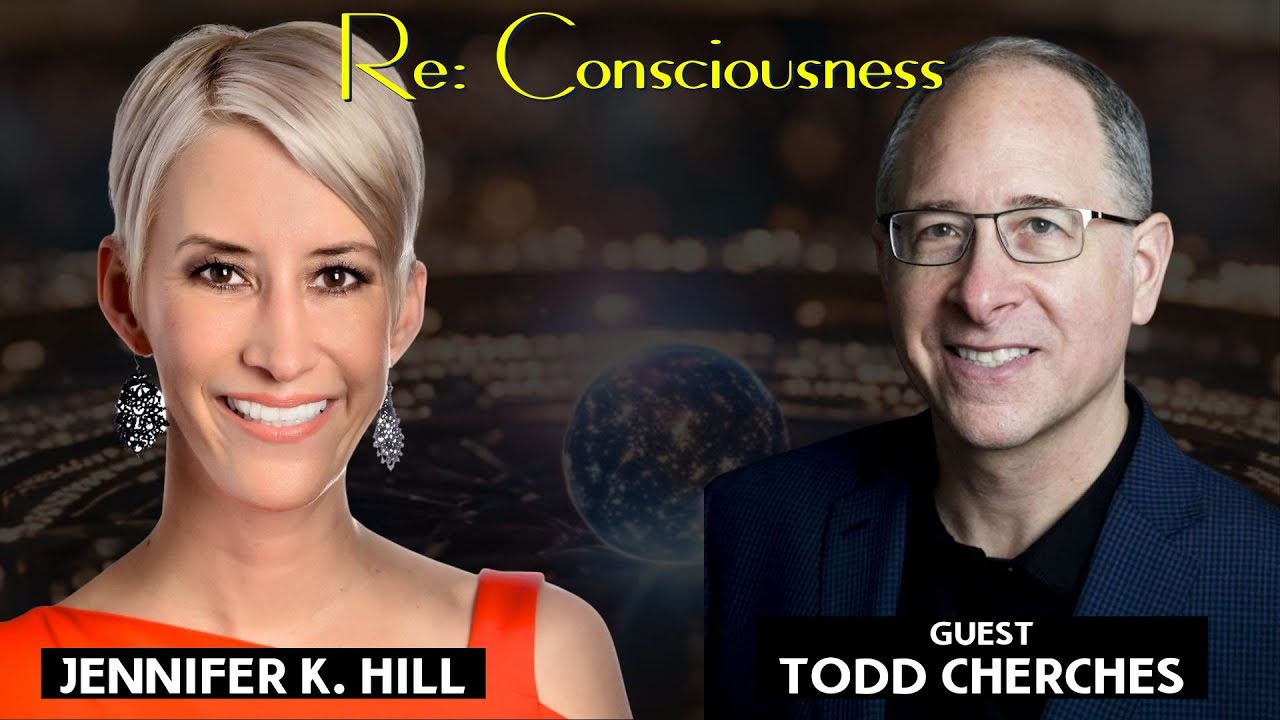
Todd Cherches, CEO of Big Blue Gumball and author of Visual Leadership, explains how simple drawings and gestures solved a language barrier on a theme-park project in China. He argues everyone is a leader and that visual storytelling is a skill anyone can learn through journaling, rehearsing, and frameworks like Pixar's story beats.
Chapters
Creating your own reality. Is it possible for me? I am Jennifer K. Hill, the Consciousness Architect, and I am here to tell you that it's not only possible, it's closer than you might think. Welcome to the show. Hello friends, and welcome back for another episode of Regarding Consciousness. I am Jennifer K. Hill, host of this show and CEO of OptiMatch, om.app. And it is our joy and privilege to scour the world and find you some of the top thought leaders, scientists, and bestselling authors on all things consciousness. Because as you probably heard me say before, if this is your first episode, welcome. But as you may have heard me say before, our focus here is how can we expand our consciousness and bring greater awareness and consciousness to everything we do in life. And today's episode is going to be around leadership. We have a wonderful, incredible bestselling author, award-winning professor today joining us, who I've had the pleasure of getting to know through 2 different groups that we're mutually a part of, the Octopus Movement and another dear friend, Meredith Bell. So Todd Church's is the CEO and co-founder of Big Blue Gumball based out of New York and is a management and consulting as well as training and executive coaching firm. They have their patented visual leadership approach that Todd uses, and he is a 3-time award-winning adjunct professor at the New York School of Professional Studies. Todd, it's such a pleasure to have you here today. Is there anything else you'd like to add to that? That I— you have so many accolades. We could spend the whole episode just talking about all the incredible things you've done from your TED Talk to your book, Visual Leadership. But did I miss something?
Thank you, Jennifer. No, you did a great job. So at NYU, I've been teaching leadership in the HR master's program for 14 years, and I teach at Columbia University. I teach leadership for Broadway stage managers in their MFA theater program. So 2 very different audiences, but the bottom line is we all need to lead in order to succeed, and using visuals can help us do that. So that's our focus of our conversation today. But you also mentioned the word about expanding consciousness, and I keep this on my desk as a reminder. So if our minds are closed, there's no room for growth, but we expand our mind, it creates all of this space internally to think differently and try new approaches. So sometimes people say, oh, I'm not visual, or I'm not whatever. You're putting your own constraints or limitations on it. So we need to open up those closed minds, expand our consciousness, and then the possibilities are unlimited. So that's a little visual prop demonstration of how we can use visuals to convey and communicate abstract intangible Concepts.
So that's a little note for those of you listening on iTunes or Spotify. You can always find the episodes as well at Jennifer K. Hill on YouTube, where we share all the episodes whenever they air too. So I do encourage you for this particular episode to see the wonderful visual demonstration that Todd just showed us of basically a closed little ball that was just tight and had no room to grow, nothing. And then it was one of those amazing kind of 3-dimensional tricks where as he pulled it apart, He was illustrating how much space there is. And I think one of the things that really got me, Todd, before our first call was you said, Jen, please go. And if you have a moment, go check out my TED Talk. And I remember I'm sitting there watching it and I'm like, I don't know who you are. And I'm like, okay, cool. What's this about? And I'd love to have you share a little bit about that story of going to China, because to me, I think it's so powerful in how we can be not just leaders, whether you're somebody who's out there managing a team of 5, a team of 500 or 5,000, or maybe you're managing your family or yourself. We all have the opportunity to be a leader in our lives. So could you share with us a little bit about that story you do in the TED Talk?
Sure. So my TED Talk is called The Power of Visual Thinking, and I tell a story about when I went to China. That's my origin story. I was managing a theme park project in China. But I just want to hit on one thing that you said beforehand.
Yeah.
Leadership, how we view leadership has a lot to do with how we define and describe it. And there are 2 camps. There's big L leadership, which is you're only a leader if you're like a VP or CEO or president. And there's small L leadership, which is the fact that we are all leaders, even if we're just leading and managing our own lives. So you are a leader, you are a manager regardless of what you do. So it's not about direct reports, it's not about title or position. You are a leader. So anyone listening to this, 'cause sometimes I ask that trick question to my students, I'll say, oh, just for curiosity, how many people here are leaders? And then they don't know whether to raise their hand or not. And I say, by the end of tonight's session, we are gonna completely redefine what leadership means. I'm going to ask the same question, and at the end, it's a little showmanship, but everyone raises their hand and says, yes, I'm a leader. Just anyone listening to this, you are a leader regardless of where you are or what you do, right? So the story that you were referring to, long story short, I was working for a theme park production company in LA, in Hollywood, and we produced these life-size animatronic figures that we produced in LA, shipped across the Pacific Ocean, and I had to fly to Hong Kong and then go over to Shenzhen, China to oversee the installation of these audio-animatronic life-size animals, elephants, sheep, and cows in a theme park in China. And we got there, none of the workers spoke English and none of us spoke Chinese. That's okay. Now what do we do? We needed tools, we needed different things. So we just started gesturing like we were playing charades and we started drawing on pieces of paper like we were playing Pictionary. And like, Good thing I grew up, grew up playing those party games because that's basically how we got this project done. It was like, 2 words sounds like screwdriver. Or it was like we would draw a picture of a hammer and say, hold up 2 fingers saying we need 2 hammers. So that's like my visual thinking origin story. 'Cause it's not just about words through which we communicate, but through nonverbals, through imagery, through story, through metaphor. That's the, my visual leadership origin story. And then I ended up working in the TV industry for a number of companies, including Disney and CBS, developing TV shows. So everything I did had an element of storytelling, metaphor, character development. And those are the techniques and practices that I apply to my executive coaching work, as well as my teaching at NYU and Columbia, and all my management leadership and team building work I do with clients.
I can hear what our audience is thinking, Todd, and they're asking, well, what if I'm not visual? Or what if I can't tell stories. I get asked that time and time again. In fact, somebody I just referred you to last week, that's one of the reasons I wanted to connect you, is he was asking you about storytelling and I had recommended your book to him. What do we do, Todd, if we have a story that we're not good storytellers? Then how do we do that? And how do we learn to have our communication land in a more clear way? Because let's be honest, leader, not leader, whether you define yourself as a leader the way Todd just broke it down, the small L leader, which we all are, We all often have breakdowns in communication, no matter how much personal development you've done, visual or not. So 2-part question. Part number one, what if we have a story, we're not a good storyteller? And part number 2 is the leadership part of that is how do we have our communication land more clearly?
Yeah. The good thing is we are, some people say, oh, I'm visual or I'm not visual. The bottom line is we are all visual. And we are all wired for story. So if someone says, how was your day today? You say, oh, you wouldn't believe what happened to me today. You're telling a story, right? So a lot of times, real life example, I was once doing a workshop on visual storytelling for a group of 20 CEOs. And one of the guys says, I hate storytelling. I'm not good at storytelling. I said, and I said, why do you say that? He said, let me tell you what happened. He launched into a line that he told this really, he was trying to tell a story to a client and he completely blew it. But the story he told was so valuable, powerful. And impactful. Everyone else in the room was like, wow, that was an amazing story. Because he once blew a story many years ago, everyone else, he put that limitation on himself. He put that label or constraint on himself. And yet he showed how good a storytelling he was, storyteller he was. Because everyone in the group said, oh, you're an amazing storyteller. We always, we hang on every word. Like he actually said, so it's like how you define yourself as a leader, same thing how you define yourself as being visual or not visual or a storyteller, not storyteller. These are all innate. They're human qualities and they're learnable and teachable and developable. So that's what I would start with. Wherever you are, you could always be better. And if you're terrible, I talk loud and fast because I'm a New Yorker, but I am an extreme introvert. I always describe myself as a 3 Bs guy, a back of the room, behind the scenes bookworm. That's who I am. That's who I always was for the first 40 years of my life. So it wasn't until I took a communication and presentation skills public speaking course that they found that I have the skill and I could get better and it built my confidence. So the more you do something, the better you get at it, the more risks you take and the more confidence you gain and the more you develop those skills. So that's what I would start with is just say, if you say I'm not a leader, I'm not a storyteller, I'm not visual, yes, you are. Wherever you are, let's see how we can get you to the next level in all of these areas.
You're reminding me something, Todd, of what I used to teach people when I ran a recruiting company. I, years preceding that, I had started off doing a lot of television work myself in my 20s. And one of my publicists at the time taught me something very valuable. He said, all the great people who show up on television, they do this thing called blocking and bridging. They have these preset talking points that no matter what you're asked, you block and bridge. So, I would role-play often with job seekers who would sit in my office, and I would teach them the same skill of how to do that in terms of interviewing. Is I think it's a good practice for all of us to have 3 to 5 stories that really can be impactful. One of my favorite examples of this is Steve Jobs. I think in the, in the best speeches of all time, Steve Jobs' inauguration speech that he gave where he literally was reading it off of a piece of paper and it was 3 different stories and it was 18 minutes, 3 stories, and that was his keynote he gave. And I think it illustrates the point of you don't necessarily have to have it memorized. It doesn't have to be perfect if you can just share a story. And I always find a good way to tell if somebody likes a story is if they ask you for more. If they say, oh, tell me a little bit more about that, then it's a good barometer, right?
Exactly. Yeah. Stories have certain qualities. Stories have— Aristotle said this thousands of years ago— stories have a beginning, a middle, and an end. There's a villain, victim, and hero. There's a quest or a goal. There's an obstacle or barrier that stands in the way, and then there's some result at the end. So all stories— there are so many different storytelling structures out there that you can learn. Pixar has a storytelling structure. There's so many different frameworks. So like you said, what I recommend people keep a journal. As stories come to you, write them down. If you're going on the job interview, they're gonna ask you certain questions, right? Tell me about the time that you did this, or give me an example of that. Don't go in there cold and be like a deer in the headlights. Anticipate, and everything's about PMP, preparation and practice. So if you prepare for those questions and practice your answers, you're gonna be much more effective. Whether you're a startup going in to pitch to investors, whether you're a, you know, job searcher going in to meet with an interviewer, storytelling is the key to success in many cases because it basically provides backup for what you're trying to sell. And even if you're just selling yourself or selling a product or whatever, tell me, there are success stories, there are failure stories, there are cautionary tales. I have a stack here about 20 storytelling books. I'm like taking a deep dive into storytelling this summer. So there's so many resources out there that will help us to be better storytellers.
Agreed. And I think you started to touch on the second part of the question I was asking about communication. I think stories are one great way to have our communication land. Though, as leaders in our lives, I think we often say things and then we have the opposite result. It's like we say one thing and it's— this is why in what we do at OptiMatch, we literally call the different types fruits because it's that old adage. It's one person speaking apple and another speaking orange. If you were alive in the 1990s, they used to have these funny commercials that had Macs trying to talk to PCs and it just didn't communicate. So how do we make sure that we're both speaking the same language and that we're not trying to speak in a way that's not landing for the other person? And that's why the greatest attributes of any good leader—
Yeah. One of the models in my book is my 3-legged stool presentation model. I'm gonna describe it visually. So that, that's one of the things about visual communication. It could be visible to the eye, but it could also be visible to the ear. So if you're watching this on YouTube, that's one experience. If you're listening to it on iTunes, That's another. So we need to make things as visual as possible, even for people who are just listening with their ear, right? The 3-legged stool model is the stool represents the purpose. Whatever you're communicating or whatever you're presenting, the stool is your purpose. So you start with what's the purpose of this communication, right? Sitting on that stool is your audience, whether it's 1 person or 1,000 people. You need to think about who am I talking to? So just as you're asking about the stories you tell have to land with your audience, the metaphors that you use have to connect. And help them relate and need to resonate as opposed to disconnect or, or put up a barrier. So if you're a CEO and you're talking to your group and you're telling this great story to your employees about what happened at the yacht club after you played a round of golf the other day, you just lost 90% of your audience, right? Because they can't relate to that most likely, right? So you wanna tell a, a story that will resonate with the people you're listening to. Same thing with stories and examples. I'm a big baseball fan. I use a lot of baseball analogies. But if I'm talking to someone from India, I might use cricket, or someone from England, I might use football/soccer, or someone where tennis is more universal. So you, again, you wanna speak the language of your stakeholders, right? I think that's how you connect. That's how people say, I get you and you get me. Because one of my catchphrases is, how do you get people to, quote unquote, see what you're saying? And they're only gonna be able to visualize what they know. So you need to be able to paint a picture with words and create a mental movie in the minds of others. And if you're talking about things that they can't relate to or don't understand or have no connection to, you just lost them. So that's the key thing is speak the language. Just if one person's speaking Spanish and another person's Chinese, but you both speak English, then you talk in English. Otherwise you're just speaking a different language. And this is not just literal languages, but if you're in HR and you're talking to someone in finance, what's the language of finance? If you say we need a new HRIS, if they don't even know what that stands for, you're not getting the funding, right? But if you say it's a human HR, human resources information system, and here's the ROI of that. Here's how it will benefit the company. Then you've got their attention, right? So if you're talking to marketing or IT or finance, you need to speak the language of the listener, the stakeholder. And this applies to writing as well. So not just through spoken communications, but a text, an email, any other kind of messaging.
Beautiful. I love that. It's so good. I was, I like to write things down as people share them because as much as you may read something or hear something, for me, I find it ingrains for me when I write it down. And I think that's where so many of us lose our audience is we talk at people rather than to or with people. And when we bring our consciousness, tying in the consciousness element to the conversation, just as you showed that beautiful example of expanding the circle that you showed to start us off with today, then all of a sudden space becomes available. And then in that space, you can create something. I remember I was in a workshop years ago with a woman, and she said, in order to give birth to anything, you need space. A mother needs to have a space to be able to give birth to a child. And I remember she actually used the example in the class of New York City. She said, even if you look at New York, if New York didn't have Central Park, if London didn't have Hyde Park or St. James's Park, the city would almost close in on itself because you need space to be able to hold something bigger beyond it.
And to breathe, right? Just to catch our breath. To, you know, slow things down, catch our breath, be here now, right? So, that's a great— I live in New York. So, when you mentioned Central Park where I play softball, I play on 2 softball teams every week. Yeah. Without that, imagine living in Times Square and that relentless pace and the crowds and never having any escape from that, never having any breathing room to just slow it down, take things in. So, I love that idea of what's the Central Park in your life or in your mind where you can give yourself permission. To stop, slow down, pause, and, and, and just breathe. Because, and also the metaphor of if you have a cup that's filled up, there's no room for anything else in the cup. So sometimes you need to empty the cup, at least partially, if not all the way, to create more space to fill that cup. I just wanna finish up the metaphor of the 3-legged stool. Absolutely. Because the stool, the seat represents the purpose. Sitting on the seat is your audience or stakeholders, and the 3 legs of the stool represent your content, your design, and your delivery. So if you're sketching out a, a 3-legged stool like you would see in a bar, the 3 legs again are, one is your content. What am I gonna include and what am I not gonna include? The design is how am I gonna structure my message and what examples am I gonna use? Metaphors, stories, any materials I'm gonna produce. And then the 3rd leg is your delivery. That's the actual presentation or communication. So just like a stool with 3 legs, if you remove one of the legs, it's gonna tip over. When you're going to deliver a communication or presentation, if you don't start with your purpose and your audience and then think about all 3 of those legs, then your communication or presentation is probably not gonna be very successful. So it's a full set. You need all of those, the 3, 4, 5 different components. And every presentation has to have a purpose. Thinking about beginning with the end in mind, what do you want people to think, feel, know, and most importantly, do? at the end of your messaging.
Thanks.
There needs to be a call to action. Otherwise it's so what? So there needs to be, how do I want people to change or transform, whether it's their thinking or decision you want them to make. There needs to be some kind of purpose, reason for the communication, and some type of call to action at the end that lets people know what they should do with what they just took in.
I'm taking so many notes, Todd. Every time we have a conversation, I learn so much new stuff. So I'm going to read this to everybody because I want to be sure I got my notes right. So Officially. And I also want to be sure those of you out there note-taking also get it right. So we're talking about the 3-legged stool, and the top of the stool is the purpose. The audience is sitting on the stool, and then you have the design, the content, and the delivery, which are the 3—
In order: content, design of the content, and delivery of the content.
Oh, so it has to go in that order? Content first, then design, then delivery. Ah, very good. I'm glad you—
Because once you— so if you're asked to deliver a presentation or you know you have a meeting coming up, you need to think— this is all In our minds thinking about, all right, who am I talking to? What am I talking to them about? And then what am I not gonna talk to them about? What am I gonna exclude? Because we can include— one of the biggest things that people do wrong is they try to— they overload people with information, right? So you can't possibly— if you have a 5-minute speech versus a half hour versus an hour, you need to figure out within that timeframe, within that space that you were just talking about, less is more in a lot of cases. So sometimes we overload people, too much information on a really bad PowerPoint slides, or we give people too much where we drown them. This is saying drip on people, but don't drown them. We have a tendency, especially if we're excited. I do this too. I'm guilty of this because, as you could tell, when I talk about something I'm passionate about, I talk really fast. I give too much information, and then people like, "All right, I'm exhausted now. You just drowned me." So I need to force myself. In fact, my wife gave me this for those who are seeing this. It's a little snail shell I keep on my desk to remind me to slow down to a snail's pace. Sometimes doesn't work, but it's a good reminder to slow it down and let people take a breath and absorb all this information for a little bit.
I completely get that. My dear friend and business partner and coach, Arthur Samuel Joseph, trained Tony Robbins how to speak, and Pierce Brosnan, Sean Connery, Dwyane Wade, and many others. And Arthur, when we first started working together, he used to call me bird breath. So God forbid you Google my name and look at anything I did over a decade ago. I used to talk like this, and this is me. And then everybody said that listening to me was like drinking out of a fire hose. And so it has taken me decades of work. And still, like you, Todd, when I get really excited, then all of a sudden my pitch goes up and then I start to talk faster. And yet so much of it is like, you're an award-winning professor, so you, whatever you're doing, listen to what Todd has to say because he definitely has his system down. And that's the thing, though, too, I think, to counteract what you just said at the same time, Todd, is there is something to be said for exuberance. Because people— wasn't it Maya Angelou who said, people will forget what you said, they will forget what you did, but they will never forget how you made them feel? And I think that our communication as leaders in our life and the consciousness with which we communicate is directly correlated to how that communication lands. I was talking to a friend the other day. And she was telling me what she was going to tell somebody in her life of something that she was frustrated about and a reason she couldn't go to something. And I said, what if you could say that same thing and remove any judgment or righteousness? Think of how often we say something benign. Oh, I can't join you for dinner tonight. And yet it's— there is, hey, I'm so sorry. I can't join you for dinner tonight. I can't join you for dinner tonight. And then we often text and then you don't even know the tone under it. And if it doesn't have the happy face emoji next to it, then you spend the next 3 days in a hole and wondering what you did wrong, right?
Yeah. So many say— I teach a whole module in my course just on that, on miscommunications, because we all have filters, right? We filter things. And think about visuals, right? A coffee filter, an air filter, a gas filter. What the filters do, they let some things through and keep other things out. So we all have external filters, noise and distractions and multiple things going on. But we also have the internal filters in our brain, and it's so easy to misinterpret someone's text or misinterpret someone's tone of voice or their words. So I was— I love the phrase assume positive intent, right? If you start from the fact that I'm going to give this person the benefit of the doubt as opposed to canceling them just because— because so often we say things, we're in a rush or we're distracted and it doesn't always come out the way we meant it, or it's not always interpreted the way we hope it was. The message was intended to be delivered. So that's a great reminder is our tone of voice, our body language, Emojis, that's a great visual tool, but even emojis without words can be misinterpreted because it's just a visual image that people could filter through their own lens. Words without emojis, you don't always know someone's tone. That's why when you use emojis and words in combination, that's often a very powerful and creative way to communicate. So there's a concept called dual coding theory that when we use both words and imagery, it's more powerful than either words or imagery on their own. There's a lot of science behind that, but I'll just leave it at there. But when you use emojis, use them sparingly and strategically. Some people have 30 emojis after this. I don't have time to decipher each and every one of those. But again, be purposeful and try to view things. I call it flipping the eye. Try to see things from the lens of the recipient and filter it through their lens. And then that will help you to formulate better communications and presentations. If you know, every audience member always has 2 thought bubbles hanging over their head. One says, why should I care? And the other one says, what's in it for me? So any communication needs to address Here's why you should be interested here, and here's how you'll benefit from this. If you don't hit those 2 thought bubbles, then you've lost the purpose. So the purpose and the person, because everyone's always trying to fill— I'm talking about filters. Everyone's always filtering things through that lens of why should I listen to this person or read this email or this blog post, and how will I benefit from it? You need to be able to set the context and sell the value upfront that you want to hook people in and engage them in that messaging.
Oh, Todd, my brain is just buzzing with wonderful information. My consciousness is buzzing. My brain is buzzing. I think that you've given us so much information, and I feel like— I know I feel satiated with the immense amount of information and wisdom. I also don't want to leave that piece out. Todd, you've shared so much wisdom today. Just in case there's something we left out, maybe something I didn't get to ask you, is there anything before we get into where people can connect with you? That you would like to leave our listeners with? Any other last pieces of wisdom or something you'd like to reiterate?
Sure. I'll do this visual for those who are looking. We can talk for hours, but one of the key messages is, if you notice the COVID of my book, even if you're just listening, has a rainbow-colored eye. And the rainbow eye on the COVID of my book represents the fact that just as there's no one in the world who has a rainbow-colored eye, or anyone I've ever seen or met, No one in the world sees the world through the same lens that you do. So if you just start with that, because when leaders say, why didn't you just do that? Or it's so clear to me, or didn't you get my memo? It's not clear. Like, I would say the burden of communication is on the communicator. So we need to remember that rainbow-colored eye and remember the fact that just because you see something— there's a saying by Thoreau, it's not what you look at that matters, it's what you see. We all see different things even when we're looking at the same thing. So just remember that. And if you use all the colors of the rainbow, all the colors in the crayon box, to communicate and to innovate, you're gonna be able to be more effective and more successful when communicating with people who see things through a different lens. So I'll leave it at that. And I loved our conversation and hopefully people will check out my book and my TED Talk to learn more about how they could be a better visual thinker.
Amazing, Todd. Oh, so juicy. I love it. So again, the book is Visual Leadership. I'm sure people can buy it where books are found, Amazon, et cetera. Where else would you like people to go to connect with you? I know you have your own website. What's the best
Yeah, connect with me on LinkedIn. I'm on LinkedIn all the time. Just say you saw me on Jennifer's show, and I'm happy to connect with you and continue the conversation there. I have 2 websites. One is my company, bigbluegumball.com, but just go to toddchurches.com if you wanna watch my TED Talk, learn more about my book, and learn more about what visual thinking and visual leadership are all about.
Thank you so much, Todd. Thank you for sharing your heart, your wisdom, your lens of how we see reality. And I remember years ago, I was thinking of doing a TED Talk around this. I never got to it. Is what if first we could look at the lens or the filter that we see the world through? Second, what if we could choose and actively participate in the lens we put on any situation, just as you so beautifully said with the I on your book? And third, what if one day we can get to no filters? So I'll leave you to chew on that, just like a big blue gumball. Thank you so much for tuning in today and looking forward to having you here for a very special next episode, which is going to be a second time that we're having Dr. Cynthia Sue Larson back, quantum physicist, for a Halloween episode on her latest book, The Mandela Effect, and piggybacking on the last interview we did on her book Quantum Jumps. Thanks for being with us. Thank you.
More from Jennifer





Episode 33 - Stillness, Power, and the Art of Transformation with Marcia Martin


Episode 32: Three Seconds of Courage & Turning Reactivity into Creation with Josselyne Herman-Saccio

Episode 31: Your Spiritual Heartbeat & Aligning Your Inner Truth with Outer Success with Liv Fisch


