What Lights You Up? with Special Guest Yanik Silver
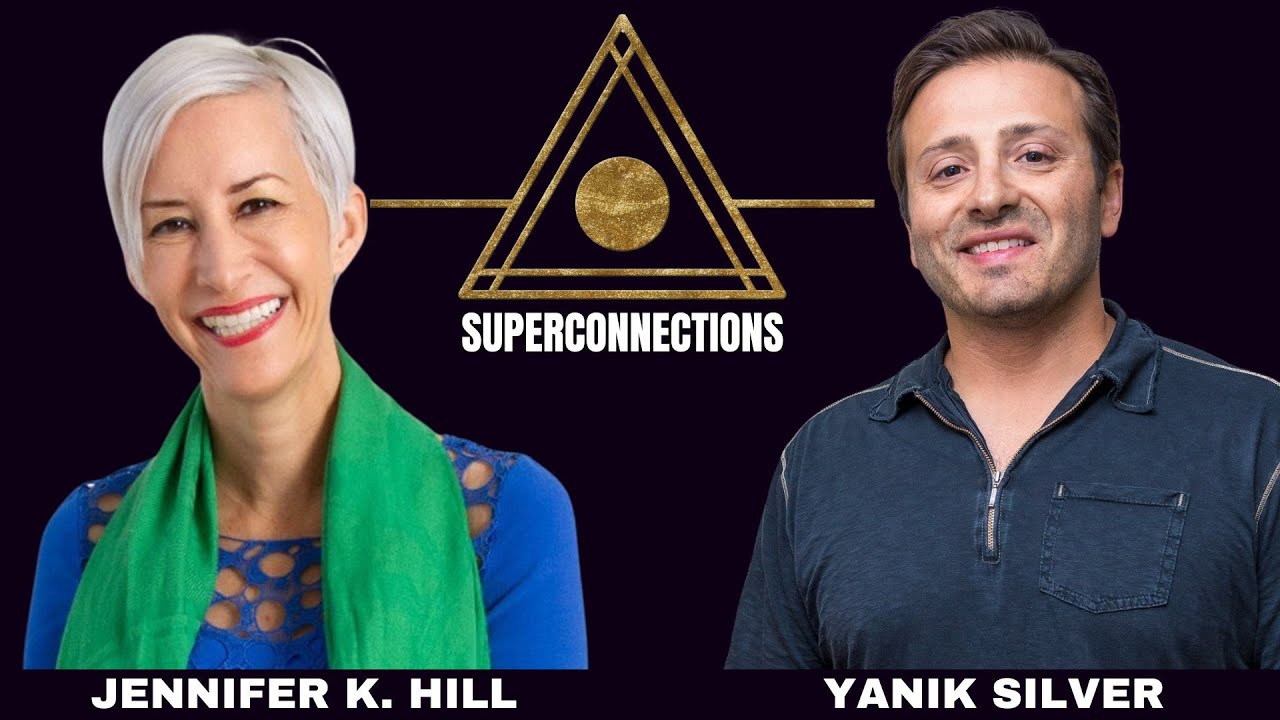
Yanik Silver moved from high-earning digital marketing to following what he calls his "cosmic alarm clock"—a daily inner voice asking honest questions. He uses a three-circle framework called the Golden Triangle (growth, impact, fun) and built Maverick 1000, a global community blending business, philanthropy, and play through experiments like 100-day art challenges and creative games.
Chapters
Welcome to Super Connections. I am your host, Jennifer K. Hill, helping you with the Golden Triangle of Connection, where you will super connect to yourself, others, and your purpose. Join me each week as I will share from some of my favorite tips and tools for super connecting, and I'll bring in some of my favorite friends and thought leaders To help support you on your journey to super connecting to the life of your dreams. Hello friends, and welcome back to the Super Connections Podcast. I am your host, Jennifer K. Hill, and you are joining us for episode 22 of Super Connections, where we explore how to super connect to yourself, others, and your purpose. So what better way to help you to super connect than to have one of the world's greatest galactic goofballs, maverick mischief makers, and cosmic catalysts, as well as human super connectors that I have ever met, Janik Silver. He redefines how business is played in the 21st century at the intersection of more profits, more fun, and more impact. Janik is the creator of The Cosmic Journal, which I personally use and love, author of Evolved Enterprise, and the founder of Maverick 1000. A global network of top entrepreneurs, visionaries making a serious difference in the world. In fact, he loves to dress up as a lemur, a showgirl, or even a mermaid. And he might do a puppet show for us if we're lucky.
Maybe. Welcome to the best episode ever.
I know, right? That if you wanted fun, if you needed a little, like, a little juice, a little uplift today, you're definitely going to experience fun with this guy. So, Janik, shout out to all of our mutual friends who brought us together. Maya Marshall-Weeder, Jem Fuller. I had heard your name for a long time, and it is such a delight just to have you in my life. Like, how we went this long without meeting each other blows my mind, right?
Impossible.
Yeah. So tell us a little bit about your journey. What helped you to superconnect to yourself? I know you are like this galactic goofball who loves to just play with space and time, which I think is one of the many reasons you and I resonate together. But talk to us a little bit about your journey and how you came here.
Yeah. So, I think the connecting to yourself is, I think about this concept of, I call it the cosmic alarm clock. And it's like you can either hit snooze or you can answer it. And it's like that little voice, it's never going to be the loud bang. It could get louder and louder as you go along. And it's really designed to wake you up. And so, for me, it was, I've had it multiple times, but most recently it was about 17, 18 years ago where I came from the digital marketing internet world, was doing very well and pretty great reputation, making a lot of money, driving the hot sports car, kind of all the things that you would expect, right? As the success looking from the outside in. And I just asked myself a super simple question, which is, am I happy? And would I be happy doing what I'm doing 10 years from now? And so in my journal, which is one of those, I think, secret foundational things that, that is a great practice of connecting to yourself is a journaling practice. And we can talk a little more about that in a moment. But I wrote that question and I answered truthfully, and the truth was no. And it wasn't like I was terrible. Like, I was helping so many people. I'd show up at random events even if I wasn't speaking there, and they'd be like, oh my God, Yannick, you changed my life. I sell guitar lessons online now or whatever because of you. And it was always very rewarding. When I really went deeper, it was like, that's not what I truly wanted to do with my life. I felt like there was a deeper impact. And so, following your heart, I say, is always— can be scary but never wrong. And you have to really tune into We talk a lot about connecting your head, which is our business side or maybe our marketing side, whatever. And then your heart, which is the impact you want to have. And then your higher purpose, like how do you bring it all into alignment? And then of course, not to forget your happy, goofy inner child, bring that along for the ride and connect all of that together and then see like what comes up. But that journaling practice to me is one of those foundational pieces to really help you connect. And from that, that question came these 3 circles, these little interconnected— what I've since learned is called the Venn diagram, but it was originally make more money, have more fun, give more back. And we've since changed it to growth, impact, and fun to represent like a tree, a happy face, and a heart. And to me, that's like the nucleus of everything.
Beautiful. So let's imagine somebody's listening right now and they're not having fun. Life is tedious, it's hard, it's challenging. I'm sure none of you out there— let's just imagine there's one person in the whole world who's having that experience, right? What would you say to them, Yannick? How can they help get out of their head into their heart, have a little more fun? How can they have a more fun experience if life is lifing, right? And it doesn't necessarily feel fun.
Yeah. And I want to clarify that I don't wake up every single morning. I'm like, oh my God, this is so great. And I get to play with puppets and I draw and I, but I do add these creative aspects into my world. And the more you can intentionally add them. So I go back to, there's a magic moment, I think between about 8 years old to maybe 13 or so, maybe a little younger, maybe even 6 or 7. But you start thinking about, all right, what did little Jennifer love to do? What did little Yannick love to do? And then you come back to that moment and that's how you add some of the fun. It's like, all right, what did— like for me, I wanted to be a professional hockey player and a cartoonist in the offseason. And I still play men's league hockey and I definitely did not make the NHL, but the drawing came back and that was really interesting. And during the time when things were going sideways with my business and that had never happened before, I had built like 7, 8 different like 7-figure product services all without really trying. And then Maverick, which was that the genesis of that whole exploration, was going sideways. I'm like, what is going on? And I care more about this than anything else. And so it had me really go back to some of the roots and some of the foundational stuff. And one of them was actually drawing. And that was like my creative expression. And I remember writing Evolved Enterprise because that was the culmination of part of this journey. of all these little puzzle pieces of people like Sir Richard Branson being a part of it, but then also some unknown people that were all part of this idea of how does business make a greater difference in the world. And then, so I was writing, I was on the deadline, and I remember literally at 3 o'clock in the morning, I just got this surge of energy. I'm like, oh, I know what it's missing. It's missing my drawings. And so I added some of my doodles to the book, and then I felt like I truly put my heart and soul into it. So going back to what did you love as a kid? And then Seeing where you can insert it. And it's not just a frivolous thing. It's truly meaningful for you. And think about where can that be inserted? And then also, who would you want to play with? So I bet there's more than a few people that you're like, yeah, we don't get enough time together. And so designing something that, that's just fun. It could be an experiment. I love experiments. So we can talk about those too.
Yeah, I love this. It's much like you, Yannick. I forgot when I was a little girl, life happens, right? We get bullied, we make mistakes, people make fun of us, and then we suppress that side of ourselves, right? judges your drawing and you say, oh, I am not a good enough drawer. Yeah. For me, that is how it was with dance, is I remember being a cheerleader when I was 15 years old, and our cheerleading coach, when we were doing a particular dance routine, said, we are only as good as our weakest link, which is Jennifer. So keep that in mind. Ooh. And for decades, Jannik, I forgot about my love of dance. So long before I became a cheerleader, I would dance around. I would put on my grandma's bathing suit, and because it had little tutu-like stuff on it, and I would dance around my grandparents' living room when I was a little girl. And then fast forward, I started doing inner child work, and we have done some episodes on that podcast. And when I started doing inner child work, I forgot I loved to dance. So now I have an agreement with my inner child. Every day we dance, and at least once a week she gets ice cream, because those are 2 of her favorite things, is ice cream and dancing. And so I would love to hear some experiments of what are some ways that we can begin to play with this little version of ourself, boy, girl, they/them, and integrate them and experience them in day-to-day life.
Yeah. So it's gonna depend on what did you love or what did you wanna do as a kid? And none of 'em are wrong and they're, they come from this beautiful aspect of our true essence. And so for me it was the drawing and it, and, and what really came through, I would start drawing again in my journal and I've been an avid journaler for many years. And what came through was the drawings of my journal. And then, like I said, in, in the book, but then it was this 100-day experiment that I saw. It was like a 100-day art experiment and I don't know where I ran across it. I'm like, Wow, that feels like a lot. And I had done other experiments before, 33 days of no alcohol or no sugar or just different things. Because again, I love experiments because there's like a beginning and then there's an end. And then you see, does that enhance my life or not? And then you're not committed to it forever. And so I saw this 100-day art experiment floating around and I'm like, in my journal, I wrote, wow, that's a lot. I travel around a lot. I don't know if I can do that, but I'm like, let's just see what the byproducts would be. And it was amazing. It was like the thing that I look forward to all day. And no matter what, like when you make that commitment, that's really big too. It's that commitment truly? Like the way we set an appointment, it's like, all right, we're keeping that appointment with someone else. Like this appointment, right? On my calendar, I'm like, I'm showing up and I want to show up in my best way. Meditated before this and just, okay, this is a sacred commitment. But can you do the same for yourself and truly hold it in that same way? And again, it doesn't have to be 100 days. Could be 33 days, could be 22 days. This is the episode 22. Make it 22 days. And then, but enough that you can see and see how does it impact your world. And so like for you, you're like, all right, I'm going to dance every single day. And for some of us, we need like a little checkbox, right? So you have somewhere, you have a little checkbox, maybe it's on your wall, a whiteboard. For me, it was in my journal, the 100 days. So I started a new journal and it was just a page a day. And I was like, I don't know what I want to draw. I'm like, I'm going to draw a journal page every single day, like a drawing and then something, whatever comes through me or some of my old pages. And it was really incredible after day like 50, Or 60, I started using it like an oracle and I'm like, oh, what does it need to know? Or what do I need to know? And I'd flip it open and I'd be like, oh, okay, this is really cool. And I just started falling in love with the process and I loved this so much. I'd carry it around, I'd show it to people. And then one of my friends is like, dude, this is amazing. I see how you light up about it. I'm going to pay to publish this. So it never was like really a project originally. And then it turned into a project and then it turned into a Hay House book. And then it turned into a set of oracle cards. So it's like, and it's like my most fun, most engaging project because it just beautifully flourished out of really my inner child.
I love it. And that's the thing is I was just on a call with some coaching clients earlier. I coach about 5 or 6 CEOs at any given time. And so many of the people I coach, they talk about they might have success in business, right? But then the play and fun dies out in it. How do I know What opportunities to say yes to? How do I know if I want to write a book, I don't want to write a book? How do I know what's going to light me up? And in fact, speaking of books, a friend of mine wrote a bestselling book last year called What Lights You Up? And that's my question to ask people is ask yourself, journal with yourself, ask yourself, what lights me up? And then go and do that. Because what this world needs is people who are alive and lit up. And maybe it does turn into a business. But I actually just wrote an article a couple of months ago. I think I referenced it in the last one of the last episodes. Yeah. Called What Will We Do When There's Nothing Left to Do? And with this amazing emergence of moving towards AI and so many things that were cumbersome and heavy that we didn't like to do, like maybe answering emails or administrative tasks that can now be automated, what does that free up for you? So there's both this vacuum that's about to be created in the workplace and in our own lives that's going to be now taken up by some of these technological advances. And the question becomes, what do we do with that vacuum? Who do we wanna be? What do we, what brings us the greatest joy? And if you have an extra hour, 2 hours, 4 hours a day, do you spend it with your kids? Do you dance? Do you draw? Do you sing? What is, what lights you up?
Yeah. Let me add to that, Jennifer, which I think is what I love is like usually it becomes 2 or 3 things combined. Yeah. And a lot of times, especially as successful or ambitious entrepreneurs are like, if I can't be the best or one of the top in this thing, why would I do it? And when you start actually binding things together. So like my drawings here, I'll show you like what some of them look like. Actually, here we go. This is perfect. So it says, your questions create your answers, right? So you can see the page and then the drawings are not like, actually, this is one I really do enjoy. This is—
I love that one. Yeah.
This is really fun. But so like the drawings, I had an interview with one of my friends and it was, I think she meant it as a compliment and it came across mostly that way. She's like, your drawings are not the absolute best or something like that. But she like meant it as, hey, anybody can do what they're, what they're meant to be doing. And I'm like, thanks, Jess. I appreciate that. And, uh, and she's like, no, I just want people to know that they can put out stuff. Like, we're so busy comparing ourselves, especially with social media. And it's like, all right, well, this is not at this level, then why should I even do it? But your own unique expression of it is going to be what the thing really deserves. And so for me, it's like drawing, but then also adding like some wisdom and wittiness and some basically whimsy to it as well. And that's where some of the unique combination is. And I think there's, if we can combine 3 things together, when I talked about for Maverick, those interconnected circles, the, now it's a tree, happy face and a heart, right? Growth, impact, and fun. That's a unique expression and you can add that to your own world. So it's not just like, all right, play for play's sake, which is also a great thing, but could it be combined in some way? And it doesn't have to be a business. It could turn into one. But for me, the play also, what lights me up when I started Maverick, I'm like, I want to go on amazing adventures with my friends, combine it with business, combine it with charity and philanthropy and a lot of fun and see what happens. And we would do everything from fly, make— the first one was a Baja dune buggy racing trip because I love Baja dune buggy racing. I'm like, ah, I could get some other friends with me. And they all, everyone had their own businesses and whatever they were doing, they were busy. But if you invite people to something that's really fun and playful, they'll show up. And what happens out of that is incredible connection. You can't even put a dollar amount on that.
I agree wholeheartedly. And that's it. It all comes back to when we connect to the deep inner fun and what lights us up, that simultaneously connects us to others because we're going to find like-minded people. I was at dinner, actually, with a guy last night in New York who's a prominent doctor, and he was talking about med school and residency and how there was this guy, right? And he was like, not vibing with this guy. This guy was like a jock, like a good old American boy, and he's not that guy. And so he's like, oh, he's just not my people. And then somehow or another, after one of the classes, this guy's, hey, let's go to a bar, let's hang out together. And he goes out and he has so much fun that he and this guy, 20 years later, post-residency, the guy who was like, that's not my person, they went and had fun together and they've been best friends now for 20 years. Yeah. So where are we stopping ourselves from having fun? And allowing ourselves, because that we first have to ask ourselves, what even is fun to us? And I think that the more we connect to that deep sense of inquiry of what is fun and play and lighting us up look like, then from that emerges something beautiful.
Yeah. And then can you invite others that you want to spend more time with, especially deeper, more meaningful time with? Can you invite them into what feels like play for you? And then also, and again, this is some exploration, and I think journaling is such a great way for it and other modalities and other work, but who are you at your true essence? And I think there's layers to it. So the more you can get down to what is that truest expression of who you are, then you can have these deeper connections with others, with yourself, and then invite others into this aspect, the sandbox really, to come play with you. And the more you make it experiential, the more you make it fun. So my wife gives me a hard time. She's like, you can't just have a dinner, can you? I'm like, but why? If we're gonna have a dinner, then why not add? So I have this game called Dinner Quirks. that we play sometimes, or Dinner There. And Dinner Quirks is everyone gets either an envelope or a text. So half the people get envelopes that say, welcome to Dinner Quirks. Here are the 3 things that you'll be performing tonight. Don't tell anyone else. And then the other half get envelopes that say, hey, here's an engaging question that you can ask, you know, your neighbors. And so half the people think that everyone else got questions. Half the people got— think that everyone got these quirks. And the quirks are like, You're the high fiver. You're the, you're the verbal texter. WTF? You're the, you're the air quotes guy or gal. You're the, you challenge people to push-up contests. You're the one-upper. So there's stuff that is like ridiculous and there's a whole slew of them. You're the close talker. So stuff that's slightly annoying and slightly funny and it just creates chaos, but it creates more fun. And so I'm all about like, all right, how do we take something and turn it into just more, more fun because people are going to remember that. There is times when I've forgotten to tell people that they were playing Dinner Quirks and they leave thinking, oh, all right, that person was very odd. But—
That is hilarious. And that's beautiful. I think that the takeaway I'll say from this episode is play. Whatever play looks like for you, go play, explore, adventure, discover what that is. And it can be different. Maybe you like to collect stamps. Maybe that's your idea. And I'm sure there's a community of people out there who want to do that with you. So Yannick, this has been so uplifting as always. I love our time together. I always feel revitalized by it. Any closing thoughts before we tell people where to connect with you and your work with Mavericks?
No, the biggest thing I think is to go, if you don't find, like you said, collecting stamps, there are definitely groups for that. But I also find for some people it's, I want to create my own group or community of people that collect stamps, but are also into, I'm going to make this up, are into French Bordeaux and who are into something else. puppets, right? So we're gonna, we're gonna collect stamps with puppets and drink wine or something like, like, who knows? But if you combine things that you really love, you'll find those exact people and then you become that center linchpin or hub. And it's even more incredible for what you want to do.
So powerful, my friend. And where can people connect with you if they want to find out what you're doing? Of course, we'll have in the chat or in the show notes a little bit about some links for you, but anywhere you want to suggest that people go to find out what you're up to? Connect.
Yeah. If, if you're an amazing entrepreneur who's doing something incredible in the world and you want to come play with us, go to maverick1000.com. And I just started a new daily newsletter of my drawings and I call them, they're 1000sunsparx.com. So every single day is a new sunspark.
Ah, incredible, my friend. May this conversation have sparked something in each one of you. May you reconnect to that spark of joy of, as my husband calls it, delightment. And just go out there and experience more joy, more delight, more fulfillment that will lead you to your purpose. I'm Jennifer Cahill, and I thank you for being here with us.
More from Jennifer





Episode 33 - Stillness, Power, and the Art of Transformation with Marcia Martin


Episode 32: Three Seconds of Courage & Turning Reactivity into Creation with Josselyne Herman-Saccio

Episode 31: Your Spiritual Heartbeat & Aligning Your Inner Truth with Outer Success with Liv Fisch


