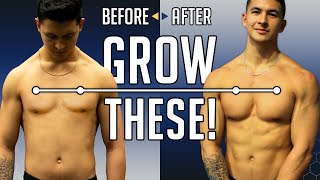
YouTube fitness tutorial describing two primary chest-building exercises—a low-incline dumbbell press and cable- or band-resisted fly/push variations—and the scientific reasoning for prioritizing them. The presenter explains muscle activation differences, strength-curve complementarity, practical setup/tweaks (15° low incline, arch/tuck technique, band alternatives), and a recommendation to replace excess variety with focused progressive overload on these movements.
Chest is one of the most enjoyable muscle groups to train, yet at the same time, it seems to be a muscle group that many people struggle with. Developing this then often leads them to throw every single possible chest exercise at it in hopes that it'll grow. But the truth is, this often does more harm than good. Today I'll show you how you can get the most bang for your buck in terms of chest gains by instead just focusing on two very simple yet effective exercises that when paired together, can make a big difference in your chest development. Development the first exercise is the low incline dumbbell press. Pressing movements for the chest are necessary because it enables us to apply a high amount of tension to our chest over time, since we can both lift heavier loads with it and easily progress it over time with more weight. But dumbbell presses in particular have advantages over barbell presses since it allows us to achieve a greater range of motion on our chest fibers while also enabling us to have more freedom with our elbow and wrist positioning as we press. This gives us the freedom to tweak our form to better suit with our individual chest fibers and with what just feels most comfortable on our joints. Now, a low incline press is chosen here for a couple reasons. The first reason is that we want to ensure that we're adequately training each portion of our chest, the upper, middle and lower fibers. And what we typically see with chest development in general is a lagging upper chest, commonly due to a high amount of flat pressing done relative to the amount of incline pressing. In fact, a recent 2020 paper had subjects perform only the flat bench over the course of eight weeks, the middle and lower portions of the chest grew considerably faster than the upper portion of the result. However, at the same time, this does not mean that we want to perform a typical incline press because research has shown that even an incline up to just 30 degrees, so typically just two notches up from the bottom of a flat bench results in greater upper chest activation, but comes with the cost of significantly greater front delts activation and significant mid and lower chest activation when compared to a flat press with an incline up to 45 degrees now proving to be even worse. Whereas with a low incline up to just 15 degrees, you still get a significant boost in upper chest activation, but with less of an increase in front delts involvement and with less of a drop in activation from the middle and lower portions of your chest. And I'd even argue that when you then apply a slight arch in the upper back and tight tuck the elbows in slightly as you perform this movement, you'll now be aligning the resistance with even more of your chest fibers and experience even greater activation of your whole chest. But going beyond chest activation and growth, the second reason why this exercise is beneficial is comfort. This is because with the flat dumbbell press at the bottom position, your shoulder tends to be put in an internally rotated position, which can become problematic or uncomfortable on your shoulders, and especially if you lack sufficient shoulder mobility. But by adding a slight incline, your shoulders will be now placed in a slightly externally rotated position, which for many is just a much more comfortable pressing position for the shoulder to be in. Now, this isn't to say that flat dumbbell pressing is bad and should be avoided, but it's just another unique benefit of the low incline press and is why I highly recommend that you include it in your routine. And if you currently only have access to a flat bench, or you want to try out an even lower incline than 15 degrees, or then simply adding one or two weight plates under your flat bench is a great alternative and will provide the slight bit of incline that we're looking for. The next exercise is going to be any sort of cable or banded movement like a seated cable fly, or if you don't have access to cables, then banded push ups or banded flats. Now, the reasoning for this movement has to do with the strength curve of our previous exercise. During a dumbbell press, our chest experiences the greatest amount of tension at the bottom stretch position. But as you press the weight up, the resistance progressively decreases until you reach the top position, where the chest now receives very little stimulation. And what we know about muscle growth is that exercises with different strength curves will likely produce different amounts of muscle growth in each region of our muscle. In fact, as illustrated in a 2015 paper, by Simply altering the strength curve of a knee extension, subjects not only experience different amounts of muscle growth in each of the various muscles of the quadriceps, but but they also experience different amounts of growth within the specific regions of each muscle. Which implies that if we stuck only with the dumbbell press, or if we added in other chest exercises that have a similar strength curve, like the dumbbell fly, for example, then we'd be failing to adequately train and stimulate our chest in a locked out position. This would mean that some muscle fibers of our chest would remain understimulated and hence could could cause us to miss out on some additional chest gains. The cable fly accommodates for this by providing adequate tension on the chest throughout the whole range of motion, especially during the fully contracted position. Similarly, if you don't have cables, the Banded push up or banded fly is a suitable alternative since the resistance applied to your chest will be lowest at the bottom position, but then progressively increase as you lockout and reach the chest fully contracted position. By combining these two movements and the respective strength curves, you'll ensure that you don't miss out on any potential chest gains. Now what you choose to do with these two exercises is totally up to you. I would definitely recommend plopping them somewhere into your current chest routine as you see fit for the reasons that I previously went through. And if you're currently doing a ton of different exercises and volume for your chest yet you're not making any progress, then simply shifting more of that volume and effort to these two movements instead while focusing on performing that with proper form and progressing them over time will do wonders for your chest development. Oftentimes more is just not better. And for a step by step program that uses science to show you exactly how to train and how to fuel your body week after week so that you can build muscle and lean down as efficiently as possible and simply head on over to builtwscience.com and take our analysis quiz to discover which of our programs is best for you and your specific body. Anyways, that is it for today guys. Thank you so much for watching. Hope you enjoyed the video. Please don't forget to show your support by giving the video a like leaving a comment down below. So what you'd like to see me cover next? Subscribing to the channel and turning on notifications for the channel as well as this all really does help me out. Thank you so much. I'll see you next time.