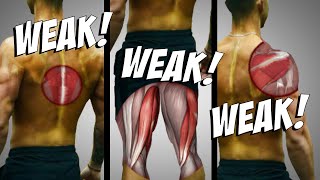
This single-speaker YouTube tutorial explains three commonly neglected muscles that create imbalances and slow strength/muscle gains: the lower trapezius (scapular stabilizer), the hamstrings (often weak relative to quads), and the shoulder external rotators (rotator cuff). For each, the speaker cites scientific findings (a 2017 paper showing trained lifters lacked greater lower-trap strength vs untrained; a 2014 S&C Research paper linking external-rotator strength to lower shoulder pain rates) and gives practical corrective exercises and programming tips (e.g., wall slides, scapular pull-ups, prone Y raises; include hip- and knee-dominant hamstring work and eccentric focus; face pulls, full can, sideline ER). The video ends with a program promo and viewer-engagement ask.
Questions this video answers
Trained lifters had significantly greater strength in larger muscle groups but the lower traps showed the same strength level as untrained subjects.
Among a group of 46 trained lifters, those who regularly performed external-rotator strengthening exercises had about a 2% incidence of shoulder pain/impingement versus roughly 18–20% in those who did not.
When it comes to building muscle, most of us put all of our attention on our mirror muscles, as these are the muscles that we and others can actually see and they visually demand the most attention. Unfortunately, as a result of this, the various muscles that we can't see or don't even know exist get neglected in the process, which over time leads to crucial muscle imbalances and weaknesses that people only care about when it starts to catch up to them, whether it be through an injury, blow, postural imbalance, or an inability to perform a lift, for example. So in this video, I'll go through three of the most common muscle imbalances that your routine is likely creating, why they matter, and how to then correct them right away. The first muscle you're neglecting are the all important lower traps, which are simply the lower fibers of your trapezius muscle. Now, although this muscle doesn't do much in terms of improving the aesthetics of your back, they do play a very important role in scapular stability to help you properly move and rotate your scapula. And when the lower traps are weak or imbalanced compared to your other muscles, the instability that this creates can not only put you at a greater risk for shoulder injury, but it also negatively affects your ability to execute various movements, such as pressing weight overhead or even maintaining a stable base of support during the bench press, for example. Meaning that keeping this muscle strong relative to your other muscles is crucial because yet it's something that most people just don't do. Because although it does play a role in various back exercises like rows and pull downs, your more powerful muscle groups, like the upper traps and lats often tend to take over instead. So if you aren't allocating time to directly train this muscle with lower traps exercises, then it's very likely it'll end up weak over time. And in fact, a 2017 paper provides evidence supporting this. What they found is that when compared to the strength of a group of untrained subjects, trained lifters had significantly, significantly greater strength in all of their larger muscle groups, except for the lower traps, which instead had the same strength level as the untrained subjects, which is a finding that's been documented in other papers as well. So how can you best avoid developing this imbalance or start to correct it? Well, you can start by simply incorporating a few lower trap specific exercises into your routine to first activate it and then gradually build up its strength. So what I'd recommend starting with are something called wall slides, where you stand with your back against the wall, ideally with your Lower back flat against the wall. Then you simply slide your arms up, mimicking a shoulder press movement pattern as far as you're capable of doing. And you want to avoid arching your back and losing contact with the wall as you raise your arms. And if you're unable to do so, you can take a few steps forward to make the movement easier. And during each rep, you should feel a strong activation in the middle of your back as opposed to your upper traps, which will try to take over if you're struggling with that, though, you can always try out scapular pull ups instead, where you first hang from a bar, you let your shoulders relax, and then you simply pull your body up by bringing your shoulders down towards the floor without allowing your elbows to bend again. Here you should feel a strong contraction in those lower trap muscles, and then once you get the activation of your lower traps down, you can then move on to strengthening it with something like the Pro Prone Y raise, which has been found to elicit significantly higher lower trap activation when compared to other common lower traps exercises. And for these, you simply want to lay on an incline bench and raise your arms in a Y position with your thumbs pointing up. And as you raise, I want you to think about extending your arms as far forward as you can and avoid the tendency of tensing up those upper traps. When done properly, you should again feel a strong contraction in the middle of your back. And with these, you want to start with no weight, and then you want to very gradually add weight as your lower trap strength improves. But by simply performing a couple of these lower trap exercises two to three times a week and overloading it over time, it's going to help prevent or correct an imbalance with this muscle and improve your strength and stability during your lifts. As a result, the next muscle you're not focusing on enough are the hamstrings, which often tend to be significantly weaker and overpowered by the quadriceps that most people put a lot more emphasis on. And this is detrimental because we know that a weak hamstring to quadriceps ratio is the main major risk factor for both future hamstring injury and knee pain, and can also become a limiting factor in your strength in key lifts and various athletic abilities, such as your sprint performance, for example. Despite this, though, a lot of people unfortunately still develop this imbalance by failing to devote enough attention to their hamstrings within their routines. Take a look at the following leg workout, for example, which is more or less the go to leg workout for most gym goers. And now let's take a closer look at how much the hamstrings are actually involved in this workout. So, starting off with squats, the hamstrings simply act as a stabilizer here and aren't very involved. In fact, based on EMG analyses, the hamstrings only elicit roughly 20 to 30% activation during the squats, whereas the quads are about three times more activated. Then moving on to the leg press, and it gets even worse. Again, the hamstrings here mainly act as a stabilizer and aren't involved much. And EMG analyses have shown that during the leg press, the quads are roughly four times more activated than the hamstrings. And then onto leg extensions, which we already know is virtually all quads compared to hamstrings. And then you finally make it to leg curls, which does sufficiently work the hamstrings. But let's be honest here, you just have fastes since you're already so beat up from the previous exercises. And this is how so many people unknowingly let the hamstrings get imbalanced and overpowered by their quads. So instead, to ensure you're training your hamstrings in a balanced manner, what I'd recommend is the following. First, we know that research has indicated that to best develop the upper and lower regions of the hamstrings, you need to include both hip dominant exercises like deadlifts, as well as knee dominant exercises like the glute ham raise. So you'll want to make sure that you have both of those included in some way within your leg workout or your overall routine. Secondly, research also indicates that it's the eccentric strengthening of the hamstrings that seems to be the most important for enhancing athletic performance and preventing injury, meaning that you not only want to make sure you control the weight down of each rep during your hamstrings exercises, but you should also be incorporating more eccentric, focused variations such as the Romanian deadlift, or even do some eccentric focused sets to your other movements, for example. And lastly, since we know that exercises done early on in a workout are more effective for growth, you should at least occasionally switch up your routine such that your hamstrings are trained early on when you're less fatigued. But by incorporating these three simple tweaks, you'll be able to better avoid potentially creating or worsening an imbalance in your hamstrings, which will pay its dividends in the long run. Now, the last muscle group that you're neglecting are the external rotators of your shoulder, which make up three of your four rotator cuff muscles. And these three muscles are crucial that you keep strength in, as they are the main muscles responsible for externally rotating the arm. Whereas your bigger and more powerful muscles like your chest, your front delts and your lats, they all contribute to internal rotation instead. And the problem is that the vast majority of the movements that you do in the gym train these internal rotators and leave the all important external rotators neglected unless you train them directly and over time, this can lead to a massive imbalance in the shoulder joint, which reduces the stability of your shoulder during your key lifts and can eventually contribute to shoulder impingement that'll cause pain whenever you try to perform most of your pressing movements, which then obviously requires you to take some time off and limits your gains in the process. Illustrating the importance of this is a 2014 paper from the journal Strength and Conditioning Research which found an inverse relationship between external rotator strength and shoulder pain and impingement. In fact, the researchers also found that in their group of 46 trained lifters, of the ones who regularly performed external rotator strengthening exercises, only 2% exhibited shoulder pain and or impingement, compared to roughly an 18 20% incidence rate in those who did not directly train their external rotators. So if you currently aren't devoting much attention to these muscles, it would likely be in your best interest to start doing so. And it's not difficult to do at all. For example, within your back and or shoulder workouts, simply adding in a few sets of face pulls with a focus on external rotation at the end of the movement by keeping those fists up high, is a great way to start to prioritize and strengthen those external rotators a little more. In addition, exercises like the full can and sideline external rotation, for example, are also great movements that you should sprinkle into your routine as well, just to ensure that you're strengthening all three of your external rotators. And I do cover these moves in a lot more depth in my rotator cuff video, which I'll link in the description box down below for you to check out. But by making the following adjustments and changes into your training routine, you're going to effectively correct and prevent these common imbalances from occurring, which will in turn minimize your risk of injury, boost your strength and indirectly speed up your gains in the process. Anyways, guys, I hope you were able to see that it's the little muscles that you can't see or maybe don't even know exist that often go overlooked, but really are what will enable you to build muscle most effectively and protect you from injury in the process. And for a step by step program that puts this all together for you by showing you exactly how to train to build muscle without developing imbalances or weaknesses in the process. Then simply head on over to builtwithscience.com and take the analysis quiz to discover which science based program is best for you and your specific body. Anyways, guys, I hope you enjoyed this one. Please don't forget to show your support by giving the video a like leaving a comment down below as to what you'd like to see me cover next, subscribing to the channel and turning on notifications for the channel as well as this all really does help me out. Thank you so much everyone for the continued support. I really do appreciate it and I'll see you next time.