4 Exercises That Are Harming Your Shoulder (And What To Do Instead!)
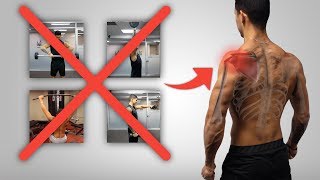
Jeremy Ethier identifies four exercises that increase shoulder injury risk: upright rows, behind-the-neck presses, behind-the-neck pulldowns, and front-delt isolation work. He shows safer alternatives based on EMG studies and explains how these moves can cause impingement.
When it comes to building muscle, losing fat and progressing in the gym, nothing is going to set you back more than injuries will. Which is exactly why you need to design your workout program such that it ensures your longevity in the gym and minimizes your risk of injury. And one of the easiest ways you can do this is with proper exercise selection. Now, although it's true that any exercise can very quickly become dangerous if performed incorrectly, there are certain exercises and variations that for the majority of people don't not only have a higher risk associated with them, but as backed by research, are also inferior in terms of muscle growth and should thus probably be avoided. And in this video, I'll discuss four such exercises with why they're considered risky in the first place, and what you should do instead. The upright row is a common choice for those looking to develop their traps and shoulders. However, if you actually analyze the mechanics of the exercise, it's easy to see why this may not be the best choice. This is because at the top of the movement, the shoulder gets into something called an internally rotated position where the elbows are high and the hands are below holding the weight. And as the shoulder is in this position, the tendon of the supraspinatus, which is one of your rotator cuff muscles, can rub against a bone in the shoulder, which can lead to shoulder inflammation and pain. And observational research agrees with this idea as well. For example, this 2014 paper from the Journal of Strength and Conditioning Research looked into shoulder injuries and exercise selection among 77 resistance trained men. They actually found that there was a significant difference for the presence of shoulder impingement among individuals who performed upright rows when compared to those who did not, leading the researchers to conclude that there seems to be a significant strong association between the upright row and shoulder impingement, therefore indicating that for most individuals, the upright row is just something probably not worth doing. So what can you do instead? Well, one option is to modify the upright row to make it not only safer but also more effective. And you can do this by making the following three changes. 1 Widen your grip to about 200% of shoulder width, since based on this 2013 EMG analysis from the Journal of Strength and Conditioning Research, this grip width is safer on the wrist and shoulder joint and elicits higher upper trap and lateral deltoid activity when compared to a narrow grip. 2 limit the top of the movement such that your elbows don't go above shoulder height and 3 ensure that as you raise the weight, your hands are not below your elbows but are actually raised up to elbow height and as you can see here, this point will be key in eliminating the internal rotation component of the movement and thus making it much safer to do so. The new and improved form should look something like the following and will not only make the movement safer, but but also makes it that much more effective at activating the target muscle groups. But another option that may be better suited for some individuals, especially if you've had prior shoulder injuries, is to simply use lower risk alternatives that hit the same muscle groups as the upright row does, mainly the upper traps and lateral deltoid. For the upper traps, one great alternative is the barbell shrug which I show how to properly perform in my science based trap video. And for the lateral deltoid a great alternative is the dumbbell lateral raise or which is however vital that you perform correctly and is explained in my science based shoulder video and I'll link both of these videos in the description box down below. The behind the neck press is another common exercise used to target the shoulders and is a slight variation of the standard overhead press such that the bar is brought behind the head instead of in front. However, for most individuals this can again be a risky exercise to perform and the reason being is because in order for you to safely lower the bar behind your head, it requires a great deal of external rotation at the shoulder, which most people just don't have the adequate mobility to do. In fact, one 2015 paper from the Journal of Sport and health science took 33 trained subjects and had them perform overhead presses both in front of and behind the head. The researchers concluded that behind the neck presses required greater shoulder flexibility and external rotation than most males possession and this becomes risky because when you don't possess the adequate mobility for the movement, it not only excessively strains the shoulder, but you also tend to compensate by sticking your neck forward in order to allow the barbell to pass behind your neck. This in turn increases the compressive forces within the neck and should definitely be avoided. So what should you do instead? Simple Stick to the standard in front of the head shoulder presses as this will target the same musculature as behind the neck shoulder presses, but is a much more natural plane of movement for your shoulder and therefore enables you to lift more weight when compared to behind the neck presses. Again, due to the mechanics of this exercise and the degree of external rotation needed to perform it correctly, it makes it another exercise that for most people just simply isn't worth the risk of doing. Instead, your best bet is to stick with front lat pulldowns since this variation doesn't involve excessive external rotation of the shoulder and is also the better option in terms of back development. Proving this point, this 2009 paper from the journal Strength and Conditioning Research compared activity of the lats during behind the neck and front of neck lat pulldowns. They found that front lat pulldowns elicited significantly higher lat activation than behind the neck lat pulldowns, which led the researchers to conclude that that given the potential risk of behind the neck lat pulldowns and its inferior activation of the lats, it appears to be an unnecessary exercise and should be avoided. So for these reasons, simply stick to front lat pulldowns. Now. Although this exercise in itself isn't necessarily dangerous, in my opinion, for most people it's just not needed and can definitely contribute to problems down the road. This is because the front delts are already very active in most pressing movements, which is why most people have proportionately bigger and stronger front delts when compared to their rear delts. And since, as shown in this paper from the Journal of Clinical Biomechanics, the rear delts play an important role in reducing injury potential. By further emphasizing the front delts through isolation movements and spending less time on the rear delts, it just worsens this common muscle imbalance and can very well contribute to shoulder injuries over time. Therefore, for most individuals you can just avoid any front delt isolation and leave it to your compound movements like overhead presses to develop this area. So instead of dedicating more time to your front delts, I'd recommend increasing the volume dedicated to your rear delts instead, as this will not only provide a more balanced look to your shoulders and posture, but will also help reduce the risk of injury over time.
That's pretty much it for this video, but keep in mind though that these exercises for some individuals can be perfectly fine and even beneficial depending on your specific goals. However, this is highly dependent on your current range of motion and your specific anthropometry. But since we know anatomically and through research that the majority of individuals will likely have problems with these exercises and that the risk of performing them highly outweighs the benefits, it would be wise to stick to the recommendations I provided. And guys, if you're looking for a truly evidence based program that ensures you're able to transform your body not only as efficiently as possible, but also as safely as possible, then simply head on over to built with science.com courses where you can choose the best program for you. Anyways, that's it for now for those who haven't already, I'd really appreciate it if you gave me a follow on Instagram where you can stay updated with what I'm doing and see a lot of the informative content that I post there as well. And if you enjoyed this video, I'd also really appreciate it if you gave me a, like, left a comment down below. And if you and subscribe to my channel if you haven't already. Thank you everyone so much for the support. I really do appreciate it and I'll see you next time.










