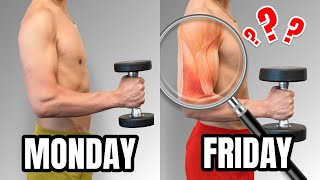
YouTube tutorial explaining four practical ways to determine if you're gaining muscle: 1) track fat-free mass (body weight minus fat mass) using body-fat % from consumer electronic scales or circumference formulas (US Navy equation); 2) track circumference changes (biceps, thigh, glutes) with measurement technique and expected % gains; 3) take standardized progress pictures (morning, same lighting, multiple angles) every 2–3 weeks; 4) monitor strength improvements (early strength gains are neurological; sustained strength increases imply muscle growth). The speaker gives numeric benchmarks, practical tips, and promotes Built With Science training programs.
Are you making gains every week? Most people can't tell. As a result, they have no idea if what they're doing is actually working. I'm going to show you four simple methods that will determine if you've put on more muscle or not. One of, if not the most accurate way to measure your gains over time is by tracking what's known as your fat free mass. So this is your body weight subtracted by how much fat you're currently carrying. For this method, however, you will need to be able to track your body fat percentage over time. And there are a couple of ways to get this without having to do any fancy body fat tests. The easiest way is to get yourself one of these an electronic scale. Now, many claim that these scales aren't very accurate. And while this may be the case in some circumstances, accuracy is actually not what we're worried about. What we are more concerned with is consistently tracking changes over time. And newer scales have been shown to do just that. For example, your scale may read that you're at 20% body fat, when in reality you're actually at 15%. But if you were to lose or gain 5%, then your scale would be able to accurately pick that change up, which is all that we need. And for those without a scale, a good quality one like the one I have here. It's not expensive at all. In fact, you can pick one up on Amazon for less than 30 bucks. I'll leave a link in the description box down below to one that I'd highly recommend. An alternative to this that is a little bit more cumbersome, yet doesn't require a scale, is to estimate it based on circumference measurement formulas, which have been shown to be accurate within 1 to 3%. One of the most well known and accurate of these formulas is the US Navy equation. The something that we incorporate into our built with science programs. To use it for men, this will require you to enter your height, your weight, your neck and your waist circumferences. For women, you need to enter the same information but also add in your hip circumference. Take these all relaxed, without flexing, and then it put these into the calculator that I've linked in the description box down below and it'll spit out a rough estimate of what your body fat percentage is based on your measurements. Now, after you know your body fat percentage, it's time to actually use it. If you take your current body weight and multiply it by your body fat percentage, this is going to tell you how many pounds of fat that you currently have. If you take your body weight once again and subtract your fat mass that you calculated, this will let you know your fat free mass. Tracking this number over time is a great way to see if you are actually building muscle because if you are staying consistent with how you weigh yourself, then increases in fat free mass are very strongly related to increases in muscle. As for how fast it should be increasing. As a point of reference, research finds that on average Participants gain about 3 to 4 pounds of fat free mass over a 12 week period training program which breaks down to about 1 pound per month. Less trained individuals will obviously be able to gain more muscle at a much faster rate, whereas more advanced individuals should expect to gain at a much slower rate. Another practical way for you to track progress is just to measure the circumference of your muscles. In a 2020 study, researchers measured the changes in the size of the biceps after 10 to 12 weeks of training using ultrasound or a much more practical method, arm circumferences. Both methods did not significantly differ in tracking the percentage change in size. So how can you practically apply this? Well, the easiest way is to just pay close attention to how your clothes fit. Are the sleeves on your shirt tighter? Are your jeans fitting tighter than normal? These are all good indications that you have indeed put on muscle. An even better recommendation though is to actually measure and track the circumference of your bicep and your thigh over time. This is going to give you good insights into the overall growth occurring in both your upper and your lower body. To achieve the best measurement for the upper body, flex your bicep and measure around the largest area of the muscle. For the best results, take three measurements and average them together. For the lower body, sit upright with your dominant leg propped up straight out in front of you. Flex your leg and take a measurement at the halfway point, just like the bicep. Repeat this two more times and take an average. You may want to also take a measurement at the largest part of your butt just to keep track of those booty gains as well as for how fast these measurements should be increasing. Eight to 12 weeks of training has been found to result in an approximate 4 to 6% increase in circumference in the arm and thigh, so about a 2% increase per month is what you can expect. This means that someone with 15 inch arms could expect an increase of about half an inch to an inch over the course of 23 months. The downside with this method though is that fat gain can actually start to complicate things, which is where the next two methods can help fill in that gap. By the way, guys, within our step by step programs@billowscience.com, we've built in easy to use trackers that make monitoring your progress a breeze. I'll talk more about these programs at the end of the video. For now, let's move on to method number three. Perhaps the most practical method is progress pictures. When done properly, this can help you visually see the added muscle and increase size that you've actually put on. But it's not as simple as finding your closest mirror and snapping a pic whenever you think you look good. Ideally, you'll want to take these in the morning before you've eaten anything and in the same lighting conditions every single time for consistency. Although the post workout pump picture can be great, it's not good for comparison. If you compare one picture of yourself from early in the morning before you ate anything to another picture right after an arm workout and a few meals, then you're likely going to be significantly misled. Our goal here is to limit as many variables as possible. In addition, when taking these photos, try to take a few different angles, flex and unflex. Take these every two to three weeks and assess the differences. If you're newer to the gym, then you'll notice significant changes pretty quickly in as little as four to six weeks and dramatic changes over time. For example, here's Michael, a Bill with Science member who went from £106 to £130 in his first eight months of training. On the other hand, for those who have been consistently training for over a year, you should only expect to see minor differences every six to eight weeks, and even then it will be quite subtle. But this will add up to significant improvements over the course of several months. Now do note that while you are building muscle, it's often inevitable that you will gain at least a small amount of fat as well. As a point of reference, even if your diet and training is on track, weight gain typically occurs at 75% lean mass and 25% fat mass. This means that if you put on five pounds of muscle, it's very likely that this will be accompanied by a little over a pound of fat. Due to this, based on pictures alone, you might actually think that you're starting to look worse as you were building muscles. Since the added fat can hide your muscle definition and mask the added size that you're putting on. In many cases you won't truly be able to visually see the added muscle that you put on until after you commit to a diet to shred off the excess fat. Adrian's nine month transformation from our Built With Science program showcases this process quite well. So realize that while progress pictures may be easy and convenient compared to the other methods, they can be very misleading in certain cases. And there are a lot of variables that you need to control for during your first 12 weeks or so of training. The rapid increases in strength that you experience are mostly due to neurological changes as you get more skilled with your movements as opposed to actual muscle growth. As you become more trained, however, the role that neurological factors play in strength decreases and the role that muscle growth plays increases. So if you've been training for at least a few months and you're still getting stronger week after week or at least month over month, then you can be pretty confident that you are in fact building muscle and making gains. Rather than relying on any One of these 1 methods exclusively, use a combination of these different methods to provide you with an accurate indication of if you've made progress and to give you the assurance that what you're currently doing is actually working. That's exactly why within our step by step programs, we not only provide you with science based workouts and diet plans, but then show you how to ensure that you're making progress week after week whether your goal is to lose fat or build muscle. To join today, just head over to builtwithscience.com, take our analysis quiz and we'll show you what program will best help you build the attractive looking physique and confidence that you've always wanted. Anyways, that is it for today guys. Don't forget to give the video a like to show your support and check out some of my other videos for some more content. Cheers guys and I'll see you next time.










