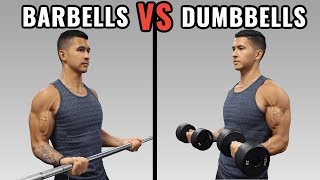
YouTube video (Jeremy Ethier) comparing barbells vs dumbbells for maximizing muscle growth. It reviews evidence and practical considerations: barbells generally allow heavier loads and finer progressive overload (better for maximizing mechanical tension and low-rep heavy compound lifts), while dumbbells often elicit higher muscle activation, greater range of motion, and reduce imbalances (useful for higher-rep work and accessory movements). Cited studies include a 2011 Journal of Sports Science finding ~20% greater bench press load with barbells, a 2013 study finding ~10% greater standing shoulder press load with barbells, and EMG/activation studies (2016 J Strength Cond Res and work by Brett Contreras) showing greater pectoralis and anterior delt activation with dumbbells. Recommendation: center programs around heavy barbell compound lifts for mechanical tension, and include dumbbells for higher-rep, activation-focused work and imbalance mitigation. Concludes with promotional announcement about the creator's upcoming online programs and links to his website and social media.
Questions this video answers
Close to 20% more weight (2011 Journal of Sports Sciences study).
Close to 10% more weight (2013 Strength and Conditioning Research study).
A 2016 paper in the Journal of Strength and Conditioning Research reported consistently significantly higher pectoralis major activation with the dumbbell press.
When it comes to maximizing muscle growth, there's no question that you need to prioritize free weights exercises in your routine. But when it comes to your choice of free weight exercises, you're left with two options, barbells and dumbbells. Now, although it's clear that both are effective options to build muscle, what's less clear is whether one is better than the other in terms of maximizing growth. And to find out, we need to weigh out the pros and cons of each. To start, let's take a look at barbells. So for those who are unaware, as brought to attention by meta analysis by Schoenfeld and colleagues, there's thought to be three main mechanisms of muscle growth, with mechanical tension being suggested as the primary driver of growth. And as stated by the researchers, in order to maximize mechanical tension, you need to be performing heavy compound movements and get stronger with them over time. Which now leads me to the main benefit of incorporating barbell exercises, which is they generally enable you to maximize mechanical tension to a larger degree than dumbbell. And this is due to two reasons. Reason number one is because you're able to lift heavier weight with barbells compared to dumbbells. For example, this 2011 study from the Journal of Sports Science showed that subjects could lift close to 20% more weight with the barbell bench press as opposed to the dumbbell Press. Similarly, this 2013 study from the journal Strength and Conditioning Research found that subjects could lift close to 10% more weight with a standing shoulder press when a barbell was used as opposed to dumbbell because barbell movements require less stabilization as you press when compared to dumbbells. Now, the second reason why barbells better maximize mechanical tension is because they enable you to more effectively progressive overload when compared to their dumbbell counterparts, since barbell exercises are easier to get into position, which minimizes wasted energy and can be overloaded with just 2.5 pound increments on each side, as opposed to the common 5 pound jumps for dumbbells. This enables you to progress faster with barbells compared to dumbbells and thus over time leads to more mechanical tension and theoretically more growth. But with that being said, this doesn't mean that you should exclusively stick to barbells, since dumbbells do have their advantages as well. The first and one of their most significant advantages in terms of muscle growth is that they tend to elicit higher muscle activation when compared to their barbell counterparts. For example, this 2016 paper from the Journal of Strength and Conditioning Research found that the dumbbell press consistently significantly higher pectoralis major activation than the barbell bench press. This finding has also been replicated in the past in an extensive EMG analysis by Brett Contreras, which found that both the flat and inclined dumbbell press elicited greater chest activation when compared to flat and inclined barbell presses. And as for other muscle groups, this 2013 paper found that utilizing dumbbells allowed for more activation of the anterior deltoid when compared to barbells during both the seated and stand. Increased activation with dumbbells is something that would probably hold true for most other muscle groups as well, and the reasoning behind it is likely because utilizing dumbbells enables you to achieve a slightly greater range of motion than barbells since, for example, at the top of a dumbbell press you're able to perform slightly more horizontal adduction than you can when compared to having your hands fixed on a bar. It also enables you to move the dumbbells in a more natural path that best suits your individual body structure, which rather than being stuck in a relatively fixed path with the bar, thus leading to better activation of your target muscle and also often providing a more comfortable press if you tend to experience aches and pains with the barbell. And muscle activation aside, another major benefit of dumbbells that you're probably aware of is that it can help minimize muscle imbalances. Since each arm is working independently, your body can't subconsciously favor one side when pressing or curling, therefore leading to more balance development in the long if that's something you struggle with. So as you can see, both dumbbells and barbells have their drawbacks, but they both have their positives as well, and completely avoiding one in favor of the other means you'll always miss out on one set of positives. So instead use a combination of both as this will likely be optimal for muscle growth while minimizing potential imbalances and injury. What I'd recommend is center your program around lifting heavy with the big compound movements, which are most effectively done with barbells in order to maximize mechanical tension. This is especially true when a Lower rep range of 46 reps, for example, is employed, since doing so with dumbbells becomes challenging to balance and stabilize the weight and thus less efficient. But in addition to these main barbell movements, you should also incorporate dumbbell exercises, particularly for upper body exercises and particularly with a higher rep range, as this will help to both maximize metabolic stress and muscle activation and will help minimize potential muscle imbalances and or injury in the long run for for a chest or push workout, starting with a barbell bench press in a lower rep range and then moving on to an incline dumbbell press with a slightly higher rep range would be a good way to go about incorporating both, and the same methodology can be applied to other muscle groups as well in order to ensure that you get the best of both worlds.
Thanks so much for watching guys. I hope you enjoyed the video and found it useful. I do have an important announcement for those who are unaware. I've been working on my online programs for the past six months or so and I'm proud to say they're going to be released sometime next month. They're going to be very detailed and basically combine all the research I do into clear and concise programs that you can follow. Hence why they took me so long to finish. So for those who are interested and want to be notified as soon as they're released and receive updates and early access to the programs, please do me a huge favor and join the Early Bird email list, which you can join here@builtwithscience.com Earlybird I'll also leave a link to this in the description box down below, which you can follow to enter your email as well. I put in countless hours of hard work into these programs, but I know you guys are going to love them anyways. As always, for those interested, I'll leave a link in the description box down below to the written summary of this video on my website builtwithscience.com and if you enjoyed this video, please don't forget to give it a like leave a comment down below, subscribe to my channel and turn on notifications for my channel as well, as this all really does help me out and if you haven't already, I'd really appreciate it if you gave me a follow and connect with me on Instagram and Facebook as well, where I try to post informative content on a more regular basis. Thank you so much everyone for all the support. I honestly can't believe we're almost at 500,000 subscribers, so thank you for that. It really does mean a lot. Anyways, that's it for today guys. I'll see you next time.