Best VS Worst Fat Loss Exercises (Ranked By Science)
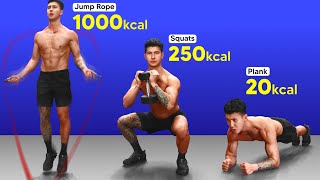
Jeremy Ethier and Kevin test 50 exercises with gas masks to measure calorie burn. Sprinting and burpees torch the most calories but are hard to sustain; incline walking and basketball burn less per minute but feel easier and keep going longer. Boxing ranks best when you balance calories burned with how hard it feels.
What are the best and worst exercises for fat loss? Today, my friend Kevin and I are putting on the world's most accurate calorie track. And together we're going to rank 50 different exercises. At the end, we'll reveal one as the most effective fat loss exercise. But we'll also discover which exercises burn the most calories with the least effort and which ones are high effort but don't actually burn very many calories. Using these bindings, I'll create the perfect, perfect fat loss plan, guaranteed to help you shred body fat. Starting off with what all the data tells me is the most effective for calorie burning high intensity training. Beginning first with 60 seconds of sprints.
Go.
Because the workouts are so intense, Kevin was already starting to feel it before the 60 seconds were finished.
That's brutal. Your hurry went up to 185. I'll go to that water fountain over there for the dog and shit. First exercise done. I'm a little worried for Kevin. We're asking a lot for him today.
But he's a champ. In case you're wondering, Kevin is a programmer here at Built With Science and he's currently working towards his own fat loss journey. My hope is that doing these workouts together will give me the data I need to help Kevin optimize his fat loss journey. Next up were 60 seconds of burpees and then 60 seconds of mountain climbers. Just like with a sprint, Kevin was struggling to make it the full 60 seconds.
I remember why I hated those so much.
With three exercises down, sprints had taken an early lead at an average of 15 calories burned per minute and and burpees coming in second with an average of 12.5. Now, these values were lower than I expected, but we'll explain why that is later on. But so far, all three exercises have been exhausting. How would you rank your perceived exertion on burpees? On a 1 to 10 scale?
10, 11.
How about on the sprints?
12, 10.
10. 10.
For me, the sprints were like 8 or 9. The burpees were like they exceeded the scale.
So if I want to help Kevin build a program that burns a ton of ton of calories without feeling like he's dying, we're going to have to keep searching. Fortunately, we still have 47 exercises left to test. That's good. As we continued testing high intensity exercises, the data showed we were burning through our calories. But just like with the previous exercises, training at high intensity is not easy.
How would not. How would not choose this.
And with Kevin still struggling to make it through some of the exercises.
Almost there.
I had to find a way to continue pushing him to collect the best data possible. So as I finished my circuit on the assault bike, I decided to make Kevin an offer he couldn't refuse. If you can beat my total of 34 calories in a minute, I'll give you $500.
I'm okay with not. Let's go.
Now, some of you data nerds may be wondering how the assault bike could tell me I burned 34 calories in a minute when the best exercise we tested so far to even burn half of that. Well, that's why we're relying on the panole mask for all of our data. Basically, it measures the amount of oxygen we use and the carbon dioxide release, and it combines this with our heart rate to get the exact number of calories we're burning. So while Kevin was catching up to my 34 calorie total, I was skeptical about the accuracy. For more insight, I reached out to Dr. Eric Helms, a pro bodybuilder and host of the Mass Research Review YouTube channel.
Cardio machines are really a bit of a black box. There is some equation that goes in there. It's definitely not like a peer reviewed equation, and it's certainly not going to be as accurate as gas exchange like you're measuring with the masks. The only way that I would use the energy expenditure on a cardio machine is if you're comparing a previous session on that same machine, entering the same measurements as a relative difference. If you burned 30 on that machine last time and this time you burned 60, you probably did about twice as much work. But beyond that, I wouldn't put much stock into those values, even though I.
Learned you can't always trust a cardio machine's calorie tracker. For this challenge, a deal is a deal.
Don't pass out. Don't pass out. Don't pass out. All right, Kevin gets a fat bonus. I was not expecting that.
Instead of 34 plus calories per minute, actually burned around 12 and 13. And to avoid skewing results, we'd make sure to wait for our heart rates to return to baseline before moving on to the next exercise. But when I checked in on Kevin, I realized we had a problem.
All right, let's get Kevin out of his deathbed. You're going to tap out?
Yeah, I'm going to tap out of that. Turned out that even though I had tried to select the most optimized workout for fat loss, nearly every Exercise so far was leaving Kevin absolutely exhausted, and that's no way to sustain a program, which means we're going to have to find a new approach. Low intensity exercise. First up, incline walking. So we started with 3 miles per hour and a 2 incline, which burned around 6 calories per minute.
Oh, this is so nice, Kevin.
Bumping the speed up to 3.5 in the incline up to 6 led to a pretty impressive 30% jump in calorie burn. But you know how people at the gym tend to lean on the cardio machines or hold onto the rails when incline walking. Yeah. So we tested that next, and it dropped the calorie burn by 20%, which aligns with the findings of a 2014 study that tested the exact same thing.
If you are leaning on the treadmill, unloading some of your mass, you're essentially reducing your body weight. Then you're basically only walking with a part of your body, as weird as that sounds, and therefore burning fewer calories.
So much easier.
But what's true of all of our walking was that Kevin was able to get through without feeling like he was going to collapse, which meant the switch to low intensity training was definitely a step in the right direction. Longboarding, an activity I loved doing as a kid, was winning in my calorie battle for low intensity exercise. Burning an oppressive 11 calories per minute, beating the elliptical StairMaster, and other forms of cardio that I just don't really enjoy. And although Kevin didn't feel comfortable hopping on the board, basketball was working out really well for him, and it looked like he was having fun doing it.
So I think the first thing you want to do is establish, do you have the fitness level that high intensity training is on the table? If yes, do you enjoy it? Great. If you enjoy it equally to a moderate intensity, then you can choose when you want to do it based upon your time availability. If you don't enjoy it, don't do it. For me, it always comes down to what's practical, what's sustainable, and do they have the fitness level, so that's not a potential risk of doing this very high intensity activity and time.
You're a champ, dude. Getting easier.
Man 2 and after catching our second wind with low intensity, we moved into strength training to find out how it compares to cardio. Surprisingly, unless the weights got really heavy, strength training was burning significantly less calories than cardio. Not to mention we could just barely make it to a minute on most exercises.
Strength training is even higher intensity than many forms of quote unquote high intensity. Cardio, it's so high intensity that instead of going, all right, I'm going to go a minute on, two minute off, like you might with cardio. You're typically doing 5 to 12 reps, which is going to take less than a minute. That's typically going to be completed in 20 to 30 seconds. And if you're training to failure, then you may need to rest, you know, one, two or three minutes before you can then perform at your best afterwards. You're spending more time resting during a weight training workout than you are actually lifting weights. So weight training is great for maintaining muscle mass and ensuring that the weight you lose is primarily body fat. But it's not a great tool for fat loss itself. From an energy expenditure program perspective, we.
Also tested ABS exercises like crunches, which ended up burning the fewest calories of all the exercises we've tested so far. At this rate, you'd have to do 17 hours worth of crunches to burn the calorie equivalent of 1 pound of fat. After our first day of testing, it felt like I had pretty much everything I needed to create the perfect fat loss workout plan to help Kevin. Until I presented some of that data to Eric.
I think an important perspective for the viewer is that if they go in and they absolutely crush it with, say, a bunch of interval work for 45 minutes three times per week, the impact of that will be a whole lot less than if they say, went from having three to 4,000 steps per day, being relatively sedentary up to getting seven to 9,000 steps per day. The latter would have a far greater impact on their total daily energy expenditure and their ease of getting into a calorie deficit and seeing sufficient successful weight loss over time than those three 45 minute all out sessions.
Talking to Eric, I realized that just testing exercise to create an optimized workout wasn't going to be enough. It turns out what we do outside of the gym can have a far greater effect when it comes to fat loss. And to find out just how much, I had to keep testing. That means testing every chore and activity you can do with your free time, whether it's vacuuming, reading, or folding the laundry. And starting right off with standing, just simply standing. As for Kevin, he was going through the same circuit of tests downstairs, testing the average calories burned standing, sitting, sitting while fidgeting, and sitting while playing a video game. And not only was I earning boyfriend of the year award by taking care of all the housework, I was finally starting to build a clear picture of all the ways you can maximize calorie burn through the course of the day. For example, just walking outside burnt an impressive 6 calories per minute for Kevin. Although that's almost a third of what he burned doing sprints. I'm pretty sure he'd much rather go for a 30 minute walk than suffer through 10 minutes of sprints. Burpees are dishes, Jeremy.
This is all day, every day.
But the one thing I still haven't found in our testing was a high calorie burning exercise that Kevin actually enjoyed. So I started searching online to find other exercises that claim to burn a shocking number of calories in hopes of finally finding one that's a great fit for Kevin's training. Beginning first with boxing, medicine ball slams, and power walking.
At least one foot on the ground at all times and just try to go as fast as you can, I guess just look like a bunch of angry moms out there.
You know what's incredible? How much burns off energy is playing chess. Can burn up to 6,000 calories a day while playing in a tournament. Okay, so I don't actually know how to play chess, but to test this claim, Kevin and I will be playing a game of high stakes checkers. Remember the 500 I lost challenging Ken Kevin on the assault bike? Well, now we're going double or nothing. If Kevin beats me again, he's getting $1,000 bonus. So I do not want to lose. But since this could take a while, let's take a look at some other tests.
So we'll just go right to the single leg breakpoint. That's one of the highest calorie burners, but we'll see.
So what was the actual calorie burn from kettlebell swings? Well, not anywhere close to some of the other special exercises we tested, but what can you expect taking advice from TikTok? Anyways, just like the assault bike challenge, the checkers match was neck and neck with Kevin once again getting the best of me. As for the calorie burn, although my brain probably wasn't working quite as hard as a master chess player, it didn't burn nearly as much as I anticipated. 2.2 calories per minute. Just a touch higher than sitting.
I have no doubt that being intensely intellectually active burns more calories than, say, just chilling. You probably burn more calories playing chess than listening to Joe Rogan. I'm sure the. The first is a lot more intellectually challenging and stimulating, but I. I don't think it's probably as high as 6,000 calories a day. If I had to guess.
And even though I was now $1,000 poorer than when I started the challenge, I had all the data I needed from each exercise, including a shocking first place exercise to reveal to Kevin. What exercise do you think burned the most calories? Well, obviously, like burpees, I don't want to be number one. Like any, any of the burpees. I don't care what you tell me. If it was the highest, I. I still wouldn't do them. So your number one all time highest calorie burning exercise was Boxing. Oh, wow. That surprised me too. Boxing. And you said you had some fun doing it, right? I think it was fun. It just felt like we were like goofing off at that point. In fact, Kevin and I had the same top three. Sprinting, boxing and the Devil's Press burned more calories than any other exercise. And although sprints, when averaged out between us, came out as number one, boxing was the one that burned the most calories compared to our perceived exertion, which is enough to make it the winner in my books. As for the low intensity exercises that still burn a surprising amount of calories, longboarding, shooting hoops, and even just plain old walking worked great. So depending on your conditioning, you can pair any of these exercises with consistent strength training. And you should be well on your way to losing fat. Because ultimately it's about finding the workouts that you enjoy and can stick with in the long run. And thankfully, that's exactly what we were able to find for Kevin. Though maybe we could use a coach now. In the description box down below, I posted a link to a list of all 50 exercises ranked from highest to lowest based on calorie burn. While finding the right workout plan is a great first step to truly succeed in your fat loss journey, you can't neglect your nutrition. And that's why here at Build with Science, we not only guide you every single week with your workouts, but we also guide you step by step with your diet to get you into the best shape of your life. And to join today, just head over to built with science.com and take our quiz to find the best plan for you and your body. But for those of you who are just looking for a cheap, healthy, science backed meal plan, you can start following today to lose fat. Then give this video a watch.
Next.
Thanks so much for watching and see you next time.










