Can You Build Muscle WITHOUT Bulking? (New Science)
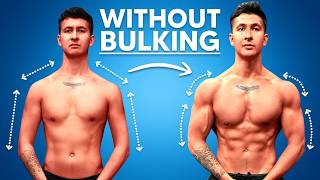
A 2021 meta-analysis shows you can build muscle in a small calorie deficit of 200-300 kcal, though larger deficits over 500 kcal cause muscle loss. Beginners gain about 2% bodyweight per month with a 400-500 kcal surplus, while intermediate lifters need only 200-300 kcal. Advanced lifters can build muscle near maintenance calories.
If you want to build muscle, you go to bulk, right? I mean, that's what all the biggest guys in the gym seem to be doing. But bulking can actually be the wrong way to build muscle for many people today. I'll share why that is and how you can build muscle without bulking. Now, when I first started lifting, I took the advice, you ought to eat big to get big to heart. I kid you not. At one point I was drinking almost a gallon of milk a day. But after that first bulk, I began to notice that bulking just didn't give me the results I hoped for. I would end up gaining way more fat compared to muscle, and I just couldn't figure out why. And this got me thinking. Is overeating really the only way to build muscle? What about the excess fat on your body? Could that instead be burned off and used as fuel for the muscle building process? Well, let's take a Look at this 2021 meta analysis, which is basically a study of studies. They wanted to compare how muscle growth and strength is affected when you're in a calorie deficit eating less calories than your body needs compared to eating at maintenance or in a bulk. Surprisingly, strength gains didn't actually differ that much. But for muscle gains, almost every single study involving a calorie deficit led to muscle loss, whereas every study without a calorie deficit led to muscle growth. However, a deeper look into the individual data points paints the real picture. Although on average the calorie deficit led to more muscle loss, it depended on the size of the deficit. With a smaller deficit of around 200 to 300 calories, muscle growth was actually quite common. It was only once the deficit became greater than around 500 calories did muscle gain become far less likely. This debunks the belief that you need to be in a calorie surplus or bulk to build muscle. For many people, it's completely possible to get hold of the holy grail, building muscle while losing fat. But is this the best approach for everyone? To find out, I reached out to Dr. Eric Helms, a pro, natural bodybuilder and fitness scientist who specializes in the concept of bulking.
And there's a great paper by Barakat and colleagues in the Strength Conditioning Journal all about body recomposition, specifically looking at sometimes case studies or individual participant outcomes in well trained lifters. And they show multiple times that people can lose fat and gain muscle at the same time. Now, is that as efficient in an intermediate or advanced lifter as being in a small surplus? Probably not, but it is one way. Another approach that might fit someone better if they're already high higher in body.
Fat than they would like to be when executed properly. I've seen this strategy work with many of our built with Science members, but it won't work for everyone. And I'll explain why later on. Now, does all this research mean bulking is useless? What if you're not worried about fat loss and simply want to maximize growth?
If you're starting at an already high body fat percentage, it's totally fine to go into a surplus and put on muscle. Just be aware that it's going to come with more body fat gain. So if you're already close to where you're comfortable with the way you look, you might want to consider taking an approach where you're eating at maintenance or you're trying to lean gain, or you might decide to cut first before then eventually bulking. And that doesn't mean it's better from any standpoint. It really just has to do what the individual is comfortable with and what their aesthetic goals might be.
But there is one group of people that highly benefit from bulking. They studied them back in 2002, took a group of beginners who just started lifting weights and and gave them a 2000 calorie weight gainer on top of their usual diet. After eight weeks, they all gained around seven pounds. If you do the math, this means they were probably in a daily calorie surplus of around 400 to 500 calories. Now over the seven pounds they gained, almost all of it was lean mass, not fat.
It goes to show you that if you're a young untrained person, like I said, relatively normative body fat ranges, and you go on a pretty aggressive bulk where you're in on average probably a 400 calorie surplus is what it kind of shook out to. In this study, you're going to put on predominantly muscle mass so long as you're training hard and progressively.
So I mentioned my first bulk earlier. It worked really well. I gained a lot of size while staying relatively lean. Beginners had the highest sensitivity to muscle growth. This is where the term newbie gains comes from. And it's why bulking mostly works for newer lifters. What happens when you're past the beginner stage though? One study published just last year found that in trained individuals, eating enough to just maintain your weight led to a similar amount of growth compared to bulking, but with far less back in. Which makes sense. You can't just eat as much as you want and have all the extra calories turned to muscle. If that were true, everyone would walk around jacked out of their minds. You'll get lifters like Sam Solick and pro bodybuilders, who are an exception, and I'll explain why shortly. But for most people, muscle growth is slow and it gets even slower as your body grows. So in the beginning, building muscle quickly means your body can use more of its excess calories. But once this slows down, more of those excess calories will be stored as fat instead.
The only mistakes that you don't want to make are being in a really large surplus, far beyond what would be beneficial as an advanced or intermediate lifter or when you then need to cut, being in a much larger deficit than is needed, because then you actually start losing some of the muscle you gained. And this is kind of a bad cycle that people get stuck in. Their quote unquote bulking season or improvement season turns into this seafood diet, and they gain far faster than they could hope to, you know, put on muscle. They're way past the point of optimizing the ratio of fat to muscle gain. And then they get too high in body fat, and then they wait till the last minute before when they feel like they want to look different, and they do this rapid cut, either for a competition or for the summer or for whatever reason that spurs them on, and then they go on this crash diet. So they end up putting on unnecessary body fat, and then they end up dieting and actually losing some of the muscle mass that they would have got. And there's no benefit to that process.
So what about Sam Solick? In a way, steroids take you back to your beginner stage of training. You all of a sudden can build muscle really quickly. As a result, more of the excess calories you eat will go towards building muscle rather than fat.
Theoretically, when you're using anabolics, it does move you back maybe one step. If you're advanced, it'll make you get intermediate gains. If you're intermediate, it'll make you get like novice gains. But. But honestly, you shouldn't be doing this unless you're advanced at all. In the first place.
Sam Solick weighs in at around 240 pounds and eats anywhere between 5,000 to 6,000 calories per day during his bulk. And he gains close to a pound a week from this. And from the looks of it, a good chunk of that weight gain is muscle rather than fat. But this can be misleading. For example, I remember back in the day watching videos of the incredibly jacked Ronnie Coleman eating 6,000 plus calories a day during his bulk and thinking that I had to do the same. But eating anywhere close to that number of calories would have just blown me up, and not in a good way. For a natural lifter past the beginner stage, muscle growth is very slow, much slower than any of us would like to admit. If you try to rush it, you'll just gain more fat rather than muscle. You need to scale your diet based on your experience level and how sensitive you are to muscle growth. Which brings us to the next question. How many calories should you be eating to build muscle while minimizing fat gain? Well, my talk with Dr. Eric Helms led to some great recommendations. If you're a beginner, which means you're able to get stronger at the gym pretty much every week, then aim to gain around 2% of your body weight per month. This works out to what most people would define as a typical bulk, where you eat a daily calorie surplus of around 400 to 500 calories. Now, this is what 2500 calories looks like. If this was the right amount of food to maintain your current weight, then a 500 calorie surplus would look like. Add in one small meal into your.
Day, and then once you start to notice that it seems like it's mostly just fat coming on, you want to slow down that bulking process. You want to cut that calorie surplus probably in half, right? Roughly. And then just focus on progress in the gym.
Now, typically, your newbie gains slow down after about a year of consistent training, which is when you'll want to scale it back to more of a gain tuning approach. It's technically still a bulk, just slower, where you try to gain just 1% of your body weight per month by using a small surplus of just 200 to 300 calories, such as adding an extra granola bar and apple to your day. Then once you get into the advanced stage and are near your genetic cellular muscle growth, that's when you dial it back even further by using a small surplus that could honestly be as little as one extra banana per day. As you can see, it doesn't take much extra food to build muscle, which means it also doesn't take much extra food to gain fat either. Believe me, guys, I've been there. You all of a sudden go into bulking mode and you use that as an excuse to eat whatever you want. Now, even if you use a small surplus, you should expect some backing, but it shouldn't be excessive. For example, I've only gained around 8 pounds in the past seven months. By sticking to a very small surplus of just 200 to 3 calories, I've seen really solid muscle and strength gains. And while I have put on a bit of fat as well, I can quickly burn it off. Just four to six weeks of dieting compared to my traditional bulks in the past where I'd have to diet for at least 12 to 16 weeks afterwards. That said, unless you're super analytical or really dedicated to your fitness goals, I'll admit tracking all this stuff can get overwhelming, especially if you're trying to nail down a really, really small surplus. And if that sounds like you, then don't worry about tracking anything. I mean, most six year old kids that I know don't count their calories, but they still manage to eat enough to grow and get bigger. So just focus on eating lots of protein, healthy whole foods and use your strength and your body weight to determine if you're eating the right amount. If after a month you step on the scale and you've gained 10 pounds, then you know you gotta dial it back. On the other hand, if you lost weight and you haven't been getting stronger at the gym, then that's a sign that you gotta eat a little bit more. Okay, pay attention because I'm about to give you a simple breakdown of the best approach to building muscle, depending on where you're at. First off, for those who aren't crazy lean and want to lose fat while building muscle, then eat just enough calories to maintain your weight or a small deficit to lose no more than half a pound a week. Just keep in mind that this approach can become less effective as you get more experience on the other end. For those who are less interested in losing fat and want to maximize muscle growth, then use the bulking and gain teaming guidelines I presented earlier. That said guys, if you're not training in a way that forces your muscles to grow in the first place, then you're not going to see very good results no matter your approach. So if you're not completely confident with the effectiveness of your current workout routine, I highly recommend taking our quiz at built with science.com to find the best science based program for you and your body. Also, if you're struggling with your nutrition and you want a quick, cheap and healthy muscle building meal pie, then give this video a watch.
Next.
Thank you so much for watching. I'll see you next time.










