CRAZY 3 Month Transformation: Step-By-Step How I lost 23 lbs and 10% Body Fat
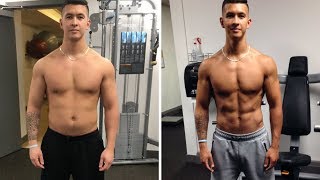
Jeremy Ethier walks through his 3-month transformation: 23 lbs down, 10% body fat lost. He breaks down his workout routine, diet, intermittent fasting approach, and cardio strategy for cutting fat while keeping muscle.
Questions this video answers
Around 3200 calories.
Around 2900 calories.
15% (cutting calories around 2500 kcal for week 1).
He stated he would not go below 1900 calories.
At least 1 gram of protein per pound of bodyweight (example: 180 g protein in week 1).
Got that poker face like I don't care but you can see it in my eyes Seems like you still got a hold on me even after all this time and no matter what I.
Do.
I can think about somehow it is always you want Guess I no longer have to play.
What'S up guys? In today's video, I'm going to be showing you exactly how I was able to achieve the transformation I previously showed and how I was able to do it while working a full time desk job. And more specifically, I'll be going through the weights routine I used to my diet and also my cardio routine that I use for this transformation. Keep in mind that I've been working out for several years now. So although it may not have looked like it, I had a lot of muscle hiding under my fat when I was at 18% body fat. I just needed to get rid of that fat to reveal the physique that was hiding under all that fat. So if you're in the same situation, then I highly suggest that you watch this video and implement the protocols that I go through. Because your body will look amazing once you get down to a low enough body fat and you'll see all the muscle that's been hiding under your fat. But with that being said, dropping your body fat by 10% in just 12 weeks is really hard to do and it's especially hard if you're working a full time desk job like I did or if you're a full time student and pretty much sit all day. However, if you implement the tips and protocols that I'll be going through in this video, then I'm confident that you'll be able to get shredded pretty quickly. And before we get started, if you haven't already, please make sure that you hit that like button and hit that subscribe button. I put a lot of effort into this video, so I'd really appreciate if you support me by subscribing to my channel. Anyways, let's get started with the video. So the first thing I want to talk about is my weightlifting routine, which is pretty straightforward forward. You'll sometimes hear people say that you need to switch up your lifting routine when cutting by lowering the weight and lifting with higher reps. Well, this is pretty much the opposite of what you want to do. All it's going to do is make you look flat and it's going to make you lose a lot of muscle. Because when cutting, your main concern should be to maintain as much muscle mass as possible. And to do that you need to continue Lifting heavy weights. I kept my lifting routine pretty much the exact same when I began my cut, which was a push, pull, leg split twice a week. I focused on lifting heavy and using a rep range of around 6 to 12 reps for most of my exercises. And I tried my best to not let my strength drop, especially on compound lifts. And I was able to pretty much maintain my strength on my pull and leg day. But my push day lifts definitely got quite a bit weaker, which is usually the case for most people. Now let's get into my diet and cardio routine. But first, one important thing to keep in mind is that getting down from 18% body fat to around 10 to 12% body fat is much easier than getting down from 10% body fat to 7 to 8%. And I'll go through the specific changes I had to make in my diet and cardio routine in order to get below that 10% body fat barrier. So let's get started with the diet that I used. Of course, as many of you already know, you must eat at a caloric deficit in order to lose fat. At the end of my bulking phase, I was eating around 3200 calories with a maintenance of around 2900 calories. So for the first week of my cut, I used a 15% caloric deficit which, which brought my cutting calories for the first week down to around 2500 calories. And from then on, I would gradually drop my calories throughout the 12 weeks, but I wouldn't go below 1900 calories. So on average I was further dropping my calories by around 100 calories every two weeks. And this was just to prevent reaching a fat loss plateau. But I adjusted this based on how fast my weight was dropping, my energy levels and my strength in the gym. If I was losing weight too quickly, for example, over two pounds per week, or my strength was dropping too quickly in the gym, then and I would adjust by slightly increasing my calories. On the other hand, if my weight stalled and I didn't look any more defined in the mirror from the previous week, I would slightly lower my calories. As for macros, I keep it simple and I try to get at least one gram of protein per pound of body weight, around 15 to 20% of my calories from fat and the rest of my calories from carbs. So my first week of cutting, I was eating at 180 grams of protein, 50 grams of fat and 320 grams of carbs. And every time I drop calories after this, I would mostly drop my carbs and leave my protein and fat relatively the same. I also utilize intermittent fasting whenever I cut, as I find it really helps me with losing my stubborn fat due to the increased catecholamine levels. And it also enables me to have larger, more satisfying meals. I use a fasting protocol with a 16 hour fast and an 8 hour feeding window. So I would eat from 12pm to 8pm and fast for all hours outside of this. And this protocol was basically just the easiest for me to maintain. And as for exact foods I would eat, for the most part I eat lots of fruits and vegetables, chicken, eggs, fish, rice, peanut butter, potatoes, and I also use if it fits your macros as well. So I tend to fit in a lot of the foods I enjoy throughout the week. And one more thing I want to briefly mention is that after about week seven or eight, once I was down to around 10% body fat, I started incorporating refeed days in which I would eat at maintenance calories or a bit higher by increasing my carb intake and decreasing my fat and protein intake for the day. I had about one refeed day a week. And then as I got leaner throughout the next weeks, I increased the frequency to about two refeeds per week. And the main purpose for this was just to help me satisfy cravings that I had and also to get my metabolism a little kickstart to get rid of that last bit of stubborn fat. Now finally, let's get into my cardio routine. So for the first six weeks, I actually perform very little cardio. I would simply play a little bit of tennis or some other sport one to two times per week. The caloric deficit I created through my diet was enough to bring my body fat down to around 11 to 12%. So cardio wasn't really necessary yet. But after this point, I needed to start incorporating cardio to continue seeing results. And as many of you know, I'm a big fan of hiit, not only for fat loss, but also for its cardiovascular benefits. So my approach when it comes to cardio is to overload your cardio routine every week by strategically using a combination of low intensity, steady state cardio and hit. So for example, in week six, I perform one hit session per week and one low to moderate intensity cardio session per week. Something just like 20 minutes on the StairMaster, along with whatever sports I was playing for fun. And every week after this, I would either add more cardio sessions per week or I would increase the volume of those cardio sessions. And by week 12, I was performing HIIT twice a week as well as three 20 to 25 minute moderate intensity StairMaster sessions per week, which honestly is quite a lot but was necessary if I really wanted to get shredded while working a desk job. Another important point I want to mention is that after week six I tried to make an effort to increase my activity level while I was in the fasted state as I believe it really helps me lose that last bit of stubborn fat and research seems to agree with this. But starting work at 8am for five days a week made this kind of difficult. So for two to three times a week I would try to get in my workout and cardio session at 5:30am before work while I was still fasted and I would just supplement with BCAAs and on the work days that I didn't do this I would use some of my 30 minute work break to take a long walk outside before I had my first meal. So I was still in the fasted state. Basically I was always trying to somehow increase my activity level while I was in the fasted state and if you want to learn more about why I do this, you can check out this video I made on the topic. So basically to sum things up, what I recommend you do is the following. 1. Start with a caloric deficit that is around 15% less that of your maintenance calories. 2. Use a weightlifting routine in which you lift heavy within 6 to 12 reps. Focus on maintaining your strength every week, but know that some strength loss is to be expected, but you shouldn't be drastically dropping your lifts every week. 3. Implement intermittent fasting and refeed days to help you get past that 10% body fat barrier and will also help with food cravings. 4. Use a combination of hit and low to moderate intensity cardio and gradually increase the volume of Cardio you do. 5. Tweak all of the above based on how your cut is going. So basically adjust your diet and cardio based on the number of pounds or body fat percentage you lose per week and you ideally want to lose one to two pounds per week and adjust also based on your strength in the gym and your overall energy levels. And that's basically it guys. When it comes down to it, fat loss is all about exercising more and eating less, but the key is you want to do it in a way that prevents your body from reaching plateaus and enables you to get down to really low levels of body fat and you constantly want to tweak things based on how your body is responding. So what worked really well for me may not work as well for others. So what you want to do is just constantly monitor your progress and adjust your diet and exercise routine accordingly. And believe me, the process is not easy, but it is 100% worth it. All the extra attention you get and the comments you get about your body is nice, but what's most rewarding is the personal satisfaction you get when you see what you're truly capable of if you push your limits. You work hard and you put in the work even on days that you don't want to. I hope this video inspires you, and I hope it helps a lot of people. Please don't forget to hit that like button and hit that subscribe button and let me know down in the comments below if you have any questions. I'd be happy to answer them. I'll see you next time.










