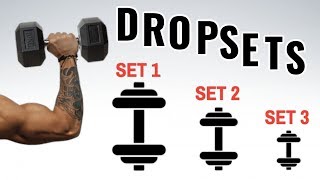
A 2017 study found drop sets built more triceps muscle than regular sets in less time, but the research is small and mixed. Use them for accessory exercises when you're short on time, drop about 20% per step, and keep progressive overload on compounds as your main focus.
When it comes to the quest of maximizing muscle growth, a variety of different training methods are often employed. One popular training method, drop sets, simply involve performing one or more sets with a lighter weight immediately after you finish your heavy set. They're typically used to accumulate more volume in a shorter amount of time, achieve a greater muscle pump and elicit more metabolic stress than you would with standard straight sets, which would theoretically lead to better growth since metabolic stress is proposed as one of the main drivers of muscle growth. However, given that recent research has revealed that metabolic stress may not be as important for muscle growth as we once thought, it begs the question as to whether drop sets are worth incorporating at all, or whether sticking to normal straight sets would instead be best. And to figure this out, fortunately, there are a handful of studies that can provide us with some insight. For example, one very recent 2017 paper by Fink et al. Compared the effects of using drop sets versus normal sets on muscle growth and strength strength during the triceps pushdown, the drop set group performed one heavy set of their 12 rep max and then immediately went into two drop sets with lighter weight to failure, whereas the normal set group simply performed three heavy sets of their 12 rep max with rest periods in between. The result? Despite the drop set protocol taking just half the time to complete, and despite volume being equated between the groups, after six weeks the drop set group experienced almost double the triceps growth as the normal set group group. But before you go ahead and start implementing drop sets for all your exercises, there are a few things to keep in mind. First off, although the drop set group experienced greater muscle growth, there was a trend for greater strength improvements in the normal set group, which makes sense since they were able to use heavier weight rather than dropping it throughout the sets, which we know is better for strength gains, meaning that over time normal sets would likely lead to significantly better strength gains and likely better muscle growth in the long run due to the concept of progressive overload, especially if the comparison was done on compound movements as opposed to just the triceps extension. Secondly, this study was done on just 16 subjects and their findings have yet to be replicated. The only two other drop set studies out there where volume was equated between groups showed no significant difference in muscle growth when drop sets were employed. And lastly, it seems that training to failure is required in order for drop sets to be effective. And since we know based on recent research that training to failure causes more more fatigue and extends your recovery time when compared to non failure training, this can become problematic if you start over using drop sets, since each set requires you to reach failure, which can negatively affect the rest of your workout and even workouts later on in the week. So does this mean that drop sets have no place in your routine? Not necessarily, it just means that their implementation should be carefully considered and to provide you with some guidelines, here's what I'd recommend. 1. If you find yourself time constrained for a workout, then drop sets are an effective way to significantly reduce the duration of your training session without hindering muscle growth. And to implement them. Instead of performing three sets of a biceps curl with rest in between, for example, you'd instead start with one heavy set to failure, then immediately drop the weight by roughly 20% and do another set to failure, and then repeat this again by dropping the weight by another 20%. Now, this definitely shouldn't be used for all of your workouts due to recovery issues, but it can be useful to occasionally implement whenever you're short on time. 2. You mainly want to incorporate drop sets on accessory exercises or machines rather than compound movements. This is because implementing drop sets on compound movements tends to lead to form breakdown, which can be risky, especially when you don't have a spotter available. And not only that, but research has also indicated that training to failure on major compound movements diminishes performance for at least 48 hours and likely even longer. And since drop sets require you to train to failure, this lingering fatigue could negatively impact training sessions later on in the week, whereas doing so with isolation exercises doesn't interfere with recovery to the same extent. And finally, 3. Use drop sets sparingly. For instance, instead of replacing every single set for every single exercise with drop sets, you can instead reap the possible benefits of them without causing recovery issues by simply adding in a drop set to just the final set of the last one or two exercises in your workout, doing so is a time efficient way to quickly add more volume and induce more metabolic stress within your workouts without causing much interference with your recovery. So for example, in the following upper body workout, this is how you can employ drop sets using what I previously mentioned. Again, just keep in mind that you don't want to overdo it, so consider and be wary of any potential recovery issues in the event that you do decide to implement drop sets into your current routine.
So some of the video here are the main takeaways, but keep in mind that there is definitely a lot more research needed to be sure as to whether combining drop sets with traditional sets does actually enhance muscle growth in the long run. Because based on what we have right now, it's just relatively unclear. But regardless guys, if anything, drop sets really are just icing on the cake in the grand scheme of things. Although it's perfectly fine to incorporate them for their possible added benefits and their time saving capabilities. Just know that your main focus and priority needs to be on progressing your main compound movements over time, as it's clear both anecdotally and through research that this is what's going to deliver the majority of your results. And if you're looking for a complete evidence based program that takes all this research into account and shows you how to optimally and efficiently transform your body, then simply head on over to built with science.com courses where you can choose the best program for you. And for those of you who haven't already, please do me a huge favor by giving me a follow on Instagram where you can stay updated with what I'm doing and see a lot of the informative content that I post there as well. And if you enjoyed this video, I'd also really appreciate if you gave it a like left a comment down below and subscribe to my channel if you haven't already. Thank you all so much for the continued support. I really do appreciate it and I'll see you next time.