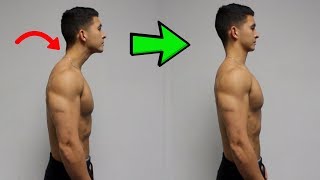
Jeremy Ethier breaks down forward head posture: tight anterior neck muscles and weak deep cervical flexors cause it, leading to increased spinal load and neck pain. He demonstrates three stretches and chin tucks with progressions, recommending the routine 2-3 times daily for results.
Questions this video answers
30 to 60 seconds or 10 deep breaths.
About 15 reps.
Around 30 to 40 reps per day.
Ideally two to three times every day.
What's going on, guys? It's Jeremy here, back with another video. And today we're going to be talking about forward head posture, which is something.
That is honestly becoming a lot more prominent nowadays due to increased technology use and time spent sedentary. And we usually see this posture associated with rounding of the shoulders and rounding.
Of the upper back. And this isn't always the case, but.
Regardless, we need to address the issue.
Of what's happening at the neck because.
The sticking forward of the head causes a considerable increase in the amount of pressure that is placed on your spine. And over time, this can lead to.
Neck pain, breathing problems, and a lot.
More serious health issues. And you're also just going to look healthier, taller, and just overall more confident when you get this posture corrected.
Ideally, if you were to draw a straight line down from the top of your head down to your hips, everything should be aligned like so instead of your head protruding forward. And the reason your head does this is one, due to weakened muscles, mainly the deep cervical flexors that are supposed to keep your head in its neutral position, and two, overactive and tight muscles that are causing your head to protrude forward. So what you need to do to fix this is stretch the muscles that are tight and strengthen the muscles that are weak, which has actually been shown in clinical studies like this one by Butler et al to be a very effective method in correcting forward head posture if properly implemented. In this video, I'm going to show you guys a daily routine that you can use, consisting of stretches for the tight muscles, strengthening exercises for the weak muscles, and tips to prevent your forward head posture from coming back or worsening. The three main muscles we need to focus on stretching and releasing are the sternocleidomastoid, the anterior scalenes and the suboccipitals. As a result of hours of looking down at our phones or computer every day, these muscles become stuck in a shortened position, which creates the forward head posture that you see. The first stretch is going to lengthen the sternocleidomastoid. You can do this either sitting or standing, but make sure that you keep your back straight and neck in line with your spine as you perform this stretch. To stretch to the left side, using your left hand, depress your chest a little bit to create some traction. Rotate your head to the opposite side and then bring your head all the way back until you feel a stretch. You should feel a nice pull in the front of your neck. Hold this for 30 to 60 seconds or 10 deep breaths and then switch to the Other side. The second stretch is very similar, but is going to target the anterior scalenes. To stretch the left side, use your left hand to depress your chest. Bring your right ear to the right shoulder, then rotate your head to the left and then point your chin up towards the ceiling. Again, you should feel a nice stretch in the front of your neck. Hold this for 30 to 60 seconds or 10 deep breaths and then switch to the other side. The third muscle we are going to target are the suboccipitals, which are located in the back of the neck. We are going to release them by using a tennis ball or a lacrosse ball and placing the ball on one side of the back of the neck while lying on the ground and tucking the chin up and down. You can hold the ball with your other hand to prevent it from slipping. Do this for about 10 deep breaths on each side. Now we are going to work on strengthening weakened muscles in our neck, which is just as important as stretching the tightened muscles as we previously did. For this, we are going to use chin tucks, which act to both strengthen the weakened muscles and lengthen the tight ones. To start, do these while lying on your back with your knees bent like so. Tuck your chin by activating the muscles below your chin in the front of your neck and hold this for a second or two and repeat. Think about trying to give yourself a double chin and you can also use two fingers to guide and cue your chin through the movement. Perform about 15 reps of these. Once these get easy for you, you can progress it by just very slightly lifting your head off the floor by a centimeter and then performing the chin tucks with your head elevated. Again, focus on activating the muscles in the front of your neck which you should feel working throughout the movement. And these don't necessarily have to be performed just on the ground. They can be done sitting or standing with your back straight against the wall or even when you're driving or just standing throughout the day. Try to get around 30 to 40 reps of these throughout the day. Now, finally, in addition to these exercises, you need to be aware of your neck alignment throughout the day and during lifts you perform in the gym. When sitting or working on the computer, always try to keep your head and neck in a neutral position with your back. And when it comes to exercises in the gym, something I see a lot of is sticking the head forward during every rep, especially during pressing and pull movements. This is only going to worsen your head position over time, so be aware of this and instead keep your head aligned with your back during all of your lifts instead of protruding it forward. So to sum the video up, here is a sample routine that you can use ideally two to three times every day. When it comes to postural corrections, frequency is the most important factor. So try to do these at least a couple times a day and you'll start to see improvements in your posture very quickly. That's pretty much it for the video guys.
I hope you enjoyed it and found it useful. If you did like the video then please don't forget to give the video a like share it around with some friends you think would benefit from this. And also don't forget to subscribe to my channel for more content. And don't forget to turn notifications on for my channel as well. I would really appreciate all that.
And one thing to keep in mind.
Guys, is that this posture took literally hundreds of hours to develop, so it's not something that's just going to fix itself overnight. But if you adhere to and stay consistent with the routine that I mentioned in this video, then you're going to see a lot of major improvements really quickly. With that being said, forward head posture more often than not is accompanied with upper cross syndrome or rounding of the.
Shoulders and the upper back. So if you guys are struggling with.
That as well, then I highly suggest that you check out this video that.
I made on that topic as I.
Think you guys will find it really useful. Anyways, that's it for this video guys.