FIX Your Knee Pain: Stop Ignoring This Muscle! (Full Exercise Routine)
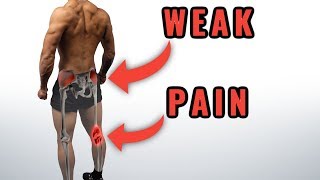
Jeremy Ethier shows how weak glute medius muscles cause knee pain and how to fix it. A 2011 study found glute strengthening reduced knee pain by 4.43% in four weeks. The video walks through three progressive exercises: side-lying hip abductions, lateral band walks, and side-plank hip abductions.
Questions this video answers
4.43% reduction in knee pain in four weeks (2011 study, cited as Dalek and colleagues).
If you currently experience a nagging pain in your knee during exercise, then you already know the extent to which this can negatively affect your workout and overall progress. It's also likely that you've tried to address the problem by either avoiding certain exercises altogether or focusing just on strengthening the structures around the knee. But the truth is, although there's several causes of knee pain, it's often due to a commonly overlooked aspect within most people's training routines strengthening the glute medius. This is because the glute medius, which is one of the lesser known glute muscles, plays a vital role in key movements at the hip. And when the glute medius is weak, you're unable to properly control your femur and as a result it slightly rotates inward to compensate, which happens anytime you stand, walk or perform lower body exercises, for example. And this inward rotation creates excess excessive stress on the knees in different areas, hence creating the knee pain you might be feeling. And not only do multiple studies agree with this and show a strong positive correlation between a weak glute medius and resulting knee pain, but studies also indicate that strengthening a weak glute medius seems to drastically reduce knee pain and joint loading, with one 2011 study by Dalek and colleagues demonstrating a 4.43percent reduction in knee pain in just four weeks after incorporating glute media strengthening exercises. So it's clear that if your glute medius is in fact underdeveloped, which is likely the case if you sit for most of the day or don't exclusively train this muscle, then strengthening it should be your priority when it comes to alleviating knee pain. And regardless of if you feel pain or not, it's still a crucial muscle to train since it aids in lower body exercises, boosts performance and prevents future problems like lower back pain and IT band issues from arising. Therefore, in this video I'll first cover how to test for glute medius weakness, the best exercises to strengthen it, and then how to combine this all into a routine for you to follow. One easy and quick method to indicate if you have a prominent weakness in your glute medius is something called the Tredlinberg Test. Simply stand with your feet shoulder width apart and lift one foot off the ground. Normally your pelvis should remain neutral or very slightly raise up like so, and you should be able to comfortably stay in this position. However, if either your hip drops towards your lifted leg or you have to excessively lean your upper body towards your planted leg in order to hold the position, then it's likely that your glute medius on the planted leg side may be weak. Another simple indication is assessing how your knee tracks during lower body exercises. If, for example, during single leg movements like lunges or the Bulgarian split squat, your knee tends to track inwards as you perform them, or you tend to compensate with excessive leaning over as you perform your reps, then this is another good indication that the glute medius may be weak and not doing its job. And lastly, if you've never exclusively trained your glute medius and feel a strong intense burn in the hips when performing the exercises I'll provide the then there's a good chance that it is in fact underdeveloped. Now as for the best exercises to strengthen the glute medius, two recent large systematic reviews have compared the activation of the glute medius during a variety of different exercises. But rather than simply performing the highest activating exercises right away, it's best in your case to gradually strengthen the glute medius by progressing from lower to higher demanding exercises. And one simple yet suitable non weight bearing exercise to start out with is something called side lying hip abductions. To do them, simply lay on your side with your legs straight and feet together. In a controlled manner. Lift your top leg to roughly 45 degrees without any rotation of your pelvis. It should instead stay pointing straight away from you. You also don't want to rotate your toes towards the ceiling to compensate, instead keep them neutral or slightly pointed towards the floor in order to better activate the glute medius. When done properly, you should feel a strong contraction in the glute medius of the leg you're raising up as shown here. And to increase the strength of this contraction, you can simply place a band around your knees or ankles and perform the movement like so. Once you feel comfortable with this, you can then move on to an excellent weight bearing exercise. Lateral Band walks For these, simply place a band around your knees, get into an athletic stance and take small controlled lateral steps without excessively swaying your upper body. Your pelvis and toes should remain facing straight and if you were walking to the right, for example, you'd want to feel a strong contraction in your right glute medius as shown here. In addition, as shown in this 2015 systematic review, glute medius activation during this exercise increases as you move the band from the knees to the ankles to the feet, which is just a good way to progress it over time. The last exercise and the final progression is something called side plank hip abductions and was shown in both of the systematic reviews mentioned earlier to elicit the highest activation of the glute medius. To perform them, simply get into a side plank position by raising your hips up and then lift your top leg up just how we did with the sideline hip abductions mentioned earlier. The same key points apply for this exercise as well, and again, you can add a band around your knees or ankles during this movement to further progress it. So to sum all these exercises up, here's what you can do to get started. Start out with a sideline hip abductions for three to four sets a few times a week. Focus on first really feeling your glute medius work before progressing it by adding a resistance band to the movement. Then once you feel comfortable with that, you you can then progress to the other two more difficult exercises which if needed can then be progressed even further by using a band. Again, perform these two exercises a few times a week, either at home or within your leg workouts. But regardless, they should remain a staple in your weekly routine. And finally, if you're eventually able to do so without pain, an excellent way to ensure you're firing your glute medius during movements like the squat and is to place a band around your knees like so. Forcing your knees to push out against this inward resistance will help you feel what it's like to properly use this muscle during the squat. And if you currently don't have any resistance bands, I would highly suggest that you invest in some. For those interested, I do have built with Science mini resistance bands available on my site which are the ones I used in this video and I'll leave a link to these in the description box down below.
That's pretty much it for this video everyone. I hope you were able to learn something from it. As you can see, often overlooked muscles like the glute medius really can cause a lot of trouble if you don't address them properly.
And if you're looking for a truly.
Evidence based program that takes every little detail like this into account to ensure that you can transform your body not only efficiently but also safely, then simply head on over to builtwithscience.com courses or where you can choose the best program for you. Anyways, that's it for now. For those who haven't already, I'd really appreciate it if you gave me a follow on Instagram where you can stay updated with what I'm doing and see a lot of the informative content I post there as well. And if you enjoyed this video, I'd also really appreciate it if you gave me a like left a comment down below and subscribe to my channel if you haven't already. Thank you everyone so much for the support. I really do appreciate it and I'll see you next time.
It.










