Go From 0 to 10 Pull-Ups In A Row (FAST!)
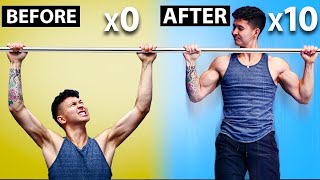
Jeremy Ethier breaks down why pull-ups are hard and gives a three-stage system based on your current ability. Beginners start with horizontal rows and slow negatives; intermediates use submaximal sets staying 2 reps from failure; advanced lifters add weight and reduce band assistance. He also targets weak points like core and lower traps.
Let's go, Jeremy. Today is the day, baby. 10 pull ups in a row. I can feel it. Oh yeah, Number one, Smooth as butter. Oh man, this is gonna be easy, huh? Okay, that one was a little hard. What the is happening? Muscles won't work. Pull ups are a great muscle building exercise. They also look pretty darn cool when you can bang them out effortlessly. Oh my God. Did you just do 10 pull ups in a row? Heck yeah, I did. There's a reason why so few are able to accomplish this impressive feat of strength and are unable to do enough reps to truly maximize the muscle building benefits of this exercise. Today I'll explain why that is, how to improve it, and then give you a full workout designed to quickly take you from 0248 or wherever you're at all the way to 10 pull ups in a row and beyond. Let's begin by covering why pull ups are so difficult in the first place. The first reason has to do with your body weight. So under normal circumstances, to improve your strength in an exercise, you use a weight and rep range that suits your current strength level and then you progress from there. With pull ups, however, you're forced to lift your own body weight. Whether you weigh 150 pounds or 300 pounds. That's the weight that you'll have to overcome with each rep. It's like being forced to use 225lbs every time you bench press, independent of how strong you actually are. Yet most people completely disregard this and try to improve their pull ups by, well, trying to do more pull ups. For example, if someone can do, let's say five pull ups in a row, they'll likely be able to do five in the first set, three in the second set, and then two in the last set, for a grand total of just 10 reps. Not only are you essentially training your all out max strength every time you do this, which has been shown to tax the body quite heavily, but you're also not accumulating enough pull up volume needed to improve. In addition to this, most people don't realize that pull ups are not just a back exercise. To properly perform them, several other muscles in your upper and lower body must work together synergistically. No matter how strong your bigger back muscles and biceps get, if you have weak links in the chain, it's going to prevent you from improving your pull ups. This is exactly why research shows a weak correlation between movements like the lat pulldown and pull up strength. And that's why many people can get really, really strong with Assisted pull ups or even chin ups, yet still struggle with pull ups, you need to focus on the weaker, often overlooked muscles that these big exercises just don't train very well. So how do we solve this? There's three steps to this. The first step is to change the way you train your pull ups so that you're able to do enough quality volume to make strength improvements. The right approach, however, depends on your strength level. If you currently can't do any pull ups or you can't do more than four in a row, then we're not ready to use pull ups quite yet. But we will use two other exercises to quickly build your strength. The first exercise will be used for all strength levels, but is especially helpful for the 0 to 4 group. With it, by manipulating your body position, you can pull your body weight just like you would in a normal pull up. But your body won't have to fight as hard against gravity. Keep your core engaged, glutes squeezed and legs straight and pull with your elbows to bring your chest towards the bar. As you get stronger, lower the rowing angle to make the move more difficult until you get completely horizontal. Now we still however, need an exercise that trains your body vertically, like in the pull up. This is where the second exercise comes in. This exercise takes advantage of the fact that you have considerably more strength during the downward phase of the pull up as opposed to the way up. To perform it, use a bench or box to assist yourself up to the top part of the pull up. From here, hold this position for a few seconds and then lower your body as slowly as possible, stopping and spending more time in the most difficult spots where you're the weakest. Work towards a five second hold at the top position and a total five second hold on the way down. Alright, now step three of this video. I'll explain how and when to retest your pull up strength. But once you're able to do between five to seven pull ups in a row is when you'll want to then progress your approach. To start, we'll use a pull up training philosophy popularized by Pavel Tatulini. Tatsula Tatsulin Former TRAINER of the Soviet Special Forces the idea is that we do several sets of pull ups that never allow your body to reach complete failure. The result is a high amount of successful reps that will help your body quickly build strength and learn how to better activate the muscles involved in a pull up. To apply it, you're going to do sets of anywhere between 2 to 5 reps. These sets should be at least 2 reps away from your max effort. So if you can currently do just five pull ups in a row, stick to sets of two to three reps to avoid overexertion. You'll do a set rest for 30 to 90 seconds, do another set and repeat this process until you reach a grand total of 20 reps. It doesn't matter if this takes you 4 sets or 10 sets to accomplish this. And it also doesn't matter if you can only do sets of just one pull up by the end of it. The key is that you're staying away from failure and accumulating those reps. The goal is to over time comfortably reach a total of 30 reps. Second thing you'll do is you get yourself a few of these. Loop one around the top of a bar just like this and put your feet into it. The band will exert force upwards as long as you stand on it, effectively reducing the amount of resistance you need to overcome with each rep. The thicker the band, the easier it's going to be. So choose one that enables you to do between 6 to 12 reps. Wait, wait, Jeremy. But what if I don't have a band? Well, you can instead use the negative pull ups I showed earlier. But whether you get the bands from me or somewhere else, they are 100% worth the investment. Not only for improving your pull ups, but for mobility and even optimizing resistance curves for different exercises. And trust me, I know how intimidating it might seem to set this up and do this exercise, especially in the middle of the gym, but it's going to be one of the most effective ways for you to improve your pull ups and far superior to something like the assisted pull up machine. I hope that this at least encourages you to give it a shot. But with that being said, let's move on to the final strength level. So once you get to 8 to 9 reps in a row, yet can't quite break through 10, you'll simply use the same routine as the 57 group, but with more difficulty. For the bodyweight, pull ups add a five pound weight, either with a weight belt or a dumbbell between your feet. For the banded pull ups, switch to a thinner band or take one foot out to lessen the support. So now that we strengthen the big pulling muscles and practice the skill of actually doing pull ups, the next step is to strengthen common weak links in the chain that are likely holding you back. There's two muscles in specific that are heavily involved in the pull up, yet tend to become underdeveloped. The result of a 2018 research study by Hugh Hewitt and colleagues helped reveal the importance of the first muscle. Their research team took subjects who could perform more than 10 pull ups in a row and measured the activation of various muscles as they performed their pull ups. It may come as a surprise for many of you, but the highest activated muscle, even more than the back and biceps, was the core, which makes sense. With pull ups, you're essentially doing a mid air plank and forced to use your core to stabilize your body. To best replicate the intense demands placed on the core from pull ups, we can use what's known as a long lever rocking plank. Set up how you would a normal plank, but move your arms further up towards your head, squeeze your glutes and rock your body slowly forward and back. As for the second muscle, its importance is illustrated by a study from the Journal of Strength and Condition Research. The researchers analyzed muscle activation during the pull up, but this time compared it to other exercises like the chin up. They found that one muscle, the lower traps, was highly active during pull ups and to a significantly greater degree than it was during chin ups. Since this muscle plays an integral role in stabilizing your shoulder and upper body as you pull, it's essential that you train it to prevent it from limiting you to do so. We're going to use an exercise that looks deceivingly easy until you try it. Hang from a bar with your hands shoulder width apart, feet together, core relaxed and elbows locked. Relax your shoulders and back muscles to let your shoulders come up towards your ears. Then without bending your arms, you're going to pull your shoulders down and away from your ears and you should feel this in the middle of your back. Pause for two seconds at this top position, come back down and then repeat. All right, now you're probably wondering how the heck do I take all this stuff and remember what to do in my next workout? Don't worry. Stop frantically writing everything down. Just relax and pay attention as I've done all the work for you with a free downloadable workout for you to follow next time you're in the gym. But before you go and download it, let's quickly go through the final step to cover how to best use this workout. Alrighty, here is the game plan. You'll first start with the main back exercises based on your current strength bubble. This will be followed by the core and lower traps exercise we went through. But how you incorporate this workout depends on what your training currently looks like. It can easily be used as a full back workout performed once a week, or if you train back twice a week. You can plop in a couple of these exercises onto each day as you use this plan. You'll also want to retest your max pull ups every month and then move on to the next level as your strength improves. Then once your prestige is when, you can now enter a whole new level by adding weight to continue maximizing the muscle building building benefits of this exercise. As for where to download your free workout with all the reps, sets, exercises and tutorials, just head on over to builtwithscience.com pull up PDF and I'll send it right over to you. Even if you can't do any pull ups right now, use this workout, stay consistent and just like countless others have experienced from my past pull up videos, you'll be blown away with just how quickly your pull ups increase. That is the true power of science. And if you're looking to apply this science based approach to the rest of your training to make faster gains and build a body you're proud of, just head over to builtwithscience.com and take my analysis quiz to discover the best step by step program for you and your body. And one more thing guys, you're going to be doing quite a bit of pull ups in no time, so it's extremely important that you ensure that you're doing them with proper form by giving this video a watch next to avoid the most common pull up mistakes. Thanks so much. Don't forget to subscribe for more videos and I'll see you next time.










