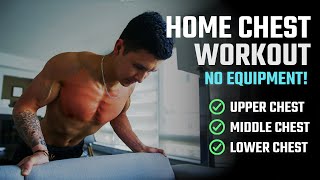
A March 2020 YouTube fitness tutorial that presents a full home chest routine using only bodyweight (and optional bands/backpacks). It argues bodyweight can build chest mass if exercises are progressed and varied to target upper, lower, inner, and whole chest. Key movements: close-grip pushups (knees → standard → hands-back variations with cited % bodyweight: ~53%, ~66%, ~73%), elevated feet/decline pushups and wide reverse-grip pushups for upper chest, dip-style elevated pushups for lower chest, rotational elevated-hand pushups for inner chest, and sliding/bed-sheet fly progressions as a burnout. Program guidance includes training splits, pushing sets near failure, using ~30-rep threshold to indicate need for harder variations, and emphasizing nutrition and a CTA to buildwithscience.com.
Questions this video answers
About 53% of bodyweight.
About 66% of bodyweight.
About 73% of bodyweight.
Roughly 30 reps per set.
When it comes to chest development, most people are under the impression that they can't pack on much chest size with just bodyweight exercises, and that heavy pressing movements in the gym, like the bench press, are instead essential to doing so. Now, while these pressing movements in the gym are in fact extremely effective and convenient to use to build your chest, you still most definitely can build an impressive looking chest with just bodyweight training. I mean, gymnasts are a perfect example of this. It's just that it takes a little more creativity since we now don't have the convenience of being able to simply add more plates to the bar as we get stronger or adjust the incline of our bench to target different areas of our chest. And this is where most home chest workouts fail and why most people fail to see results with them. They either don't progress the movements in a way that enables you to continue maximizing your chest growth over time as you get stronger, or they'll fail to incorporate exercises that target all of the various regions of your chest, both of which lead to suboptimal chest development. In this workout though, I'll show you how to achieve both of those so that you can build your chest most effectively even if you don't have access to the gym. The first exercise we'll be using will target the whole chest and will be the close grip pushup, which you can perform either by just using a narrow grip or a diamond setup like so, depending on what's most comfortable for you and your wrists. We'll be using this orientation since, contrary to popular belief, a wider push up grip has been shown in multiple EMG analyses to elicit significantly less upper and lower chest activation and instead provides more front delt activation when compared to the narrow grip, and therefore just likely wouldn't be the best option for chest development. To progress these, I suggest starting these out on your knees, which research has shown reduces the amount of your body weight that you're actually lifting to only about 53% of your body weight. And then you simply want to progress to the start standard version where the load now increases to about 66% of your body weight. And then you can even progress this further by shifting your hands backwards very slightly to increase the load you're lifting to now be about 73% of your body weight. This way, you can progressively increase the load over time without the use of weights by just manipulating your body position as you perform the pushup. To progress even further from here, though, you can continue adding external load by wearing a backpack stuffed with books or water bottles or or alternatively performing these banded like so. Next, we're going to incorporate more shoulder flexion into the previous pushup to now shift more emphasis to the upper chest. And you can do this by simply elevating your feet up onto a platform and then again progress this by adding more external load or resistance with a bag or with a band, for example. But if you find these too difficult, you can perform these on your knees instead with just a slight elevation by using cushions, for example. An alternative to this though, are wide reverse grip pushups, where you instead use a wide underhand grip to hold onto an elevated platform and then perform your pushup against that. These are a viable option as well, since research has shown that, at least for the bench press, using a wide reverse grip boosts upper chest activation by about 30% when compared to a standard grip, which likely carries over into the push ups, given that you're now incorporating more shoulder flexion into the movement and better aligning the tension with the upper chest fibers, which you'll feel right away when you perform it. To progress these, you can again use a bag and or gradually decrease the height of the platform that you're holding onto. Next, we're going to move on to dip pushups to now target the lower chest by incorporating more shoulder extension. We want to include some form of dip movement into this routine, since they've been shown in EMG analyses. To best activate the lower chest and to do so at home, we'll be simulating a straight bar dip by getting into a pushup position on the floor, but elevating our hands up on a step stack of books or whatever you have handy. Then we're going to push our arms downward to raise our upper body up into an upward position until our arms straighten while just letting our lower body slide along for the ride. The internal rotation and shoulder extension involved in this movement helps better target that lower chest region. To start, I'd recommend doing them with no elevation if needed, and then progress to elevating your hands and then continue to elevate your hands even more over time by using two chairs, for example, as this will increase the load you'll be lifting and will simulate the straight bar dip even better. Like the other exercises, you can also add a weighted bag to increase the load, but even better, if you have a band handy, I'd also suggest wrapping it around your neck and hands like so, to provide an added resistance that will progressively get more difficult as you press up during each rep and as a result, better stress the lower chest Next, it's time to incorporate a movement that will enable us to emphasize the inner chest a little more, which is difficult to do with standard push ups since we can't actually get our arm across our body to fully contract the chest through horizontal adduction. But we can do so with this exercise by getting into the standard push up position and then elevating one of your hands onto a platform. Then perform the push up, but as you press up, rotate your body towards that elevated arm, which will now enable our arm to move across our body to a greater degree, and as a result, better activate the chest and its inner fibers if needed. You can start by doing these on your knees, and then you can progress them by wearing a weighted bag and or using a band for added resistance. And lastly, we're going to work the whole chest here and use this exercise as a sort of burnout, just as you would with cable flies in the gym, for example. What you want to do is find a smooth surface, get on your knees and place your hands on two cloths or paper towels that can easily slide. You want to then lower your upper body by spinning, spreading your arms out to the side, and then at the bottom position, perform a fly motion by squeezing your chest and bringing your arms inwards to raise your body up. You want to keep your arms just slightly bent as you do so, and simply focus on bringing your biceps together as you raise your body up in order to best activate the chest. Now, this is admittedly quite a difficult movement, but there are ways to regress it. And you can start by just performing the eccentric portion of the movement by controlling your upper body downwards until you reach the floor and then simp pushing yourself back up to the starting position and then repeating this. Then once you master that, you can move on to the push up fly, where you perform the fly with just one of your arms, while the other one bends and extends to help you push your body back up. And then from there, you can perform the full fly, but with your hands positioned closer to your knees to decrease the load. And then over time, you can lengthen the lever and increase the load placed on the chest over time by performing the movement with your hands further out, away from your knees. An alternative though, are bed sheet flies, where we use the setup I presented in my Full Body Home workout video by tying two knots together and throwing them over a door and then closing them inwards. For these, you want to wrap the bed sheets around your hands, and then you can perform the same fly movement I presented by spreading your arms out while letting your body fall forward and then bringing your arms back inwards by squeezing that chest to bring your body back up. You want to start with your feet further away from the door and then progress them by bringing your feet closer and closer to the door over time. So to sum the video up, here's what your home chest workout could look like. So this workout most definitely can be performed all in one as a chest workout on its own, but I'd recommend instead splitting the exercises up into at least two days throughout the week by using an upper lower split for example, in order to better manage the training volume and frequency. As for the ideal rep range, again, as I emphasized in my past Full Body home workout video, the ideal rep range will vary for everyone based on your strength level. So instead simply focus on pushing every single set either to failure or then a rep or two of failure as this is crucial in order to maximize growth since we don't have access to heavy weights. And then if in any of your exercises you can perform more than roughly 30 reps per set, then this is an indication that has now become too easy and you need to progress to a harder variation that presented in order to continue maximizing growth over time. But all in all, by using this routine and gradually progressing each exercise as you get stronger, you'll be able to effectively build your chest in the comfort of your own home without the need for heavy weights and equipment. Just keep in mind though guys that for the best results you need to pair your workout routine with the right nutrition plan as that really is the key and is far more important than your training when it comes to drastically transforming your body and packing on size. And to be honest, now is a better time than ever to start prioritizing your nutrition and learning how and what you need to be fueling your body with in order to maximize growth for a step by step science based program that shows you both how to work out and what to eat week after week in order to build muscle as efficiently as possible with science. Then simply head on over to buildwithscience.com to take the analysis quiz to discover which program is best for you and where your body is currently at. Anyways guys, that's it for today. I hope you enjoyed the video video. Please don't forget to show your support by giving the video a like leaving a comment down below as to what you'd like to see me cover next subscribing to the channel and turning on notifications for the channel as well as this all really does help me out. Thank you so much, everyone. I'll see you next time. I got that.