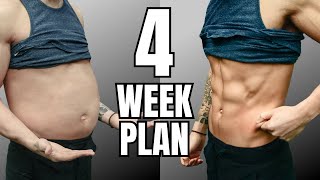
A four-week plan to lose belly fat using calorie tracking, increased daily activity, weight training, and cardio. The speaker covers how to measure progress accurately and train abs with weights for better results.
Questions this video answers
Every morning after waking up and after using the bathroom, before drinking or eating; record daily weights and use the seven-day average as the weekly weight.
Multiply body weight by 13 if using pounds or by 29 if using kilograms.
About 0.5 to 1% of body weight per week (for most people ~0.5 to 1 kg per week).
Aim for roughly 7,000 to 9,000 steps per day (increase gradually by ~10% if well below).
At least 30 minutes of exercise three times per week (better: 60 minutes, four to five days per week); target 150+ minutes/week for greater weight loss.
I'm going to show you how to lose stubborn belly fat for good with a four week plan. During each week, we'll implement one of four things that have been found in research to be the key to losing fat and keeping it off. We'll show you how to properly assess and monitor your fat loss progress, give examples on food swaps to kickstart fat loss, talk about a few exercises to speed it up, and then combine everything with a bonus tip for those who are really serious. By the end of this video, you'll have a full plan that you can get started with immediately, if followed consistently, will help you finally lose that stubborn belly fat in week one. You need to start weighing yourself every day, but you need to do so with a specific method that's going to significantly improve the accuracy of your weigh ins. Consistently tracking weight has been shown in several studies to be a major predictor for those who successfully lose weight and keep that weight off. Before moving on to the diet tweaks that we're going to do to kickstart fat loss in the next step, you need to get this right to do so, weigh yourself every morning after waking up and after using the bathroom. Don't drink or eat anything. Before you weigh yourself after seven days, take an average of your weight. This seven day average will then be your weight for that week. Every week you're going to repeat this process. You're then going to compare these weekly averages to assess how much fat you're losing with what we'll implement next in weeks two to four. It's important to weigh yourself in this fashion because your weight will fluctuate day to day. Factors such as the timing of your weigh in, how much you've slept the night before, how hydrated you are, how much you ate during the weekend, and even the timing of your last meal can all affect your weight by even up to £10. So if you're just weighing yourself randomly whenever you feel like it, then these fluctuations will make it next to impossible to assess if you're actually losing fat or not. As for what to look for with your weekly average weight, a reasonable goal is to lose weight at a rate of around 0.5 to 1% of your body weight per week. For most people, this will amount to about 0.5 to 1 kg of weight loss a week. If you were to lose more weight than this, you may be doing too much too soon and putting yourself at a risk of losing muscle and making adherence difficult. If you lose less than this, however, then you can consider stepping up what you're going to do in the next three weeks. So during the second week, in addition to tracking your weight, we need to close the gap between how many calories you can eat to lose fat and how many calories you're currently eating. This is what's going to help kickstart the fat loss process, which we're then going to speed up in weeks three and four. First, figure out roughly how many calories you can eat to kickstart fat loss. In our Built With Science programs, which I'll talk about later on in this video, we've developed software that automates this whole process for you. So for now, a really simple method to get you started is to take your body weight and to multiply that by either 13 or 29, depending on if you're using pounds or kilograms, write that number down. And then what we have to do is figure out how much calories you're actually eating at. And to do so, go download a food tracking app such as MyFitnessPal and start logging every single thing that you eat throughout the day. By the end of the first day, you'll be able to see roughly how many calories you're eating. You can do this for a few more days to improve its accuracy. What you'll notice is that this number will most likely be higher than the number of calories you can eat to lose fat. We need to close this gap to kickstart fat loss to do so once you have your calorie goal. Research shows that almost any diet can be effective as long as it's sustainable. Avoid eliminating foods from your diet as that has been correlated with less fat loss and less dieting success. Instead, use a flexible approach where you more or less continue eating what you want, but gradually make swaps to reduce your calorie intake. I made a recent video on this very topic which Ill show at the end of this video. But some examples are to swap fattier meats to leaner meats, swap cooking oil to spray oil, swap bacon for turkey bacon, swap dairy milk for almond milk, and swap peanut butter for PB2. These are just some of many easy swaps that you can make to significantly drop your calorie intake to kickstart fat loss without making drastic changes to what you're currently eating. But take this step at your own pace. It may take you longer than a week to implement, which is perfectly fine. This is going to serve as the foundation for losing that stubborn fat, and when paired with the next two steps, you'll be able to Speed up that process to ensure that you're being active enough. Starting in week three, we're going to track something called neat, and we're going to work on boosting this to burn more calories every day. So any activity that you perform outside of your scheduled workouts is referred to as neat. And it may not seem like it, but daily activities like walking, fidgeting, washing dishes, and folding your laundry, they all increase how many calories you burn today and can make a big difference when it comes to fat loss. For example, taking 10,000 steps a day can burn well over 500 calories alone, which equates to roughly 1 pound of fat loss a week. In addition, research shows that having very low levels of NEAT can make it more difficult to control your calorie intake. For example, in individuals with very low NEAT levels who only take a few thousand steps a day, hunger signals are not well regulated and they're more likely to overeat as a result. But once activity levels are increased, your body seems to start doing a much better job at regulating your hunger levels and the calories you consume. Now, the easiest way to track your general activity is through your step count. Most phones and smartwatches nowadays can track this with high accuracy. As for how many steps they aim for, the greatest benefit seems to occur in the range of 7,000 to 9,000 steps per day. And that's a good minimum that you'll want to aim for. If you're well below this number, then gradually increase your current step count by about 10% at a time until you're within that range. This can be as easy as adding in a 10 minute walk in the morning and evening or after each meal. Once you've nailed this down, then you can finally move on to week four to further speed up the process. So during week four, you need to start implementing a structured exercise routine. But you need to use the right amount and the right type of exercise. As a recommendation, you should aim for a minimum of 30 minutes of exercise three times per week. If you can step this up to at least 60 minutes, four to five days per week, then that's even better. For reference, research has shown that people getting at least 150 minutes of exercise per week with were able to lose twice as much weight as people getting 75 minutes of exercise per week. To add to this, when exercise is combined with your diet that we established back in week two, it's even more effective for losing weight than either method by itself. As for the type of exercise to do, while people often gravitate towards an all or nothing approach to doing either weights or cardio. A combination of both is going to get you the best fat loss results. Weight training will ensure you maintain or increase your muscle mass, while cardio is a much more efficient way to burn additional calories. What we recommend within our built science programs that have worked wonders for thousands of our members is to start with a foundation of about three to five weight training days per week. Once you're consistent with that, add in 20 to 30 minute cardio sessions to help you hit the weight loss targets that we established back in week one. Now, for those who are eager, combining all of this with the next bonus tip can indirectly help with the results even more so. Although you can't target fat loss specifically from your belly, you can grow your abs just like any other muscle by training them with weights and getting them stronger. As they grow, they can pop through your skin a little bit more and can make them more visible even if you haven't quite yet lost all the stubborn belly fat. To do this, train your abs with weighted movements regularly two to three times a week. Weighted cable crunches, weighted reverse crunches and weighted sit ups are all great options. I do have a video on weighted diet training specifically, which I'll link at the end of this video as well. And for those looking to take this one step further with a program that puts all this together for you, such that you know exactly how to train and what to eat week after week to lose stubborn fat for good and build lean muscle just like thousands of our members have done. Then take our free analysis quiz@builtwithscience.com to determine which of our plans will best help you transform your specific body. That's it for today. You can click somewhere here to watch some more of my videos and I'll see you next time.